€15,000 FARM START-UP IN GERMANY (Helle Bauer with Jasper de Wit)
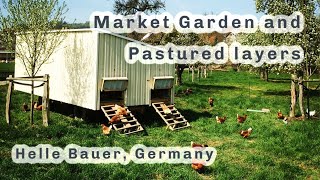
Video interview (Richard Perkins with Jasper de Wit) documenting Jasper's first-year farm start-up in Gugelheim, Germany. Jasper is establishing a 3,000 m² market garden (50 outdoor beds + 7 inside), running an eggmobile (built for 400 hens but starting smaller), and renting a 6-hectare asparagus field to access an existing market and farm shop. The project sits alongside renovating historic 1800s buildings on the property; Jasper bought into the property (approx. €120,000) and began work in January. Startup costs cited: roughly €11,000 for the gardens and €4,500 for chickens (total under €20,000); the eggmobile cost ~€3,000 to build. Plans include agroforestry (apple trees, berry rows, nitrogen fixers, hedgerow windbreaks), small CSA (20–30 boxes), and integrating chickens for weed management in asparagus as an experiment. Community engagement and on-site workshops are emphasised.
Questions this video answers
About 3,000 square meters (50 outdoor beds + 7 inside).
6 hectares of asparagus.
Started in January (year of interview).
28 years old.
About €11,000.
Chapters
So I finished my trip to the UK and picked up a load of stuff for the farm and I've dropped in on Jasper in Gudelheim in Germany. He was an intern last year at the farm and he's setting up a project here. So we're going to have a look around, see what he's up to in his first year of farming. Hi Jasper.
Hello. Hello.
So Jasper was with us last summer doing the internship and you were designing another property at that point, weren't you?
That was smaller field, around 3,000 square meters.
Yeah.
Market Garden was the original plan with trees and things.
So what happened? Your girlfriend lives here.
Exactly.
Not many Irish accents here in Germany.
Not too many.
But your girlfriend's father bought this place and it's this incredible place. We've got these amazing old buildings from the 1800s and old barns. And down in the distance Jasper's setting up his market garden and the eggmobiles over there as well as a bit of agroforestry. So your project scaled somewhat a little bit. You've got six hectares here.
No, this property itself is this field which is planted with apple trees at the minute going to be turned into agroforestry. I've got this field from the neighbour who's not using it. Those two fields together are hectare and the market garden is 3,000 square meters.
Awesome. And you had. You've already built up a bit of a client base.
I'm also renting asparagus farm for the year to try it out and it's exactly 6 hectares of asparagus and that already has a very well established client base with its own farm shop and a lot of equipment. And through that I'm gonna sell all the rest of this and get a name for myself established.
And you've been basically working for a couple of months now.
I pretty much started here, January, getting this set up. January built the polytunne. We started setting up the gardens.
Tell us about the process. How have you gone. Was this like a ploughed field before?
No, until there was grass. So you see sort of a little drop there. So that was a grass field and the rest of it was a plowed field. There was corn in the past year. And so Basically I've got 50 beds. They're 20 meters by 75 centimeters outside, that is, and seven beds inside.
And how have you gone through the actual bed formation? You've gone straight on the grass cardboard.
And then laid on top of that.
Perfect. And what's planted out so far?
The first bed I've got radishes, kohlrabi. I think that's radishes too. I just planted some salad today. And then under here we have kohlrabi. Two beds of kale, one bed of bok choy. I have to transplant some beets today. Three beds of carrots, three beds of onions. And then we have turnips here we got a bit of a doing by a mole, but there they go.
And tell us a bit like, where are we? Where are we located in Germany?
Pretty much in the middle of Germany. The Weser is the river that runs through there. We're in a little bit of a valley. It's a huge river that goes up past Vehmann and then into the sea.
So people are coming hundreds of kilometers just to buy the asparagus.
Exactly.
And you've got six hectares of that. Yeah, It's a great building point for your vegetables and eggs and.
Exactly. Yeah. That's now in its third year. So it's been certified organic or not yet. Since third. What do you call it? You have three years in German, it's Umstedungstzeit. So you have three years before it's actually certified organic.
Our conversion period.
So we're on the third year. Next year, then it's certified organic.
Awesome.
Yeah.
And so what's your. I mean, you've taken a massive project down there. Like we'll go and have a look at the house. But it's a beautiful old house with oak timber. Timber frame and wattle and daub. So they're doing clay rendering and all kinds of renovations there. Tell us a bit about the property. Was your girlfriend's father bought the property as like inheritance for.
Exactly.
Your girlfriend and sisters. You bought into that?
I bought into that and got the land then to do what I want to do, which is regenerative agriculture. Yeah. And it's a beautiful spot for it.
And it's like €120,000 for the whole property. And obviously the buildings we'll see need a lot of renovation, but amazing work to take on. How old are you now, Jesper?
28.
28. So young enough to take on house building and gardening at the same time. And what have you done to set up the gardens? You've had to put in irrigation.
I've had to put in irrigation, which was a challenge because I had to go under the bike path over there. So I had to get a big company with pneumatic thing that shoots underneath the road. Got water set up. I got electricity in the greenhouse because I've got three propagation tables. Love it.
Super nice. Wow, you've been so busy. How many hours a day are you working at the moment?
At the moment I'm with the check ins so I'm up with them at 6 and when I put them in at around 8 o', clock, half it I don't know.
Then you're done.
Then I'm done.
Wow. So it's lots of crops coming on.
I got these heating cables on thermostats and they run under their sand. So they run through the sand and that's supposed to stay moist.
It's a nice warm day today. But it's been cold weather up till now really hasn't it?
Exactly. I've had no problems. At the start I had a few problems but I only had a few trays on and I realized when I fill the whole table then it can heat up properly and if it's going to freeze at night I'll just put a row cover over the top of it and it's grand.
And what's going in the tunnel later this year?
Tomatoes and cucumbers.
And how are you planning you're going to do vegetable boxes?
I'm going to do a few boxes and then I'm going to sell in the farm shop for the asparagus. So that's two month season. I'll be selling through there. And then I'm thinking so at the minute for my eggs I have a little stand up at the farm shop. It's basically just self service. Take the eggs, put the money down and that's working perfectly. So I'm thinking maybe to try that in the shop. Then when the asparagus season is finished to set up a little stand where people can just go and get their own vegetables. Try that, see how it works. I'm gonna do a small csa. I've got a few people that's interested. I'm thinking maybe 20, 30 boxes, something like that. Yeah. But we'll see how it goes if I need to think of other things and I'll. I'll go with it. And also I have where I done a yoga teacher training and the Yoga Ashram, it's 45 minutes drive from here and it's the biggest one in Europe. So they have room for 900 people there and they're very interested in vegetables. Vegetables, awesome.
So tell our viewers about the like you're starting up on a fairly low budget. Now tell us a bit about what you put into the gardens this year.
The gardens all together I think 11,000 and then for the chickens. Four and a half, I think. Awesome.
So less than €20,000 startup and you'll turn over more than that this year?
Probably not for sure.
How's it been putting compost down? It's a lot of work in the beginning now.
So not at work, but I had some great help.
Yeah.
The first day I done the tunnel myself and then the first day I got a few friends and family from a girlfriend from the village. I think we were 10 people or something. And we done 24 beds and the rest of them myself.
Perfect.
It's a lot of work, but you don't have to do it once, pretty much.
Sweet.
So it's all good?
Yeah. Well, you've hit the season with a bang. Really? It's ready to go, isn't it? What's the longer term plans? Are you gonna like fence this off or anything like that? Do you have like rabbits and stuff here?
Short term I want to put up a one brick around it. Long term, a nice hedge the whole way around. So I've left 4 meters on the outside from the beds, 2 meters so I can get around it with a little tractor in case I want to bring compost or something. And then two meters for a hedgerow.
Nice. Is it quite a windy sight, is it?
Yeah.
You're down the valley here.
Yesterday we had a lot of wind and we. They're not the best quality. Some of them started ripping and the fennel doesn't look too good down the bottom. It got the most of it, but. Yeah. So I need. Need a windbreak for sure. But longer term I want hedgerow for all other benefits that come with it.
Yeah.
I made that with Johnny, a friend of mine from.
That's your bed roller?
That's my bed roller. It's made out of the leftovers from the greenhouse.
Perfect.
And then I bought a few wheels.
Cost you what? $10?
Cost me €20.
€20. Perfect.
But it's better than the 300 that you spend if you want to buy one. It's nice and heavy and it works perfect.
Right.
So basically the field I got has already been planted with apple trees. It's not the best pattern, but like here, they're a little bit too close together. Here we have 8 meters between the rows and then as we go over it goes into 12. But it's great having apple trees already on the field because I was planning to do agroforestry anyway. So basically the idea is now to do three lanes from east to west on the south side. Then I'LL have berries and then in between nitrogen fixers and hazel and run the chickens through the rows.
Perfect.
The same as red seal.
Yeah. And this guy, this guy, he's working on the trees right now. He's the guy that planted these.
So he planted these ones from the naboo, which is people that look after birds and protect birds. And here there's a rare owl. I don't know what it's called in English.
And what's it called in German?
German kauts. It's like a little small owl that lives in apple trees and old trees. So basically this is in German. It's called Historische Kultur. I can't even say it. But anyway, it's historical plantings of apple trees because when the water quality was too bad, they drank not cider, but the stuff with a bit less alcohol. So pretty much half cider. Don't know what it's called in English either. So all the villages used to be surrounded with these fields of apple trees and nobody wanted to do it anymore because there was nothing interesting, couldn't make money from it. And everybody went over plowing and destroying, but they want to re establish these. So there's a lot of funding behind it and you get all the trees for free. So they planted all these trees and now I was talking to them earlier on, explaining what I'm doing. He's totally in love with it. Said it was.
I see you've been planting some of the berries already.
Yeah, I've got started.
And you're gonna focus more on the birds and gardens this year?
Yeah, exactly.
When do you think you'll start planning this out fully? Is that going to be.
So I bought quite a few different varieties for. Because I want to propagate my own. It's too expensive to buy them all, so I thought I'd plant these ones, make one row so I can show people what the plan is, what I want to do, and then propagate my own and plant the rest of the field and maybe that field if I get permission.
Awesome. It's going to be beautiful. And so how much land have you got for the eggmobile?
I've got a hacker at the moment with 160 hands, but I' the option of going into the snack field once I scaled up a bit.
And you just finished building this over the winter, now you built it for 400 hens?
Exactly. It's set up for 400, but I thought I'll start small, make sure I can sell all the eggs first and then Whenever hand works then I can always buy more hens and scale up a.
So you built this with Albert who was also a rich guy.
Exactly. Albert came for two weeks.
I bet you had a lot of fun.
No fun and very long days.
Show us around. I want to see inside this little beauty.
So it's built on an old hay wagon. Nice and sturdy.
Yeah, that's a beauty.
And it doesn't really get stuck. Hopefully. But I don't think so. I can't say it.
Wow. And you've been mimicking a bit the chicken caravan though.
Exactly. So the nest boxes mimic the chicken caravan a wee bit. And the main design is sort of Bridgedale. So yeah, the two flaps for letting the birds in and out had a few small problems with them, but seemed to be getting used to it. The first day they just came up, sat down here. Next one's come up, sat down on top of them and then there's a wall of chickens. But now they've got used to it. Now they're starting to get used to the roosts and they're happy enough. These are on wheels so I can drive and just roll behind it on the steps.
Beautiful.
Put up and down anytime I'm moving to make it as fast as possible.
Awesome. I bet you guys had so much fun with the engineering. Now.
That was definitely good fun.
Wow, look at this. So you basically made a copy on the cheap of industrial egg boxes. It looks awesome, dude. Tell us a little bit about how it works.
So the nest boxes go down the left and the right and there's six on each side a meter long each. Enough for the 400 chickens. And when I come in, I built a small egg belt. That's for my egg trays. What you left over there. Put the egg tray here. Here I have a ratchet spanner.
Ratchet spanner.
And then collect my eggs, put them on the egg tray.
Jasper's awesome. It's freaking awesome. These nest boxes, like for people that don't know. If you buy a nest box like this from the industry, it's made of tin sheet with the same kind of functionality. It cost you like €6,7000. And what's it cost you to build this slot?
The NAS boxes themselves. Maybe the egg belt. I had to buy 50 meters because I couldn't buy 12 meters. The minimum was 50. That cost €5 per meter. And then the wood itself, maybe €150 Nasmat. But all in all, the egg mobile, I'd say €3,000 for the whole thing.
Amazing. Can I Get inside and you show us how the. How you close the nests up. Because you've built in closing nests as well, haven't you?
So here, there's a little lever and. And pull that across.
I don't know if you'll be able to make this out, but this is close to flap here. Maybe you can do it again. So that opens the nests up in the morning.
And then.
Dude, it's amazing because you can automate that if you want to. You could make the whole thing automated. There's a bird just going in to lay now.
I think I just kicked her out.
Oh, you kicked her out. Oh, you've done an amazing job. And they're roosting down below a little bit.
They like it up higher, better.
So they're roosting up on the sides more.
I don't know if I want to. Maybe I want to put these up a little bit if I get more birds.
So you've gone for. You see underneath here you've got a metal mesh with the sort of Astro turf nets that we use at the farm. And so if any eggs break in the beginning, when they're soft shells, they'll just drip through into the pasture, obviously with a mesh floor dropping scale onto pasture. It's a really nice space. It'll be great for. As you scale up to more numbers, you might need some. You might need to lift them roosts up a bit off the ground.
That's what I was thinking.
It'll be easy enough. What a great job you guys have done on the nest box. That's a winner.
That's the track.
Yeah. How did you manage to. To set this thing up? Is that the fiddly bit?
That's the fiddly bit. So basically there's two bearings on the front and two in the back on. What do you call that in English? I'm thinking in German. And there's not. So I can adjust it.
You've had to align this drum, basically, so the belt is coming totally straight.
I wanted to jump over all the time at the start. So I built in the back some things to keep it on the side so it doesn't want to jump over. And then align it by tightening or loosening these bolts and felt these rollers out of scraps. It's working good.
That's super cool, man. You've saved yourself a lot of money in the setup, haven't you?
And it's made of wood. I like wood.
Wow. So we're in this incredible barn made of oak. So this is where you're setting up workshop.
Exactly. The first thing about most important part of the farm, a nice workshop.
Tell us about you. You also picked up a silo there for the chickens real cheap.
Exactly. I picked that up for €150. Went to pick it up with Albert.
And you've got plans to. This will be like center of operations in a way, won't it?
Yeah, exactly. So there's lots of room in here. It's still a bit full. I had to tidy everything up, going piece by piece. But this is going to be the workshop started, not finished yet. And in the next section. So I want to put in a wall here to close it off. And then in this section, I want to build a veg cleaning station in there and then a cot here so that I can just reverse the van and have one chain. Vegetables come in the back, come out this side, ready for delivery or wherever they're going. It's going to be a bit of work, but that's the plan.
It's such a beautiful asset and it's all. It's limestone roofing, isn't it? That's needing sandstone. Yeah, it's got some holes in it. There must be tens of tons of stone on that roof. But you can basically have someone come in, take the stone and they'll do the job of roofing, modernizing the roof here.
I would love to keep the old sandstone, but so expensive and it needs a hell of a lot of repair to get it back into good shape.
Yeah. What an awesome space. And I mean something that's become apparent just coming to visit is like, this is a real life project, isn't it? I mean, the buildings are in need of a lot of repair, but once they're done, it's just amazing the potential of this place, isn't it?
It's got so much potential.
This is for asparagus.
Exactly.
What's the deal? You've got six hectares of asparagus and you. You're leasing that out. And so what's the work that's happening there?
So we basically don't have a clue what it's called in English, but it makes the dams loose because if it's too hard, the asparagus will find softest root and then you won't get nice, straight asparagus. So that comes through, that makes the dams nice and loose. And then afterwards you put black plastic over the top, keep it wet and gather the heat because you want them to grow as fast as possible. Already pretty late this year because of the weather.
Yeah. And when does picking begin?
I would say about two weeks.
Yeah. So what's the longer term plan with the asparagus? You're hoping to keep that going because you've got the established market for that. And then you can really hope to build all your other sales on top of that.
Exactly.
So you'll keep doing that in the sort of more conventional, organic way.
I don't know. I've been thinking about and researching different ways to do it. I don't want to continue doing it in a conventional way because I don't really agree with it that much. But I'm thinking maybe if it's possible to complete combine it with agroforestry. And I was reading a study about using chickens to do your weed management and fertilizer. Yeah, fertilizer, it's called. In English. You're having trouble with English in German all the time. But basically, after you're finished harvesting, you let the plants grow up and at that time you can bring the chickens in, let them run about. They'll take away the small weeds. You wait till the asparagus is about that height so they won't touch the asparagus. They'll come and eat the weeds and do their thing. And I'm gonna give it a go this year and see how it works. There's a lot of hectares, so I'll need a lot of chickens. But I'll try it in a small area and if I'm gonna. I'm gonna try it out for a year. That was the deal. And if I want to keep doing it, then I want to change it a lot. But it's all basically an experiment, see how it goes. First of all, I have to try it for a year and see what it's all about.
It's a good staple. Reliable income as you build everything else up.
Exactly. Wow.
So it's really some work. Now this is old pig pension.
This. I think there was a Milken parlor here. And this building had completely collapsed and was super dangerous, so we had to take it down. Now we need to put a new wall in here. Take the straw off. It's been sitting there for a long time and clean it up. Just a wee bit of work.
So your girlfriend's father's built, bought the place for like. Basically you two are going to live here longer term. And it's amazing what you get for the money in terms like, we'll have a look around this house. It's huge. I mean, it's a lot of work and It'll cost the same again to do it. That probably won't it? But it's. It's the work for a young man.
Yeah. So up in the top corner there's a box for falcons. And I think last year the neighbor told me it was a falcons in it. But there's a few raccoons running about here. Havoc. And I think they destroyed it a wee bit. So I have to go and clean it up.
It's a really. I mean, they've kind of spoiled this by putting concrete on top of the old lime rendering. Haven't they? But you can see this old. This would have been an old drop toilet. So the sewage would have probably just dropped straight down into a pit or something.
Exactly.
And you've had to start getting into replacing some of the old timbers.
Yeah, that had to be replaced. They were rotting away. But it seems like we went the whole way around the ground floor and it was just here. And this place doesn't gets a bit of sun in the morning. So I'd say that would have been the most wettest section of the house. And that's where I feel the beams were rotten. But.
But you're starting on the inside.
Yeah, Exactly.
Let's go take a look in there.
Let's do it. It's a bit loud Of a friend over from Ireland who's to help me a little bit on eastern floors at the moment. So it could be a bit hard.
It's all this beautiful natural rendering.
Now.
You can work in here.
We have.
Cob.
Yeah, we don't cob. This was. We took it down or took the old plaster off. And we seen these beans and we thought we'll have to beat them. So we've done the carbon around it in the rooms themselves. As you can see, there's nothing that. There's one there.
But this is all cob as well. No. Beautiful.
Nice old windows. House beautiful.
This will be your office.
This will be my office.
Yeah. It's a big old house. Do you want to show us some of the main features?
Yeah. Let's take a walk around. So in here we have. These two rooms are connected. There's a big. There's gonna come a fireplace in here which will be visible through both sides. So there'll be a door on each side where you can put the wood on. And I'm not sure what to call it in English. I'm just thinking in German all the time. But so that the heat's like a.
Circulation to heat the wall up. Like a thermal Mass.
Yeah, exactly. Thermal mask. And then these two are for hot air which go up into this room and that room and then you can turn them on. So the. The heat from the fireplace goes upstairs.
Amazing.
That's built in already.
But the house is structurally sound. Yeah, it's all old frames. How is 1815?
1815. Yeah, it's pretty old. Most converted on review. And here you have a beautiful view. Stay down in for a chicken.
See the chickens, the gardens.
Yeah.
Wow. You've been so busy since I last seen you already. How long, how many years do you reckon it's going to take to do.
Up the house and the whole house? Well, there's difference actually. So there's this section of the house.
This is the end of the. The living house.
Well, in there is going to be the kitchen and that's kind of the end of it. And then goes into another section. So you could. There's another pretty much house on the other side. That's going to take a long time. But this we're hoping to get this done with next year.
Now how are you making the mix?
It comes in bags and so you can make it yourself. Obviously it's just clay and straw, but. And the bags. The straw is really small so they can put it through a machine.
So you can see it in the wall here in the render. So it's a premixed carbon and you spray it on with machine. It's beautiful. You're saying that's the original?
Yeah, exactly. You can see that still has the straw from 200 years ago.
And are you taking advice from specialist companies to do this? This one was done to three days ago and it's a challenge to get it to dry now because it's so cold. But now the spring is coming, windows are open. It's going to be a beautiful kitchen.
German soldiers, bread bag from the Second World War and all the old documents. Mr. Adolf As a stamp. And I think I have a. There's a farming manual from who knows long time ago learning how to farm.
Wow.
Yeah, there's a lot of old documents in here.
There's been some rodents living in here.
I'm a dead raccoon here.
So this is all up on the third floor.
No. Yep.
And this is a hay loft in the house. So we're up above that big entrance that comes in under the. Wow.
The falcon there it down the back. But I haven't really. I don't know if you can look through there. You can see through the floor. So I don't trust Myself to walk over there and clean it out.
Wow. It's a job.
See the b toilet?
Yeah. So this is the bathroom overhanging the drop.
Hasn't been used in a few years.
Hasn't been used in decades by looks of it.
So this used to be an old smokery. You can still smell the tsunami. That was the smoker. I think they said they couldn't get it out so they have to in there.
Do you know anything about the history who lived here?
It was owned by or built by Albas family and I think they died and didn't have any children or many got killed in the war. I'm not 100% sure. And then the house went to a guy called Ben at Kar and he lived there for. Until last year. He died last year. And it used to be the biggest farm in Guggelheim. And there was. There's a schnapps distillery down in the back corner. And neighbor told me that the farmer. So what he used to do is to make the snaps and then invite all other farmers to drink away. And when they couldn't pay for it anymore he'd be like, oh, it's all right, just give me your food. And that's how it became the biggest farm in gum. So in German this is called the Tenne. I don't know if there's an English name for it but. So the straw is up there and one side of the house where we want to live is in here. And then there's another whole other side where Nobody's lived for 50 years. So it's in pretty bad condition but can be done up. And you basically have another house.
Can we check it out? It was a house in the past. It was.
So that was their toilet.
That's an old school toilet.
Yeah. And then the neighbor told me actually in this room, room used to be for the person who looked after the horses. So the horse stables are behind that. And they said there used to be a door a year. No heating or nothing. He just had to get up in the morning and go out and check on the horses. And that was his room or her room.
That's the machinery that you're using to mix the cob there.
Exactly.
Okay. So this is the stuff that comes in the bags here.
Nothing. That's it. And basically you just add water and.
So you get this very nice consistent product.
I think this is the. That's the panel there. So that's the one that goes on the top. There's two different ones. There's for the main wall. And then this is the fine stuff to finish it off. I just put it in here, mix it with water and squirted on the walls.
So there's a distillery as well?
There is. It's not in the best condition.
Might be hard to depict this on the. Oh, we can see in here.
So this was the old album going up.
Can't really see much, but there's basically a chimney stack that you see on the drone footage. And this is the hearth at the bottom of it.
And there's a well in here. Don't know if it's working too well anymore, but you can see the water. I'm not exactly sure how to. How to make schnapps, but you're gonna learn. Gonna have to learn.
Amazing.
So that's the insulation, but then onto the clay, it's wood fiber, so it can brace with the clay and water can go through it.
How are you gonna heat the house? I mean, it's a massive space too.
Well, that side of the house we have a fireplace and put in a heating system, but hopefully be able to pretty much heat everyone with the fire in the winter.
What's the sort of winter temperatures here?
Depends. This year we got two weeks that were down around minus 10, but it doesn't usually get that cold, so not super cold.
We're in the depths. The bowels of the house. In the cellar, there's preserved plums from Wednesday. When are they from 1932? Who knows? I suspect they're still edible. Looks like they've got plums on top of the. This probably won't show up in the film, but it's. It smells like an old church, as you might expect, in the basement of an old house like this, but loads of storage. So this is not connected to the distillery that we just saw, but loads of space and nice vaulted ceilings. That's what you're spraying on the plaster with. Can't see it on the film, but I think people get this, like a plaster applicator. This is old. Is that heating oil or something? Wow. Amazing. So much space down here. It's quite something. You know, to take on projects like this as well as the market gardens is enough for anyone, but to take on all the building as well. I'm super proud of what some of the ex rigidalers are doing and I really want to go and visit more people because there's a bunch of people that have been farm managers or apprentices or have been on our trainings that are doing amazing work. So I'M hoping to get out and about and do this more often because it's super inspiring and I think it's really useful for folks that are just starting out to see what can be done on a shoestring budget, you know, and just the desire to just get out and do stuff and do it in an intelligent and smart way with models that are known to be useful. And it's just amazing to hear the stories about how the local community are responding. And as you heard Jasper say, he's budgeting half an hour to an hour just to chat to people on the footpath every day. And I think that's a really wise investment at this point because this is going to become a real hub for the village. What's blown me away coming here is the. This is very different from what we were talking about when you were in Sweden. Stepped up 20 years, but it's a lot of work. I mean, it's amazing. What an amazing thing to get into. And like, how do you feel? I mean, you've made a big commitment starting farming, but you. It's not just farming by any stretch. I think anyone watching this can see it's like, this is a major job to do up these houses. Like, how does it feel to have taken that on? At the same time.
I just take it day by day and do my thing and get things done. I can see it's a long project. It's great.
I don't know, some years.
Some years for sure. But I've got sort of an idea in my head of what it could be like and that's. That's definitely enough motivation to keep going because this place has got so much potential.
It's beautiful and it's amazing that the community are excited about it and already getting behind it. You've done well to really start building that network already.
I think it's going to be something really special for the village because you don't see that anymore around here. And, like, I've had a lot of people that come and I ask, are you going to start doing milk and this and that? And I mean, the possibilities are endless. But people are really excited that something's happening in the village. They're used to growing up because in Germany, around the villages, most of the people are a lot older and they're used to being able to go down to the or back in the day. They went down to the farm and got their vegetables, got their milk and they really appreciate that and they love to see it coming back.
Regenerative agriculture is coming back to Germany. Jasper's on the case and a lot of people are going to love seeing this. I love it. Just the history and the culture in the place is such a beautiful thing. I don't know. So much going on in Germany. There's not so many places where people can learn about pastured poultry and biointensive market gardening, that kind of stuff. Yeah, I think you're going to get a lot of people interested. Like are you open to people coming and helping out? There's obviously a lot of room for people with skills to come and get involved.
Yeah. If it's the right people with the right motivation.
Thanks so much for showing us around. Awesome.
Thanks for coming.
Super proud and I'm going to be very eager to follow you. This is amazing. Thanks so much for watching everyone. Hope you enjoyed that and you can find out more on the Facebook page below and be in touch through the comments here. Thanks for watching. We'll see you in the next video.
More from Richard


A review of short and intensive season on a mixed farm and restaurant/event space in Sweden






Alskade Kyckling Exploring complexities of poultry production in Sweden and what we stand for


