€25,000 IN ONE BROILER PEN (Our new model for pastured production)
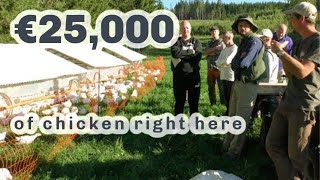
Richard Perkins demonstrates a new pastured broiler-pen model on video, explaining how he moves multiple Salatin-style pens using 50m and 25m electric fences, places food to encourage self-moving young broilers (about six weeks old), and handles logistics to protect approximately €25,000 worth of birds. He covers equipment (energizer, waterers), spacing and design trade-offs, predator risks, and labor-saving benefits for scaling to ~1,000 birds.
Questions this video answers
About six weeks old.
€25,000.
50 meter and 25 meter fences.
Built for 1,000 birds.
About 16–18 meters (four by three configuration).
Chapters
So we're going to move these first. I normally move independence first. And finishing with these, you can see the impact that the birds have had in a day here and what the ground looks like where they haven't been. So they are foraging a bunch. This ground is not recovered, but it's the only fresh greens that we can give the young birds. And there's a lot of young birds, so we want to give them that. So times, you know, like this, we have to make decisions like that. So this is a higher risk thing. There's €25,000 of birds in here and so just bear that in mind as we do this because we're pulling heavy things over the top of very small, fragile birds. And anytime you squash a bird, those €30 disappeared. So it's a little bit more high risk. But I like this because the whole intention of the model is giving the birds 30 or 40% more space and less work to move them. We've had no predator issues. Everything seems to be going good and these birds are now self moving to like 70% of them. The last few always need a bit of encouragement. But you can see the path we're going uphill. So this one we have to be very careful setting up the nets and we're using food to go down the middle of the new pen and that will encourage them to run through. They'll run through anyway, but they come running back again when they realize there's no food. So this energizer is very powerful. You want to be careful you don't touch that. I'm double checking it's off. It wasn't. And so we leave this fence and set up the next fence ready for them to come running through. This is kind of whilst the ground is not recovered, it's ideal for these young birds. It's not too tall for them and they're only six weeks old, so they're still babies, but it's very vegetative. That is perfect forage for such young birds. Now they know they're going to move, so we have to work a little bit swift and we have an opening up here so we can open this into the new pen as soon as we're ready. And we're using a 50 meter and a 25 meter fence and they will get both of them at full extension as they grow now. But you see they're not getting the full 50 meters. And so what we're actually going to do is play with adding another fence that goes from there to here up and connects back in it's obviously got to be long enough for the four pens. Well, each pen is a salatin pen with a wheel on it. So it's four by three. So you can see it's 16, 17, 18 meters. So we've got to know we have 18 meters in this case. I think we're going to take a 25 meter from here to here and bring the end of that fence to be meet it. And it will be just long enough to get all the pens in now, because we've got 18 plus 7 meters to be able to do that. So it works. So we lay the fence out and then we get it up as quick as we can. They might start crashing the fence soon because they know we're going to move. They know the ground's good over here. You see, they're foraging and there's no electric in the fence. So let's get going. So we always start now, we start here and go this way. We're joining onto the fence here and then we're going to bring the end of the fence to it. And then every second day we're setting up a new 50. So he has to bring the fence here. Lukas, you need to bring the end here so that we know, like, we'll take this bit away as we let the birds through, but we need to know it's in the right place. So this is where it starts. And so when we get two sections across, then you can head 90 degrees that way. And so, Simon, do you want to put that corner post in where it was there? And then I can take this away and we'll let the birds through. As soon as he's got that fence up so someone can follow Lucas and start putting that up, I'll take this out of the way and we can take these two bags of feed and we want to put them down the middle here in a long line. And the reason we're doing it precisely in the middle is then we can pull the pens over the top of the birds who are going to be focused in on eating food so nice and evenly. You'll start in the middle and you can see how long it is. You want to be in a straight line here. Straight up, really straight. And we're tensioning the bottom of the fence really well. So nice and straight, you guys. You should make one line right down the middle because now we're going to be in danger of squashing all the birds. It's counterproductive. So start in the middle very clearly in the middle, So it might become A little precarious now because we're going to have birds feeding right where the wheels will be. Yeah. Is there pegs in? So we're using pegs in these fences typically that we've got to move them first, obviously. And we're using the old fence to create a guide for them. I would put it on the inside and so you see the birds become self moving and then we just start unlocking the wheels. They have a little screw through the spokes to stop them moving. And then we have to come along and carefully move the pens over them without squashing a bird. Now this must be done. It can be done swiftly, but it must be done well because if you run over a bird, you kill it, basically it will die of internal bleeding. And so this is where the feeding was really not very optimal. Like one line down the middle means the birds are very concentrated, that you can basically walk quite fast over them. Because these birds aren't as responsive as something like a layer hen. They'll just sit here. And so it's a little bit logistical this morning. I just want to keep them away from the leading edge. Someone wanna we can start moving the subsequent pens. And we're watching all our wheels. We're not just walking along, we're being very mindful of where we're at. I'm actually watching all the wheels because I'm not sure if you're watching, but I'm normally. I'm doing it alone, like I don't need other people to move this. We get this right to the end. Now we're trying to keep the fence up to it, so. And then we plug in the screws again right into their holes. And then an important factor is to make sure we can still reach the waterers because they have an automatic waterer, but it's not enough for all these birds. So we're using these waterers still. So this pen can only be about this far away to make sure we can access this. These two waterers are obviously on the same end, so that's important to see that. But it's, you know, it's not a slap dash thing. If you're concentrating on moving the pen, you're putting your energy in the wrong place. You've got to concentrate on the birds at all time. It's not hard to move the pen, it's harder to avoid squashing birds. So a little bit nervous, but you get the idea they move themselves. They're eager to get on fresh ground and they will move on their own without food. But Obviously, when there's food, they will stay there too. So then we're just getting the fence up the back. We're trying to keep it quite tight up to the structures. And because this isn't a natural connection, I need to sort of plug that under there and I'll just tighten it back up again with this one, we want to get this waterer to the middle of the pen, so we need to actually enter again here and we'll pull it all the way to the middle where it's accessible to the maximum amount of birds. And it's always important with this kind of water, it's just homemade and it's like loose connections that you hold it by the actual cord as you walk, not just pull it along, because you'll be fixing it every time you do that. So I'm just holding it with that as I move it, just to not pull on the actual joint, as it were. Yeah, exactly. Yeah. In the middle. Yeah. It's better for getting as many birds to it. So it's nice having automatic water, particularly in these hot times. And that's one of the benefits of a pen style, is that we could piggyback another water off the back of that and have enough water for all the birds. We just haven't got round to it. But right now I want to keep a water on each one just so birds have access to water really close, because they're not necessarily moving around so much right now. Early in the morning, they're looking around, they're taking a lot of greens. Later on, they're sitting around talking about the football, how England beats Sweden, didn't they? Yeah, probably that's what's on their minds. They're English chickens, primarily, and. Yeah, yeah, yeah, yeah. And then the energizer will go back on when we come in, because that's where we want to turn it off again. This is Swedish version of the things we've been using in the fields. It's rubbish, it's very strong, but it's totally impractical. It's too big, it's too clunky. In the photos, it looks normal size because I bought it because of the rating of the power. It's the same rating kind of as the ones in the chickens. It's just double the size and weight, and so it's kind of impractical. So we use it for, like, static pig fencing or whatever. We just ran out of energizers this year, so we're using it here, but you see how it's working with the like. This fence actually needs to be left in because it's part of the electric fence and that's a single. It's only got a single foot, so it's a rubbish quality fence. You need these double feet. They're much more practical, they're much more stable. This one's a nightmare to push in the ground because the pole is just bending out. But now, as the birds are getting bigger, we can keep increasing the size. Right now, they've just got a 25 with the ending to the 50, but the whole pen, it's built for a thousand birds. And if it had a thousand birds, the maximum we would need is the 50 and the 25 as a full pen. Obviously, that would be coming quite far away from the pens. So what I would do in that formation is leave a bit more of a gap between the shelters to minimize the space between a fence and the shelter, because if it's not too wide a gap, a predator bird's not going to come in there. Like, imagine landing in here. It's pretty intense now. It could happen. I mean, I've seen buzzards sitting up here watching, but they're a little intimidated to land in there because they don't know what's going to happen. And so this one, it's a variable energizer, which is really nice because you can turn it right up to super strong. But in the very beginning, when the birds come in, it's a bit too much. They're only this big and they haven't got all the feathers and that can really shock them. And so now, as they're bigger, we turn it right up, or not all the way up, but up enough that it really shocks them. And they learn pretty quick. Like, they don't sit on the fence ever anymore. And as they get older, they get smarter. Like, I came up when it was drizzling yesterday, and they're all sat under the rain line in the dry. When they first come out, they're just like. And they sit out in the rain or they get scared by the noise on the roof and they all go sit in the rain. And that's what kills young birds is wet and exposure, particularly to wind. So this one's ready to go, I think. Yeah. Or have we filled up water? No. So we have to fill up water at the ends first and then we're ready. Turn it on, but pretty quick. No, a thousand birds can be done very swift and they have more space and that will increase the amount of forage they actually take. You see, they really enjoy taking leaves and forbs. And they also, at this age just eat sticks and whatever. You know, they haven't really worked out what's what. But compared to the laying hens, like, these guys shit a lot, right? So, like, compared to the hens, as they get bigger, they leave massive shits and they shit a lot. Which is partly why you need to move them twice a day in the salad and pens when they get bigger. Like, you can see what an impact it's had here. But it's a very even load of manure compared to the layers where you have a high concentration of manure under the eggmobile and a bit of manure around the place. With the boiler pens and this pen, it's all very concentrated that you get a very even fertilisation, as it were. And you can see that in the aerial footage laying paddock, you'll see where the eggmobiles were from the aerial footage, whereas these guys, you'll see where the entire pen was. So it's a much better, even fertilizing tool, as it were. But I like it. I'm more and more into this model and, and I've just always been cautious to like, you know, recommend people to try it because it is a big potential risk. You need to think about your predators and you need to respond to whatever happens. But I think I will always do something like this. It's much nicer for the birds and the workflow is really easy. The first days is more work because you have to kind of come along with these boards and move all of them for like maybe four, five, six days. And then they start like, okay, yeah, we're going over there. And they're not particularly. They're not big enough to do that big run yet. Were they here when you were here before? So at that point they were like small. Right. And they were not really following and just a bit meh. But quite a change, no? Yeah. So the first week is more work, but it's an investment in a lot less work over time. So this would be the equivalent of 11 or 12 Saladin pens. And if it was a thousand birds, it would be the equivalent of 14 pens. So it's a lot less work to do like this. And the birds get a bunch more space when they get their full netting. So the amount of space a bird needs is based on a full grown bird. Right. When they're young, they don't need that much space because they're not moving around much. They're tiny still. So we're increasing the paddocks as the birds grow. Right now I'm happy with this size, but we've got this situation where we were using a 50 and a 25 and the reason we're doing that is we always want an opening for the next day as it were. So if we. You can't do that with two 50s, it's too big a fence. So we bought 25 meter fences just for this and that allows us to always have a gate to join the next one with a gate and have a gate for the next. You know, you need to go at both ends, otherwise it doesn't work. So this is a, like this model, you should think of it as a thousand bird model with a 50 and a 25 meter and four pens but they have as much roof space as five Salatin pens. But they have a lot more space on the ground obviously. So the Salatin pens are built to regulation of size. But in this case we want to give them a bit more space than that because I think it's a bit intensive. The Salatin style pens, they're also very well thought through. I mean Gel Salitin's developed them over 40, 50 years and, and they work and there's a reason they work and there's some of the intricate details you can only appreciate by actually using them. It's all good trying to innovate and change things but you know, there's a lot to be said for really trying to understand why people develop things over decades. You know, it's good reasons but I do find it intensive and I do think we could take care of birds welfare a little bit better by giving them more space, more forage and better. Like in the hot spell we're having now, you see the other birds get very hot and this has got a lot more ventilation. But on the equal opposite side, when it's wet and windy, these birds are more exposed. Now you could remedy that by just sticking some drop down sheets on the side. A nice design addition here would be to put like a corrugated plastic V in front of each wheel so it like scoots the birds out the way. But even then probably feet would get stuck under and then people wouldn't be being so cautious. They'd think it's automated so they'd just pull it too fast and probably break feet. So you know, I'm cautious to do that because it's observational based, it needs to be done carefully. But I haven't ever put drop down sides because yeah, I'm just Curious how it goes like this. If I need to, I'll obviously come and do it. But we brought these birds out in a thunderstorm. It was like the only rain we'd had. And we actually came out and put sawdust under them and just made sure they were dry. But they were all inside, in the dry. And so we just chose not to move them onto wet ground and just keep them where they were in the dry and put some bedding in there and they were totally fine, there was no problem. But they look good for six weeks they look pretty good. This was an unusual batch that they came out, the Buddha, at very different sizes, some double the size of others. They're evening out a bit now, but it was unusual weight distribution from the beginning, I think. Now, obviously you get some variance with males and females and you get variants anyway, just genetically, but they look like good, healthy birds. Now. They're not grazing in the way a cow is, but, you know, they're trampling a bit. But they have really grazed this. I mean, look, they've eaten it, so I'm happy for them. But ultimately it's not ideal for the fields. Ideally it would be long grass, graze with a cow, then come in with them. That would be much better. So that's part of our grazing planning has been to get the ground ready for the birds. But then obviously that's all gone out of whack because the ground's just all not recovered. So we just got rid of the cow. But if we get some rain now, this will be a very nice, you know, it will recover very well and in the autumn it'll be very nice here.
More from Richard


A review of short and intensive season on a mixed farm and restaurant/event space in Sweden






Alskade Kyckling Exploring complexities of poultry production in Sweden and what we stand for


