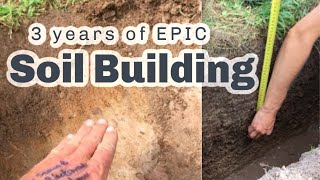
Richard Perkins shows how he built 25 cm of topsoil in 3 years using compost, biochar, and grazing. He brews 180 liters of compost tea, tests leaf protein extraction, and demonstrates a rocket stove. Soil roots now reach 40 cm deep in his keylined fields.
Chapters
So today we're running around, we're looking at people's projects, generating ideas for business still. But we're also making some soil preps, biochar and making concentrated leaf protein. And we're about to Skype with a friend Marco in Luxembourg, who's got a wonderful market garden set up for 250 box shares. Look at all these blackcurrants. We've got some harvesting to do here, So we. We've got about, I reckon, 300 baby crows that spending a lot of time behind the boiler pans picking up old feed and spending time at the neighbours farms. Now it's not a problem, they're not causing any nuisance yet, but it's interesting to see how many young birds there are this year. There is an abundance of baby birds everywhere. Actually I've been seeing many more than the past three years I've been here. Day seven, I think. Day seven. Do we want to add a little moisture at this point? It's going well. It looks homogenous. The farm manager is going up to feed and mulch the nut trees up in Nutfield right over there. And to add some Bittenfelder, which is an apple that grows true from its own seed, just like Antonovka can. So there's three apples that are good from seed that produce an acceptable apple from their own seed. So anything growing on its own roots has got a taproot and it's going to be more resilient and disease and pest resistant. So we're going to put in Biddenfeld in place of some dead nuts. We've also got two English walnuts coming from a neighbouring interested friend who's growing them in shield, which is about 30, 40 kilometers away. And they're giving nuts a 25 year old tree now put in as a bigger tree. So anyone pushing the edges with nut trees, it sounds like growing them up in nurseries longer before putting them out is a good idea. But all the nut trees have been cleared and they're going to be fed and mulched again nicely and new stakes put up so they're identified in the long grass up there. Mr. P has lost every single one of his tail feathers now. I think he's a bit confused. His girlfriends are gone, he's hanging out with the ducks, all of his tail feathers are here and that happens every year and it's quite fun to see how quickly these ducks have grown. I really want to start a duck enterprise here because they grow just as fast as the broilers. But my preference would be to be supplied young hatched chicks as opposed to having a breeding program, because it's just too much for us to manage with everything else going on. But I think that'll be something for next year. A lot of changes happening next year as I keep talking about, but they're slowly getting clearer and clearer. And I'll be updating you throughout the rest of the season as that process develops. So bed plans have changed. A lot of mescan has been pulled out because of the overproduction I talked about before. And what are you seeding now, Carla? Carrots. Nice.
They're good for winter storage.
So we have 70 new beds going into different production because of the sheer amount of material we get out of a mescaline bed. And so some nice quick thinking from the team and we got a good new plan. And a mountain of peas. These are all edible flowers we grow for adding to the salad bags. Veg team got more beautiful boxes. This is our small share that goes out for €15. What have we got?
Well, we got turnips, we got romaine lettuce, we got yellow and orange carrots, fennel, sugar, peas. Very tasty. Onion, garlic. This is mango, chard or mango. Here we have lavas and a nice hyssop. It's very nice for tea. And this one is nice for cooking. We have two different types of kale.
First, cucumbers.
Cucumbers, cabbage.
Okay, so we forgot. There's also a bag of mescaline mix too. Very nice. Beautiful box. That's a small share. That's a very generous small share. I think that's very good value for money and very happy that you guys pumping out very beautiful boxes. We can take a look at the big box as well. This is a big box. So big box has got nice bunch of chard, herbs and flowers and romaine lettuce. And a bigger bunch of onions, kale and turnips. Very nice. Nice bunch of red and yellow carrots. Two fennels, baby fennels still. And we've got. Look at this first. Zucchinis coming into the boxes and couple of cucumbers out the greenhouse. And a cabbage, two green garlics and a big bag of peas and two bags of mescaline. Where are they? Can we have them? Wow. So this box is a 29 and a half euro bag box. And what do you reckon the value is we're putting in?
I reckon that's between 4, 450 and 500 crowns.
Yeah. So 45, €50 if you go and buy organic food. Like this beautiful box. Happy with it?
Very happy with it. I think it's one of the nicest boxes going out anywhere.
So where are you going today, Matt?
We're going to Karlstad. We have our regular drop off point which has now been mixed. The regular viewers know now with the Rico.
With Rico.
So we have these one time first time customers rather so far. The average is that every week we have people from first time customers that then feedback that they want to become subscribers.
Yeah. Which has happened every week because they're paying a higher price just for a one time box. So it's better for them, better for us because we can plan easier. And we're giving away free beer again from our local brewer. Free beer.
We also.
How do people like that when you.
Well, they love it. I mean you don't expect to get free beer when you're going to a parking lot to pick up vegetables. So they love it. And we also have chickens in here. Fresh chickens, beautiful. Temperature controlled all the way there. And so we also have a printed recipe where people can do like a beer brine for the chickens.
Very nice.
We're providing a recipe for carrot top pesto. And we're also providing some information about making tea with the herbs that you provide.
You guys are rocking it. Yeah.
And we've also got some 14 boxes of eggs. 14 times 5 boxes of eggs. And that's for a combination of local restaurants where they sell, where they'll sell them in 12 packs to people and Rico and our regular customers.
So packing station seems to be working okay. It's very rudimentary and simple. I've just invested a bit in building the structure as you saw if you watch our videos. But really it's a lot of free timber that we took out the sawmill in one of the old videos you might see seems to be working fine. Here's a bit of their planning for the harvest schedule. Really loving the garden team's ability to just rock out. Awesome birds. So water testing for the slaughtering part of the control program. We supply all the documentation but also water sampling, etc. It's very high quality water needed to run your own slaughtering. Just checking out the compost tea that's bubbling. This is a bacterial compost tea we started yesterday for application this evening. It's about 180 liters which is the maximum we can run on this old sewage pump to saturate the air. Some nice foam developing. It's a good sign for us. And seven kilos of good aerobic bacterial compost. From a pile that's finished, and we've added 500 mils of sugar cane, molass, some rock dusts and some plant extracts from comfrey and nettle to help feed the bacteria. And it's a bacterial tea for the veg garden. So we'll be looking under the microscope this evening, seeing if it turned out how we liked. We normally add fish hydrolysate that we make on the farm, but we haven't actually made any this season. So we're trying it without that to see how it goes. And it looks to me like it's going to be full of bacteria. So we're prepping to make biochar tonight and we'll talk about that later. We're also running around doing concentrated leaf protein, which we're going to put into some brownies to taste test and see if we like that. It's a way of extracting the proteins out of green leaves and concentrating them. It could be used for animal feed, could be used for human food. So we'll be juicing different things. We're going to try aspen, cabbage and nettles, which are all known for. Poplar is the known leaf concentrate protein. But aspen's in the same family, so we'll go with that. So the guys are making the hole. It's going to be a cone pit. Very simple. The simplest, easiest way to get consistent charcoal. And we're selecting out. This is our winter firewood supply. But we're selecting out thin bits that don't need chopping, just to save time. And it uses quite a lot of wood to make, you know, third of a cubic meter of charcoal. So this is how we're going to cook the concentrate leaf protein. It's just a little rocket stove you might have seen by Biolite. So it's got a thermocoupling and it charges up a battery in here. That blows a fan. If I press this button, you won't be able to hear. It's blowing air out these holes to make a more complete combustion. And then it has a little USB port where I can charge my phone or an iPad or something. I also have this grill attachment for it. And you can grill a whole fish with a handful of twigs. That's the idea. Very small amount of tweaks and you get biochar as an output. So now we're burning and I'm plugging in the foam here. Then we're charging, so we'll keep this fed. And we've got poplar here. Aspen, actually. And we've Got nettle and we've got cabbage leaves. So we're going to juice them and take them individually, put them in here, boil them. That will separate almost like cheese making. Separate the curd and whey. Then all we have to do is put it through a compost tea strainer, press it and we'll get a concentrated leaf protein. And there's a few different plants that are used for this, like for impoverished areas with malnutrition. But it's an interesting idea for creating your own animal feed proteins on a small scale or as human food. But some people say it tastes okay, but I'm yet to be convinced. But hidden inside chocolate brownies, nothing gets a goer. So this is a stove attachment, just sits on top of here and you can feed the fire through there. When I close that, flames come out here. Good for cooking fish on a canoe trip. So this is cabbage juice and we bring it to the boil and it will coagulate and then we'll strain that through compost tea strainer to extract the rest of the juice.
I load it.
So it's starting to separate and we wait till it's coagulated. So this is boiled and you can maybe make out that it's starting to separate, that we can put it through a sieve. This is. So that's for scale. 300 mil of juice comes out as this intensive protein mush. We're going to press it now. Yeah, this is nettle juice and it's kind of thick and congealed. Not sure how well this one will work, but we scraped the poplar and we're going for mesclun mix because it's quite hard to get the juice out of things like poplar. So we're gonna take a bit of excess mescaline and juice that. So this is nettle. It looks quite disgusting. It tastes like fish. So we reckon, how much protein do I reckon this one?
About 3 grams, maybe.
We reckon about 3 grams of protein in this, which is equivalent like a cabbage worth of leaves juiced and then pressed. So it's about half an egg of protein. And I reckon we got a higher yield out of this. I mean, nettle is obviously higher protein and it tastes really fishy. But I reckon inside the chocolate brownie it'll be forgiven.
I reckon.
So then, last one is mesclum mix, which is not exactly known for its protein content either. Okay, so this is mescaline mix Premium Ridgedale salad. Yum, yum, yum. Okay, so this is our mescaline protein. So quite different colours. The light's perhaps not very good here, but interesting. We're going to give this to the chefs and see what they can do with it. So, as with making this biochar pit here, you have the opportunity to see what the soil is like. Before we've come along, doing the farming practices we have. And we're going in a moment to look at the keyline rips. They did a cut through through places we've keylined. You see here we've got about 14 centimeters, would you say, down to here? Not very far. We can measure it, perhaps. Nearly all the root activity is happening in the top 15, maybe 18 centimeters, but that's how thin the topsoil is here, where we haven't worked the ground. This place has never been disturbed. We're at the end of the market gardens here, and this is just an area where we dump stuff. So it'll be interesting to compare what we find in the other fields.
Okay, getting down a lot further here.
So look, this is. We found a vole hole. Clever little things. Now, look, this is very different immediately. Right. So this looked the same when we first moved here. What we've done in this field is pull the key lime plow through twice. And we've been planning our grazing three seasons now, and we see immediately that the topsoil is down to somewhere here and the roots are obviously much deeper. Let's measure that. So this is the result of three seasons of having animals. This is the third main season. We didn't have many animals the first year, but we're down at 40 now. And you see, it's quite homogenous. It's not like you can see where a key lime plough shank went through. It's homogenous all over. Now, in theory, you might pull the key lime plough a little bit to the right, little bit to the right. But in reality, you can't even see where you were last year, so you just pulled, pulling it wherever you can, probably parallel to the tree lane and then just going back and forth. But I would say to get a really conclusive picture, you would want to do multiple pits around the farm, maybe five in each field. But I'm pretty certain that we've done this all over the place because of the grazing. Mainly. I would say the grazing is the bigger influence on this, allowing plants to, like, keep actively photosynthesizing as long as possible and rooting and then planning the grazing that we're not eating the root reserves, we're allowing them to express themselves. But you see, the density of the roots is a lot greater than up there. So I'm quite happy. Like, this is what I would expect to see. And one thing I can't tell you is whether the key lime plow made any difference than just grazing management. I don't know that and I don't think many people actually have any data that can really tell you that. I think, for me, it's still worthwhile as a mechanical kickstart because it does immediately break up that plow pan. So it's a quicker way in. But I think you could do that just by grazing anyway. But for me, it's worthwhile to tickle it because it's just a subsoil tickle. It's not damaging the surface. You can't see any place. We've pulled a key lime plow through here now.
I thought here, perhaps.
Yes, but you can see that only from the surface where the chickens have disrupted that. You can't see it in the profile at all. You might feel it with the penetrometer. So it could benefit from one more key lime plough. I decided not to do it this year just because the chickens make a quite intense interaction with the key lime. The open bit of soil, they will just make dust blasts there. And I just feel like it's unnecessary at this point, in the same way that using a broad fork just won't be necessary in our gardens. Probably even now, like, you know, we can pull carrots out the ground without digging them. It's like, do we actually need the board fork? I think we'll use it this year, maybe next year, and then we'll stop using it. And that would be the same with the keyline plow. It's like we've got active topsoil and roots down 40cm. We don't actually need to improve that in any way. It's like, you know, we're 25 centimeters better off than we were three years ago, so what's the point? It's going the right way. We don't need to drag metal through the ground anymore. We just keep our grazing plan up. Very nice to see. No, yeah, definitely.
It's quite crazy. 25cm in three years is a lot.
It's harvest time. We always pay it forward and put about 200 jars of jams, 100 kilos of blueberries in the freezer for next year, because we've been eating berries all spring. But we've got a lot of harvesting to do. These bushes are just laden, so it's Time to get in here and start picking. It's feeding time and the guys know it. But I'm not feeding. These two over there are. Hi, girls. So we've been doing some more of that time monitoring. We're talking about efficiency and time and motion studies a lot. So there's been a pair doing egg sorting and packing each day. I went in there yesterday and we did eggs. I did half the eggs in 22 minutes. So it's a 44, 45 minute job to do the eggs from 800 layers, which gives me confidence to scale it up next year to 1500 birds. Perhaps. We'd have four eggmobiles. So it would double the amount of time in moving in the morning. So we'd have an extra one to move each day, about 45 minutes maybe for morning chores. And then it would double both egg collections and feedings in the day and about an hour and a half sorting and packing in the evening. But that would be turning over about 1.2 million crowns, which is €120,000 at high margins. It's a very neat tent price and we already know we can sell that many eggs because the restaurants have already ordered all the eggs we produced this year and we've had to refuse them because we already have many other customers and we value keeping those customers. So that's the plan for next year with the laying operation. There's two bubble systems in here. One pipe goes down along the floor and has many holes drilled in it that keep the bubbles here. And this one just has a straight tube. And that's because we sometimes suspend compost in a bag off this one and we're blowing air to BL organisms off the particles. And so we just set the tap to equally distribute the airflow to get as much agitation as going as possible. Smells wonderful. It's slightly sweet and ferment. Not fermenty. It's sweet and forest flooring. It's actually really nice smell. And I've just knocked the bubbler over, which this is holding the bubbler down in the water. But things are going good. We're going to have a Skype call now and then come and look at this under the microscope.
Terra, it's basically a cooperative that's growing fruit and veg on about 2 hectares of land which is situated just outside of Luxembourg city, about a 10 minute drive away. But it still feels like you're in the middle of nowhere. And Terra is based on three main pillars. That would be production. That's the main thing we do. We Produce fruit and vegetables for a csa. We also do all sorts of educational activities. We have about 50 different workshops throughout the year. That's everything from full on PDCs to kindergarten visits and everything in between. And the third main pillar is community building. So really creating a new social cohesion around agriculture, which is something that was definitely not happening in Luxembourg. So I'll take these three things one by one and dive a little bit deeper into each one of them. So we start off with production. This, this is what Terra looked like when we first found it. If you're ever around here or interested in seeing more, then you're more than welcome. There's always people coming and it'd be a pleasure to share more. And especially the ones that are seriously thinking of setting stuff up. We'd be very excited to share the little bits and pieces that we've learned.
Cool.
Okay, well, thank you very much for your attention. I love talking about what I'm passionate about and thanks for listening.
Can you play us a little song?
Yeah, I'll play a tune. So this is my new creaking lute and I'll just play Bye Bye tune. Wishing you a happy harvest. Sam. Yeah, that's a tune from Crete that. The name of it is May the harvest be rich. So there you go.
So we've got the soil microscope set up. We're looking at 400 times magnification via the big screen and there's a little bit of a time lag, but these are all bacterias and there are some protozoas in there too. And they are all moving as you see, which is how we know they're organisms. Now there's some rod shaped bacterias and some other bacterias. This is one method. Like if we wanted to count the number of organisms, we would use a gridded slide or take an image or video here and then we could actually count per sample. So this is a bit of compost tea just in a cup because we haven't got a pipette at the moment. And one drop put on a slide and squished down. And then looking through 400 times magnification there. And there are thousands and thousands and thousands of organisms in this just small field of view. Because there's actually, if we change the focus, there are layers of organisms. It's going to be really hard to see that because of the time lag, but there's many layers thick of organisms and we've got 200 liters. So we've made billions of organisms, which means it's worked out very well, so it's actually quite hard to see on the screen in the resolution you can through the eyepiece. It's quite hard to hold a camera here actually. But there are many really fast moving organisms that are ciliates that you might just catch racing across the screen. So that's protozoas with fine hairs that they use for propulsion. There's definitely amoebas in here, so I'd say a large presence of protozoas of different types. I see some ciliates running across the screen there and real massive amount of bacteria. And I'm just going to zoom around the slide, see if we have things like nematodes, which I wouldn't expect many of in this tea, it'll be mainly bacterial with a decent amount of protozoa. So we found, we found a dead, dead nematode. You see, it's full of bacteria. There's a nematode eating bacteria that probably eats about 10,000 of these a day and excretes them as plant available nutrients. A lot of nitrogen will come out in the excretion, but all these little pots are bacteria. Some rod and other types of bacteria you'll see coming around. Things like Lactobacillus look a bit like that. Maybe he's not dead, maybe he's just having a nap. But there's also ciliates that you see better through the eyepiece, but they often move very fast across the screen. You have flagellates that are drunken looking things that go. They're also protozoa and amoebas are more.
Like.
Pulsating things but bigger than these bacteria. So this is very heavily bacterial, as we'd expect and perfect for putting on our vegetable garden. So a very interesting day and I've had a great time. Thanks for watching our videos as always. You can find out a lot more in the book. Making Small Farms Work. Really appreciate the support through that and if you want to give us comments and feedback about the book, please do. It's great to hear from people around the world.
Sam.
More from Richard


A review of short and intensive season on a mixed farm and restaurant/event space in Sweden






Alskade Kyckling Exploring complexities of poultry production in Sweden and what we stand for


