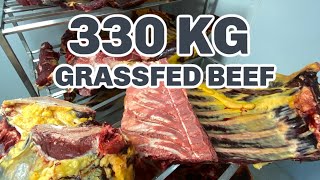
YouTube video by Richard Perkins documenting handling and initial processing of a grass-fed bull named Skansen (slaughter weight ~320 kg). Covers logistics of moving large carcass pieces to a chiller, plans to age the meat (time and temperature considerations), discussion of animal welfare/stunning practices in response to viewer comments, thanks to helpers (paid ~1000 crowns/€100), and promotion of a Regenerative Agriculture Masterclass with three scholarship places.
Questions this video answers
Approximately 320 kilos (slaughter weight).
One thousand crowns (≈€100).
Three scholarship places.
Chapters
Okay, sounds like the bull is ready to pick up 280 kilos. And we've just made a new habitat for Ragnar's cockroaches. They're trapped in. Where are the cockroaches? They've all hidden away. So they've got some kale, some carrot chard, some leaves, compost, and they've got some eggshell egg cartons to hide under. But there's a whole load of two different species of cockroaches in here. Okay, times pick up Skansen apparently. 320 kilos. 330 kilos. 300 and thirty kilos. Now, obviously that's got the bones in, but that is a huge amount of meat for our family. Unbelievable. Okay, so we're just deciding what we're gonna do because this is heavy. Even just this midsection is probably 60, 70 kilos. So we'll probably take it in half again that we can move. Oh, sure. Okay, so we've put down some card to protect the van. We're just gonna have to put it straight in the V. Justine is taking away the fillet. And then we split this again here to make it manageable. Guess that's lunch. Look at that. That's l. Okay, That's a heavy one. I can't do it on my own. Try. It's too heavy. It. Sam. It. Take it down this way. Behind it. Good. Turn me. Oh, it's okay. Good. Nice, nice, nice. So There we go. 320 kilos. Got to go and get that in the chiller. Amazing. Okay, so 320 kilos slaughter weight for Skansen. Pretty impressive. And an incredible amount of food here. This will serve the family as well as the entire team and training participants next year with first quality grass fed beef. Pretty amazing. Next step of this is to age the meat. And that's a factor of time and temperature. We haven't decided whether we're doing a shorter or longer curing yet to age and develop flavour in the meats. We haven't decided exactly how we'll do that yet, but I will keep you updated on the process. Want to say a massive thank you to Hawk and Steen. They only wanted a thousand crowns, €100 for their help with all this process, which is amazing. And we just don't have that heavy lifting gear that you would need to do this job properly. And Steen said he watched the video and really liked how it came out. I think Hawkins doesn't have a computer and probably hasn't seen that, but he appreciated the video and liked the fact that you folks enjoyed to watch that. I wanted to follow up on a couple of points that came up. I don't normally go through the comments very often because YouTube is not renowned for the most useful conversations, but due to the sensitive nature of the previous video, I wanted to see the responses and I wanted to address two points that were brought up in the comments section on the last video. Firstly was about leading the bull away from the cows. Now, we specifically don't do that. If we're taking any animal that's, you know, like a herbivore, like a sheep, etc. Or a pig, we will take them down and bleed them right where they stand in the pasture. And I feel that that's the best for the animals in general. If you lead the bull away from the cows, it will stress the cows that the bull is being taken away, but it will stress the bull. And when you're just about to kill an animal, when there's stress hormones running around in the body, that's the worst thing you can do. As you saw, it went very quick, very well, and that's our preferred approach. We'll always take an animal where it stands rather than lead it away. And I think that's the best way. And in most cases, most animals don't really seem to mind what's going on around them as long as it isn't happening to them. If we do that with sheep, for example, they don't even raise their heads, they just carry on eating. Cows often do the same, but obviously with the activity going on, the cows are quite curious, and they're particularly curious cows anyway. But I feel like whilst it was slightly disruptive for the cows, it was no big deal. They're over that and carrying on with their wonderful existence that they have here. The second point I want to bring up is someone mentioned about the actual killing and that Skansen seemed to be breathing for a little while after the actual stunning. So the stunning with the bolt gun is not to kill the animal, it's to stun and make them unconscious, and then they're killed by bleeding out. Now, if you just cut the throat, the carotid arteries, most animals will be unconscious within five or six seconds from blood loss. It's a very quick, easy way to kill something and it's a very clean, good way to kill things. In my opinion, it's not allowed under EU regulation. You need to stun animals first. And I talked about this with Steen and we concur that this went perfectly. It couldn't have gone better. Now a big animal like that will be breathing and its heart will be pumping and that's important to pump the blood out of the carcass for the meat preservation. But we think that it went totally perfect and actually couldn't have gone better. Quicker, smoother in any way whatsoever. Okay, so that's it from this episode, folks. Hope you enjoyed seeing how this process develops and we'll of course keep you updated as we butcher the animal down and prepare it for the freezer and for eating. Thanks so much for watching our videos as always. Don't forget, you can find out a whole bunch more in our book Regenerative Agriculture. And as I mentioned in the previous video, we're launching the Regenerative Agriculture Masterclass that's running only as a live event once a year. If you want to be in for the 2021 cohort, you can follow our free mini series to see a taste of the course. It's available in the links below. We've also got three scholarship places available for people to enter from all over the world. Look forward to seeing you in the video soon. Bye for. It.