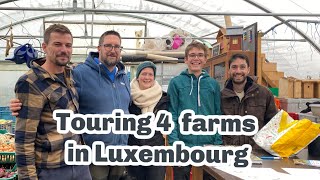
Richard Perkins visits four Luxembourg farms running CSA models, from Jeff's 70-hectare operation with 40 cows to Yves and Eve's 1.2-hectare intensive garden serving 110 members. Terra scaled to 230 members and raised staff pay €800 a month after streamlining operations. The farms share tools, knowledge, and practical innovations like eggmobiles and no-dig beds.
Questions this video answers
About 70 hectares.
About 70 boxes.
About 25 tonnes (summer production from rented glasshouses).
About 40 cows (black and red Angus).
About 40 animals per year.
Chapters
Okay, welcome back to another video, folks. So I'm in Luxembourg. Marco's been an incredible host and feeding me great meat, quality local foods and we've had a great day. We did a really nice meeting with the government ministers that went really well. We did a really nice public Talk for about 140 people showed up, really nice group. And we had a great workshop yesterday with about 40 farmers from five countries or so. Yeah, nice to see old and new friends. And today we've been on a little trip around to see three or four of the CSAs that are working here in Luxembourg. And so we'll bring you along. Hey, first farm of the day, Jeff, tell us a bit about where we are. Who are you?
Yeah, hi, my name is Jeff and we are here at a nice farm next to Ashelna in Luxembourg. And we're standing here in front of our nice shop where you find a lot of nice meat stuff and transformed stuff like sauces and soups and eggs and so on, which we produce.
This was a family farm and this was no chapel.
Right?
You've turned into.
Yeah, exactly. That's what really. The farm was part of the monarchy in Trier and my grandparents bought it and now we were here. And the chapel thing is at this part of the chapel they were praying and in the bottom part they were producing alcohol. That was the history of the chapel here. And we make new life inside by putting a nice farm shop in it.
So this is a self service shop. People can come take meats, sausages, there's products from other local productions and transform products. So you've got. What have you got? You've got massive glass houses. You're doing like 25 tons of tomatoes. Yeah, exactly.
We rented some glass houses and during summertime all the Luxembourgers are on vacation. So you really need a plan B to store things, to transform things and to get rid of your tomatoes. So we made like nice products here. So this is like a special tomato salt and we mix it with minced meat from our farm. So it's a nice Bolognese sauce, for.
Example, and you've got some. You're saying this is like a pretty special local delicacy?
Yeah, this we call it like Kratzykraut and it's a special sort of plum which is cooked for eight hours and then you only have to add very less of sugar in it and it gets a really, really nice taste. That's really a nice product which we do on our own.
So you've got your herd of Angus, you've Got an eggmobile here. You've got tree crops, other things going on. And then the tomato production is elsewhere.
Yeah. That's 10 kilometers or 7 kilometers from here. So on the road to Luxembourg City.
Marco and I and his brother are doing barbecue. So look at this little baby dry aged. How long is that dry age for?
That's. That's a. A part of dry aged from my Angus car. And it's like five or six weeks dry age. So it's really, really nice part. And what's a bit special of it, it's. It's from a bull. Huh. So normally you get this cows to the nice meat. But also we try to do it with bull meat and if you see the shape and everything's really, really nice.
And we're going to pair that with some local wines. Jeff's been very generous. Thanks for all the gifts you gave me. It's super generous of you, but we've got. Tell us a bit about the local winemaker. You're really into his work, right? He's a specialist in alchemy.
That's a wine for my friend George. He started this like eight years ago and he's doing like more. He's putting a lot of effort in his wine to really. To change it and you can really taste it. It makes no headache or almost not. And he's not doing the classical line, what you find here. He has probably also the classical wine salts, but he mixing them and doing a nicer product out of them.
So here in Luxembourg it's more white wines.
Right.
It's not for red wines.
He also has one red wine now in his sortiment. But it's mostly the white wine who is really common here.
Yeah. Oh, it's full nice. I always say comes back to chickens. So here down in this region, Germany, etc. People often selling at 50 cents an egg, which is better than I sold for in Sweden ever. Plus food is similar price. So it's a really good business for those of you in central Europe typically. And the security of this seems to work really well for you.
Right.
We heard from some of the people in the conference that they've had troubles with this kind of setup. But they're downtown in the city where there's a lot more thievery, etc. But you've had no problem with that?
Not yet. We had problems, yeah. But I'm really thinking of a system with an entrance password or an app, an application to have like a membership almost. But first we wanted like starting like this, that's easier for the, the people to get to know the shop.
Yeah, it feels more inclusive. This is beautiful rolling countryside and this is quite typical of Luxembourg, I guess. Tell us like how many hectares is the farm here?
Yeah, we have like 70 hectares on our farm here. You see we have really a nice view around but it makes it also more difficult to explore our farm.
It's quite a steep terrain so you've had issues with finding a suitable eggmobile and developing infrastructure's challenges. And it's quite for people listening in, that's not familiar. The land prices in Luxembourg are extreme. You've benefited from keeping on the family farm essentially.
Yeah, exactly. The prices are like really off grid. Goes to €100,000 a hectare or something which you can never pay off with farming. But you can also rent land that the prices are really okay to do it.
Yeah, yeah, yeah, yeah. And that is like my biggest takeaway from this time here is CSA is a big thing. Jeff's got a CSA running here for vegetables and that's quite common around Luxembourg. And what's really impacted me here is the sharing and caring between the farmers to meet up to network. You all sort of meet up and share challenges and what's going on and help each other too. It's really beautiful. So this is the CSA. This is a self picked CSA. I think it's 70 boxes and the box schemes are very common here obviously with a big catchment in the city. But this one is running on self pick so the members, they use a flag system and the members will come and self harvest pros and cons. And we've been discussing that in the workshop because obviously some of the work is done by the members to harvest but then it's logistical, it's a nice model for inclusion and you know, families all bring their children and get engaged with their food but it's, you know, people walking on staff or taking things that aren't meant to be picked because they look better, etc. But really lovely inclusive model and I think that's something I've always experienced down here in this part of Europe is the CSA and shared, you know, community based models are a lot stronger here than where we are in Sweden, for example. Really nice to see. It's a really lovely aspect of their farming to really include the community in a very, very strong way and I think they all really benefit from it. Another really cool thing is they work with this apprenticeship scheme. So the university, I think to buy land here you have to have farmer training from the ag school. Where we did a public speak on Friday which went down really well, had about 140 people come to that and some of the ministers. It's really cool. But that program, the apprentices have to go and work on farms where you have someone who's got a bit more experience than you. It's a really cool model. Like Marco had to do that at the farm and now he takes people and they run their practical experience of ag school at a working farm. And now these guys have all networked together and they share their apprentices. So they'll spend a month at each other's farms and these guys running the farms all meet up once a month to problem solve, etc. It's a really lovely model and I think they've all really benefited from it. Like to have this really active, bubbly network where they can share rather than compete. There's no sense of competition amongst them, which is really beautiful to see. All right, so Marco, you don't do self pick. You. You guys harvest and have help from members, but you guys run exclusively self picking.
We have a part of pick up. One set is a pickup system where we do the harvest and 2 3rd is the. The self picking. Yeah.
And so tell viewers about the self picking model. Pros and cons from your experience.
Yeah, the pros are absolutely. You have a bit less of work. You do not have to do the harvest, but you have to organize the garden in a better way so that the people can go everywhere in the garden. You have to mark the beds where they can put the vegetables. You have to ride a big wall with all the products they are ready to harvest. So it's a bit of work there, but I think it's in average it's less work. But you cannot run your garden so intense like you do with the pickup system. So until a bed is empty, it takes time. Not all the people are coming every week and so sometimes you could be more productive. So this is probably more a bit an extensive way of doing the market garden.
Yeah. But you get this beautiful interaction where families come with their kids. And we saw you've got this pizza oven. So it's part of your marketing is to bring people in and involve kids.
And I get like a lot of feedback from the people and like the children asking is this vegetable from farmer Jeff and that decides of eating it or not? And that's really cool to see that stuff happen. I still will have like last week and probably the week after.
So that's the end of the past, is there? And You've got some of this beautiful beach forest also.
Yeah, exactly. We do have five factors of forest and we are doing lots of wood for, for my heating system on the farm and also for my brother. So that's like a bit the winter work to do.
That's your, your father's up there processing wood. In the background you can hear maybe and you. So you make these big bundles. Yeah, maybe we zoom in there.
Yeah.
So that's like the feedstock for your central heating system.
Yeah, exactly. The bundles are easier. We can transport them, we can put them somewhere. That's. That's a good way of doing it. Yeah.
Modular polytunnels.
Yeah, and double layer.
And it's a double layer. You have this rope inside and it puts the layer outside.
So you've got insulation. Insulation inside so that each panel can be replaced individually. What's, who's the manufacturer? For Europeans that are interested.
It's called, it's called ficler tunnel and it's from, I buy it from niche in Germany. And also to, to put the air inside, you have one element or two elements where you. Which you can raise. So there's a circulation inside. You do not open them from the side. You can only both sides and the elements.
Pretty good ventilation. Yeah, I like the height.
Yeah.
Winter barns too. Wet on the pastures. Now what does tell us about your Angus? Because this was a dairy farm when your parents were running it.
Yeah, exactly. This table was like for a dairy farm stable. And at the end last year we had even a robot to do the dairy part and then we changed it to have the cows inside.
And you see.
Yeah. Now like 40 cows inside. Resolved. We have the black and the red Angus cows. So it's not only the black Angus but also the red. And the food, you see, they only eat grass all over the day.
Grass fed Angus. It's a good one. It's quite, I mean dairy and beef is quite big in Luxembourg, I guess.
Yeah.
It's like a lot of land is used for that. So you're running like up to 120 animals on the farm. Exactly.
We can like slaughter like 40 animals a year and for that year like half of the production we sold directly and we will do more over the next years.
So you've got your shop here now and you've got another shop.
Exactly. We have a little shop in Astronaut in a village nearby. And then we have two restaurants and three little other shops. We sell our meat and that works quite good.
So one of the limits we've been Talking about is the. It's a really high cost for processing to then get the cuts back from the butcher. And you've been exploring with the environment Minister about the possibilities of a mobile.
Slaughtery in Luxembourg and exciting things. The mobile slaughter we would have also mostly an advantage that the cow is really from birth to death. This, all this process is on the farm and I, I'm nearby to do that and not that you separate the cow from the herd and then it goes to the slaughterhouse or something. Then, then the stresses. That is always stress for the cows and I like to have this process here and also already to start on the farm with the transformation with the.
Butchery and the processing.
Exactly.
Because it's a really high cost here. No.
Yeah, it's really, really high.
You were saying like wholesale value. The beef is actually worth less today than it was for your father 40 years ago.
Yeah, exactly. We find an old, an old bill from my father when he got paid off for his meat and it was €4 a kilo and today I'm on a price like €3 43 or 50. That's really 40 years ago. That's really crazy. Yeah.
So direct sales, that's the future. These are. So we'll have a look at the eggman bill but the. This is for nests for the winter location in barn but they're quite decent price. So these have automations to close the door. It's pretty standard sort of roll away nest we didn't absolutely familiar with but it's got an automation that opens and closes. So this is for organic standards for 200 hands. 208 hands and it's couple of thousand euros.
Yeah. Last was like €2,500 and the nests were really cheap. It was only the automatic open and closing.
This cost Quite, quite but still a pretty good price. It's affordable. I haven't heard of this system so it's still a manual collection. Like on our egg mobiles we pick the eggs. But Jeff was saying they also make EU approved eggmobiles. It's another German company that make them. There's quite a few now. That's cool. As most of you know I've always been on the lookout for affordable nests. So for my sort of style Egmobile that would cost you maybe €4,000 to have organic standard nests with automations and the benefit being you know steel sheet and plastic it's much easier to maintain hygiene for mites etc compared to wood. So to build up a Ridgedale egg mobile with these would cost you about €5,000 if you built the egg mobile. Still very affordable when you're kicking out €30,000 of eggs a year. This was the original eggmobile. Not many flat places on the farm to have an eggmobile.
Exactly.
But the people like it when they go around here and they see the sign and they see the chicken around. They are really. They like to see that. And it worked not so bad. But I use always needed quite a big machine to move it.
Too heavy.
And that was still the point where I say I want to get out of the big machines for moving it. And yeah, therefore I bought another one. This information you find all around the farm here. So the people working here, hiking here, doing a bike ride. I see them quite of stopping here and reading what we are. What we are doing here. So it's a bit like self explaining farm to. Because this touristic region here is really important. There are a lot of people coming here for doing holidays. They are like. There's a lot of hiking here around in the forest and everywhere region is really nice to doing that. And therefore my idea was also to implement that part into the farm.
So another chicken caravan. This is from Chicken Caravan Australia, right? Yeah.
But this is.
You're not actually able to use this. You have problems with regulations because of organic production, right?
Yeah, exactly. It does really. Even if it's a really nice system, it's not so heavy to move it around.
You liked it because of that, right. It's light and easy to get it.
Around the land from Australia. Because of that I was looking for a long time. But now where it's an organic. It does not get along with the organic rules.
It's.
It's just not a kind of system how you can have hands but it. The organic rules does not fit with it.
It's not big enough space.
Yeah, it's not big enough. There's no food and water inside and so on and so on.
It's this constant thing that we've always been talking about on the Channel with different regulations and people adapting the Ridgedale style eggmobiles for Germany, Austria, whatever it is. It's different in every country and down to the regulator you work with, right?
Yeah, exactly. And now we make here a fix stable. So in fact we go three steps back in our production of the egg.
Yeah. And the reason you're doing that is because you're organic tomato production and things you can't afford to. You can't have non organic production on the same land, right? Yeah, exactly.
It's a bit you always have differences if you have an organic part and a non organic part to do the same productions and because in fact the changing to grow organic with the rest of the farm is not so hard and not such a big change. So I decided to go with all the farm to organic to be cleared and do not have the difficulties.
Cool. Thanks for showing us the phone, Jeff. Where can people find you? I can put links below, but where's the best place to find you?
The best place on the Internet are Farmseed Fromberg Point Alou. You find us and I also do a nice Facebook work. You find us on Facebook. I put a lot of pictures and.
Things and you actually have. There's some holiday lets here. So you can come stay on a farm and be part of the CSA and.
Exactly. And if you went here like vacation, you can go to the garden and get your vegetables and buy a lot of farm products and I think that's, that's a nice thing to get to know the farm and, and see the region and you are really welcome.
Great. Thanks Jeff.
Thank you.
Off road. And where else are we going in Marco? We're going to see Terra quickly update there.
Yeah.
And then we're gonna see Krautka. Old fans.
Yep. And Eve, another csa. That's right. Excited.
Look at these beautiful beech forests. So not the best time to make videos for you folks in the end of the season. Everyone's got like a week or two left in their CSA harvest I guess, right?
Yeah, that's right.
We're back at Terra. You guys have seen the old video I put out with Marco looking around Terra and the cooperative here and it.
Was back in 2017, summer of 2017.
Time flies.
It does.
But we made, I made some pretty strong recommendations. You guys were in a situation where you all needed a little bit more cash for different reasons and this, this scenario of increasing the size of the farm to generate more revenue and that always rings alarm bells for me and I made some pretty strong recommendations to you guys just because I know you well. So I felt occurred. And you wanted to say a little bit about what happened there. Yeah.
So here we are four years later. And just to summarize the. The main points of these recommendations, one of them was standardizing the length of the beds. So if you remember, they were all different lengths and now we've standardized them. They're pretty much all 20 meters with some 10 meter ones. That has obviously been, you know, a pretty smart move. We should have done that from the beginning.
For planning efficiency.
Yeah, For Standardization of like nets and all the covers and the irrigation lines and for everything. And for the planning, of course, the second recommendation was, if you remember, we were still working on 1 meter 20 beds and we changed all of that to 75 centimeter beds. And of course, that's been awesome because now we're using a lot of the standardized tools for that. And it also makes it easier for the planning and just streamlining everything. So that was awesome. A third important point was the spacing and density of the plantings. So we increased that to the point where we now know exactly how much space each different crop would need. And that was, of course, awesome as well. We kind of increased the amount that we could produce from the same space.
Doubling down on the area you were already working on raveling, expanding the area and diluting everything.
Yeah, we ended up actually abandoning some beds rather than building more and producing more, having more members, more baskets, and of course, more produce from less growing space.
So you scaled up to like 250.
Last year, realized that that's a bit too much. And in order to increase the quality of life at work, we wanted to bring that down a bit. So we're at 230 this year.
And you've also done a bit what Krautgard are doing, where they. It's a very transparent spot payment scheme where you offer like different levels of payment for the boxes and you show the customers what the expenses are and what you will earn as a salary if they pay these different tiers. And that's also increased the value of the shares because people are willing to contribute to your salaries.
Yeah. So the price didn't go up, but the options of paying more were introduced. And it was really nice and heartwarming to see the about 80, maybe 75% of the baskets were above the basic one. Only about 10% were in the basic one. And then there was 10% on the highest one as well, which meant that we could have fewer baskets and still manage to cover all our costs, which has been super sweet.
That's awesome. And so what's the outcome of implementing those changes?
The outcome has been that much better quality of life at work. As I said, the workload has gone down and the stress and everything that comes with that has also decreased, which means we have more time to take care of not only the gardens, but also the trees and the flowers and all the infrastructure and just have a much, you know, better management of all the different systems here, while feeling a lot less burdened and enjoying coming here every day. That's really made a pretty big difference.
And you all got. You ended up getting an increase. You all got €800 increase in your salary per month.
That's what we were aiming for and we basically achieved our aim.
That's awesome. Double down folks. That's the way to go.
I think there's a couple of other recommendations that you made. One was something around like how to sell. Not only having the CSA but also direct sales which we introduced. And that worked very well because now any surplus that we have we can get. You know, we can sell it very easily and we've created a customer base for that. Working with chefs, things like that has helped us to pretty much have zero waste. Everything that comes out of here has, is sold. Pretty much.
Awesome.
Yeah.
And we also. I recommended to send Pete off on a holiday to singing Frogs.
Singing frogs and to visit other farms, which we did. And each of us gets an allowance from the company to go off for a week and do trainings or visit farms. And that's awesome as well.
Super nice. So the cooperative is going really well and it's a really nice model. That means you all share responsibility. And what's your sort of typical work hours per week now?
So for a full time person, we're here five days a week doing eight hour shifts and that's it. Very rarely do we need to do a bit of overtime if someone's away or if it's like, you know, if it's in the height of the season. But most of the time, even that over time we take into account and then we take it off in winter. So that's really sweet.
So you're heading into a bit of downtime, got another tunnel to put up and then you've got a couple of months after Christmas to rest before the new season.
That's right, yeah. Some of us are taking a couple of months off doing other things. Some people are doing the winter jobs here on the farm. But it's, it's sweet. We've got enough people to cover the work and we're very happy about that.
This was also one that I recommended you get.
It's been quite useful now.
It certainly has. Yeah. Of course, I mean, as most of you would probably know, it made harvesting maybe 10 times quicker for the different greens we're growing.
It's nice. This tunnel has changed into more propagation and tool storage now.
Yeah, we didn't have any proper tool or workshop space and it's great to have that out. Eventually there'll be a more like bigger structure that we could use as walk in fridge and washing station with office space and education space above and attached to that like an open, open space.
It's very hard to get building permission here. We're right outside city center, aren't we? And it's. Yeah, there's plans to, to in the next years build a radically new facility in this.
Yeah, yeah, yeah, we can do, we can do that because we work on agricultural land and for agricultural purposes you can, you can build that. So we're going to go for it.
Nice.
One of the amazing benefits of having extra time thanks to all these changes is that we can now allow ourselves to have little side projects, things that we aren't necessary or we didn't necessarily have the time for. And now we do. And personally, one thing that I'm super excited about is in our concern to build soil and to bring in the healthy biology into the soil. One of the processes was going to no dig. So that happened. We were using a little bit of machine before and now it's since what, four years now it's no dig. And we've been invested in a microscope and I've been monitoring what's going on in the soil and making compost teas in order to introduce whatever was missing. And that's really exciting to document that, to be able to see it and share what, you know, the bacteria, protozoa, nematodes, the hyphae, the fungi, what's going on with them in there and see that we're actually having a positive impact on the soil while being very productive.
And you guys actually just had someone coming around testing because there's concerns of the high level of compost additions. This is all municipal compost. And you were. Tell us about that. And it was all good, right?
Yeah, yeah, it was, it was. So there was a concern that there might be runoff that's leaching in and contaminating the. We're on a water protection zones here. So the authorities came and checked to see what the situation is and the results were not necessarily surprising for us, but there's absolutely no problem. So I think the main concern was nitrate. So too much nitrogen in the compost that would then go into the cause problems. And the results were totally. They were actually better than a lot of other farms where they're not putting this amount of organic matter in.
No.
Yeah.
So we started off our little farm visits today at Geoff's place, which is all the way east, right next to the border with Germany, then stopped off at Tether, which is in the heart of Luxembourg in the city. And now we're heading south towards the French border where Yves farm is before we end up on the far west, right next to the Belgian border where Krantgart is situated. So we've pretty much done the whole country of Luxembourg without the north in less than an hour.
So we made it to Ev's farm.
Hey.
Hi.
And we are in a different part of Luxembourg. This is a vegetable base csaa that you've started on rented land, is that right?
Yeah, it's rent land from my grandparents as we started in 2019. So it's the third season now.
Yeah. And you've had a big journey that we heard about in the workshop yesterday, with pretty compacted land that's waterlogged.
Exactly.
And so you started no dig and then you've gone to minimum tillage, surface tillage, and tried to address those problems. And it's looking pretty neat. You're working with a lot of COVID crops to build biology.
Yeah, we try to. We started this year, so now we want to look how. What it's doing in the future.
And what gives the overall picture of the sort of how the farm is structured in terms of how big it is, the members you have, etc.
Yeah.
So we have here 1.2 hectares of land and we cultivate on like a 4,000 square meters market gun. And we have like 110 CSA members for the moment. And we have like two third of the people who comes at pick your own gun and one third who gets a fixed box on Friday evenings, right?
Yes.
You guys use the same municipal compost that they've got at Terra.
Yes, it's the same, it's quite woody based.
But you guys seem to get good results with it. I mean, those guys are using it for no dig exclusively. And so what I try is to.
Have it here in August and to keep it on the pile until January.
It's not fully broken down when you get it, is it?
Yeah. So it's still warm. Yeah. So maybe because it's changing a little bit more to soil if you leave it longer on the pile.
You've also got these double skin tunnels. Yes, they seem popular here now.
Yeah, I needed some very heavy tunnels because we have a lot of wind problems here. So those are agreed for like 100 kilometers an hour of wind. But we lost one with 110 kilometers.
So. Okay.
Before there was a second, a bigger one.
This is the same brand that we saw over at Jeff's farm. Double skinned, nice quality.
Up until here. And then it's going down like 10 centimeters over there. And so the main problem is this.
Area, this is the area we saw that was pretty waterlogged with pretty heavy standing water between the beds. But it seems like we talked about different solutions in the workshop. It seems like cover crops is really the obvious one for you especially as you've got sort of min till approach.
This year because we know we had a little problem so we had my packs on it all the season and the squashes were in and so now we trying to do with green manure on it for the winter.
It's kind of a homogeneous clay underneath, isn't it?
So it's the whole of what we saw in the vegetation is still a little bit here. But you see like it is full of water. So 40cm deep it is what just ticked one week ago and it's not going away.
Yeah. And so your season is coming to an end now. I guess you've got a little bit.
One week to go.
One week to go. And then what do you do in the winter? Do you tend to put it down to cover crop?
No, we try this one out because one of my, my gardener who is here with me also he is scared about mice. So he caught me. It's. It's not true that you will not increase the problem of mice and slugs.
With greenpods still you're in a transition phase finding the best solutions for this time and place. And yeah, so you've got your. You've got standardized beds and then rows of orchard trees.
Yes. So we have 30 meter beds and we have like 16 in the row, like 560 square meters, one bed. And then we have a little bit of tiny grass rows and then we have some rows of trees, of fruit.
Trees and I can see some laying hands down the end there.
Yeah, we have our chickens here like 50. Everything is done by hand because we have no tractor, no big machines.
Tell us a bit, how did you get your customer base when you started out?
We did most of the work with flyers in the post boxes of the people and then it was like a waiting list for the second season.
Is that like a service where you pay and the post service delivered to each?
No, Claire is our. She's a graphic designer at the base so she is doing all that work and we order flyers and then we have local students who can do it for us.
Okay, cool. And so that created the membership and.
It'S just been rolling but now it's social media and it's maybe a little bit of Articles in some magazines or stuff like this.
Right?
Yeah. And we went through free markets. So that's also something like they come to the garden to pick their own vegetables.
Tell us a bit about. I want to hear the pros and cons of self harvest. What's your experience?
Self harvest is you need disciplinary people who respect gone. But so we. It's the first year we had a lot of damage by cutting in our dip lines and all this stuff and people harvesting where they don't know or they harvest wherever they want because they think it's ready. So we improved our system how it.
How to.
Put up the gun by with the help of our members. So now we have a flag system. We have the bolt where they can find where they have to go. And we have also done a lot of work with pictograms. So the idea is that kids can find the place in the ground so adults normally can do it also. So one of our members even created all these pictograms for us. And so we have this board where everything is done for. For one week. And so it's working very well.
Perfect. So it's all about communication and you've got it working good now.
Yeah, we put a lot of energy in all these things. So it's a lot of hours. And all these hours are not in the garden. So that was at the beginning of this season, one of the biggest programs because it was not so often in the garden.
So.
But long term, it's a bigger time saver.
Yeah.
Yeah. And it's also creating that community feel.
It's.
And it's, it's.
It's working really well now. So we have less, less problems than we had before with all these new systems. Strange. But the main part of the garden is still here. So it's crop planning.
And this is super cool. Check this out. So this is the. I think this is the neatest crop planning system I've seen. Lego.
Yeah.
Tell us about this. How does it work?
The idea is that every family plant has one color. Like cabbage is wet. So like we on the market garden we have to do in one year like more cultures on one bed. So and when I'm not here and when we have to improvise something, all my stuff can see where was something on during the year and they can put a new, new culture behind. So normally when we start at the. This at the beginning of the season we will have like one legal block. Sorry, it's not working all the time. So we will have like a block like this and you have a coat on it. We have it also on our young plants already. And you have a. And you will have a color on it. But this will be the. What I do for my team. And then I place it on. On the Lego board like here. And so the team knows that they have to plant this on that thing. And when they have planted it, they will put this one in front.
Nice.
And then they have like this one. So it was planted in week 32. And they will put also one behind when the harvest periodically can start. And so you can manage your garden very fast and everyone can understand. We also have a to do list. Normally you can have different colors of Legos. So you can put to do lists on it. Like a black one will say you have to put compost on it. Or you have a violet one for you have to clean it. All the things you can integrate everything in perfect. And then you can do like we do for each month. Also we take one. So you can see the evolution of the gun.
And you've got a record of the whole season.
So next season you have. You can plan on all these things again.
Eva. I reckon so many people are going to copy this. It's so cool. For me, it's super fun with Lego.
Yeah.
And so you keep also on the vault, you keep always what family was behind the wall. So next year we. We know exactly what we can put.
In like a standard sort of rotation.
Yeah, yeah.
Perfect.
Because there's also an. I don't know what's in the word, but she really should. So we did all this in axle first. And so you also have a block in axle. This is our culture planning. But we have also the whole garden system in an axle. I don't know where it is now here, that's an axle sheet with all the cultures when they come where. And then you can put it on the table. So my team knows exactly where what has to come when.
Awesome.
Yeah. And so you can find the same code thing here. So even when we get young plants, this cord is already on it. And so we can prepare the whole board.
Awesome.
What a cool system.
And to clean it, you put it in the.
What is it?
The washing machine and it's clean again. And so you can use it again next year. So because one of the things is you can use papers in your greenhouse because it's getting melt by. By water. So this was a quite easy system to have the whole gown and to.
Do it is chili and processed chili not so common here. No. So you're developing a new range.
We have all these geeks who. We love it. So we have different kind of chilies and different strains of chilies. And so we. We will start. And this year was the first year we.
We started to.
To be the toilet.
Great. So doing some specialist crops and products on the side of the CSA as well.
Exactly.
Yeah, yeah.
Yeah.
Because here's a member harvesting. So that's really cool. All of the members come harvest here, but also the people that pick up a box come to the farm to pick it up. So there's zero delivery, which is a really nice model. And you found that's no problem. Like you're quite well populated around here. I guess you're not too remote for people to come out and. No, yeah.
We have to do. Because we have one. We have. We want to engage one gardener more. So we need someone. So we need also like 30 members more for next season.
Yeah, yeah, yeah, yeah. Tell us a bit about it. Like one thing that's really impressed me here in Luxembourg is that you guys really meet and talk and share problems, work together to help each other. Yeah, that's like. Is that just happened organically and.
Yeah, it's organically. And even before I created my farm I was all already in this group and so they helped me a lot by giving inspiration or helping with problems.
At the beginning it's like a real cooperative movement. It's not like competition between.
But everyone has his own business. And once a month we meet together on the farm and we discuss problems.
That's really cool.
We do like inviting you or organizing stuff.
Yeah, yeah. Super nice to see.
I think it's a little bit special inventive tool.
So it's.
It's the cop is not still to earn but how you can fix how much people can take. So we have this. So these are our measurements instruments that people know so one because they cannot wait something. So we have to find some creative solution. So we have.
How does that work? You're saying this is marking how much of the bed you can harvest. Ah, perfect. These are kind of like. It seems like this style of production is quite well established in this part of Europe, in Germany, etc. Where you have these like simple visual means and efficient ways to do this. And you found like with the education you do with the members you find that it's okay they stick to the paths and don't walk on stuff so much anymore.
We meet every member before the season and they exactly showed how to come into the garden. What they have to do and whatnot. Even talk to their kids. And it's their food, it's their gun.
So they.
I think they will keep it also respected.
That's great.
Yeah.
Nice. So more chicken caravans. These are the Australian ones too. Nice.
We want to have more but they are so expensive now that it's not wantable to have more.
Yeah. So you're planning orchard out here?
Yeah.
Making sort of agroforestry rows at the beds and can move between now.
Next month we plant two rows more and then we have a space here where chickens and sheeps can go out.
And Nice.
Build some soil.
Are you aiming to keep the farm this sort of size or are you going to grow it? Because it's your family's land, you've got the possibility to rent more.
At the moment I want to stay small like this and if we one day we get opportunity to have more land on that side, we can mirror maybe the high part of the farm and keep this for the each vegetable you really have grown.
This is Claire. Is this your work?
Yeah, also yeah.
Claire is a graphic designer as well as the grower. Very nice. So this is all part of the visual communication to let people know about what they're getting, how to harvest it, etc.
And what they can eat and what they. They need. Two houses. Yeah.
Super nice. So it's about 4,000 square meters of bed space.
Exactly.
How's the economy going for you this.
Year we did like an income of €110,000 with 110 members.
Great.
And it's not switching to pay all the salaries, but next year we have to be a little bit more productive and yeah, to get a little bit more money.
What sort of increase do you need, do you think?
The target is like €145,000 for next season on the same area we are not increasing by space, but like for the stealth harvest you need more space to produce. So we can do something on the space we have now and produce more on this little surface.
But for reference, for folks listening from around the world, I mean we're in Luxembourg, salaries are pretty high here. Like a qualified salary in this part of the world is what me like a boss.
I need like €38,000 for one salary. Yeah. So. So we are now four. So I need three full time salaries. It will be like €105,000 of this, of this, 145 will be salaries. Yeah.
What do you estimate the running costs to be next year?
The one. So we estimated like we need €14,000. Extra of the salaries to run the business next year.
Yeah, and it's quite common in this part of Europe to buy in young plants. I know you do some of your starts. Do you buy in plants also?
Yeah, we do like one cert at our own and we work with an. With an organization for people with special needs who could rules for us young plants. Yes, two third of them are produced by them because we don't need big units. We only need like three plates of 77 for 140 members. And so we have to build this Luxembourgish of young plants too. And there was an opportunity now with this structure to have this super cool.
So third season things are still building up, but you look like you're doing great and you've got plans for. You were saying about the neighboring land sprayed. So you're blocking a bit of the with the greenhouses. But you're putting in hedgerows next year along the fence line. You want to build pond systems, more trees.
And then we can maybe take it to irrigate if we find solution to keep the wastewater away from the neighbor.
Cool. Yeah, super nice. It's a shame to see it this time of year when it's raining, but I think everyone knows what it looks like in the summer too. Tell us about you. Who are you, sir? I'm the apprentice from here.
I am for two days at school and the other three days from the week I'm here. Nice work.
And this is like the common system in Luxembourg. You have to do training on the farm, right?
Yeah, it's really cool.
The first year was at school, school year. And for the second year you need a farm. That's really cool. And it's a problem in some ways because there's more people that want to start farming than there are farms, right?
Yeah, some people, they don't find a.
Farmer that's sad because they can't complete the training or they can't find the.
Also a farm because there are not.
So many farmers here in Luxembourg. And how's that experience for you? Like as someone that's going into farming, are you learning everything you need to know? Yes, I think so. And you're also part of the network with these guys that you see all the other farms here.
Yep, yep.
That's a cool community.
Really cool.
Nice to be a part. Yeah, Good for you. Good for you. You just. I wanted to say that for the camera. So this set of beds on the other side, you can see the topography of the farm here. Most of the beds are up at the Top there and there's this big slope.
So you're saying these beds you don't.
Actually come to so much?
Yeah, we come not so much because it's so far away also for my stuff. And so sometimes they are a little bit alone here like a week or two. And so we had heavy wheat on this this year and on all the farm because we had not enough manpower. And so all the farmers who are in this CSA model came to. To my farm for one day and.
Like from ter and crack, we had.
Like 30 gardeners here and clean the whole garden in one day.
So it was.
It was really, really amazing because I was close to stop everything to. Yeah. And so it was a big motivation for the. The whole season again.
That's beautiful. To go away power community.
Yeah. I think it's quite unique what we did.
What's the sort of investment you've had to put in? You said you're running debt free.
Yeah, so the first year I put like €40,000 of my own capital in it and like two years of salary.
You basically didn't pay yourself for two years so that you could run debt free. Yeah. Yeah. Well, that sounds pretty smart. I guess. These tunnels are quite a big investment. They're not cheapest ones. They're high quality, aren't they?
1500 Euros for both.
Okay.
And so in Luxembourg you get like subsidies for it because I'm the first official farmer of us all with a new farm created since 30 years. So it's something new for Luxembourgish government.
Okay.
And so it is so important that we had all these meetings because like the startup and all these things, it's something new. You know what we did all together.
Yeah. So you're doing Mintil with the bts. Yes. Just turning over the sort of surface layer.
Exactly. With the dust roll on behind so we can adjust the height so we are only going like 5 centimeter deep. So to put young chance.
Exactly.
On the. On the water layer underneath.
Yeah.
Perfect. You said you had some problems initially with compost drying out in the.
In the dry years because normally it's very windy up here and like our.
You're like on a hilltop. So.
Yeah, like our compost is so woody.
It's.
It's getting dry after a few days.
You find that's helped a lot to just incorporate a bit.
Yeah, it's like you have the whole surface. Who is getting wet now with the drip lines and not before it was only this under the ground. And so now it's getting. You can see on the surface that water is sucking more on the whole surface.
That's great. The thing I really like about these double skin tunnels is that rather than you've seen like blow up versions where you have a pump blowing air between the two skins. This just has a 6 mil poly rope that's pulling down the inside skin. That creates the air gap and insulation. It's really smart. And the opening system is cool for the side ventilation. So you can see Eve's just winding there at the end. And that just lifts this whole panel up to like a meter high. That vents the whole tunnel. Pretty cool system. So what's one tunnel like this costing?
It was like when we bought it it was like €7,000.
7015.
15.
Yeah. Because of Corona now Corona doubles prices. There you go. Pretty cool venting system now. So you've also got venting up above the door. But you can also open this whole side panel.
Pretty cool system on this one. So you can put it on the leg.
Nice.
You can open the whole go in.
With the tractor easily. Can't believe they doubled in price. Are you like at the ag school as well?
No, no, no. I'm just have no real education in gardening, so I.
You just decided to start gardening?
It's not exactly like that. I'm a graphic designer. So I have been working for three or four years and I found out that I could not be 40 hours a week sitting down, sitting there and just. Yeah. And I had the opportunity to do an. How to call it, it was like a program to get you to be coordinator for a community. So there I met also Eve and that was my first experience to see if this could be something that I would like to do.
And you did. Yeah.
And so it turned out that I quit my job. So I took a 20 hours job in graphic design and I had the time to invest myself to this project and I also doing other projects.
You've been here from the beginning?
Yeah, yeah. I built it up with Eve. Yeah. It's nice. And it works quite nice for me to do both job sets.
And you can bring your skills to all the things too.
Exactly.
It's always not just one thing. It's always good to have different skills.
I think for business sometimes like the self harvesting somehow like that comes as.
A shock to me because I don't.
I wouldn't. The part that I don't like is.
That it's not that organized.
You have people that don't know what they're doing and it's like it messes up My plant. Like I want to be the one harvesting because of that. And it's two qualities that I find it intriguing that they come together. You enjoy the self harvesting.
Yeah. Because you also. For me, the teaching idea behind is also something I want to promote and I. I think it's a very.
It's.
We have to teach kids how we grow vegetables. And we. When we close everything and we do the harvest and they eat, they see it only on the shop. We have missed everything because I think we can only create the future when kids know how everything is growing and when they have an idea where it grows. So when we close all our farms, we lose all this knowledge. And this is why we chose to have Salfour Clarend oil. Because for us it is important to even to have school classes all over the next year from Luxembourg coming to the farm. And they bring also some money with the. And so it has to get a garden for the kids and the families where they learn something by coming and harvesting their vegetables. That was the idea behind the other idea is that we have not the stuff to do all the work. So I know in terror, you harvest like three times a week in four hours in the morning, Friday morning, we have finished. That was cool, man.
I'm sure there's moments where you're like, oh my God, I wish.
Yeah.
I have members to comment. It's evening who taught me like one or two hours. But yeah, but it's your members. So you have to be careful.
It's a price you're willing to pay for a noble cause of education.
Exactly.
That's.
That's inspiring.
Yeah.
You got this old. This whole case. Yeah, we have those. I haven't seen that, but I wanted.
Only to have written something in it because this was a little bit fast going. We don't need to film.
You designed this all on cad. No, but this reflects back to Marco's point because you. You like precision and order and you're willing to engage in the disorder of community harvest. That's really cool. It's a really dynamic.
So we draw everything or even the buildings. Well, what will come. And so we had everything finished at the beginning.
Super nice.
Good plans and everything knows where it has to go after.
And you made your own contour map of the land with the bunyip level. Yes. Super nice.
Yeah, we did everything. It's a lot of work, a lot of hours.
And this is the. So you do reporting for the customers to show where all the finances go.
And money is going for customers and always to show to explain how much money we need for the season after. So this was this season. So you can see that we have like, it's from January to October, so we. Or what we. What we.
Expenses.
Expenses was like 180,000 for the moment and we had like 110 coming in.
Yeah.
Income. So for us, it's so we can show members exactly why prices are going higher or stay at the same level or why we need more money.
Perfect.
Exactly.
Everyone speaks three or four languages here, I think.
Three or four languages.
This.
This is flyers in three different languages, Luxembourg style.
Yeah, everything has to be.
And you were just explaining you're moving to the model that we've seen in the other farms here, where people can choose what they want to pay. So you have your basic price and people can choose to pay more. And that's based on your projections and.
What you need and the salaries you're going to get.
Is this full transparency?
Yeah. And they can also do. We can have more money for the salaries if we. They want to pay more for the baskets.
But what salary are you going for? A thousand euros. Yeah, but he's. You're like apprentice in the school.
So it's fixed by the government.
You can't push him for like 3,000.
No, it's.
It's like.
It's like fixed by the government. His salary.
So you. You've got the opportunity to keep. Yeah. On after being an apprentice, you can stay as an employee if you want. Awesome.
Hopefully.
And so it's the team. It's the three of you, essentially.
Yeah, it's the main team is our three. And Adam is not here for today, but he's the new member of the team. Yeah, and he will be, but I think he maybe stays only one year and he wants to create his own project again.
Well, thanks so much for showing us around and well done, you folks. You've done a great job and excited to follow you. Where can people find out about you? I can stick it in the links below the video, but where's the best place to show Facebook from Grace.
And if not on our homepage, where we are still working on it for the moment.
Cool.
In a few weeks.
Yeah, I'll put the links to it.
Nice.
Great job, gang.
Thanks for coming.
Okay, last stop on the tour. Gonna see the gang at Krautgart. Those of you that watch the Farm Like a Hero tour, you might remember them. We made it. Container gang. Hey, Look. This is JM's lovely tiny home now. Beautiful. Hey, gang. We decided to make a whirlwind YouTube tour. So you are now on YouTube.
Oh, and Yoshi is too. My dog's an idiot sometimes with more people.
So we realized, gang, that the light's low and it's going to get dark soon. But are you happy being on the video?
Great, why not?
We made a little tour today, so we're just sharing it with the world. Max, tell us about what is Krautgart. Who is Krautgart?
Well, crowd God, that is me, Max and two other people that you gonna meet. Half of them, one is already gone. That's Jean Marc. That probably the community already knows from your hero tour.
Yeah, some of them will. And you guys are in the back of my book, Magendra and Agriculture too.
That's right. So that's really cool. Here comes the other guy.
That is Claude.
That's the third of our associates, where we started business, basically.
And what is Krautga in a nutshell?
In a nutshell it is CSA of 120 baskets, 400, 150 baskets. Excuse me, 150 baskets. And we're producing 30 weeks or 33 weeks of vegetables for those families. And we have a chef and yeah, that's most of our. Most of our business business. We sell a few young plants too. So that's become a part of our business too as we are producing all our plants. We also sell some plants to customers who do home gardening.
And you're a group of friends from university, right?
Well, Jean Marc and I, we know each other from. Yeah, basically from a kid's age. Because we grew up in the same village that's also the same village where we started the business. So that's pretty interesting too. And Claude is a like minded guy which always crossed in some weird kind of way. But we found each other and then we decided to continue as three.
Nice. And you've actually got two sites, Right, So this is one of them.
Yeah. So this is our newest one, basically. So this one is 2017. This was just pasture. So standard twice or three times mode, nothing. And our first site is a real smaller one and a more extreme one without water, electricity, on sandy soil. And that's the small garden where we started in 2016.
So how much bed space do you have overall to produce those 150 shares?
Well, strictly bed space. So no paths, that's 2500, it's 150. 15 meter beds with standard 75 centimeter width.
And it's when it lands, it is all rented land. Yeah, yeah. And you started up pretty low cost Right. You've gone for shipping container storage, tool sheds, etc. And yeah. What do you reckon you invested to start the business?
Well, to start the business was in 16. So the first real investment was 15,000. That's 5000 a truck, delivery truck, 5000 the tunnel and another 5000 some materials of all kinds of tools and nets and stuff like that.
I think these figures are all in the back of our book. Right.
I think did a good job at that too. So there should be everything detailed in it. And then I don't think that in this first starting price these things are in because these kind of came as soon as we had this place. So we started in 17. We had basically nothing here. I think we bought this on an auction to have a little storage place and then we reinvested it for. Yeah, we got these for a couple of hundred euros. And then we did some smaller investments over the last five years. But the first investment was 15k.
And you guys have been quite pioneering in the price setting that everyone's now mimicking with the other CSAs we've been talking to. So you offered this very transparent system where people see your salary at the other end and can choose how they pay. So tell us a bit how the overall economy looks for you guys now.
Well, now, so one thing we did, we basically raised the entry price, which was our fixed price at the beginning. That was €850 to enter. And we rolled with that for two seasons and then we pumped it up the minimum price a little. So that was at 950 for the whole year. And then since we started to open it up to make different categories that people can. Can pay more so we can have bigger salaries. Since we did that, we put up the average at about €200 more. So now the average of a basket is €200 more than the minimum price. So now I think this year we should be around with the chef and with the plants. We should be around 180, €185,000. I reckon around that. And for next year the goal would be 200k because we get another chef and more plants to do because we got awesome infrastructure too that Jacob built.
And.
Yeah, so 200k for next year would be awesome.
Cool. Let's have a look around.
Most of the stuff around here is more or less low tech and also recycled stuff and seeing stuff lying on the road picking it up or talking to people to get it here. Yeah, just like the containers that JMarque organized because they were standing like for two years in front of our distribution plate.
This is kind of your. So you have a separate building in the village where you bring the vegetables and people pick up their baskets.
That's in the family of Jamac. And he has a car stacking there and he just gave us one part of that bunch of. To get installed and to have the distribution to store some stuff. That's a really nice place in the center of that same village. And that's also that vine where we sold our first vegetables in that market.
And they kind of weigh out their own shares. Right. You put a list of what they can take and they weigh that. But what's this space you've got like a walk in cooler, tool storage.
One container is like now basically a cooler with a fridge for the egg for the team and some little weighing platform which is really nice. So that helps with the.
With the flow.
It's going to change probably a little next year.
Yeah.
And we're probably going to have another cooler too because that's really small and it's kind of stacked sometimes and that is a problem. So. And then the other one is going to be. Well, that is basically a workshop. Inside there's a workbench and Jacob's tools, all the drill machines, everything technical is inside.
Yes.
Some.
Some wood. And then we want to use the storage space, the roof space to store other hardware from the gardens, the nets and stuff. And this is all still in. Still in development.
So how does it work with the two sites? How do you manage time between the two? And one of them's got less infrastructure, water, electric, etc.
So we basically use it to our advantage too because the other. The other side you can dark earlier. It's a sandy solid, even more exposed than this one. So it gets warmer earlier. And we also adapt crops so on sandy.
So we.
I make a lot of these crops that take a long time like parsnips and parsley roots and carrots. And I tried onions and leaks this time too. So also stuff that doesn't take so much maintenance all the time.
Yeah, yeah.
And you guys are doing total no dig.
Yeah, yeah.
Basically this side the most of the beds didn't see a broad fog even so there's nothing. There was nothing dug or moving in that soil. And we started with the classic method of Charles Downing cardboard. 15cm. At 15cm of compound there's this.
Huh. Hey.
It's a young vegetable, almost two years old.
And you're one of the family members that you arrived before our intro screen. And Jean Marc is in Costa Rica.
Yeah.
Yeah, yeah.
He's doing a bit of vacation too much.
Jean Marc, if you're listening, we miss seeing. Yeah, You guys are doing all your own stats.
Yeah, all your stats.
Tell us and show us your setup for.
So this is the newest project on Jacob's side.
So this is going to be a.
Huge temperated nursery box for all sizes of plants.
And you're selling young plants to people as well.
To people as well.
Yeah.
We always sold our excess plants but now we really have basically a crop plan for those. For those plants too. So we really sow on different dates to get a good period for hobby gardeners also because hobby gardens don't work like professional gardeners and they have to kind of shift it towards. More towards the spring because they don't have the fleeces. They're not.
So.
So that went really well. And yeah, a little bit of organizational space here. The kitchen is also going to develop more. Also the planting potting station is going to develop. And these are basically the now our final home built nursery boxes heated with cables.
Great.
And we got a few of these irrigation carpets underneath there's water body to store the heat.
Nice.
If not.
Yeah.
The heat is not distributed nicely.
And then you can just put a row cover over the top to keep the heat optimal.
But.
But we just did that one because the big box kind of dropped for last year. It was planned but Jacob got an accident so he couldn't build it. So we had to improvise like always.
So what's the difference between your. You've got boxes outside heated ones here. I'm guessing the ones outside aren't heated.
Right?
The outside are.
They are.
And insulated too with the big pla. With the big doppel stick platen. I don't know the word in English.
You know the channel plastic. Yeah.
The big ones and the translucent ones. So they let through 80% of light. That's pretty good.
How would you use the two types differently?
Well, basically the height of plant. So these are designed for the biggest young plants there is. Basically that's fennel to when the COVID is closed, they don't hit the COVID with their leaves. So usually here should all be small plants included cucumbers and zucchinis and squash deal. Which are pretty low at the beginning.
So you guys really represent the low cost. Do it yourself lot in this whole group in terms like a lot of people are buying in young plants here. And it can be economic if you're factoring your time, etc. But you're really going for Homespun. Totally do it yourself.
Because our chance was for us, it was no discussion from the beginning. I love plants. I'm also. I'm a botanist too, so I really like growing stuff and I like to see and observe the whole cycle and have the choice and flexibility.
Yeah.
And from the start, where the garden was really small, we kind of also were able to grow the nursery with the business or with the garden itself. So it was kind of a slow start. And then we got lots of experience. Experience. And then. Yeah, we thought that just matches and yeah, should be no other way.
So this sort of system is what I recommend most people viewing to go for. Like if you've got the space of a tunnel and heated benches, it's much more efficient way to do stars. A lot of people that follow my channel, I try and reiterate this, but I'm using lights because I'm so far north, I have to use lights. There's not enough sunlight at the time we're starting seeds. And because heated space is a premium in Sweden, it's so cold, I've gone with the very small space, easy to heat and vertical space. But this is way more practical, logistics speaking. And pretty cheap.
Right.
How much do you reckon it cost to put together a box? Pretty expensive bottom plate. So that's the.
These facade plates. I don't know what material it is, but it's pretty, pretty tough and really thin and really nice for the design. It's pretty heavy. But one box like this, cables included and thermostat included. Yeah. 250 maybe because the cable and the thing is already €100.
You can run your all your starts out of that pretty much.
Oh yeah, you get, you get, you get a hell. You get 350 plants in one. In one of these. In big pots like these strawberries right now. And yeah, you can do a lot once you see that the flats or the quick pots, whatever you put it inside here and that's heated up pretty easily. It's not a fancy construction, but we probably going to build another one in a year or two. And you can just put the quick pots in and then no sunlight hits it so that the flats don't dry out. So you have to water once and as soon as you see something popping, you can take them out and put them on the light too. If not, they stretch too far and you can stack in volume. You don't have to use all your precious space in the surface so they can get a hell out of quick.
So this is.
You're starting to sew salads in January.
The first ones. Yeah, end of January. I started that two years ago. Usually it's Valentine's Day here to start the seating show.
So it's a really handy thing to have when you're in this outdoor setting too. Yeah, super nice. At least you guys have got a Swedish guy on the team, haven't you? So you started incorporating Ficas. This is a Rita Fika. Look at that. Thanks so much. Okay. Overwintering crops. Yeah, we don't get that in Sweden.
So we had some experience a few experiments a few years ago with carrots out of the Coleman Winter Gardening book to sow carrots at the end of the season to be able to harvest it right at the start from the season. And people love really nice baby overwintered carrots in their first baskets. So that's what we see here. And yeah, that's. That's something that most people don't do. But now I think everybody also, also does it because, yeah, we openly share stuff, we talk about stuff, we. We help each other out.
And that's a big part of like you guys all in this lovely situation, right, where you all meeting up, sharing between Terra and with all the other farmers in the group. Right. And that's a really beneficial process, basically.
Full transparency as far as I'm concerned. It's really nice.
That's a big advantage of such a small country. We really interconnected, I think.
How did that happen? Or did you just make it happen between yourselves?
I mean, there were so few, few guys at the start. I mean, we started two years after them, I think. And then through. We have a lot of events in Luxembourg where then Tara and we. We have stands, informative stands or we sell juices or whatever. And then most of the guys that started At Market Garden 2, they just came to these events and we kind of even got to meet each other before they even started. And then, I don't know, we always had a kind of network that kind of worked pretty well. And then we just met up and we understand each other really well and. Yeah, kind of.
And you're all. It's so obviously all influencing each other and refining little things that work well and. Yeah, it's great.
Yeah.
Sharing knowledge, tools and services as well. Like people, they have access to machine art. Can come over one day, help me move some compost? Yeah, sure, I will. Oh, you got the six row cedar. Can we try it? Yeah, it's really nice.
So this was the, what, the original plot? Or is this the Newer plot.
This is two. This should be 218 then.
Yeah.
And now the.
The.
The. The field works in different ways on different spots in the garden. And here it is kind of way wetter. And sometimes when it's heavy raining in winter to water tends to come down from the hill sort of. And these plots you see, they eat the compost much more quicker than the beds down there. So I think there's just some weird activity that just digests the compost quicker.
Yeah.
And here's the mo. Most of the. There's the heaviest wheat pressure too, also from the pasture. So from the parameter it flies in. But these are the most difficult plots to handle the weeds for some reason.
Yeah.
And also you even get some in these dry years, you get these huge rifts basically also. So the soil is much more heavy than down there or just next to it. So here's kind of. Kind of the problem plot.
And you guys as really old friends, you know, it's interesting arrangement, I guess, to start a business together. How's that been like dynamically, socially between you to like go from friendship to running an actual company together?
Yeah, well, it is.
India.
In the end, after five years of doing the business, we really realized that it's not easy and that there are some risks that you don't realize from the start because everybody does his evolution.
In the business, I guess, and in personal life.
Right.
You're having families, personal life, different personal.
Lives, different personal contacts. And we try to fit these three contexts in one tiny little garden. And that's also with shared responsibilities over the whole period, which is a strength. A strength from the start. But it creates sometimes unique unintended consequences and they have to be dealt with with great care. And. But we're kind of in the process of. Yeah. Straighten things out that kind of sometimes also drag out through the seasons and you don't. You don't meet up enough. But we're in a good process. So in the end. Yeah, it's really not easy to. Especially if you. If you know, if you know each other for really long. So you had your teenage years and you had everything. You know the guy, you know, and then you do the business and some. And then seriousness and formality comes in.
And is that. Do you share that same sort of experience? Yeah, more or less.
Well, for me it's still a special situation because I get got to know them a little bit later. So I don't know Jean Marc as long as Max does. So I joined already existing friendship, so to say. But since the beginning we had the same interest and I think through this project we also got closer. So we can also have very positive sides. It all depends on personal context. But yeah, mainly I, I share what Max said.
Solutions for that is key is communication at the right time. Out of my point of view it is sometimes to find the right time is not easy and sometimes then to try and force the right time is also not easy. And yeah, it is communication, plain and.
Simple to sit down and share and not only share the technical, hey, you need to do this or that and that or I'm going to do this and that. But also before we talk about work, how are you feeling? You know, where you at, how's things for you?
And we do that in the garden.
We do that in the garden, like in. As a core team. And then I also make sure that I do it individually with not only the core team, but also all the people around apprentice offices. Interns.
Individually.
Yeah, yeah.
Once a week, sitting down or every two weeks sometimes, but providing that space. So it's not always in the collective and it's not always like me talking to you because I have more confidence or whatever. But like creating those spaces and I find that that has helped balance out a lot of things that would probably not have been dealt with if we.
Didn'T have those spaces.
So you have like meetings and one to ones.
Yes, yeah.
One on ones. And it's sometimes, sometimes it works and then sometimes it doesn't work and then there's somebody on holiday and then oh yeah, we didn't have the meeting and yeah, but I guess we're still on the, on the good track. Plus we now that we. I don't, I don't know if we plan to hire people next year, but now we kind of hired two more people full time. City ethos. So for indetermined time, the same pay the same wage than we do and we kind of. Maybe we're at the start of creating a new car. I don't know if that makes sense.
And are they sharing the same responsibility as you?
No, no.
So no, they're on the same level.
But there's still a bit of like there's a difference.
Yeah, yeah. Well, in the case for Rita, she came this season.
This season.
I mean, like, I don't have to tell you. And there's so much happening and changing. She basically started with a friend of hers as an apprentice to basically whether end of this season go out and start their own thing.
Okay.
And now here she is without her friend getting Full time.
Your friend didn't. She's decided it wasn't the life for her. Right. But then you decided to move in and. Yeah, I mean employee.
We'd always been talking about a second season anyway. And it just developed in a way that we. I think I took on some responsibilities that weren't necessarily part of the internship and I quite enjoyed that a lot. And it just developed that way I think very naturally.
So you're. It's like a. Yeah, it's just a natural evolution and transition.
Right.
And it seems like three, four years is a very common place to, you know, reevaluate where things are at and where you're going and.
Yeah.
And the wobblers are just beautiful. Yeah.
Is this caterpillar tunnel from. From me.
Nice.
Yeah. Watering well on this side we're going to install a wobbler system. System we have just a three quarter inch feed for the water so that's not a lot of flow. So we have to see if we're going to invest in having a bigger water line from the street, which shouldn't be too complicated.
So how have you been irrigating up to now?
We have been irrigating this year with some mobile wobbler rigs. So I just connected half inch hoses and put the wobblers where I needed them. And in the past we had just these Gardena sprinklers which did a pretty good job because everything is square and they kind of COVID things pretty good. But with the wind and weather it's sometimes difficult because we're quite conservative of water. We don't have a strict number of leaders we put down on each bed because we just weren't able. And we saw that even in droughts, no dig. And the vegetables we plant and the timings we do, they kind of are fine most of the time. And on the other side we just have a pond that collects the water from the tunnel and we have a big Honda pump that puts the water in big tanks, 2000 liter tanks on a high platform. And then just by atmospheric pressure we feed usual low pressure drip lines downhill. That works wonderfully. But on that side we just have the water from the pond and every drip goes into the tunnel outdoors. No irrigation.
So what is the future of Krautgart right now in your heads? What are you thinking?
Well, first step would be to create the new core team basically with the people we hired, hopefully long term. And next year is going to be much around solidifying what we created this year and finishing some improvements that we didn't do this year and increasing a little the production for the chef. So we're going to have a few other chef plots.
You're kind of keeping the shares the same and increasing.
The chefs stay the same. And we want to sell more young plants and we are going to add another chef. So that's basically the enterprise that's going to change. And then infrastructural work and yeah, giving the gardening newbies also a repetition of one season. I mean, playing it again one more time to solidify their experience and then go from there, I guess.
Then over the years we started some side businesses. We are selling our young plants. It's actually a good business to do when you're growing your young plants yourself to also sell them to your customers and to other people. So we are trying to make that more efficient. We are trying to diversify maybe a little bit when the co workers get more free time to think of other side projects maybe or to make like selling the stuff to the chefs more efficient and maybe growing some herbs. I'm pretty interested in growing herbs and maybe starting a little tea brand just to experiment. That would be some fantastic thing. But yeah, still something to develop.
And what we maybe can also sell at retail could also say the sales next to the CSA box because we have a few partners. We sell next to the CSA box. We sell eggs. Who knows, maybe we're going to have chickens again with a. With a proper grazing plan.
You've got a bit of pasture around the back here, haven't you?
Yeah.
And we sell some honey, we sell some olive oil. And then we thought about maybe a good vinegar. We already sold bread next to the baskets, but that with the suppliers, it's pretty difficult and sometimes it doesn't work. And the bread is not good at all too. At least not the ones we really want to sell. So there's ideas and partners too, potentially for that to increase more sales next to baskets.
You have more time and capacity to also work on the community side. Yeah, there is already great community, I find, and there's a good, good connection with our members. But to be able to also. Yeah, as you said, to maybe offer some things on the side and to increase it. And also the last two years was very special with Corona, so distributions have changed dramatically. And yeah, to see how this is.
Going to evolve next year, we kind of went from a pack your own, so you come into the barn and pack your basket with some boards like it is actually A2A like this. And so we didn't Want or couldn't let the people come into the barn to do that. So we kind of switched for last year as a driving system. So fully like driving system. You come, you drive by, you get your feet finished box into the trunk and off you go. And that is really. That works really well. And we have a lot of experience gained. We never packed boxes and now we have kind of a routinely packed the box.
Nice.
So that was interesting. And many people, sadly, they love it too. I mean, convenience. Nobody hates convenience.
I think the light is such that we, we are wrapping up this tour because the. That's going to be super grainy. But tell us where can people find out more about Krautkart?
What's the best place on Instagram and Facebook? Just Krautkart. And if you wanna, if you wanna see what we do and also recipes and other cool stuff, it's krautkart.com perfect.
I'll stick it in the show notes. Thanks so much for showing us the fun.
Thank you.
All right, back from the tour. And to finish it, we gotta eat meat from Jeff's farm. And Alex, Marco's brother's doing reverse seared barbecued Angus beef. And we got some steaks to add. We're gonna eat.
Good.
That wraps up an amazing few days. And I want to end with thanking Marco for his incredible hosting. And it's been amazing. It's been such fun to see these farms. Hope you enjoyed it. But Marco is a very humble man. I wanted to just show off some of his skills. Not only is he an awesome farmer, he's a capoeira teacher and he's a brilliant musician, but he also makes instruments. Check out these beauties. What have we got here? These are like guitars.
Classical guitar. That's a Cretan Lyra. And this one here is a Greek gypsy guitar. Steel string.
Beautifully made. In the workshop downstairs and there's more over here. We've got bouzoukis and all kinds of things. Beautiful craftsmanship. And so I thought the best way to end the video is that tune that we played on our hang drums that we used to to busk with. Maybe you want to hear it played properly on the instrument that it's designed for. Thanks so much for watching the video, folks. Hope you enjoyed it and I'm very excited to share all the links below if you want to find out more about the farms. And we'll end on this beautiful tune.
More from Richard


A review of short and intensive season on a mixed farm and restaurant/event space in Sweden






Alskade Kyckling Exploring complexities of poultry production in Sweden and what we stand for


