4 REGENERATIVE ENTERPRISES that are not full time farming for a living
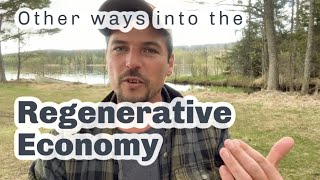
Richard Perkins outlines four businesses that support regenerative agriculture without full-time farming: commercial compost production for market gardeners, seed-saving operations with maturity data for local bioregions, breeding fast-growing meat birds outside industrial genetics, and farm-sitting services for small operators.
Chapters
Okay, welcome back to another episode, folks. Today, a little bit different. I just, after a few conversations I've had in the last week or two, I wanted to just talk about a few key enterprises that I feel would really support the regenerative agricultural space connected with farming, obviously, but not necessarily a typical image of being a farm producer. So let's get into that. So what I wanted to talk about was a few different enterprises and I've got lists of maybe a dozen, two dozen of these that could be a way into the regenerative economy. For an entrepreneurial person coming into this space that isn't revolved around 9 till 7pm Farming every day, five or seven days a week, whatever that is, there's lots of roles to fill in this space to support the farmers. If you know that you don't have access to land or don't want to commit yourself to farming, there's still ways to get involved with the regenerative economy. So one of those things would be compost creation. Nearly every European country I've been to and nearly every market gardener I've spoken to has a really hard time getting hold of good quality, highly aerobic and life filled compost. Now a lot of us are doing no dig and I think the influence we've had in this space, I've seen hundreds of new no dig market gardeners doing the same style that we're doing with our beds and wood chip pathways and, and growing commercially, which is something that's amazing to see. But the feedback is that it's very hard to find good compost. There is scope for a compost maker in every country in Europe and multiples of that too. Now I know if I had a good quality compost maker at the right price, I could make their business work instantly by creating YouTube videos or putting out, you know, in the local groups here around good growing. Because it's such a limited resource, the infrastructure needed is not massive. You need some kind of tractor or whatever to start turning piles and you could become much more efficient and mechanized over time. With an enterprise like that using like windrow turners on very big scale, they're using, you know, big machines that create specifically compost rows. But it's essentially a fairly straightforward business and there's a lot of money to be made. We pay thousands of euros some years for our supply of compost, although now we're able to make that on farm ourselves. There's a lot of people willing to put thousands of euros in a year. So if you're in a concentrated area with a bunch of market gardeners around, there's definitely a business opportunity there. Now it's, you know, all of the things I'm going to mention here require skill and expertise. It's quite easy to build up. There's a lot of free resources on how to make good compost. It's more a question of, you know, most of the people that want the compost have got their plates full and are busy and they don't have access to the facilities needed to make it at scale. Certainly at the time of year they'd need to be making it to have it ready for spring, for example. So you can look at Karl Hammer's example, I think on the old Farmer to Farmer podcast, when that was around, there was an exceptional interview with Karl Hammer, who you might remember from Vermont composting. And that particular episode on Farmer to Farmer podcast I thought was brilliant. It really brought out a lot of his thought process and his journey into being a very successful compost maker. And that's a great business and there is a lack of that in Europe. In fact, I don't know anyone personally who's doing that on a way that makes sense. But I think that's a great business opportunity. Number two would be seed saver again for the market gardening crew. Because to be frank, market gardeners shouldn't be growing seed to save. That question always comes up in trainings and in comments here on YouTube, etc. But if you're a market gardener, you need to be growing crops that fit the demand and produce the profit. You need to stay in business. Now, every crop we eat is harvested way before it's actually mature. You know, the point that plants are actually ready to give off their seed is when they basically decompose on the ground. So you don't have space for that in the market garden or time for that. Now, it could be true to say a seed saver might have a market garden, but I think the other way around is not going to work out. And it's a skill, it's a next level skill. You need to, you know, develop professional skills to be a professional seed saver. If you go to some of the large seed saving organizations around Europe, like one that comes to mind is Kokopelli down in France, and I went to visit their headquarters seven, eight years ago on a film tour. I did. Then they have seed for swap or sale and they have professional seed and then they have amateur saved seeds. And that's to make a distinction that certain crops, depending on pollination and I could talk for couple of hours on pollination, how that all works. But basically some seeds are not so simple to save. You need to have specialized knowledge on every single seed and also you need a bunch more space to grow seed at a scale that would give you the revenue through the business of selling that seed. But it's a fantastic business opportunity because here in Sweden, for example, you know, we're in a high latitude, cold climate with long sunlight hours, and we're buying seeds locally and also from other organic seed suppliers around Europe. We need seed that's specialized to our local bioregion. But we also need information like days to maturity. And so if a local seed company can't tell me that, I can't plan my business because I don't know how long this plant takes to grow. For example, a carrot could take 50 to 100 days. That's a very big difference. I eat a whole total new crop in that one bed and I've got 200 beds to manage. So we need certain information and we do need seed that's saved locally and we need people who are stepping up to set up gardens specifically just to save seed for the market gardeners to buy. And again, I could help anyone locally getting started with this as a business by promoting it. But it's got to be someone with the right mindset who's got the space to do it. You would need much more space to drive the revenue, revenue you would need to have a successful business through seed saving than you would to run a market garden, for example. But I don't think anyone should be dabbling with both. I think a lot of people coming out of the permaculture world and that sort of idealistic thinking, you know, would set off trying to do that. But it's, it's not compatible. If you want to run a business, and I say that as a business owner and having spoken to the leading people all over the world in this field, you can't mess with both. We do need people dedicated to dealing with seed in their local context to keep evolving it for the climatic conditions that we're facing. And you've got to understand seed is a global market you might be buying from. Like, of course, there are some local seed companies who genuinely go out and save their seed. The downside is they often can't tell you information you need. If you're planning a market garden like days to maturity, it's like, I need that number and you need to have done the research. And it's much bigger companies that typically can afford to do that research. But the important thing is the global seed trade is exactly that. It's like your local seed company is probably buying from a big conglomerate run essentially by Monsanto Syngenta, but they have non disclosure act, so you don't know where your seed is coming from unless it's specifically locally saved. Now it is truly a globalized market and you'll see brand names are different across Europe. You know, a lot of seeds that we use for like Hakarai, Tokyo Cross is the, the name in Europe often, but that's Hakarai. It's all come from one company and they're dominating the market. So it's, you know, you've got to be real with the situation of how it works globally. And yes, we definitely need to support local people, but it's got to be done as a business professionally. There's some great videos out there from seed savers that you can find on YouTube to see what their operations look like. But typically you need a bit more space and often they're doing a market garden as a cash flow source because obviously their costs are all up front and their income is in the autumn, winter or spring. Okay. Third, great business would be if someone could breed some fast growing meat birds, boiler chickens that weren't based on industry genetics. Now there are people in other parts of the world that have done that. I know that there is a breed. I think it was Southampton Farms and homesteads that are working with a breeder down in Australia now. It was a few years since I looked into this, but they were producing a brown chicken, a bit like a Freedom Ranger, but faster growing and more like the sort of boiler chickens we're or some of us are used to raising and they'd bred it on themselves. Now I think there's scope for someone to breed a very fast growing meat bird outside of the industry. It would take maybe 8, 10 years to do this. And I could probably hook you up with Bjorn, who is our Viking friend, who's a leading expert on genetics and mob breeding. I've written about him in our book and he knows how to breed double muscle onto anything and is very clued up about how to go about this sort of process. We've even offered it up to our interns to pay their salary for 10 years and help crowdsource their business if someone would commit to doing it. Now, it's not as sexy or as glamorous a job as, you know, getting into growing some veg and having some animals on the site, but it's essential work that someone needs to do. Someone always asks me, well, why don't you do that? And it's like, well, I've got enough going on and I'm running a diverse farm with multiple enterprises. I can't breed chickens too, especially when all of that needs to be happening in the depths of winter. And I don't have the infrastructure to do that because it's got to be in a heated barn. But there is a big market for that, for sure. You know, I just put out a video of the 500 Rico rings that already exist in Scandinavia. There are many people who would happily raise chickens and be very conscientious supporters of such a business because it's, you know, that's really dealing with one of the major two problems of broiler production. One being industry genetics, two, being imported grain to feed those birds. And yet poultry remains so important for small farms because they have a massive impact on the land through that imported grain and the manure. But the fact is we can produce something of very high value in a very short time, peddle in anything you can buy in the store. We can build soil really quickly and people are familiar with it and they eat it. So it works in our triple bottom line context, which is about ecology, economy, society. Now I see the flaws of it and I'm quick to speak about them. And I'm hoping one day that I can educate my customers, develop the market for geese or rabbits. But right now, you know, how many rabbits have you bought in the last 10 years? How many geese have you bought in the last 10 years? Here people eat chicken regularly and I can sell thousands a year and make a revenue that's planned and works for us. But I couldn't yet do that with geese or rabbits. I can build the business up and educate people and already have a customer base to work with. But that's a long term plan that takes, you know, five, 10 years maybe to educate even the most well intended customers. I think there's great scope for a much bigger business here. It could also be done at smaller scale. Again, could be done in different countries, locally. But it's the sort of thing that could scale to a huge business if someone really wanted to run with that. And it would be very interesting and very important to the movement too. You know, I think there's so much reliance on industry genetics, both in vegetable production and animal production. And it would be a great opportunity for the right kind of entrepreneur. Okay, the last business idea that I want to share today is farm sitter. A regenerative ag farm sitter. There are a lot of people getting started in this movement, often couples or young families. And when you start a business, any kind of business, you have to throw your life into it. You know, the first few years you're going to be doing 70, 80 hour weeks. Probably everyone I know that's been successful has put in that time. I'm now in a place where I'm taking a step back a bit and I'm putting in less time. But I worked longer hours than anyone I've ever met to get our farm up and running in the time that we did. And I don't say that to blow my own trumpet, I'm just saying that's how business works, any business, you know. And so what's really needed are people who can, who have decided not to run a farm but have enough skills to take care of a place, that know a bit about animal psychology, that know a bit about discipline and routines, know a bit about sales and accounting, how to use different programs, who are responsible, dedicated, good communicators who can go round and relieve young couples or families to go off on holidays and, you know, take a month off. We've been really willing to pay good wages for people to come and look after the farm in winter when there's not even a lot going on. It's very easeful work. It's a couple of hours a day at the most. But the point is we've got to feel safe and secure, that we can trust our farm with those people. Otherwise it wouldn't be very relaxing to go away on a holiday anyway. So there's a special niche there for a farm sitter. And the people that we've employed in the past, I've encouraged to offer their services for that because you could make a very easeful living house sitting for other people and exploring and understanding how different people are doing things and getting paid a really good salary for, you know, a high level of responsibility, but ultimately usually a low level of work because it's often in the wintertime when people can take it a bit easier. So they're my four ideas for ways that you could get involved with the regenerative economy without having to be a full time farmer. And I bet you lot have got a load of great ideas that you could add to that. So chuck them in the comments below. I've got a bunch more myself and maybe I'll talk about them another time, but hope some of you find that interesting. Share some ideas. I hope some people respond to those in the next years because I would happily support anyone that makes a real good go of that in a clear and well planned way. See you in a video soon. Don't forget to click subscribe Notifications Bell all that jazz. You can find out a lot more in our book Online Training etc in the links below. See you in a video soon. Bye for now. Don't.
More from Richard


A review of short and intensive season on a mixed farm and restaurant/event space in Sweden






Alskade Kyckling Exploring complexities of poultry production in Sweden and what we stand for


