5 Keys to success with No Dig Market Gardening
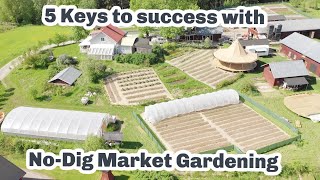
A June 2021 YouTube presentation by Richard Perkins outlining five core elements for successful no-dig market gardening: (1) prioritize soil biology and microbial health using compost and leaving roots in place; (2) maximize efficiency through standardization of beds, spacings, seedling trays, irrigation and routines; (3) choose appropriate, ergonomic tools (broad fork, 75 cm rake, seeders, harvest knives); (4) select crops strategically for local markets and profitability; and (5) design an efficient wash-and-pack station (chiller, workflow, crates) since a large share of time is in post-harvest. The video also advertises an upcoming Regenerative Agriculture Masterclass and downloadable crop/spacing PDFs.
Questions this video answers
June 5, 2021.
Richard Perkins.
75 centimeters by 10 meters.
4 cm per week (40 litres per square metre per week).
10–12 cm.
Chapters
Welcome back to another video, folks. And today's video is my five key elements for success with no Dig market gardening. Today is the day we launch this summer edition of the Regenerative Agriculture Masterclass. And so I'd like to give away a PDF copy of crop profiles of our spacings and crop notes for all the different crops we grow here at the farm to help you in your market gardening. So my first point is focusing on biology. We're farming microbes and soil, not vegetables. If we put our attention on the output of the system, we miss the main resource base that we manage and that is our soil. Now, you'll know from our market garden style, we use compost on permanent beds and we use wood chips in the pathway. Spruce wood chips here in Sweden, because 95% of all the trees in Sweden are spruce. But just take a look at this beautiful compost. We're now self sufficient with our compost on the farm, using peat moss as a deep litter system for our laying hens in the polytunnel over the long winter months. And we also bed cows. And so we can combine chicken manure, cow manure and peat moss or straw sometimes. And we get this lovely black gold. We make that in windrows. It's biologically dense, it smells like forest floor material. And one of the secrets of using a thick layer of compost in the beginning when we set up our beds, is that we physically mulch out all of the weeds. And then we've put forward the garden many orders of succession. This is how a forest floor is built, with animal manures and decaying plant material put back on the surface. And so a lot of the annual pioneers, the weeds I like to call the earth repair mechanisms, aren't stimulated to germinate because it's not their place in succession. Succession is the change in ecological communities over time and as an ecosystem progresses in our climate towards a higher order forest system, the way that nutrients become available, the way that water and mineral cycle becomes very different and that triggers different plants to germinate. So we're tricking the system. Now, I favor animal manures because they give the best heart to land, and particularly cow manure. And the fact that cows are so inefficient, that is chucking out 40 kilos of manure and compost out their back end every day makes them so effective in pasture regeneration, but also in the compost production for an annual market garden. And so I like to use animal based manures. And you've got to work with what you can get in our case, we can produce all that on our farm. And that's why I'm a big fan of mixed farming. But you can do the same approach with municipal compost made out of green wastes. People have varying success. You need to look at the breakdown, the analysis of what's in that compost, and you might need to amend it with calcium to make sure nutrients are available, or with animal manures like broiler pellets to bring up the fertility. Plants will tell you what they need. If we observe plants, they will show you if there's deficiencies. And I've never been a big fan of soil tests, but because I'd rather watch the plants in front of me because they will tell you likewise. People have always said, oh, what about putting wood chips in your pathway? Doesn't that rob nitrogen from the bed? Look all around us, we don't see nitrogen robbing in our garden. We're growing in high fertility compost. We're feeding the soil food web and in turn that makes healthy plants that thrive and don't get sick. And then what's more and what's key in my mind is to leave roots in the ground as long as possible. So once we harvest a crop, we'll cut that crop to the ground and leave that big root mass in the bed and transplant a new crop next to it, or if necessary, add a thin layer of compost to allow us to run a seeder like a six row cedar or a jiang seeder, etc. And all of that root mass is breaking down, feeding the soil food web. With such a big focus on soil and microbes, one important element that I to practice here at Ridgedale is to cover the beds at winter. Typically our veg production ends around the end of October, early November, and it's just too dark here to grow over the winter. There's not enough light. And so I put down a non woven geotextile to cover the beds. And I do that because it protects from weeds blowing in. We won't take off the COVID off an individual bed until it's planned to be planted the next year. And we don't just plant all the beds at once. So there might be a couple of months where that bed is not in use at the start of the year when there are tree seeds or dandelion seed blowing in, you know, and it could easily be bringing weed seed into the garden. So keeping the beds covered is a really good strategy. And not only that, it keeps the soil life active underneath for Much longer. If you've ever made a compost heap like a low static pile that's got cardboard on the top, etc. Or you've put tarp all in over a lawn, if you lift that back and have a look under there, the worms will be active underneath that. I've documented on our YouTube channel how in the spring when the snow is melting, I can lift up that tarp where the snow's just starting to get thin enough that I can physically lift it. And there's worm activity when the soil is basically at zero degrees. That's incredible. And having a little blanket to tuck the beds away in the winter is really actually very helpful and something I recommend. So that's point number one. Focus on microbiology and soil first. Healthy plants are a natural corollary. We're not growing lettuces, we're growing microbes. Point number two is standardization, and that's a big point. Standardize everything you can. Because market gardening is a very labor intensive enterprise compared to some of our animal enterprises. And I've spoken a lot about this in my book and on YouTube, etc. We start off by standardizing our seed trays to make sure they tessellate in our nursery space to make the maximum use of that expensive, high quality space. Then we standardize our planting. So every time I plant kohlrabi, I'm using the same spacing, same number of plants per bed. I'm standardizing my bed preparation. In the early days, we would come along with a broad fork, then we would rake the bed, roll it, transplant it. Now we don't use a broad fork anymore. Typically after three or four years of no dig. The soil biology is so bountiful and the structure in the soil is so good that you just don't need to use a broad fork anymore. And many of my students who have set up beautiful no dig market gardens have found the same thing, but by having standardized procedures, everything is simple. You don't have to think so much in the field. And that's also part of our planning. We standardize the seed orders and we have a crop calendar for the whole year so you know what to do every day of the year. So there's a lot of background planning in the market garden, which happens in the downtime between November and March, when we basically have time off. In the market garden, we try and get the seed order in end of October before all the other market gardeners have got their seed orders in, so you can get the varieties that you choose. That's really important because different types of carrots have very different days to maturity. Some carrots are done in 56 days, some in 85 days. But we're planning them meticulously so that we can get another crop in straight away when that crop is harvested. So standardized procedures everywhere. And by doing that, it makes this really complex job as simple as it possibly can be. We use standardized amendments for heavy feeders, light feeders. We're using chicken manure pellets on top of compost for heavy feeders and just compost for light feeders. We standardize the amount of compost we add. In the beginning we're putting 10 12cm down to blanket out the weeds and turn this pasture into this beautiful no dig market garden. But then every year we'll be adding a couple of hundred liters to a bed. Really not so much. And it's the same amount that people are adding into tillage based systems. We just don't till it in, we leave it the surface. Then if we want to add manure extra to that for heavy feeders, we'll add half a bucket of chicken manure pellets and once every four years we'll add two kilos of oyster shell that we have for our laying chickens as a slow release source of calcium. Because one problem you can have with excessive organic matter is the binding up of certain nutrients. So a slow release calcium source is something I also recommend. In our climate we have to use a lot of floating row covers and we use those over hoops and we use them flat on beds for direct seeded crops to keep water on the bed to increase germination rates. Because the beds are all standardized 75 centimeters by 10 meters in our case, every fleece fits any of the beds. And that's really important. And you can see on Nebraska's behind me, every set of beds needs 11 hoops spaced a meter apart to allow us to put insect net, for example, over brassicas to stop cabbage butterflies. So simple little things like keeping all our little wires in bunches of 11 just means you can take the thinking out of the daily work and just pick up a bunch and know you've got what you need to do the job efficiently. Our pest control is relatively simple here. Sweden is plagued by flea beetles and cabbage butterflies primarily. So we use an insect net, small enough mesh that flea beetles can't get through it. All of those crops, whether they're direct seeded or transplanted, are immediately covered the moment the bed is planted. And that's a pretty standardized procedure for us. To ensure that we just minimize any potential damage, we'll also do spot treatments for things like flea beetle if they do get into the nets, we'll use diatomaceous earth on individual plants and we'll do targeted slug control. But we do that typically around the edges of the garden, particularly on the neighbour's side where slugs are coming onto the property. We're lucky here that we do not have too many slugs in our garden. There's even more standardization to when things are harvested and how they're harvested so that we have uniformity in our crops and can be delivering a consistent quality product to our customers. We typically like to bunch in the field so that we avoid log jams at our wash and pack station. And we'll have standardized procedures for the harvesting and post harvest as well. A big part of the work of a market gardener is daily routines of inspections, walking around and taking stock of crops every single day to look for insect damage, to look for plants that need additional watering, etc. And so that's an important thing to standardize into your work week. Another thing to standardise pretty quickly when you set up your garden is irrigation. Now we use impact heads and we're pumping from our pond that we constructed for the purpose of irrigating the market garden. We have a well here that's just not got ample supply to irrigate the market garden. But if you have access to municipal water or an easy solution, then I would go with that. It's very costly to be build ponds and irrigation systems. However, one thing that we do to standardise our practice is typically we're putting down 4cm of water a week, so that's 40 litres per square meter every week. Now it's a dance between watching what the weather's doing, what's looking like it's going to come. We all understand that weather reports are not so reliable. And using a rain gauge in the garden and monitoring the weather and then monitoring the plants and the soil. One benefit of no dig beds is they hold moisture extremely well. And the wood chip pathways soak up moisture in really wet times of year that still allow you to walk around and have clean feet and clean crops and they will release some of that water back into the beds when it's going through drier spells. Now, some crops do like additional water. Things like squash, for example, and crops that are very water dependent will give you so much better yields if you water them adequately. So do some research on that and I've included notes on that in the PDF you can download. So that's my second point. Standardization all the way from crop planning to nursery stock to bed formation. Tools you use, processes you use day to day. The more you can standardize, the easier it makes your job. Point number three is using appropriate tools. Now, no dig. Market gardening is a human scale agricultural response. We're working with hand tools and we don't need anything super complicated. There are some very good tools however, that help us speed wise and for ergonomics sake. In harvesting, we typically use just simple serrated Victorinox knives. We use push cut knives for head lettuce and broccolis and things like that. Much more ergonomic to do this 10,000 times a year than this. And it's those things that keep your body in good shape for decades. Here's these beautiful little Japanese fingerless pruning scissors so you can trellis your tomatoes and cucumbers without having to put something down in between. But always thinking of efficient workflows and minimum movements to do these repetitive jobs that are what farming is made up of. One tool I consider essential in the beginning is a broad fork for the breaking up of heavily compacted saws. And as I said, it's typically not used after two or three years where it becomes redundant. A 75 centimeter rake is essential. If you're using a half as wide rake, it takes you twice as long. That means I finish at lunch, you finish at dinner. And then standardized hoops made out of 4 millimeter galvanized wire for the beds for the row covers. Lastly you see a bed roller. This is from Johnny's in the U.S. we use this specifically for putting down some surface compaction to allow for better seeding with six row seeders or Chang seeder. Some other key tools for us. This is a tilfer from Johnny's battery powered tilter that just mixes up the compost. We're not using it to tilth soil, we're just using it to smash up our homemade compost that's not as finely sieved as stuff you buy commercially. Then there's an Elia 3000 from Curly Zag in Australia that we've been testing out. Then our two favorite seeders, six row seeder that can allow you up to 12 rows of carrots, mescaline, whatever it is in walking speed. Basically you can either use every alternate hopper for six rows or two passes on the 75cm bed gives you 12 rows. We'll use a Jiang Seeder JP1 for when our compost is really rough, or we need to get it deeper into the compost for certain seeds. You can read about that in the notes. And we also use the paper pot system, this is a Japanese version and we use their drop seeder as well as the paper pot transplanter. One essential tool in my mind if you're growing leafy salad greens, rocket things like that, is the quick cut greens harvester from farmers friends. This thing is a total game changer. So it goes to show you don't need to spend a fortune on tools, I would say worth having a broad fork, worth having a 75 centimeter rake. Don't necessarily need a roller. You need one or other of these seeders depending on the crops you're growing. And you need good harvesting tools. And that's it. You know, you can set that up for €1500 or less. So that's point three for me. Use appropriate tools, use high quality tools. The sorts of things I've shown you in our case, hard rigid plastic cell trays that don't break when you carry them out full of plants. All the accompanying paper pot system that also tessellates on our benches in our nursery. And the basic tool, as I've shown you, does not cost a lot of money. If you're in this to make a living, then definitely get the right tools from the get go is my advice. There's many other tools that you could invest in things like the paper pot. Get that later down the line if you need it. You know, in the beginning, try and buy really high quality tools that are the bare essentials. And I like to categorize things into must, should or could. And some of these tools are musts and a lot of them are shoulds. And there's things you could have like a paper pot or like a bigger greens harvester or whatever it is, but you'll know that intuitively down the line. But always put money into good toolage. It will save you so much time and so much energy in fixing things that break, etc. Point four for me is all about growing the right crops. Now that's going to look different in different parts of the world, but we've got to look at the profitability of different crops we want to grow. Profitability is defined by how long something takes to grow, how many of them fit in the bed, what their marketability and how much you can sell them for and how they crop, are they harvested once or multiple times or all the season, etc. So we need to analyze that. And so what you see here is what it looks like in our case up at 59 degrees north in Sweden. In our marketplace, interestingly, you'll see for example, that there are tomatoes in the low value section. And that's because we don't have a culture of heating tunnels or greenhouses for indoor tomato production. In our case, you would then be competing with massive industry, glass houses just basically out compete you. Likewise, things like potato, etc. It's just much more economic for a bigger organic grower to do that. On the field scale, however, you've got to be sensitive to the cultural nuances. For example, fresh local new potatoes for midsummer here is totally traditional and totally expected. So it often has a much higher value than just standard storage potatoes. And those cultural things will be different in every country and you'll know them intuitively from growing up. You know, some people must have cabbage regularly in Germany, for example, even though it might be a low value crop. So it doesn't mean we have to only grow high value crops. We need a balance of high and low value. But in my experience, most people that are struggling economically in a market garden setting typically are growing too many low value crops and not enough high value crops. So it's really important to analyze every crop you grow, what it delivers per bed, how it does that season, season, so that you can really tune yourself into the leverage points in changing your crop plan, etc. Now, what we like to do is peg our prices to the marketplace. So we look at organic wholesaler prices and we add a margin of say 15%, because this is hand grown, hand harvested, the day it's delivered to customers, and that warrants an additional markup. In my mind, you can do that however you like. But it's important to look at the wider global food market because prices fluctuate seasonally and globally. And it's important as a food producer that you have an understanding of the marketplace you're intersecting with so that you can be informed and talk with your customers realistically and openly and you can develop trust in that way also. Ultimately, the economics come down to really careful bed planning. We use various spreadsheets and quite a complicated process to do the bed planning. And what we want to end up with is, is a seed order, a complete bed plan that puts as many crops into our short growing season as possible. And then we want it translated into a growing calendar so that you know what to do every day of the season, what to seed, what to direct seed, what to transplant, what to harvest. And that takes a lot of stress out of the day to day Activity of managing a market garden. All those kind of sheets, as well as other people's sheets, are found in our regenerative agriculture masterclass, where we look in greater detail at all the different enterprises that we run. Point number five, my last point is never underestimate the importance of the wash and pack station. 40% of the time of a March gardener is spent in harvest and post harvest. And so you need a really optimal workflow to make this repetitive task that's happening a couple of times a week at least, smooth and efficient. On our farm, we love to design workflows so we have a space where our delivery vehicle can pull in. We have wash benches that lead to a chiller and then a packing bench here behind me so that things can go in a smooth curve into the chiller as quick as possible and then out crispy cold straight to the customers within an hour from the farm. Which is what allows us to use these kanga boxes. That's a brand name, but they're just insulated boxes that allow us to take cold veg out the chiller and without the use of a refrigerated vehicle, deliver it within an hour to our customer base in perfect condition. Now, right now we've just actually done the packing for this week's delivery to Rico's. And so you can see the wash benches are actually covered in harvest crates and storage crates that have been cleaned down. That's an important part of the process, is keeping things clean and sterile and everything in functional order ready for the next operation. I like to bring bunched vegetables in these grey food crates that we also use for storing chicken. And they're part of the active food system that we can drop things off to local restaurants etc and pick up replacements straight away. And I like to bring bunched vegetables from the field to the first wash bench where someone is operating the spray gun or the dunking pots. It's really critical to the shelf life of vegetables to chill them as quickly as possible. We like to have harvests done early in the morning and then dunk anything in big tanks of cold water that's necessary, like greens that will store better once they're chilled down and then get them straight into the chiller. But things don't want to be in a dry chiller, they want to be stored with moisture. We'll either use these grey crates with bags that we can reuse multiple times over, or we'll use these fish industry crates with closeable lids that stack can store well as well. Storability is something that you don't know unless you've really looked into and done a lot of tests for yourself. For example, microgreens can turn into a mush in two or three days if they've not been harvested. When they're dry and stored properly, they can also last nearly two weeks in the fridge in good condition. So you really got to be aware of your processes to make sure you're not just passing that off blindly to your customers because you want your customers to be be returning and happy with their produce. A walk in chiller I think is a must on any veg farm. So let's have a look in here. Now it's empty right now because we've just done delivery. But this is running on Coolbot and we've got about 19 cubic meters here, which is more than we need. But it's really worth making sure you build a chiller that's big enough for all future possible expansion. Because vegetables don't need to have heat taken off them, they just need to be stored cold. It's really efficient to use a Coolbot with an AC unit. This is a split AC unit with a compressor on the outside, but it's the largest model you can get here in Europe, big enough for this 19 cubic meter space that you can also install yourself. This comes with pre filled gas pipes and so that you can connect them without a technician, which costs about €1,000 to do with a technician here. Once veg is cool and comes out of the chiller, it can be put up on racks in grey crates here and easily packed into custom orders. The kanga boxes are typically living under here and then go straight off into a delivery vehicle there. Other simple features are a whiteboard for writing down harvest targets, etc. To be able to communicate with each other. All the beds here are labeled and numbered, so it's very easy to communicate with people helping out, etc. And it's worth noting that the wash pack station is very centrally located. We have our primary north beds over on this side and then behind me through this door we have our south, east and west beds. So the packing station is right in the middle. Now every farm is going to look different. We're working with the constraints that we have in the physical space in our setup. But to have a centrally located space to do all your wash and pack, which makes up so much of the time in the market garden, is really critical for efficient design. Okay, so that concludes point five, which is do not underestimate the importance of a wash and pack station as you can see in our case, it's very simple. It's all built with free timber that we've taken out of the waste supply here. And it's just designed to make a sensible workflow that makes sense using the right tools and that's all you need. But it's a super critical element in making sure things are working smoothly and that all that time that you're putting into presenting these incredible crops to your customers is done smoothly and easily. So that's it for this video, folks. And if you want to join our live event that's happening on the 6th of June, you need to register in the link below. There's limited places for that. It's an evening in conversation with myself and past students who have gone on to set up incredible businesses of their own. We'll be looking at how they run their operations, what goes well, what's been challenging, and there's an opportunity for you to ask questions there too. I'd like to end the video by letting you know that the registration for the Regenerative Agriculture Maths class is now open for a short time. We'll be running the training over eight intensive weeks in July and August time and it's an amazing opportunity to work through a process starting with your holistic context, designing a land plan, enterprise plan, and ultimately a business sales marketing plan for your operation with the support of your peers from around the world and their specialist mentor team of some of my past students who are dedicated to helping others get started in an intelligent, smart way. There'll be weekly Q&As with myself and a private Facebook group where we can communicate as well as cross pollinate with students from the master class. In the past, you're joining part of a family and network of proactive people who are looking and striving for solutions for their families, for their farms, for the soil. I'm really looking forward to it. It's going to be an amazing learning experience and there's over 80 hours of unseen footage on there, lots of downloadable resources, enterprise planning, spreadsheets and a whole host of information in what's now the broadest and furthest reaching online education program in regenerative agriculture out there. So I hope to see see many of you in there.
More from Richard


A review of short and intensive season on a mixed farm and restaurant/event space in Sweden






Alskade Kyckling Exploring complexities of poultry production in Sweden and what we stand for


