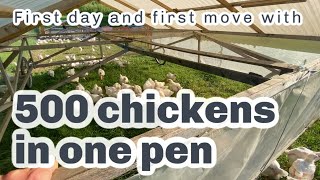
Richard Perkins demonstrates the first move with his roller-pen system for poultry, showing how to gently roll pens forward so birds follow, how to monitor wheels to avoid crushing birds, and practical choices (feed placement, net adjustments, wind protection). He notes capacity (batch of 500 birds), fence configurations (50 m line fence and 25 m perimeter fence), predator considerations (buzzards in trees, foxes), and operational tips (set next-day fence in advance). The video ends with a short aside about processing a turkey: brined 24 hours at 10% salt and roasted for about 3 hours (start covered with foil, remove in the last hour).
Questions this video answers
500 birds
A 50 meter fence straight up the line and a 25 meter fence to go around the pens.
24 hours at 10% salt.
About 3 hours (start covered with foil; remove the foil in the last hour).
Nesting buzzards in the trees and foxes.
Chapters
Did you find Magna a toad? Wow. I think he needs to go back in a cool, dark, damp place. All right, first day with the roller pens out. So now just need to gently move this forward. They're not used to this structure, so my job is keeping an eye on all wheels. I'll just enlarge the angle there. If you're careful, you can see the wheels all at the same time. The birds naturally start to come along with it. Now this is the first time with it and I'm putting the feed down in the middle here. As you can see, they naturally start to get into the rhythm of it. So as long as you're fairly slow, you can really keep an eye on all the wheels. You don't want to crush a bird. We've talked in other videos you could easily put a V shaped plastic guard or something to protect them. But I just find it's not been necessary. I've never hit a bird. Just gonna. Straighten this one up. So number two coming along now. You can see the birds here. I just simply come over the top of them. Here. They all come up the other ends. And this works the same regardless. If we have a thousand birds, they're moving at just the same rate, so they're really moving themselves. And as I said before, the other main aim of this sort of pen design is that the birds get 30% more space, 40% more space when we fully open out the nets. But I think they really enjoy it. Also talked about dropping wind protection down to the ground on some sides, but again, we've just never found it necessary. So there's lots of things you could do to adapt these, but we just have never found the need to change it at all. And as this third pen comes up now, I imagine nearly all the birds will just come in after it. Okay, last pan. See the impact the birds have made in the last 24 hours. Onto fresh ground now. So you can be quite swift. I'm being gentle because I've got the camera in one hand, so I'm less mobile than normal. But you can be quite swift with this once the birds are familiar because they know how to rol. Hey, buddies. Okay, last couple of stragglers. And you can see the line where the fresh grass is there. So we'll just close the net in, check the water is all good. So there you have it. It's always good with this method to put up the next moves fence in anticipation of the next morning's move. So that once they get used to seeing you turn up with the feed, certainly as they get bigger, they'll be ready to move and they'll be piling up at the end of the structure here, waiting to move. So you want to be always ready with that. But other than that, you can see it's very easeful, no heavy lifting. And I think it's better for the birds too. So happy to have this model out. Even though it's only a batch of 500 birds still, it's €14,15,000 of boilers in here at Swedish price. So it's pretty high risk strategy if you have extreme predator pressure. But we don't have that. We have nesting birds of buzzards in the trees up here and they've never taken a boiler and we have foxes around. But as long as you keep them fenced and we peg the fence at the bottom, we'll put metal pegs in like this, just so that the birds can't get out from underneath it. Certainly while they're smaller, that could be an issue. So we're currently using a 50 meter fence straight up the line and a 25 meter fence to go around the pens. Now, we like to keep it close to the structure as you see here in the beginning, just to minimize any chance of aerial predators coming in. But then as the birds get bigger, we actually tend to open it out a bit and then we'll start. Like when we had a thousand birds in these, we'd have four of these structures and we would use the 50 meter net to be able to give them a bigger space. They have a bit of an end space here, so you can see. So it's playing around with the net. So we're always working down a line essentially, and you've got to think it through just to make it practical. So we set up the next day's fence ready in the morning. But you need to just consider how you'll run the fencing if you want to try a model like this. Moss moped chickens, gonna pack these up, get them in the chiller. So I thought it's about time to roast one of our turkeys, all the chickens and turkeys. So this is going to warm up. It's been in brine 24 hours at 10% salt. And then I'm letting it warm up to room temperature. I'm going to roast this for about 3 hours. Start it with foil, covering it in the last hour. Take that off. Just a bit of olive oil, salt, pepper to keep it simple. It.