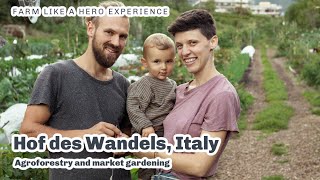
Richard Perkins visits Lisa, Jacob, and Stan in South Tyrol, where they converted an intensive apple orchard into herb production and agroforestry. The family grows herbs for distillery, runs a market garden, and kept 2,000 m² of apples on their one-hectare farm. They discuss how they split enterprises and shifted from Stan's 35 years managing apples to a diversified system.
Questions this video answers
November 24, 2020.
1 hectare (total).
About 2,000 square meters.
About 35 years.
Martin Crawford's book on forest gardening.
Chapters
Okay. Welcome to a new episode of Farm Like a Hero, folks. I'm Mitchell Perkins. Today I'm here with Jacob and Lisa from Hoftes Vandals. And that's a farm that produces herbs for their distillery. A market garden set within an agroforestry system, as well as an apple orchard. And this is actually the final episode of the Farm Like a Hero experience. So, folks, thanks so much for taking the time to join us today.
Thank you.
Thank you for featuring us.
Tell us a bit about. So, Jacob, we met you obviously over here at our farm and the farm belongs to Lisa's family originally. Could you tell us a bit maybe the history of the place?
Yeah, the farm is actually. It's from my dad, so my grandfather bought it back in the days. And Stan, my dad, cultivated apples here for about 35 years.
So.
And then he really was fed up with all this apple system and everything that went wrong and with pesticides and I think for him it was a real struggle and inside struggle, like working with these pesticides and producing something to eat. And then he was so very well, he was not satisfied anymore with this work. And then somehow he fell over a book about distillery. And yeah, this book was laying around for weeks and months and everybody was like, okay, what are you going to do with this fucking book? And he started to plant the first herbs on our farm and like pulling out apple trees and putting herbs inside. And then at some point he started to desolate the first lavender and he got some essential oil and he freaked out like crazy. And I think this was actually the beginning point, the starting point of the change of our farm. Then we went on like putting more herbs and herbs in our ground. And yeah, nobody really knew what we're going to do with all these herbs. So he had no plan and we had no plan. At that time I was studying in Munich and like finishing the studies. And I always knew that I wanted to come back, but all this apple stuff was not so cool that I wanted to come back for that. So at the point I met Jacob somehow and we started speaking about permaculture and we saw that we had same ideas and then it was. And now we're here.
Okay, I remember Jacob, you showed us some photos. You're in a beautiful kind of almost like a little valley shape, right? And you've got. I can't remember if it was terraces or you've made your own sort of terraces.
Yeah, yeah, it's terraces that we supported. Like there's the herb garden, the big one is like south facing and that's quite steep. And there's all terraces like enforced with like wood or like these kind of sandstones. And that was obviously a big job to be to put up. But it's. It's quite nice also like to work there. And it's really beautiful. Like also just taking people through there. And like you come into the middle of the valley. That's where we put up the market garden and the agroforest system. And we have a polytunnel there. And then on the left side which is kind of northeast facing, that's like there's some apples there. I think around 2,000 square meters. So it's quite small. Everything. The whole farm is in total 1 hectare, including all the infrastructure. So everything is quite intense in any way because there's like Lisa's family living here as us as well. So there's a lot of different stuff going on, which is nice.
Tell us a bit your journey, Jacob. How did you get in touch with agriculture and then how did you two end up meeting? Also?
I'm actually chef educated chef. And as I was living in other places like the last stop for me was Copenhagen. And a friend of mine that I didn't know back then who came to Copenhagen, he told me about permaculture. That was like my first how I got in touch with. And I was like about the idea. I was really fascinated, I would say. And from there on it was just like YouTube videos and reading books and stuff. I was still working as a chef. And then I came back from there and first weekend back I met Lisa in some random bar.
Sounds like two alcoholics.
And it clicked pretty fast. It brought me back a little bit further, deeper into the whole subject. And I realized, okay, I like cooking and that's cool as a career, but it's also very difficult to have a family and it can be quite stressful. And I've already worked 10 more 12 years in the industry. So it's like there's so many other things you can do in life. And I really like the idea of working outside. And it just was going like that from there on. Like it was. Everything was happening pretty fast. Like I spent another summer up in Norway and when I came back I was already helping with the last one of the last apple harvests. And then from there on, straight after, we started taking our trees and.
It was crazy actually because nobody knew what we were going to do really. So we had no proper plan. So we want to set up a market garden and earn like Thousands of euros was like, okay, we're pulling out apple trees and we do something together. And under the background of permaculture and then like six years to discover what we actually wanted to do and to end up here.
It's so funny. Everyone on this tour is like finding ways to get grants to plant trees and you start by ripping, ripping trees out. But you had pretty intensive, like dwarf rootstock, super intensive modern orchard, right?
Yeah.
And in our region it's usual. So if we live in the north of Italy and South Tyrol and here it's usual. So if you go around every free space, it's full of apple trees or.
Vineyards, or if you're not doing that, if you're too high up for that, you are having cows in a stable and you're just mowing grass to feed them.
So what's been the family's response? They've obviously given you freedom to do stuff, but what's been the process? And tell us a bit about how that works.
Process, that's the right word, I think. It's never ending. Process, actually. So, okay, my father was the one actually to give the input to start all this. What's crazy, because normally the young people or the new generation is the one giving the start for something new, but he actually was the one who start with it. And then I think he didn't realize at that point then that when we are coming back that she's going to be crazy. But now he really enjoys having here new generation and new inputs and we're taking over lots of responsibility also and organization and marketing and all that stuff that he maybe doesn't want to do anymore. He loves to work outside and he wants to do his stuff and we are doing the rest for making the farm work somehow.
So your father, is he still running the distillery bits? Is that kind of his domain?
We, at a certain point then we.
Decided, okay, I think it's best if things happen separately here on the farm. Like we are one farm, but it's better if just there's separated parts and everyone can just operate freely in their own enterprise. That was, I think, the moment where things started to really start happening. Because it was also difficult. I didn't. We both didn't have like a clear idea. And her father, he had a clear idea. He knew, okay, I want to plant that many plants of lavender and that many plants of rosemary and so on. And he was quite. He already had us. He could see where he was going. We, on the other hand, we were like totally lost.
We plant A salad here. And like.
Yeah, the beginning was very like this permaculture image, like building this huge. And those sort of stuff. And then I got into Martin Crawford's book of forest gardening and I was obviously like, really fascinated about that. Like, every new idea that seems revolutionary in farming.
We didn't want to plant to grow vegetables.
Yeah, at that point we didn't. We were not like yet in the market gardening spirit.
So actually it's too much work.
Yeah, yeah, we don't want to do that. We don't want to grow vegetables. Like, it's. Let others do that work. And my idea actually was to open like a farm restaurant.
And yes, I remember you talking about that.
And that is a good idea, I think, and it would also work. But I think in our context here, there's so many things happening. Like it's quite small structures. Lisa is also doing yoga and her mom also. And there's workshops on Sunday, Saturday from her dad. And there was just so much the farm shop now, so many things going on. I started to realize it would maybe be interfere a little bit too much with our private lives here.
All of us, we try to live here.
And so that's where. And that's why actually last summer I stumbled across your YouTube channel.
And that was like, I started hating you because you stole all my nights with Jacob. Every night. It was your voice in my bedroom, you know? You understand what that means now? I like you. But in the beginning, I really hated you.
More from Richard


A review of short and intensive season on a mixed farm and restaurant/event space in Sweden






Alskade Kyckling Exploring complexities of poultry production in Sweden and what we stand for


