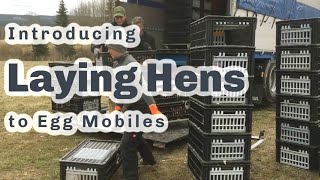
Richard Perkins documents receiving 800 point-of-lay hens (arrived in crates) and integrating them into his pasture-based eggmobile system. He describes the first-night imprinting routine, plans for letting them out onto pasture, predator management (hawks, electric netting), eggmobile design and daily moves, and additional farm infrastructure improvements (silos, windbreaks, washing line).
Questions this video answers
800
Over 2,000 birds
16 weeks
Chapters
So today we took delivery of 800 layer hens. They look in great condition and we're super excited to get them out on pasture tomorrow. There's now over 2,000 birds at the farm. It really feels like the season is really getting underway. So I want to just tell you about how we get the birds started in the eggmobiles. So we take point of lay birds at 16 weeks, and they come from specialist breeder here. It's one of the smaller breeders in Sweden and we value the sort of family business they run. And the basic process is getting the birds from the truck in their crates into the egg mobiles where we leave them for the afternoon and overnight to imprint them on that space. They've just come out of a hatching barn, essentially, and they've never been on pasture before. So tomorrow, when we let the birds out for the first time, it's going to be interesting. First one or two will come out and they're really suspicious of the outside. They've never stepped on grass before, but pretty soon they realize the benefits of being outside. And it's not long before you open the doors in the morning and out they all come in a hurry, a little bit tight inside, the eggmobiles, and that's because they only ever really go inside to lay eggs or to sleep. And there's enough roosting space for them all upstairs, but they've never roosted on roosts before. They've slept on the barn floor, and so it takes a little while for them to get used to sleeping on the roosts. We have taught the birds to sit on roosts in the past, but actually they tend to work it out for themselves pretty quickly. And so they're inside now with food and water for the night. And whilst it's a little cramped, they're also safe together. There's no risk of predators in any way. Interestingly, this morning I saw a couple of hawks circling over. There's a pair of hawks that live up in our forest, and we're really happy to have apex predators there because ultimately they're a major part of the ecosystem. And in a way, we've got to return to types of agriculture that celebrate their success by the amount of apex predators. Now, having said that, we also don't want to lose too many birds to predators. And what happened last year, for the very first time, we started losing some birds to hawks. But what was really interesting to observe was that they didn't take any of the birds from inside the electric netting. We run the birds, every day they're moving along the pasture lanes inside electric fencing for foxes and any other ground predators, as well as to keep them in a set, determined space. And that's, you know, integrated into our grazing plan along with the cows and sheep, etc. What's interesting is that the birds that got taken last year is just a few, but they were outside the fences. And for, you know, I can see that for anything that dive bombs, other creatures for a living, it's a high risk activity. You're risking breaking a wing, etc. And that would mean certain death to a predator. And so I think when you have such a large amount of birds in a small, relatively small space, it makes it too intimidating for the hawks to come down and take the birds. But when they get out, they're sort of simple target. And I think that's what we've been seeing here. So it's going to be interesting to watch. I'm going to get the drone out and immediately start training these birds. If you've been observant following our farm, you'll have seen a lot of aerial imagery on our Facebook feed, etc. And what's interesting is you'll never see chickens in those photos because as soon as the drone goes over, they go straight under the eggmobile. And they do that even if the drone is like 150 meters in the air and 100 meters away, a tiny speck. And it's very interesting to watch. So I will be bringing the drone out and flying low over the birds the moment they're all outside, just to get them used to watching out for aerial predators. And whether that helps or not, I'm not sure, but it feels useful. In the past we've done that and we haven't lost any birds to predators, other than a couple to hawks that were outside the fence last year. The eggmobiles are both similar in their design and they work very well for us. We have very windy conditions here. We made the second eggmobile on the left there a bit lighter. We had a lighter chassis to start with. The first egg mobile is on a car chassis, car trailer chassis, and the second one is on a caravan chassis. And it's much, it's probably two thirds of the weight. It's about the limit of what an ATV can pull. Here at the back you have an access door for collecting eggs and checking inside there. And then we have oyster shell feeders on the sides. So they always have access to oyster shell for calcium, for supplying, you know, to make good eggs. And we have little support legs on the sides to keep the eggmobile stable. And then the birds come out through a side hatch here in the mornings. And on this eggmobile we put a lower hatch. It comes out the bottom there. And that's just due to the way that the chassis was. And the chassis is a couple of meters wide. And we've obviously got to build the eggmobile wide enough to fit the amount of perches we need. I'm really appreciating this wedge shaped design because we get a lot of wind here at certain times in the year. And it really helps to park this up facing into the wind and there's no risk of it blowing over, which is very nice. So it's quite cramped in there right now. And we've taken the egg box out of this one. They won't start laying for a couple of weeks. And it will take some weeks till they are laying uniform eggs. But the birds are in great condition and they're relatively relaxed. And it's good to leave them in. Some people leave birds in for up to a week in a new home. But we want to get them out on the ground as soon as possible. And so we tend to take them in the afternoon and we let them out the next morning. And then they go into their daily moves and routine of moving around the pasture. So because we always start grazing in the tops of fields, we're in nut field, sorry, top field to start with. This is the drier field. We'll be taking the eggmobiles up to the top of the field tomorrow morning, putting up the fences, and they'll have their first day outside. So super exciting. Really nice to have the birds here. And I'm looking forward to getting them out on pasture and producing super nice quality eggs. What you find with running pastured poultry is that because they're moving every day and the eggmobile is the one constant in their environment. And the nest boxes are always in there. In the eggmobile, they tend to nearly all lay their eggs in the nest boxes automatically. We've never had to use dummy eggs or anything like that. And I think it's because it's the only fixed thing in their environment. It's a dark, safe space that's built to the right proportions. That makes it very appealing in the beginning. You get a few hens that lay through the floor under the eggmobile, but they're not really laying out in the fields. We've never had that problem, and I think it's due to that factor. Some other progress on the farm, we've got the staircase mostly together now and that washing line we built with a cover on top. Now, because it's often raining here very regularly, we get even rain distribution throughout the year. And so it can become a challenge when there's a lot of people here to wash clothes, dry clothes in time. We have sometimes up to 45, 50 people here when there's trainings or open days, etc. So it's important for us to have a certain level of infrastructure in place. This is a space behind us that is used for putting pig manure out from the barn by the previous owner and he had beautiful compost here full of worms and we've just been clearing that out now. We're going to put some concrete down in here and install some silos this year because we're using a lot of grain from the local organic grower and the poultry here eat a lot of food. So it saves us a lot of money to buy in bulk. It actually saves us double the cost of some second hand silos each year. So this year we feel like it's worth the investment because we're happy with the enterprises the way they're running. So we're going to be getting on with that soon. There's some windbreaks going up in the new north beds and they've just been putting these up with a double timber to hold the mesh in place. And they'll just be trimmed down to size with suitable gates in the right places. Main water for the irrigation, which comes all the way down from the pond, pumps up to here and we use assemblies of pipes to be able to water all the different beds around the farm from that point. There's also a T junction that goes across to the south beds on the other side of the house on the south facing slope there. So nice to get some windbreaks up because it gets very windy here and even a low windbreak like this makes a lot of difference for young vegetables that are growing low down on the ground. That's it for today. Thanks for watching our videos and don't forget to hit subscribe if you haven't already. You can find out a lot more in our book Making Small Farms Work. See you next time.
More from Richard


A review of short and intensive season on a mixed farm and restaurant/event space in Sweden






Alskade Kyckling Exploring complexities of poultry production in Sweden and what we stand for


