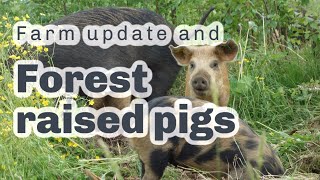
Richard Perkins outlines farm changes: removing cows, expanding to 80-100 ewes, buying a polytunnel, and launching an online training program. He's selling timber for roughly €20,000 to fund upgrades and reducing pig numbers while managing 2,000 broilers and 40 pigs currently on site.
Questions this video answers
Two batches of nearly 2,000 broilers.
About 40 pigs.
He said they put about €45 into a box that costs €30.
Possibly up to 80–100 ewes; considering taking 100 ram lambs from a Savory Institute project.
About 800 hens (two EggMobiles).
Chapters
So there's only two weeks left of the internship now. It's been a wonderful group and an epic time. We've done a lot of stuff, if you look back at the videos, but it feels like we've only just begun in a way. At the moment, we're spending a lot of time looking at people's farms and projects and really analyzing the land use and looking at business and grounding it out in reality. You know, taking apart the business, looking at numbers, looking at alternatives and other enterprises that could be stacked in as complementary enterprises, and getting into the bones of, you know, the planning and decision making that makes it all work. People have been working on keyline designs. Core team have been building epic fencing to make laneways to move animals really easily in forest pastures. And the market garden crew have just been making epic produce. I mean, the boxes are looking bountiful and beautiful. We're putting about €45 into a box that costs €30. And the kitchen team are just rocking it out. We're eating amazing food and I'm having a good time. Every morning, I think. And normally greenhouse and seating and stuff like that is usually so compost will help and needs turning. Let's have a look at that. So temperature's up near 60. Time for turning. We're just flipping the pan next to itself, starting with the same base area, and it will grow in size again slightly as we introduce more air and mix things up again. It's very hot in the middle, about 60, just coming up to 60. So it's a good time to turn it. So how long has it been there? Two days. So you've got to keep an eye on it. You can't just work on a rule of thumb when you're dealing with this amount of life. You need to observe it and monitor it. And so we're using our hands because we can feel what's hot and bring it to the outside and feel what's cold, put it in the middle so it goes through that biological and chemical process. And we keep building the edges up nicely so it's stable and doesn't fall down. So everything's going exactly as planned. The green material is the first thing to change. This is material that's been on the outside lapa, but all of the green material that's heated, I can't find any here, but it's lost its green. It starts to go blackish like this, and soon denatures that you can't actually tell what it's made of. The manure is very hot, but Part of this process, as the people are flipping on material, is to mix it up for further by hand, and then it really starts accelerating the process. So I'd expect to turn this again in a day and a half, possibly even tomorrow. We'll have to just keep an eye on the temperature, and that's what making compost is about. It's just responding to whatever's going on. A good amount of moisture. You've got to be careful not to add too much or it will go anaerobic. If we consequently left the pile without turning it, it would also go anaerobic, and that produces toxins as well as starts burning off volatiles like nitrogen, but then even carbon in the end. So we've not lost anything at this point. And good observation from the interns. Ooh, new turf surround. Beautiful. So last boilers have come into the brooder for the season, and we've been out mulching in this field. Top field. Some nice walnuts developing here. So these are birds that still got a few weeks before their one bad day, as it were. And we've taken this field quite hard. Here you can see some of the mulching we've done around the base of the currents. Harvested the first currants today for baking. Very nice. But this field's had a lot of animal impact from the layers as well as the broilers. And so we did two batches of nearly 2,000 birds in here. So we've changed our grazing plan. Cows and sheep went up to the top of nut field, which hadn't actually been grazed at all this year, which you saw on all the aerial footage of them moving yesterday. It's always fun moving the cows and sheep. The cows always like to stay behind a bit and take their time, and sheep are very eager to move and get curious. We've been eating strawberries and different varieties that come at different pace. I think I've decided that next year we'll be putting up some kind of insect net or something to keep the grass off. Mainly it's important to. So keep that there. But there's some nice strawberries developing. Not quite ready there yet. Hey, chickens. This is a later variety. I've been eating some from the top of the field. This one's good enough to try. Not sure which variety this is off the top of my head, but broiler moving is never going to be the same again. When you got all this lot lined up, That's super delicious. Hey, chickens. So there's big plans happening in the background at the farm. I'M thinking to change the business quite a lot next year. I've mentioned this before, but it's certain ideas that are clarifying for me. I'm thinking to get rid of the cows. We can't actually get rid of them until January or so because of the new calves that will come any day now. But my current plan is to remove the cows from the farm so that we turn the sheep flock into a more productive and economic flock. And it might be that we're going to work with the Savory Institute in the north. There's a Hub Fjalbert, and they're developing a new breed of sheep called the Peace Sheep. And I can't tell you too much about that right now, but we might take a hundred of their ram lambs this winter and raise them up and then next year take some breeding stock from them. And we're going to possibly have up to 80, 100 ewes and run the lambs as an enterprise. I'm looking at now investing in the polytunnel, like as an animal structure, but also to extend the garden. You might remember if you've been watching the videos, us talking about putting in caterpillar tunnels. You can see right up here. You can see the irrigation is on right now in the north beds. We wanted to have a caterpillar tunnel that we moved around the gardens, but particularly to use in the spring to grow on bigger transplants to increase the amount of crops we can fit in in a year. However, I've now been considering as we've been digging out the bedding to mulch the trees that you saw, it's not ideal to convert that whole Barn to have 800 layers. Originally, we're thinking to replace one EggMobile every year so that we would always have a flock through the winter and then bring a new flock in in the spring. But actually it's quite a nice enterprise to run year round because it's a good income and, you know, it's a salary for someone to do that work, which is only a few hours in the winter. It's about two hours a day, including selling. So it's a nice enterprise to tick over in the winter. But it's quite dark in the barn. It worked quite well, but it's very dark and it needs artificial lighting. And I really enjoyed when we used to keep the hens in the polytunnel. We don't actually want to keep them in the same polytunnel and it's not big enough. If we keep all 800 hens from both eggmobiles here. And so rather than I was thinking about concreting the floor in the barn so we could drive in there with a skid loader or whatever and take out the bedding in the future. But the investment cost is very large and it's not really worth it in an old barn. So I thought, well, maybe I'll just entertain the idea of buying a polytunnel, setting it up this autumn, having it for the chickens and the rabbits as they breed up over the winter. And then I might have to invest in some sort of mobile field shelter for the sheep. If we take the flock of hundred ram lambs, that would mean I need to get rid of the cows and sheep soon. It might be we sell cow and calf pair and sell the younger calves or take them for beef later in the winter just for family use. Not sure yet, but I'm entertaining the idea because I need to make those plans now and look at our economy. And I'm thinking of radically changing the whole way the farm runs. It might be a few people join the business and we stop running our internship program and have just a very few core team that come as they're interns, but they're coming for the full six months. Our internship program has been really popular. We've had about triple subscriptions this year, which we just can't. You know, we want to keep the quality up that we don't want too many people. But I'm thinking I would like to move more quickly towards working with just a few select people who are just about to leapfrog off onto their pathway and ease the workflow here. Because a lot of my time is spent managing people and all those processes that come along with it, which I love and I enjoy, but I'm tired of it also. It takes up a lot of my time and energy and focus and I really just want to be moving broilers and doing all the things that we do here. I've been thinking about how we will run those sheep. It might be all of these pig paddocks. We're also going to get rid of most of the pigs. We might keep the boar and a couple of sows, but we might cut the forestry this year, which is about €20,000 income. And that will pay for some of these longer term investments. I'll also invest in a new print run of books for making small farms work which is sold out nearly. And I'm thinking that's a good way to roll this winter, get rid of some of the Pigs and sell them off as live pigs or something, some as meat for the family and spread those genetics. It's really good breed of pig for this climate and we really like the pigs. But if we cut the forest, we need to leave that for some years to allow the new broadleaf trees to regenerate to a size that they can withstand the pig impact. And so the aim is turning that back to agroforestry for grazing essentially. And so it might be I overwinter the sheep in there. Now, they're a very hardy breed of sheep, but here there's regulations that you have to have indoor outdoor access. So I might have to consider a temporary structure that's movable in some way, like a large polytunnel on skids or something. So I haven't considered exactly how that's going to look. I need to have some meetings and talk about that, but probably I'll invest in some kind of like bale mover for the back of the ATV here so that I can rotationally graze them through the winter outdoors by rolling out bales of hay. Lidge probably. We decided not to use hay this year because the barn has got some structural issues and we don't want to have the cows indoors this winter because the brooder just takes too much of a hammering there. And so we don't want to put 5, 6 tons of hay up in the loft above it. So I think this year we're just going to go with haylage, a very dry silage mix that's not too fermented. Not that keen on giving pre fermented food to herbivores that are designed to ferment their own food. But one of the benefits of haylage will be that we can store it outside and I can pick it up on a pivot trailer on the back of the ATV and I can move it anywhere I like, including the neighbor's land. So that could be a real blessing. So my winter I'm trying to cut down on some of the work so we can focus on our online training that's got really a lot of interest from around the world. So it looks like doing 800 hens and all the eggs, keeping the boar and a couple of sows and maybe a hundred sheep, but they're quite low maintenance in that regard. And most other things will be quietened down for the winter, so we'll be taking a lot of time out. Turkeys are doing good. They're moving every two days. This is the fast of the neighbours fields and they're eating more and more. How much are they eating? Also? 225 grams per bird per serving. Three times a day. They're getting big. Yeah. And they're sleeping on their roosts very nicely. I think they really like their turkey mobile. We don't have a water connection in here. We didn't know how long we'd be using the neighbor's land. So we didn't want to invest in poly piping around the fields. It would add several hundred meters and a lot of valves and connections, which is a significant investment without knowing if we can graze this, you know, in multiple years. But I think it's gone quite well this year. That I think it will be no problem. And the only consideration is how we end the season here. Because the neighbour's requirement is that the whole field is cut totally down. Right now it looks short but it's actually just trampled. This is turkey trampling. So there's a lot of sitting material. But we will come back in here. We'll be doing quite a quick pass through our farm. We'll be going through Nutfield and then through summer front field. But top fields taken a bit of a hammering from the broilers that we want to rest that now. And so we'll be back in here in a few weeks and taking it right down to the ground and grazing as slowly as we can to extend that season as long as we can. It's really filled in. This is the pig paddock from last autumn. And the rest it's had all season just really gets quite dense in here. We've got the start of a fence and a laneway set up. So this is where we cross over and you saw the cows and sheep running across back to our farm. And this is a laneway. That is access for the neighbours. Forestry too. And we need to be able to get a forestry machine or a tractor through here. So it's about 4 meters, which is pretty tight. But the stream is just down here that it can't be any wider on that side. And we don't want to clear this side. We've got beautiful oaks regenerating. As I've said many times before, you don't see many oaks because of the monocultural spruce. And so we're invested in protecting them and turning this back to hazel, rowan, birch and oak forest because that's what I'd like to have around. So it's a bit tight but it's okay. And Lucas and Marie have been doing an awesome job with fencing. They've been making the pig paddocks up at the top of the hill. And this is the paddock we wanted to do with the interns. But we're. We've only got two weeks left with the interns, so I'm not sure we're going to see what they want to do. They've got interest in doing it, but it's a bigger project that we want to use our time together in the most valuable way. This week we've been going through people's projects, thinking about design, thinking about economics and the business aspects of it, and really sort of coming down to earth with what it looks like in terms of making these things work. So now we've got. This is the larch plantation. So now we've got this side of the laneway. And the reason we're putting all these permanent fences in is to be able to. Is to be able to move the animals without a care in the world. And we can also use this as a temporary paddock for a day or two to graze the grass down in here because this needs to be maintained. So a simple non electrified fence here, but it could be electrified with these insulators on. And this connects us down to where Reuben is. So for cows and sheep, it just makes it very effortless to move. But with pigs particularly, because they are, you know, they're not very good at being shepherded. And let's just see if Reuben is around. There he is, his favourite sunny spot. Hey, Reuben. Hello, big boy. He's losing all his winter coat. Hey, big boy. So Lucas decided to leave a little gap in the fence here because anytime we're coming out of this paddock, we're going across the stream and up the hill. And so the gate closes against the end of the fence here because we come through here. It's an access way generally, so we can walk down to get up to the forest this way. So we wanted to leave that open and we kept the fence quite wide over the bridge because they get a little bit. You know, all animals are happy walking down a funnel shape, but they don't want to walk into a very narrow space. And it's a little bit swampy as a seasonal flow down here. But this is the way we always come up. And we don't need any other access here other than the occasional walk a couple of times in the season. So they've been busy putting in this fence as a laneway up to the top. And so we have now two more paddocks to make this year the One we've just been walking past to the right where the pigs were last autumn. And then up in the largest spruce up here. Quite easy paddock to make, that one. This one's quite easy. It's been run through last season, so it's just a bit of clearing. And so the pigs are in here now, most of them. We've got about 40 pigs now, but for this spruce to be cut, it needs to be turned over by the pigs and then left for some years to start looking more like this. So this is the young woodland. In the title screen of all the videos, you see the pigs with running after the camera. This is where the pigs were last autumn. And you see it's dense again in here and you could, you know, you have a hard time walking through here right now. And so this will be one of the paddocks we make soon. And then our last paddock is up in here where the pigs haven't been yet. They're in here right now. We can just see if any of them. There's one. Hi, Mama. Now, they've been in here last year and they've had quite an impact. It's just shallow, sandy soil here, but most of them are up at the top there by the gate. We can't have a look. So here they are. And this top half above the access through to the other forest patch they've never been in before. And so we were thinking to split these two into separate paddocks. But this is the land underneath the wires, so they need to come and clear this anyway. So we thought we can use it as a bit of a trashing ground. Doesn't really matter if it's impacted too heavily. Once the lines cut down, we'll let it reforest and regenerate. Comfortable moment. There's been a lot of work put into this fencing. It's such a great project to have, you know, all the permanent fencing done this year. It's such a great asset for the farm and it just brings a lot of peace of mind to know that you can keep your animals in and you can keep unwanted animals out. So. So this is the next paddock where we were doing the chainsawing with Joe. It was a very nice couple of days back then. Feels like a long time ago. Time is really strange phenomenon here. You know, so much happens in the week here and these videos capture only a very small fraction of what goes on. You know, time is very distorted and it's actually halfway through our season. I was just thinking about that this morning. We're still only halfway through our productions and we've done a lot of things already. It's pretty amazing. And yeah, the pigs coming in here next and then we need to rest the land, so we'll log it this winter, hopefully see the difference. This is where the pigs have been for a month or month and a half. And this is spruce forest as we go back. So very different vegetation type. And you see on the outside of the forest, there's a lot of rowing, there's hazels over here, there's oak trees coming up. And so that little bit of extra light on the edge of the forest really makes a difference. But this is what we want to go back to and that requires disturbance and then rest. So it's dinner time. I'm hungry today. Thanks so much for watching the videos and all the comments and encouragement and support. It's great to see the subscriptions growing so radically. And yeah, it's amazing to have your support from around the world. We love to do what we're doing and it's great that we can share a small fraction of it in this way. And as I've said before, you can find out more in our book, Making Small Farms Work. And those of you that have been asking about the digital training, it's not going to be released until the winter and there's a lot of work to do. All the filming is complete, pretty much, but it's a massive work to put that together into a program and to set up all the hosting, etc. And I'm really, you know, I feel like it's going to be very unique. There's really nothing like it out there where you can go through intensive design process with a mentor and peer support, you know, to really get into all aspects of design as well as the business planning and decision making. And yeah, I see, like, there's nothing like it out there and I'm really excited for it. And so I wanted to take time and, you know, bake it real good, as it were, and I'll do my best with that. I don't like sitting in front of a computer, so, you know, I've got to find a streamlined way to edit the material that we have now to put up and look into hosting services. Although I found really good hosting service that minimizes the work I need to do. And I'm still thinking of that tiered system that I mentioned before where, you know, can access the material very cheaply. You just don't have any contact with me or any peer support. And having some tiered system so people can, like, you know, step into that at whatever level suits their economy and personal needs and desires. So no updates really on that until, you know, probably November, December, realistically. But thanks for all the questions and for putting yourself on the subscription list. There's a lot of people signed up for it and it's, you know, it's exciting times and a really big step and chapter for us. So appreciate the support and interest in that. We'll see you next time.
More from Richard


A review of short and intensive season on a mixed farm and restaurant/event space in Sweden






Alskade Kyckling Exploring complexities of poultry production in Sweden and what we stand for


