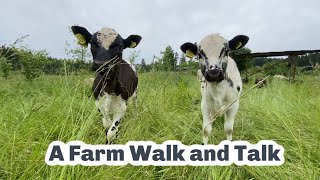
Richard Perkins walks through his farm showing vegetable crops, a germination experiment comparing two seeders, and greenhouse tomatoes fed with chicken-manure slurry. He points out recovered ponds teeming with frogs and trout, agroforestry trials with oaks and chestnuts, and 500-bird poultry flocks built into grazing strategies that armor the soil.
Questions this video answers
June 22, 2020
About 50 to 80 per week
About a hundred oak trees
Nine-day intensive course (runs over both weekends)
A "jiang" (deeper seeding) versus the existing six-row seeder
Chapters
Welcome back to another episode, folks. I thought I'd take you on a little tour around the farm, see what's going on at the moment on this wonderful rainy day. So lots of carrots coming in. I think we've got our first carrots on the Rico passing. Lots of Hacker Eyes salad, turnips. A lot of lettuce and leeks here. Squash are starting to come. Pick the first squash. Lots of spring onions coming on now that should be ready to go. But lots of nice crops in here. So one thing we've done this year is just started testing out the jiang to put seeds deeper into the compost. And as you can see, they germinate very nicely. We've had some issues with germination of some new seeds that we've been trying because the compost gets so hot and the six row seed is just not putting the seeds very deep in our compost. So first experimentations with the jiang and it seems very promising and just as Italian. I like the 6o seeder a lot, but definitely, I think with slightly deeper seeding we'll have better germination. Some beautiful breakfast radishes coming out in the garden for this week's harvest. So we've ordered additional watering units to be able to have all zones hooked up at the same time. That stuff should be arriving in the next week or two, so we should be able to get that together and show you a bit what we're doing to just upgrade that system a bit. Beautiful Kales of all types. Cavallanera is one of my favorites. Lots of carrots you see here. Like the poor germination with the six row and just putting it in too shallow. Most of the beds are totally fine, but that's why we wanted to play around with the jang a bit. So nice to get this bit of rain now. We really needed that. More salads here. And we've suffered a bit from the restaurant not been open this year. We would typically put a lot of salad, maybe 50 to 80 a week to restaurants that are not open this year, obviously. And that's led to a little bit of overproduction, I would say, but it's hard to. We didn't adapt our plan in any way due to being on holiday, not really knowing what was happening with the virus. But really nice chaos under here. Fennel's coming along great. Peas coming along great. Very nice. So things in the greenhouse looking okay? We just looked back at some old videos because we always feel like it's growing really slow in here. Cukes over Here on the right and then tomatoes going off. But it's. Yeah, we've taken a lot of crops out of here and it's now that time where tomatoes really coming up. But we've. Yeah, looking back at old videos, it looks very much the same as it normally would at this time of year. We've actually just fed the tomatoes and cukes with liquid slurry. So chicken manure that's been soaked in water and so that's been put on the central row here. Just using a watering can without the rows on it. Nice to see this hedgerow filling in. Seems to take a while. Everything grows much slower here than where I grew up in the uk. But this is coming thick and dense now. A lot of hawthorn and beautiful to see these hedges blocking up this field. We're in front field. It's quite damaged. You see the tracks left over from machine in the winter and we just grazed through this quite quickly to allow this to recover a bit. Haven't been able to keep this pond full. This is filled by siphon under the road from the other pond, but due to the hot, dry weather, we just haven't had the water to have this flowing. So it's a bit murky, but a lot of frogs and other wildlife in here despite that. But it looks very different to the really balanced ecology going on in the other pond. But lucky to have some rain. Things really start to become so lush. Really enjoying being out in the rain and walking around, looking at how things are developing. Just watching some old videos of when we moved to the farm and just how dense and beautiful the riparian is. The riparian being the natural vegetation that surrounds streams and ponds to keep the banks secure and filter the water coming through. So we will crash graze this maybe once a year, but generally it's kept as it is. And really nice to watch this all developing over time. It's been really great looking at the ecology that's thriving in this pond. Now. This is where we take water out for the market garden. But I've been sitting in the evenings watching four of the trout feeding at the same time. Brown trout, you can see. Oh, there's a snake. Hello, little grass snake. The lilies flowering over here. I think he can make it out right there. Seen a lot of snakes this year. It's always a good sign. And lots of adders. The venomous snake as well as grass snakes. But really nice to just watch the insect life here and nice to see the inflow is now flowing again. It's been ever so dry and we've been a bit concerned, but really enjoying the wet weather now. See the swallow taking water. Beautiful. What habitats we can create. One thing that's really struck me is the amount of small birds here. Now when we first came to Sweden, there was very few small birds. I really recognize the absence of sound. But this farm's become a thriving haven for wildlife. And we've seen several pairs of breeding predator birds that are on the edges of the farm. But the small bird population, baby wag tail there, it's unbelievable just to see how many birds have come back. And that's what happens when you bring species to an environment. It just creates habitat for more and more. If you bring one species to the environment, you create a niche for seven more. So by bringing this diversity and intensity of animals, we've really created a little thriving paradise. Some really nice growth on the oaks here. These are the, what I call the avenue plantings just to make use of the road space that's not used for anything else. So we've got oak and chestnut on 4 meter centers with hazels in between often. Hello, little ones. What wonderful grass you've got. This year we're seeing a lot of the knot midges. That can be absolutely awful to be around. Some parts of Sweden you can't even get out the car because of the amount of mosquitoes and midges. But we tend to be fine here. We don't have so many, but midges are definitely here right now. And I think due to the weather patterns that's been influencing it. Healthy little calves. So the grass has got quite rampant here down at the bottom of the field. I put a photo the other day. Down here the grass is right up to my breast. It's really gone off. Some people ask why we have let it go to seed. It's gone to seed much earlier than other years actually. Grasses are typically trying to go to seed by mid summer, but they got to seed a bit earlier than that this year. But we don't mind that. We want them to trample a lot of it down because that's investing in our carbon bank for the future. And we saw, if you look back at videos from the drought two years ago, you'll see that we had very high levels of photosynthesis when everyone had already gone yellow. And because we had a deep litter down on the ground, we saw biological activity continuing well into the drought. So we want them to trample 40, 50% of it and then let them select the parts of the plants they want to eat. And they know what they want to eat. Their lives depend on it. And then leave enough armoring on the soil for the birds coming in. So you can just see the egg mobiles in the background. So we want armouring on the ground for those birds so they don't have a negative impact on the ground. This is a red oak. Most of them are English oaks that I've put in here. This is a different one. Very nice. Here we've got an oak that's actually sitting next to sweet chestnut. These are ones we've done from seed, so it's taller than me now, doing quite nicely. And you can just make out some of the nut trees. Pecans, walnuts, chestnuts. Some are doing better than others. But we're going to have a look at them. You can see here where the grass has been trampled down by the cows. It does leave a good armoring on the soil for this hungry flock. So I'm quite happy with this. Some people would consider it a waste of forage, but that's not at all what we think. We want this thick armor on the ground. Look at that. And that's going to keep the moisture in. The hot spell that we're having and still gives the animals plenty of forage, but allows us to keep the ground covered and well protected for the birds and also habitat for a lot of insects, etc. And I like to have different age classes of grasses but also different heights of grass on the ground. You can see these wispy bits still standing and then a lot of different height. It's good for insects. So we've started to try and graze tall. So up at the turning circle and I've showed you this a few times, but I think it's always interesting to see. And we've very quickly grazed through here with all the animals. But just to see how these systems evolve. So you see this was cut same time. It's got all the brash still lying here, some raspberries coming back with a lot of brush. And for reference, the trees are typically 3 meters here. Much lower diversity than what we see just over the road on our land where we brought pigs through here. So for reference, These trees are 6, 7 meters tall and we've got much bigger diversity of trees coming back and really valuable trees like this oak and a lot more grasses and forbs. So we bring the livestock through here. So this was dug over by pigs completely. They are the climatic trigger of forest systems. Can really promote higher germination of trees that are in the Ground see another beautiful oak here. So we're interested in letting this forest now, all the forests. This is why we don't have pigs at the farm. We want all our forest to do, to just be growing back to the natural assembly of plants. Another oak here. We have so many oaks. You can see where the bull has stripped the bark off this willow for the minerals. I'm fine with that. There's another oak right here and quite a big oak in the back here. So these are much more. There's two oaks here, five, six meters tall now. So we've got just in this small patch which is less than a hectare. There's about a hundred oak trees here. And these trees are growing up really fast compared to the land over the road. Partly probably from the fertility of the animals. And you see they've created this lovely open glade. They also prune the lower branches, having the sheep as well. That lets more light in for the grass is underneath. And so we get much more value. Like Swedish forestry is virtually a break even business if you factor everything in. I mean, it's the companies that are milling the timber that make all the money. And I'm going to be doing some episodes later in the year about natural, foreign, like ecosystem based forestry with our friend Mikkel, who wrote a book in Swedish, but I hope he will translate it to English very soon because it's a big subject, it's not talked about. But that's something that interests me is to get away from the monoculture spruce that makes up most of the Swedish landscape and is a very low resilience and little value in some ways compared to the sort of species that can grow here. More oaks over here. So we're turning it into agroforestry with, you know, the primary economic driver being animals underneath. And they will obviously benefit from nutrients in the trees. I really like this spot. I come up here a lot just because I find it's a really pleasant environment. But very interesting to see that if you let nature do its own thing, it's, you know, it's the odd pine and some spruce, but it's certainly not what grows here naturally in the way that it's planted all over Sweden. So really interested to see all of our land turning back to natural forests with the integration of animals for the economy and then only harvesting mature trees as they become ready for useful timber and lots of species to give us all the types of wood we might ever need. So fun to walk in here. But you see, it's a dramatic difference from just over the road where nothing's happened since cutting and using livestock as engineering mechanism, you could say so up in nutfield and different nut trees of different figures. Some have done much better than others and you just never know. We're growing things that are on the edge of our climate zone so not expecting any quick results of these slow growing trees. That's an English walnut and we've got. It's either hickory or pecan doing really well. This is a Malus aversion, the original Kazakh apple. Looks like black walnut I think. More Malus aversi. This grows into a very big tree so we're just leaving it to do its thing. Unpredictable what type of apples it will have, but it's grown from seed unlike most apples. There's another one here, slightly smaller. Got more English walnut here on my way up to the boilers. So I think the last time you saw these guys they were just coming out and so they've gone down and back up again. We're only going to take them up here so we're not going up this slope. You can see they putting a high level of manure down at this point but getting a lot more space than you would typically get. So in the Saraton Pans and they seem to be doing well. They sheltered naturally in the heavy rains that we had and it's just a couple of weeks till we will be getting the slaughter going again and having beautiful fresh pastured chicken out to customers all over. So this has been good experiment for them to just get experience with grazing in this type of contraption. As I said before, I think better really when you have more than 500 birds. This is 500 better for the birds and pretty good for the land. Less time in watering and feeding generally. Now boilers are not the most intelligent creatures, it's got to be said. And sometimes we've had we get these heavy rainstorms where the birds in the salatin pen will sometimes sit out in the quadrant that's not covered. And I think it might be because the roofs are so low. The noise of the rain hitting the roof is somewhat overwhelming for them perhaps. And interestingly with these pens we notice the birds just shelter straight away. I think it's because the roofs are an angle and have a broader reach sideways. It's easy for the birds to just shuffle in. They seem to shelter really well. So we've had really epic rainstorms the last few days and much needed but they seem to shelter totally fine. None of the birds were wet at all so that's really great to see. We've got another chestnut doing pretty good here. Beautiful. Now, sweet chestnut is not a crop you find growing here. This one actually has a Malus aversii growing up next to it. Some nice pecans doing well. Pecan has done surprisingly well for us here. But it's. Yeah, these are trees that are purely just for my fun because I want to find, you know, varieties that will bear fruit up in this really cold northerly latitude. And maybe I never will and maybe I will, but that's just a pet project for me. That's a lot of fun. But I actually have. I germinated a lot of nuts during the winter. So I've got a lot of black walnut because that's grown really epically for us in the fields from seed. And I have a lot more chestnuts and walnut. So I've got to work out where I can actually put more trees in because we kind of filled up all the spaces here. You. It works well for us to have them on this diamond pattern in nutfield because we can then graze 10 meter strips between them. One option I have is filling in the gaps, you know, and putting them. The original planting plan for this was to have nuts on 25 meter spacing. And so if you take a look this tree here, then there's one here, one up there. In the overall plan, half of them would be cut out to recreate the spacing. So right now they're on 12 and a half meters. What I could do is increase that gap. But I think it would be quite logistical with the boilers, with the layers to be going around them like that. It works quite easily as it is. But another thing it could do is plant multiple nuts in a cluster and anticipating that some of them just won't survive. But I have hundreds of nuts to go in the ground. So I'm thinking of what to do with that right now. And I haven't fully decided the best approach. But I do like that little idea of an island cluster because I think that could work quite well and it wouldn't really change the footfall of what we're doing right now. The other option is putting more in the strawberries over in top field. Look at these beauties. Magic. Just want to say that we've got our farm scale permaculture design course happening. It's just one week off work. It's running over the both weekends. So it's nine day intensive. Really looking forward to that. It's great to be able to have people coming back to the farm. We're allowed to run that training. So if any of you want to join us for our world renowned palm scale design course, there's still a few places left on that and we're not taking so many people because of the corona, obviously. But if you can get here, then you're welcome to come and join us and we really look forward to welcoming all of those that are coming already. Very happy about my espaliers, which have got rhubarb and chives and things underneath, but they are growing really well. Put in as little whips. About four years ago, maybe 80 centimeter whips. And the ones behind the wash pack station for the vegetables because they get a lot of extra water, you can see the difference in growth there. And they've already reached the ends of the line. This one's got a bit rowdy and out of control. I need to come in and clean this one up because, look, it's way overgrown. A lot of apples on it. I think it's going to be a good year for apples. There's goji berry here and it's a bit rampant. I think I'll need to sort all this out. So that's on the list of jobs to do down here in the lean to, things are ticking over. More beets, more herbs, salads, chards, beans, dill. Always feel quite easeful on a day like this when it's not so hot. When it's been super hot. We've had, you know, had to have the fans on, just keep blowing air through. But it's a very peaceful feeling day to have a little bit of cold. All right. I think that's all I got to show you today. Enjoying walking around in the wet weather. It's really nice to see the farm looking lush after the sun baked drought conditions that we've had. Don't forget to check the links below. We've got a free mini course that you can look at the four fundamentals of getting started, right, as well as our book and online offerings that you see in the links below. So look forward to seeing you in a video soon.
More from Richard


A review of short and intensive season on a mixed farm and restaurant/event space in Sweden






Alskade Kyckling Exploring complexities of poultry production in Sweden and what we stand for


