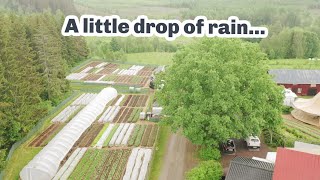
A short YouTube video by Richard Perkins (titled "A little drop of rain") documenting routine farm operations after light rain: moving broiler chickens and sheep, installing and testing a drip irrigation header, vegetable-crop maintenance, compost collection, and site groundwork (gravel/parking). The clip also includes a promotional segment describing a Regenerative Agriculture online masterclass, free mini-series materials (plans, PDFs, spreadsheets) and a deadline for free resources.
Questions this video answers
40 meters depth.
One deciliter (100 milliliters) in 30 minutes.
Approximately 400 liters per hour (computed from measured sample).
About 40 minutes per session.
Available until June 10th at 6pm European time.
Chapters
Nice bit of rain this evening. Hey, I have the same thing. I will sip. Come on, let's go. Don't stand at the fence and eat. You gotta come through. Hey, Boscow. Okay, so kind of what I predicted. We've taken about half the grass, stomped a bunch of it. That's what the cows have done. And the new paddock they're in today, that makes it a little bit easier for the broiler crew. They're just about to open up for their morning move. You see the birds are getting ready. We've been discussing whether we think they're smaller than normal but it's always a trick and an illusion. Here they come. So this is the stage where they know what's going on and they're self moving. Marauder in pack. At this point there's always a few stragglers. It's a long distance considering most people raising these in salatin pens and moving 4 meters a day. These are moving 20 meters and then they're running around a lot more during the day too. But they've taken it down somewhat. It's definitely noticeable but it's still quite long grass. So feed down the middle so we can roll the pans over. That's what the thousand birds moving themselves looks like. And you see they will focus in along that line of food all the way along. 20 meter long makes it easy to pull the shelters over. It. Easy peasy. Sheep is on the move. So they've been grazing through the orchard. Now we're putting them around the vineyard around the pond. Beautiful pack choy. Look at that. He's a big pack choice. So a new drip pipe in here and we've been waiting for some fittings. We're putting in a solid header and what we've been wanting to do is have four rows of drip on each bed with taps on each one so we can specifically water individual lines. Parts from the UK have been very slow to arrive. So in the face of having a water list by hand, we've put in the old system and put in the four pipes but only connected two. Now with any drip system you've got to be careful with the amount of water you use. And because we're on a well with only 40 meters of depth and it goes to the slaughtery as well as people as well as animals around the field lines, we can't have this on too long. So best way to work out the water usage is not follow what they say on the packet is to test it for yourself. So what you do to Test that here. We've got the drippers facing upwards so they can't clog. And we put a pot underneath somewhere in the middle, in the middle row to get an average flow and then test it for half an hour. We actually got one deciliter, 100 milliliters of water in half an hour. So that allowed us to quickly compute that with the two lines that we've got plugged in on each bed. That's 400 liters per hour. So what we're tending to do is limit it to about 40 minutes, and we can do that in the morning and evening every second day or so, and that shouldn't affect our system. So cukes coming on. As the first cukes actually form, we typically take off the bottom three, four or five to allow the plant to keep on focusing on growing in. Not too far from now, we will start taking off the lowest leaf of the tomatoes, and then it's a constant weekly job to trellis and prune. Put videos about that many times in the past, and I'm sure we'll show you again this year. So all the collected chicken manure and bedding that we layered up under the eggmobiles at each end of the tunnel here, Dave's been scooping that up with the machine to put it into a tarp next to our vegetable compost heap so that we can add that with layers of vegetable waste that doesn't go to the pigs in order to get a better strength, more balanced compost. A couple of millimeters of rain last night, which is very much needed. It's cleared the air. Beautiful smells and fragrances, and that certainly helped the pasture and the vegetable crops.
Well, that's the meaning of head lettuce.
Beautiful oak leaves. Ah, more rain today. I've been strimming soggy work. Grass is growing very, very fast now, so it's hard to keep up. All the edges need strimming and cutting. That's the way it is. But nice to get on top of these jobs and the farm is looking tip top. Big delivery day today, and I've got a few questions I want to answer that people have been writing in about the Regenerative Agriculture masterclass, so I'll address those quickly now.
That's better. Just cleaned up. Super nice to have a slightly cooler day, A little bit of rain. But hey, just wanted to say sorry for those of you not interested to hear about the masterclass. It's obviously a very big deal for me. We've had to cancel most of our farm trainings. This year and it's something I'm super pumped about. It's the best value for money I could possibly give someone lifetime access to a much more detailed and comprehensive set of educational resources in a very well crafted package. That's way more than we can offer at our on farm trainings. So I just wanted to answer a couple of the common questions that I keep getting emails about and this is my platform where I communicate with the world so I feel like I'll choose to do that. And don't forget we've been running a totally free mini series that all of you are welcome to sign up for. There's no strings attached. You need to enter your name and email address. We're offering a free PDF book. We're offering CAD plans for Rollaway nest boxes, our crop profiles for all the things we grow in our no dig market garden, as well as planning spreadsheets, etc. So go take all that stuff. It's available till June 10th at 6pm European time. No strings attached. Not going to force you to purchase anything off me that's free for you. Take it, use it, enjoy it. One common question that's been coming in all the time though is people saying I'm too busy to follow the program in the summer. Will you be running a version in the winter? We don't know. But if you're thinking about taking the training, it's lifetime access to all the materials and you can go back and study anything anytime you like and you can join each subsequent live training as they do come up. So if you want lifetime access, it's a great time to jump into it. It's a great time to take the training. If you want to hit the ground running next year. You've got all summer and autumn to digest the information, refine details, get a plan together and prep beds for a market garden, or get together the infrastructure to run any of the sort of enterprises that we are going to be talking about and covering in great detail. So it's actually a really good time, even though it's a busy time where people don't perhaps want to spend much time on a computer. But I think it's a great way to get your plans together and refined if you want to start farming professionally next year. There's no time like now. There's never been a better time to get into farming.
The global pandemic has shown us that.
People'S desire for local integrity food is just booming. It's a great marketplace to get into and there's so many other people getting in at the moment that this is a fantastic place to start. I'm going to be jumping onto YouTube live to answer questions and answers for anyone who wants to turn up tomorrow evening. I'll make a little post about that on social media tomorrow, but I'll be happy to answer your questions live there about the online training specifically, but I hope to see many more of you in there. It's going to be fantastic. And I'm super stoked about our incredible mentor.
Team Gardens are very happy about the rain. I'm very happy about this gravel delivery. So we're getting hardcore and gravel mixed. We haven't put any liner down here, but we're doing exactly the same as we've done up here and it works fantastic. This will give us parking for all the vehicles here and the trailers. We've had a constant battle with just moving stuff around the farm this year. We're getting more vehicles, more people are coming in vehicles. So this will give us a chance to make proper parking for once. Thank you, Bermudas. That should do the job. I'll leave Dave with that. He's Echo Dog. Hey, monkey. Sa. Sam. All right, that's it for the video folks. If you want to know any more about any more, check the links below. See you next time.