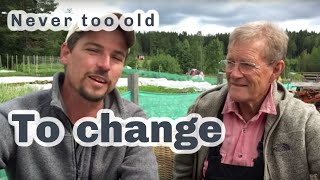
Roger farmed 3,000 acres conventionally in the 1960s, went nearly bankrupt, and retired. Now he runs a small regenerative farm in Scotland with planned grazing and direct meat sales, mentoring young farmers on building businesses without subsidies.
Chapters
So today's video is a little bit different. I really wanted to interview Roger here for the channel, and I know a lot of you are really excited to see that, but I've been really touched and humbled to have Roger here on the training because he's been farming industrial, you know, conventional farming for longer than I've actually been alive. So that's always quite touching to see someone's progressing into this field of regenerative agriculture. So I wanted Roger to really share a bit about his life experience. And he actually quit farming, saying he'd never farm again, and has come around full circle, you could say, to regenerate that again. I think it's a really inspiring story. I'd love to share that with you. I'd love to hear Roger a bit about your background, like from the beginning, when you started farming and. And how that all went.
Actually, it didn't go too well. I think what I want people to know is that I never really wanted to farm in the first place. I farmed out of an obligation to past generations, maybe I was frightened to say no to my father. Actually, at 17, I wanted to go to art college.
So.
I started really on the wrong foot. I didn't do very well at school, I went to agricultural college. They didn't teach me a lot there. Perhaps I wasn't listening, Perhaps I was chasing women and drinking beer and not concentrating on what I should have been. But anyway, I found myself, aged 31, in a state of total ignorance about farming because my dad drank a bit too much. I think probably as a result of going through a pretty awful time during the Second World War, he'd made a complete mess of the business. So I realized. I mean, I was watching a family farming 3,000 acres in 1962 when I started.
So that's quite. For those of you in the States or whatever, that's a relatively big farm in the UK.
Yeah, it is big in the UK, but not perhaps anywhere else. Anyway, 3,000 acres in 1962, and by 1972, half of that had gone and that was really sold to pay off personal debts, I think. And so I was sort of getting a bit nervous about all of that sort of stuff and wasn't really enjoying myself. I wasn't allowed to be involved. He kept me really in the background and then all of a sudden, 1976, he upped and died. But what I found myself with was a business that was almost bankrupt and, you know, when I went to the safe and got out the books and bank statements, I Didn't have to know anything to know that we were in deep trouble. So this is a picture of around about a thousand acres of alluvial silt in Cambridgeshire, or it's actually on the Cambridgeshire, Lincolnshire border. 15ft of topsoil, no stones, double cropping land.
Pretty much some of the best land in the uk.
Yeah, I think so. So really, really fortunate to be farming this stuff. But, you know, farming, if I'm truthful, really terrified me. I was always faced with weather and what it did to our soils and I was not understanding what was happening under my feet. I now understand. And if I could go back there now, I think I would treat mine farm very differently. I'd do something really, really, truly radical. And you can see here, I mean, this yard that you're looking at, I suppose there's a couple of million quid invested in that. There are coal stores, you know, chill stores, areas for unloading and loading potatoes, the onion store, there's a grain store, offices, you know, farm workshops, all that stuff. You're looking at huge amounts of capital being invested on the back of low value produce.
What was it you were farming?
Usual arable crops. Wheat, barley, sugar beet. We were growing potatoes for supermarkets. We were growing onions, peas. We grew a lot of petit pois, which were really valuable. We were growing strawberries, asparagus. A long time ago now. No, no, livestock. Livestock disappeared from the farm when my grandfather died in 1960. At that time there were, I suppose he used to have about three or 400 animals and beef, beef cattle that got fed on, you know, waste farm produce. But after he'd gone, by 1962, there were no animals. And in fact, when Jilly came to live with me, it was about 35 years ago, she woke up on the first morning and said to me, I don't want to be rude, but seem to be impertinent because I'm not a farmer, but where are the animals? And, you know, I think about that remark now and I thought, my goodness me, you know, we were needing to learn, learn a lot. So this is the yard in 1976, just after my father had died. And there's a lot of white down there, which is common concrete. We had nothing. We had no buildings. We had tiny tractors, we had small trailers. We were employing about 15 people. You know, first thing I did was sack most of the staff. And then we started to restructure the business. And I have to say I didn't know what I was doing. In fact, in the first week, the bank Threatened to foreclose. That's a story I'd love to tell you but it will take too long. You know, we had the remains of a 3,000 acre estate. This is a 30,000 ton grain store. The 30,000 tonnes isn't showing there. That was the original building that my father put up in 1962 and in those days that cost £120,000. I don't know what that would be now. Somewhere around about 2 million, something like that. But, you know, totally inappropriate expenditure. But it's what we were sort of into, you know, I was farming, but I wasn't a farmer, I was just a, I was just a technician. I knew nothing about soil biology. You know, you could look at fields of wheat and think, looks really nice. But if you went and looked down into the crop, 80% bare ground and you know, it was, it was sterile potatoes, something that I was really proud of growing. I was really good at it. We were selling really high class produce to supermarkets. You know, I would have been proud of the pictures that you'll see at the time when these were taken. And then you look at more bare soil. I mean, we're just good at creating it. You know, there's the same field, that's the same field being lifted in the autumn of the year and in the same autumn there's my big F off tractor. I was, I just loved it. It was just the most wonderful bloody machine. You know, you could pull eight furrows as fast as you can walk. You know, one man plough 100 eggs in a day. It was just revolutionary. But bare soil, what an awful thing to do. And then a friend took this video for. It. You know, this was, this, this short clip was taken by a friend of mine who just happened to notice what was happening on, on a car journey through Yorkshire and she, she, she posted this to me and said, I thought this might interest you. It's the sort of stuff you've been.
Talking about, topsoil walking out in the front gate.
Yeah, absolutely. Isn't it awful? And so at 31, knowing nothing, I then decided that actually I didn't have to know too much. All I had to do was work with people who were smarter than me. I didn't have to be clever at all. So I went and found the best in the business. Long story short, 20 years later, the business was back on its feet. We had a very smart farming operation, we were making a lot of money and I'd done the job that I'd been asked to do and at that point I thought, well, I just don't want to do this anymore. And in fact I was bleating about it to one of my boys, I've got four sons. And I was saying, you know, Daniel, I really don't know what I'm going to do now. And he said, oh, for goodness sake, Dan, get a clue. And I said, what? He said, get a clue. He said, what did you want to do when you were 17? And I said, well, I wanted to be an artist. He said, get off your ass. So I went and did a two year furniture making and design course. I absolutely loved it. Gilly and I, you know, we both retired. She was a dentist, I'd retired from farming, I was helping her to run her business and life was, was pretty sweet, but I was at a bit of a loose end. I didn't really know what I wanted to do. And then one or two things happened which most of it centered around family and not being able to have children together. We decided that we'd spend the rest of our life adventuring, doing the things that we either never dared do or never had time to do. So we raced motorbikes, we flew airplanes, we skied, we rock climbed, we did all sorts of crazy stuff. And then one of the things I wanted Julie to do was to try sailing. And so we, we booked ourselves on a, on a charter boat that was going to sail from Brixham on the south coast of England down the west coast of France. And at the time we were thinking of going to live in France. So that seemed like a really good idea. We had to pay 1,200 quid up front a year in advance of going. So, you know, we sort of thought, well, it's a bit steep anyway, we were really excited about that. And then a year later the phone rang and it was the charter company to say they'd had an accident with the boat, they didn't want to leave UK waters and we weren't going to the west coast of France, we were going to the west coast of Scotland and I went, oh. And Julie said, oh, come on Roger, it's just sailing. What's the problem? Anyway, we got these high powered sports bikes. We had good ride on the bike, so off we went. Well, that was 2000 and August 2001 and we were living in Scotland by January 16th, 2002. So it happened like it was lightning. It was like being struck by lightning. We spent four years doing stuff, everything that needed to be in place for us to move to Scotland and live there. Just happened as if by magic. And we wound up, we promised ourselves two things when we went to Scotland. One, we wouldn't live on an island and two, that I'd never ever, never, never, ever, ever farm again. And we wound up buying a house that had 74 acres attached to it. So we sort of got into, I mean, 74 acres didn't frighten me. And so we were told because of crofting law, that we'd have to have a few animals because if we didn't use the croft then our next door neighbour could come and to use it without any omissions from us. So we got some animals and we've gone on from there. So we wound up with a, with a small direct sales operation selling beef, lamb, it's all 100% grass fed. Anyway, about that time, we were watching a video by Rebecca Hosking. I'm sure that one or two of you will come across her. She made a film called A Farm for the Future and that absolutely pressed all my buttons and rang all my bells. I watched that and it was totally telling me what I was going to say, something I shouldn't say on screen, telling me what a prat I've been and that I'd been doing all the wrong stuff. You know, I loved to plough. I was told plowing was the worst thing you could do to land. You know, I was told that all the stuff that I'd been doing had been flawed. And really I just, you know, I felt, I got up out of my chair having watched the film and it took me as long as it took to watch the film to have my whole belief system completely reversed. I didn't believe after that film any of what I'd come to believe during my time in farming. And I immediately went outside and Gillian and I, in three days created a rather large no dig garden, I think 10 beds, 10 meters long, with lowered paths, not raised beds. We lowered the paths, stuck some boards in the ground and I was there sort of thinking, well, you know, I'm not going to do this without digging. You must be joking. But I'd listen to all this stuff and, you know, it looks really beautiful. It was miraculous. The whole thing was miraculous. And so we started to follow people around the world through Rebecca Hoskin. We got in touch with Permaculture, actually wasn't terribly impressed by that at the time. We'd heard Joel Salatin mentioned in one or two of the videos we watched, so we started following him. Then we got into Holistic Management and we wound up going to the Savory Institute International conference in San Francisco in 2015 and really it's just gone on from there. And now I can say that I'm passionate about farming. I wouldn't do anything else. I mean, we live on the edge of heaven. Where we live, you'll see photographs of that and know that you wouldn't want to move. And we thought, well, how are we going to organize that? And Joel Salden in one of his books, I think it was you can farm. And I was reading that because I, I was trying to help other people to understand how they could get into farming and how it didn't have to be something that was government led this subsidy thing which is so toxic. And in one of his books he said, you older people need, and of course we know most of us farmers are old, you older people need to be, you have a, perhaps have a moral obligation and duty of care to bring young people into farming and mentor and teach them how to farm and how to run a business. So we got these. They said, find some fired up young people. I thought, well, I don't know where I'm going to find those. Anyway. Then Dan and Fika walked into our lives. They're 30 year olds and we've now got these people working with us and we're going to teach them to farm, we're going to teach them to run a business and they're going to own it and we're going to step back, they're going to run it. We're not. And so at the moment we're sitting around a table brainstorming ideas for what income streams we might be able to develop. And we're going to turn it into a business that I hope that doesn't rely on agricultural subsidies and government handouts. So really exciting stuff.
Yeah. So you're doing holistic plant grazing?
Yep, yep.
Trying to regenerate that pretty wet grassland where you are.
Yeah, I mean I think we're all in, you know, we're in the process of being in a state of constant learning. So you know, we're just trying to work out what works. And you know, having bumped into Alan Savory and Joel Salatin, Gabe Brown, Dave Brandt, all those good people, you know, we started to try some of the stuff that they were talking about and now we holistically plan graze half orchard sheep, we operate them as a flird, We're getting some astounding results. We're moving cattle every day behind three line fences. We're looking at, we're trialing broilers at the moment. We don't know if that's going to be suited to our climate, but, you know, that's looking good. We killed our first 50 birds just before I came out here to Sweden. We just got another 50 chicks. And that's really all about feeding ourselves. That's really the mantra on the farm at the moment, is first learn to feed yourself and then get to a point where you're selling the surplus. We started off with that very simple, sort of simple mantra. The other mantra, of course, is no bear soil. And we're achieving that. We're very careful not to run around on the land with rubber wheels. We use our feet a lot. We're very into the business of just observation, I guess, and learning to respond to what we observe. So it's very simple. Whether it'll work as a business, I don't know. I suspect that it will. And we're hoping that we're going to be, you know, a flagship in our area.
That's amazing to keep sharing your knowledge. And I've been saying throughout the training that there's so much that we can take from conventional agriculture, all the data produced and not just the things that don't work about it, but there's so much of value just from that life experience that can be passed to generations that don't work with those things from a young age anymore.
Yeah, I think probably the thing that we're finding at the moment with these young people is that they know nothing about farming. And in fact, that's a real benefit because you don't have to persuade people about stuff. They're totally imbued with this new paradigm that we're into. And of course, at the same time as helping them, you know, we're making sure that we can stay put, but we're also dealing with succession and that's something that farmers never talk about. It's something we need to talk about and we have to find some young people pretty quickly to start farming land the way it should be farmed. And I think, you know, I'm absolutely determined to do something valuable before I'm 100. You know, I'm going to live till I'm 100, definitely. I've got to, because otherwise I'm just not going to see what we've just started. I think if I can do that with the help of a load of young people, you know, life is going to be very inspiring for the next 27 years or whatever it is that.
I've got I think it'd be nice for viewers to hear a bit about your experience coming here. So this is a 10 day farm scale permaculture design course and yeah, just to hear some of your impressions coming here. For people that follow our channel but haven't been here and sort of sensed it, seen it, felt it, like what are your impressions coming here and seeing it through the lens of your previous agricultural experience of a lifetime but also the paradigm that you're in now.
It's inspirational. I only discovered Ridgedale and Richard in February around about my birthday because Jill bought me his book as a late birthday present.
Did you read it?
Oh yeah. And I really, you know, I thought it was 1600 pounds. I thought it was quite a lot of money. I unilaterally made the decision, decision to come without consulting my wife Jilly and she's now at home moving cattle, feeding chickens, looking after broilers, taking grannies for shopping trips to home because we've got a community transport deal. So she's absolutely up to her neck. We've got a nine day holistic training program happening as soon as I get back. So there's all the cooking and stuff to do for that. So she's. And she said to me, you know, I'm glad you're in a spirit because I've been inspired. I think it's great to see such a diversity of stuff going on here and to see the results that have been achieved in a very short space of time. And in actual fact we're seeing the same sort of results on our croft in Scotland. You know, just a change in the pastures that we've got here. I think probably Richard's a better than mine, which hurts me a bit. There you go. But I think, you know, the interaction with young people, the education of folk, seeing something which is alive to the moment is alive to the fact that, you know, we need to save ourselves. I mean the planet will be fine whatever happens. But you know, this is a really good example of a detailed, well managed project. I came here to learn and I think I've gone away, I've gone, I've gone away with a whole heap of information and I'm really grateful for that. And yeah, know, I think happy you came.
Happy you came.
Oh absolutely, yes, I'm absolutely happy I came. I think it's been a really, really great experience and it's like anything in life, you know, when you're offered an opportunity, it can be an opportunity and maybe it could have been an opportunity to come and see what an amazing job Richard and his crew are doing here. Or maybe an opportunity to meet a network with people on the same pathway. And you know, we really need to get together and do this stuff, you know, we need to be shouting it from the rooftops and we don't need to be shy about doing it. Although, you know, at home we've made a decision that we'll show rather than tell because I think telling is a is. It can be a bit confrontational. But we don't want to be confrontational, we want to be sucking people in because they see something that they really relate to. And you know, this place, you know, if you haven't been, you ought to be here and come and have a look. It's amazing, amazing, amazing achievement on the part of Richard and people and the team that work here. So it's been a happy time. It's taken, taken a group of 20 something of us, you know, a whole 10 days to get to know one another and actually I think the thing is just starting to gel as a team. Could have done with a month actually. I don't know that I've enjoyed the business of sleeping in a sleeping bag and a leaking tent. I could do without that. Other than that it's been great.
It's been a pleasure to have you. I've been super happy. Again, I wonder if you've got any tidbit advice for particularly young people. I suppose big function of our farm is to support particularly young people to go into farming. And I wonder if you have any advice for people who are considering starting out and you know, maybe haven't got the confidence to start yet. There's someone that's worked their whole life through this from one side of it to the other. Like what would be your advice to someone considering starting out?
I think find somebody like me or find somebody like myself and Jilly. Who wants to stop, you know. Well, you know, the farming community is getting to be pretty aged. I think the average age is something like 66 or 67. You know, you guys, if you're listening and you've been in it for a while, have a wealth of information to transmit to people and you know, you don't have to be doing it with family, you don't have to be doing it with, you know, that sort of whole family farming thing I think is rather incestuous and it doesn't necessarily lead you to the changes that need to be made. You know, it's going to be a struggle for people to change unless they're like Me, they've had this paradigm shift, you know, this thing that happened in an hour on television. You know, I still really can't quite believe that I'm sitting here talking to a camera. And that wasn't how I thought I'd be spending my 70, 30 year. But I think there's a whole stack of opportunity for young people out there. Go and find some smart people like Richard, come to Ridgedale, you know, get stuck in and start to educate yourselves. That's what I'd say. And don't be frightened to think that you can't do. Doesn't take money. You know, all you need is either, you know, a patron, if you want to call me a patron, somebody like myself or Jilly, who, Who've got money and some expertise, who are willing to swap that for physical energy, because that's what all you young guys have got. And you really ought to be totally confident in just stepping forward and asking for help. If you want to know how to start, come and speak to people like Richard, or come and speak to me, or speak to anybody who's doing this stuff. You'll find there's a lot of help out there. Yeah, great.
Thanks, Roger. It's a real pleasure to have you here and thank you so much for sharing with our listeners. I'd love to hear people's comments and feedback and I'm sure Roger will see some of that over the next days after he's travelled home. And we'll link to your website, etc, in the links below so you can find out more about Roger's current project. This beautiful place up in the north country.
No, west, west, west, on the west coast. It's all north of Belgium. Do understand, you do understand, this is tiny. I mean, compared with, you know, farming 1500 acres or whatever, this is tiny.
Tiny, tiny little projects scaling down and getting more biologically intensive.
Yeah. And it is a work in progress, so we're not there yet. We haven't learned it all, we're learning all the time. But, oh, gosh, this is exciting. If you want to just go and speak to some people and get into it, don't worry about the money that'll show up. People are looking for people who are motivated, who are excited by life and who see the possibilities of what people like Richard are doing in places like this. So, anyway, it's been nice to talk to you.
Thanks so much, Roger. I hope you enjoyed that and thank you so much for sharing. I think people will find that as inspiring as I have, being here with Roger over this time. So thanks, as always, for watching, and we'll see you in the next video.
Sam.
More from Richard


A review of short and intensive season on a mixed farm and restaurant/event space in Sweden






Alskade Kyckling Exploring complexities of poultry production in Sweden and what we stand for


