A NEW SUPER LOW-COST PASTURED BROILER MODEL S4 ● E95
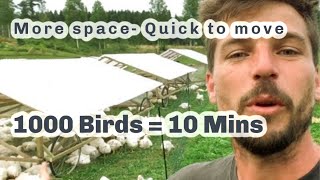
Richard Perkins tests a new pastured broiler pen design at Nutfield farm that costs around €800 for four pens and holds 500 birds per 50-meter net. The prototype aims to give birds more forage and better health while saving time compared to traditional Salatin-style setups.
Chapters
As I've said before, we never set out to be poultry farmers and we've ended up as passive poultry being some of our main enterprises with the layers and the boilers. But this might be the future of passive poultry. So here we are in Nutfield with the test run and we haven't come up with a name for this. We put out, there's a free copy of DVD Gracie's Backyard if someone comes up with a cool name for this. But to be honest, we haven't even looked at the names. I know a lot of people have left comments and left suggestions of names for this new pen design, but to be honest, we haven't actually had time to look at them. So we'll do that soon. But we have a bunch of people arriving tomorrow for our farm scale permaculture course. So it's busy days, but we'll get on that. So we'll be sending out a copy of that soon. So we've taken one of the portable energizers from the laying hens because they're going to bed now and we're just seeing how the birds react to the nets and they've never seen an electric fence before. So you hear the oddberg shrieking as they find out what it is and they're sitting away. Oh, there you go, there's one there. So they're learning, you know, and they will learn pretty quickly, I think. And so how do I feel about these? Well, we've still got, we built these three today, but we've got a bit of roof to finish and they'll be fine. So there's about 500 birds in here in a single 50 meter net. I mentioned in other videos that we want to keep the nets close up to the edges of the pens and not have too much open space like this where a predator bird could easily come and take them. Now biggest concern for most people is going to be predators in a setup like this. So let me tell you a bit about why we're doing it like this and the concerns and thoughts I had so far. So we're looking to do. We're looking to give the birds more space. It stemmed from a morning when I came up and there were 40, 50 birds escaped. And they looked so happy on this beautiful grass. And you know, I really think they will forage more with a bit more space. I have no doubt about that at all. And it's better for the birds that will be better for their nutrition and health and better for the end product too. But it's also A way to see if we can optimize moving the birds. We have six batches of boilers is about the maximum we can do at this latitude to keep them outdoors all the time. This year we've done five because we did a larger batch in the start of the year. But we want to streamline all enterprises. That's a big focus now for the farm is how to optimize every single action. And some great ideas have been generated around that. And it started with making these pens as a trial. So we have some young birds out in one of these with quite a bit of open space. We've had no problems with predators and these birds are a lot bigger. These are just a week or so away, a week or two away from slaughter. We just did birds yesterday, average 2.1 and we're looking to get back up to our old average of 2.3, maybe 2.4. And so we've been playing with different feed arrangements because we're getting new bulk food. We buy an organic food, but a few, well, five tons at a time. So it's a different feed. And so we're just learning the minute details. Little, you know, little changes in feed make massive difference to productions, whether it's of eggs or meat chickens. Something I've come along and done is put a peg at the base of the center of each post just so that that's got some extra security. The birds couldn't mop the fence and push it down, which they were doing when we were building in here, we didn't have the electrics on and it would, you know, there was a bit of commotion because we were in their space. But now that they're settled down, it's very peaceful for them. And so they've got 20% more space than they would have if all these birds are in pens. But this is just a test run because we're looking to build. Well, actually what we're going to do when these birds soon, like next Monday, some of these birds will be slaughtered. And what we'll do when we get this younger batch which are in the old style Salatin style pens, when they come out, we'll join forces and we'll have them all together. So we'll get a good test run this year to see. Is this something we want to do now? It is a test. So, you know, I'm totally open to things going wrong. We don't know what it's like in extreme weather. We've basically lifted up our boiler pans and stuck the wheels on with a An angled roof. Now that's going to be really beneficial in the winter because we store the pens outdoors. There's not so much space around the farm to store these pens and they take quite a high snow load here in Sweden. So this roof design will be a lot better for shedding its own snow. I'd be happy leaving them up in the field. Probably all of the woodworks up off the ground. So it's very nice, it will last a lot longer. But I've mentioned in previous videos when we were just building the prototype, like if it's too windy, we will add wind protection in these triangles. We can add it on all sides if necessary and we could do drop down canvas curtains if necessary too. That might be more necessary for young birds coming out in the early spring, which, you know, it's something we'll just deal with when we get there. I don't perceive any problems. But look, this is, this is potentially a huge game changer. It's very, very easy to move these. So I plan for moving tomorrow is setting up the next pen here and we'll open the gates up and start feeding in the field here. And I imagine most of the birds will move themselves. Now that worked very well when we tried it with the small pen. But then there's only 200 birds in that pen now we have about 500. It might be that communication takes a long time to get down the line that, hey, something's happening over there. Some birds feeling in the fence for the first time here, but we'll see how that goes. It might be they just, you know, it takes them a little bit of time in these pens to learn that they're moving forward. When the birds are just coming out at three weeks old, it takes them some days to get used to the daily movement. And then as they get older they just, they know that there's fresh forage and so they're off. But yeah, lots more light, lots more fresh air and open space and if we need more protection, we'll give it to them. And not concerned about owls. Someone mentioned about owls. We don't perceive any problem with owls. It will be foxes or aerial, you know, hawks and kites, things like that. Now, as I've said many times with the layers, I think that aerial predators are a little intimidated by the sheer density of animals and also the enclosed space. So keeping the fences up close, close to the roof will help with that. Because if you've got a meter and a bit wingspan, you don't really want to be crashing down into fixed roofs like this. Open spaces like this will be remedied when the fourth pen comes in. So one net actually covers the ground, but one net is not quite big enough for 800 birds that we anticipate to run under these shelters. So one shelter for 200 birds. And so we might just adjust the net. It might be we add a 25 meter net to make up the space. We'll see as we go. The other option is have two nets and have a wider space. But we'll just keep an eye on predation, see how it works. It wouldn't surprise me if something happens that we don't anticipate at this point. It's the way things go with this, but unless you take risks, there's no innovation. So I think this will save us thousands of hours because of the automatic watering. We've still got the birds with water on. Now just because there's so many in here, it'll take them time to realize that there's water over here. And I think ultimately we'll have two waterers in each pen just to spread the load around a bit. But yeah, I'm not concerned so much about foxes. I mean the layers. We've never lost anything to a fox and to be honest, if a fox wanted to get in one of these pens at night time, it would just rip through the chicken wire. So we've not had a single loss to a fox. And that's why we keep the ducks and guinea fowl around the farm, free roaming because they're our security birds, as it were. Now we get to eat some ducks too. We had one the other night. It's delicious. But you know, if you keep the foxes happy and give a bit to nature like that, then it's. That's been our insurance policy so far and it's worked very well. We've never lost a boiler or a layer. We've lost a couple of layers to aerial predators. Early this spring we lost one, we think we lost one, we're not sure. And last year we lost a couple, but that's it. So, you know, that's a tiny percentage and you'll get higher losses with just general mortality than that. So it's really no big deal for us, but really nice to see them out on nice grout and so far very happy with the model and we'll just adapt it as the weather starts getting colder. Now we might add the protections as we see fit, but it's a game changer. So if you still got any good suggestions for Names of what to call these new types of pens, then let us know because we're gonna make a draw for who's gonna get a copy of Gracie's backyard sent out. But just a little update today just to share with you this, you know, new approach to pastured birds that we're trying out. And, and we'll just keep you updated how it goes, what went well, what didn't go well, because it's a really exciting thing. It's gonna save us a massive amount of time and be better for the birds and better for the consumers. So it's an all round win, win, win, as long as it all works out. So what's interesting here is, you know, as the saying goes, we are kind of putting all our eggs in one basket, so we need to be very careful about making sure the fences are on, etc. When this is fully operational with four pens, there'll be about €20,000 of birds out in the field with a simple fence just to secure them. And we've got to be really careful with wind. We're just using little chocks in the wheels and it's pretty solid. The wind isn't going to catch these because they're quite open at the moment. So we might make some integrated chocks that just clip up on a hanger for moving effectively. But if you want to do something like this, you know, it's always fun to trial, but trial it and see how it goes and watch it very carefully if you make major changes to how you do things. But be aware of the predators in your area because we, you know, we have potentially weasels. I haven't seen any activity of them here in the last four years, but it's mainly foxes and aerial birds. And we know the life cycle and the sort of gameplay of the birds we do have, so it's a risk I'm willing to take. But what's beautiful about this setup is that it's cost us for four pens, €20,000 of birds. It's about €800 startup, so can't complain with that. There are some bigger models of commercial sort of boilers for outdoor pasture. Raised boilers, like converted polytunnels, which I was in contact with the polytunnel manufacturer that, that we're getting our big tunnel from this spring. But that was when I was still thinking about keeping the birds all inside one space and just having the ability to make the pen the size you want with fences opens up the whole array of options, actually. And you can build up the infrastructure much cheaper. And it means we can move it by hand. We don't even need the atv. And that's something you would obviously need with a larger polytunnel structure, but a structure big enough for these birds you'd need a tractor for. And we just don't want to use a tractor. We don't need one to run this farm. I'm really excited about it. I think it's, you know, a very interesting time. It's very nice to play with new models because we've all been very inspired by people like Joel Salatin. Many people are replicating that model around the world and it's a great enterprise, especially for a startup enterprise and for small farms it's a brilliant one. But there's definitely improvements can be made and it's, you know, it's very easy to get stuck in. This is how they're doing it. So this is how we should all do it. But I'm always curious, you know, how things can be refined and time efficiencies be worked out. And this is really exciting time for us to really see, you know, if we can make something that's many times more efficient and produces a better quality product as the outcome. So we'll let you know. Thanks as always for watching our videos. Really appreciate the comments and thoughts, etc. And you can find out a lot more in our book, Making Small Farms Work. We'll see you in the next video.
More from Richard


A review of short and intensive season on a mixed farm and restaurant/event space in Sweden






Alskade Kyckling Exploring complexities of poultry production in Sweden and what we stand for


