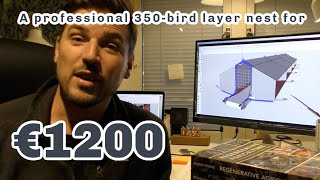
Richard Perkins redesigned a 350-hen nest box for €1,200 instead of €6,700 to €67,000. The new design uses welded wire mesh, cheap steel tubing, 3D-printed rollers, and plastic for the egg belt. He plans to add partial automation with solar power and timers.
Chapters
Well, happy New Year, folks. Welcome to 2021 and I hope you had a great festive period. I just wanted to make a quick video today to update you on our nest box project. So late last year I put up a video about trying to design a new low cost nest box for people doing pastured eggmobiles in the style that we've promoted all around the world now with Bruno Motick from GreenTools Tech in Croatia. Now, that was a very early draft and I think he wasn't really expecting me to put it out online. I just thought it'd be great to get your comments and feedback and it really was helpful. And the design has changed a lot in that time. Now, a lot of the design features that have changed were things that we naturally came across immediately in thinking about it, and then your comments reflected the same thinking. So I wanted to show you a bit what Bruno's got to at this point. And we're at a place now where we think we can start building the first prototype and I'll hopefully be testing that throughout 2021 and we can develop and see where it goes from there.
I did the design that I'm completely satisfied with and it's much, much simpler. There are much less parts and it's going to be much cheaper to produce.
So the real beauty of this design is I think Bruno will be able to probably retail this at about €1200. Now, a box of this size for 350 hens is going to set you back €6,7000 if you buy from modern producers. So this could be a really great opportunity for those of you that are wanting to do eggmobiles on pasture and want to have a system like this at an affordable rate.
DAs boxes themselves are made of this thin sheet galvanized laser cut parts. But they are totally different now. And if I remove them, if I hide them. What we have here, there's a piece here. What we have here is a structure that's based on these frames. So I'm going to move it over here just to be able to see it more clearly. So this is just a frame that I'm going to be welding and drilling some holes. And it's made of really cheap €1 per meter rectangular tubes, 20 by 20 millimeters. So if I remove the nest mats, I'm going to hide those. What we have here is basically a piece of wire mesh that's welded onto these, let's call them hands that are both. They're doubling as hands for the, for the wire mesh and for the perches. And the idea is that it could be. It could turn. So when you have to kick out the chicken, you turn it. At this point, there's going to be a pin here connected to the metal frame. And then you can just do this. The chicken go out. Okay, so this is how, how the kickout would work. And actually, I think it's a really decent solution because when you add a wood wooden beam here, then it becomes rigid, you know, so it prevents it from twirling. And so regardless, the fact that the wire mesh can bend, it will not bend. When you put the wooden part here, we should have those parts running down the length of the whole eggmobile. And then we should have some kind of parts every 50-60 cm that are going to be supporting the egg belt. I decided to go with this kind of thing. So I'm going to just move it so it's visible. So actually this is part of plastic tubing. It's dirty, cheap plastic tube. We just 3D printed by parts here, which are also pretty cheap to produce. And so we have rollers so there's less friction because the egg belt rolls on those rollers and doesn't just slide and cause more friction. So just for the sake of having a good analysis, I was looking at how this design compares to building it out of wood. And so actually, these parts here, the thin metal sheet ones, it's even more cost effective to build these parts out of sheet metal rather than wood. I think if we compare the cost of material, it's about the same.
Some of the best features in my mind are being able to hang the box to be able to make sure it's level. The now, the eggmobile should be leveled along its longitudinal plane by the support legs. And so one option, if we used stands to have the nest box standing on the floor, would just have lifting systems on one side to balance the nest box this way, assuming you've got the eggmobile level this way. But hanging it gets rid of that problem. And then you can use gravity to level the box and just lock it off at one end to keep it level with a little laser bubble there. And so that's really exciting. We've got a box that's basically big enough for 350 hens, regulation wise. And that should make egg collection once a day and really smooth and effective. Now, I said in previous videos that I wanted to automate the eggmobiles to some degree, because currently we've been going to the eggmobiles four times a day. Now we can Cut that down to two times a day. And so I'm working with Katyl from Heatherhill Farm over in Ireland, who was one of our early students. Amazing things. He was featured on the Farm Like a Hero tour and I'm sure many of you are following him already. But he automated a Ridgedale style eggmobile and also uses a winch system to pull it along between trees at either end of his pasture. It's a really cool system. He's a very smart man and he's agreed to help us with the building of the control boxes for the Ridgedale Eggmobiles. And that's a series of electronic timers and switches to allow a solar panel to charge a battery that will then power actuators to open and close nest boxes, doors as well as level the doors, level the nest boxes and have automatic lighting. And I know he's putting together a short piece online so that people can find all the pieces and go through step by step and learn how to do that for themselves if they want to. And with the proliferation of Ridgedale style eggmobiles we've seen, I think this is a great service to the community. So he's going to be helping us with that. And hopefully at the end of January or middle of February, we'll be installing them in our eggmobiles. And I'll post a link to Catl's work so that you'll be able to do that for yourself if you wish to. Okay, and with that, that's the end of the video. Folks, I hope you find it interesting to have little updates on some of the projects we're involved in. There's so many projects on right now. 2021 is going to be super exciting. I really hope that travel opens up for 2021 for all the amazing events we've got lined up for the year. And I look forward to seeing you in a video soon. Bye for now.