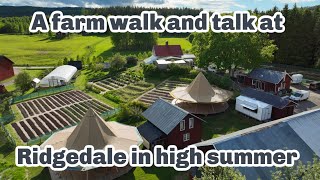
Richard Perkins walks through his Swedish farm after traveling, checking on market gardens, livestock, and damage from heavy weather. Tomatoes and cucumbers are growing, ponds need repair, and he's running trainings on-site while working on pasture restoration.
Chapters
Welcome back to another video, folks. I've come back from Ireland after horrible travels. British Airways not impressed with you overbooking our flight. It made a very long set of train taxi extra flights home. Super happy to be back in Sweden. Weather in Ireland was pretty rough and pretty hard work, but it's an amazing time. Meeting incredible people who own a huge amount of land and resources around the world between us and a really great time and I think we made the best of it. I'm back now in Sweden. We're running a market garden. No dig market garden. Training an amazing group from around Europe and further afield. And I want to just give you a little update because things have grown a lot since I've been away. Okay, machine is back to fix the problem. We got new blocks, so I'm hoping Nicholas, who was here in the first five years of the farm, is coming to visit next week. I'm hoping we can catch up and do a little functional work getting this wall fixed. We got some heavy thunderstorms and heavy rains again, but I've got a solution that we won't end up in the same problem again. Bit of a mess. Time to fix it. It's going to save my back. Okay, Eric's saving the day. So we've dug out the wall. Very nice. We've got some more of these tropical thunderstorms coming, so I might put a tarpaulin on here that drains the water straight into the pond floor. So we don't have any of this subsiding if possible. Because I'm not going to build a wall until next week when the training's and we're just scraping off the profile here to fill in here to save my back from digging by hand. Very happy for this machine. So first things first, Eric, the digger driver's done a really nice job just coming doing overtime after his day job to help remove the wall from the swimming pond. And basically next week, I'm thinking to rebuild this wall. I've got a few plans. A lot of people have had suggestions, ideas. Basically, as soon as the line is in this, I'm not concerned about the walls in here at all. And that's why I've put these tarpaulins. We're having these tropical thunderstorm events where we're getting massive rainfalls in a very short period of time and then baking hot summer sun. My aim with this is because it's a large catchment, any rainfall that comes will just be diverted straight into the floor. And I'm hoping this wall doesn't Cave in before I get round to building the stone back up. It probably will cave in a little bit, but I've got way too much on and so that's just the way it's going to be. But let's get on the surron and zip around the farm, have a look what's going on. So we've got super nice training space. It's a really nice group and this is the first training I've actually run in these new structures because we didn't run trainings last year. It's working out great. We've got the screen, the whiteboard, and it's obviously a market garden course, so we're out and about in the gardens the whole time. But it's really nice environment for doing these trainings. And long summer evenings, swimming in the lake, saunas. It's perfect. So you might remember us talking about the deer I've been watching on the cctv. I've got little cameras around the farm and I've been watching this deer come in every day between 1 o' clock and 5 o' clock in the morning. But most of the things that's after netted off now you can see the peas are a disaster. They've been taking the growing tips off the peas consistently and I figured it's actually been going under the windbreak. Deer's never been a problem for us because we've had people here and the market gardener busily working away. And because we're homesteading this year, there's less human smells and less presence. Major damage is, yeah, eating some of the kales here, but there's obviously plenty of kale and it's definitely hammered that the peas normally be a full stand, fully bushy. Would be picking a lot of kilos of peas a week out of there, but not a big deal. And that's the way it is. I haven't seen it come for the last few days now because we've got people on the farm for the training and the garden's looking great. Nadia's been doing a fantastic job. She's been mainly responsible for dealing with the garden stuff and it's looking fantastic. Okay, first stop on the tour. Have a look how things have grown in here. So we got different varieties of tomatoes coming on strong. They got a little bit stressed. It's been a very cold spring. We've had hot days but very cold nights and that's impacted things a lot. You can see we've started pruning lower leaves and that's looking good on this row. We've got basil, parsley coming in underneath, and Kate's been responsible for this. She's been doing a great job, actually. We've got cucumbers coming in from force now, as well as melons. We've got some physalis here and some other herbs, but tomatoes looking great. They're on a weekly schedule now, wrapping them and taking off suckers. And you know the drill if you grow tomatoes or if you've seen this channel over the years. But they're really doing great now and setting good fruit. So super happy with progress in here. Oh, yeah. It was a rough start for many plants and growth is slow in the market garden. Generally, it's been slow for pasture growth and slow for grain growth around this region, and you can see it in the crops. It's now end of June and we would typically have been selling for weeks now. And a lot of things just aren't ready. Partly that's because we're homesteading. We're not putting the same amount of energy and precision into what we're doing because we just don't need to. And it's also just the weather, and it's probably something that a lot of you are experiencing in different regions, funny weather patterns, and that's going to be increasingly common, it seems. So grass is getting out of hand in different parts of the farm. We're understocked. We just don't have the animal numbers to deal with it. But I'm actually cutting grass for the first year ever and I'm going to be mulching it as a fertility. When you mulch the grass, you're fertilizing because we don't have enough livestock. That's the way we got to do. So pasture boilers are doing good, although because the birds were stolen, we're a few. Well, about a week behind. We got a pasture poultry training next week where we're going to process a lot of the birds. They're going to be smaller on average than they would typically be, but they're looking good. Birds are healthy, birds are happy. Hey, nice cool evening after a hot, hot day. So berry yields are going to be raucous this year. This is just the berries just coming in. And these plants have put on phenomenal growth given the season. So this is looking pretty dense here in front field and through the gap in the trees here we will see. This is where the broilers have been running through the little gap here. Their little egg mobile sits. So these guys are moving on tomorrow. You can see the grasses. This has been grazed with cows and sheep not so long ago. But with a small flock you just don't have that trampling effect. They're actually going to move right around the corner. And I've actually had to cut the grass with a lawnmower, something I've never done before in my life. We're just totally understocked with livestock, with the herbivores that save us that kind of work. But I've just used my electric lawnmower to do that. I'm waiting for my mulching machine to come. It does a good enough job and I want the birds on a little bit shorter grass for better fence to have better electricity in the fencing. But these birds are super happy. I was very concerned at the start of this year that we would have predator issues with aerial birds. I've talked a lot in previous videos about the critical mass. When you have 400 birds in 250 meter nets. With our original egg mobiles that's high risk for a predator bird to come and dive bomb. But when there's so few birds they're an easy target really. The birds are in super prime health giving us amazing eggs and no predation yet. So happy about that. So in the grounds where the birds have already been through this is Coxford up to my eye level. And this is really heartwarming to see because we started here on really pretty degraded pastures that hadn't had animals for a long time. And to see the expression I'll just turn the camera around so you can see that this grass is 1.6 meters tall. And it's amazing to see what's gone on. Timothy just going to flower here. Wow, amazing. This really warms my heart because it's just incredible to see the changes With a couple of applications of a keyline plough and holistic plant grazing with multi species at high density at full production, 1200 egg laying hens and up to 4 or 5000 broilers and cows and sheep passing multiple times. And this grass has now obviously gone seed. So we'll be trampling it down where we're grazing and I'll be mulch cutting it to fertilize to. I'll basically be mowing similar to how we would graze so that it grows back in a way that's appropriate for grazing. Having these tall grasses really helps with the berry fruit. So for example here the currants are sort of tucked away that the birds don't find them. I've actually been cutting along here just to make it extra accessible. And ripen up this fruit. We've got a lot of fruit. We're going to go and look at these honeyberries over here. So this whole walker's row is honeyberry. Beautiful crop that we have up here in Scandinavia. It's an elongated blueberry with a hint of black currant, hint of honey. Just look at the fruit set on this. We've got a man here from Jerusalem who hasn't eaten fruit for decades because he's so disappointed by modern fruit production. But I'm hoping some of these ripen up so that we can give them some flavours from the north. Down at the bottom of the field, this is the pond that's filled by siphon from the main pond and I've been letting it dry out a little bit. The kids love catching young froglets and looking at the aquatic life. You might just see a bunch of young frogs and things zooming around in here. But I'm actually going to fill this up. This siphon's from the other ponds that we use for the market garden irrigation, but the siphon has stopped. So tomorrow we're talking about water in market gardens and irrigation setups and all the different things we might consider with that. So I'm going to re establish this siphon by using the market garden pump to pump through, cut it off and then re establish that siphon and fill this back up. But there's an interesting ecology that happens on receding edge ponds. So this is fine. This is a pond we don't use for anything other than wilderness and natural habitat. Quiet evening on the irrigation dam. So water inflow has slowed right down. Now you can see the overflow. It's barely ticking over. It's been wet weather, so we get big inflows and then we get drying off. This pond I've been hoping to get into and just clear some of this weed. I've been saying that for a couple of years now. Time takes away. I'm curious if there's still the trout that I put in here, the beck uring or the little brown trout that live in the streams. But I need to get in here and see why the water inflow is not happening. It can be that the pipe gets clogged up. There is a little inflow you can see here. And maybe at the other end of the piping, it comes from the stream that's actually downhill from here, like it's deceiving. This is why we use laser level. So if you look at the water level, the stream is 3 meters downhill. But actually if you go 40, 50 meters up, the stream is above the level. So we're just basically running stream water in, overflowing it back to the the stream. What a beautiful sight. Now. So this pond is the source of the irrigation water for the market garden. We've got a couple of rainstorms in the next couple of days. But irrigation pretty critical to success in crops. Hey. So on our way back down through topfield, just can't keep up with the grass. Let's get in behind here where we've got the nut plantings. Just have a look at the past around there. So this is where the animals have been and they're jumping tomorrow onto a row like this. You can see these nut trees are 3 meters tall. So they've got a good stand of forage to go through. I haven't even been up into the forest paddocks. Nicholas is coming next week. Who was the right hand man to me here for the first years at the farm. Super excited to see him. It's been a few years since we've hung out. I want to get up in the treehouse and see if we can fix that up. We've had leaks in the roof and to be honest, haven't been up there for a long time. Life's been busy and I want to just get around the farm and just remember things. So there's a lot of memories imbibed in the landscape here. So super looking forward to that. It's super lush to go away for some days in the height of growth and just see what's happened over time. I'm walking through nutfield to where the old eggmobiles are standing. Let's have a look. So this is where we were last grazing and there's a lot of forage still standing. We're totally understocked but this is a beautiful landscape. It's really nice to come up here in the evening time and look across the landscape. That's when you really see the insect life. The old eggmobiles sitting here as monuments to all that's been going on. But fantastic growth in some of the nut trees. And we've even got flowers on some of the chestnuts and some of pecans. Some really good growth. This is a savannah planting and it's doing mighty fine. Turkeys are sleeping in the gobbledygo there again. Like the layers, they're moving, the gobbledygos moving within the fence for a few days before we move them on to a new patch. The birds are getting big. They've only Been here a few weeks but they're already at the sort of size that we would typically send them on to customers who typically want five and a half, six kilo Birds rest because most modern people don't know how to cut down a bird for the table for the freezer and that's about the limit of most people's ovens. But these are homestead birds so I'm growing them on and they're going to fill the winter freezer. I really love turkeys. Compared to chicken it's a much more desirable meat. And you want to brine that. A lot of people have had bad experiences with turkeys because they can get dry from roasting them easily. But you brine them. I take a 10% salt. I'll put a kilo of sea salt in 10L of water and I'll brine them for 24 hours in the chiller before I cook them. And it's the best thing. Try it, it'll change your. All right. Walking up past the piggies and this is the patch that I've compared over the years that you'll remember. But just look at this. Trees topping over 10 meters. Trees on 2 meters still brushwood. It's a beautiful evening today. But this has really taken off in here. Now it's on a wide angle so everything is probably scaled funny but you can see at this time of year it's dense but underneath it's pruned low so you get light to the floor. We've got some raspberries and sub species coming back in. There's a lot of grass and forage in there and the pigs have been digging but it's a lot of pasture from bringing in the cows. We're using pigs as a ecosystem trigger. Then we brought cows and sheep in repeatedly and rested the ground and turn it back to pasture underneath these trees. But the growth in here is rampant. If you look at this compared to what's over the road, absolutely different. And let's go and look up at the neighbours field. I've been talking about this for years. Those of you that have followed the channel over many years will remember that these fields are what our farm started out like. And the transformation is why earlier in the video I was showing you that tall grass. These are all the same species of grass. And this is what our fields looked like when I came here. And it's just breathtaking to see how you can orchestrate a symphony in the pasture. So they've cut this one little strip here, but look at this. Same species These are topped out 30, 40 centimeters, no forage here. You know, that's what happens when you take animals off grasslands. And actually this will degrade back into pioneer shrubs like the willows here. And obviously it wants to turn back to forest. But this grass is, you know, we. I showed in my book and videos the top of the top field was just ladies mantle, no grass at all. This is grass, it's just topped out at hand height, it's smothered with thatch. No animals on the landscape and land degrades. I've shown that over the years because it's just amazing to witness. Like when you come to my fields, if you don't know if you're new to this and it's an untrained eye, you just think, okay, there's a bunch of grass. But when you've witnessed all the changes that happened from intelligent and timed planned grazing with animals in the right place for the right reason, along with the mechanical kickstart of our keyline plow to break up subsoil to allow air and water into the subsoil that allows plants to root, release their sugars, create life, creating topsoil from below. It's just amazing. That feels so just in tune with my landscape to have been working as an ecosystem engineer in that way whilst producing incredible quality food. And it makes me very happy and I've been happy to share that. If you haven't followed the channel for long, there's over 600 videos on the channel and you can look back and see all the steps we took and all the enterprises we've run. There's a massive amount of free content there for you and it's just vlog style, so you have to really go through it if you want the juicy information. But a massive amount of information for you there. Alright folks, that's a wrap. I've got to get to bed. We've got early start tomorrow. I do all the animal chores in the morning with the participants if they want to join and then we've got full days of training. It's pretty intensive and I'm really looking forward to the next few days with this team and I will catch you in a video soon. Don't forget to check the links below. Subscribe, share videos if you enjoy them. You can find out a whole bunch more in that book. See you in a video soon.
More from Richard


A review of short and intensive season on a mixed farm and restaurant/event space in Sweden






Alskade Kyckling Exploring complexities of poultry production in Sweden and what we stand for


