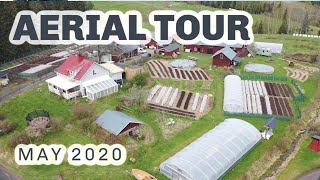
This content was created by Richard Perkins. This content was uploaded by Richard Perkins. This is a YouTube video titled "AERIAL TOUR: May 2020" created on May 4, 2020, featuring Richard Perkins giving an aerial tour of his farm. The video includes a detailed description of the farm's layout, activities such as tree planting, and interactions with other individuals like Ragnar, who finds a slow worm. The video provides insights into farm management and the impact of livestock on land.
Chapters
Welcome back to another episode. Today we're doing the aerial flyover. We got the Mavic with the Hasselblad camera, so that's linked to my phone. And we'll just do a flyover of the farm and I'll talk you through what we see. Okay, so this is what the farm looks like. This is where you come into the farm, the little road that comes in. See my little sailing dinghy there? We've been out fishing, taking the mast off her this year. And you can see a lot of the beds are starting to get planted now. There's a lot undercover. So this time of year, if we fly up to the new and old north beds, which are these ones, you can see our new compost shelter there, which is working great so far. And we haven't put up these caterpillar tunnels yet. And that's mainly just wanting to get some water into the ground because it's been so very dry these weeks. Quite a lot of onions gone in now with the paper pot. And you can see a lot of beds here under cover. So these beds, this is the new north and the old north. They are totally actually on neighbor's land. Can just see the quad bike driving off down there. So someone is off to feed birds and then they're just passing that truck there up on the hill. There's a team planting trees on the clearcut on the neighbour's land. We can fly over, actually, and see what's happening with the hens. Now, you'll remember from past videos, it's very rare to see hens on the video because they're aware of this drone even when it's a very long way away. So it's time for their afternoon feed. But they will probably panic if the drone gets too close and they will likely run everywhere. Typically they run under the egg mobile, but what can happen is some of them might spook and run into the fence. So we'll get close as we can, but I don't really want to create a major problem. So these birds are sitting and taking quite a few days. You can see the spot they were in previously, or two spots they were in previously here, just to the left of the eggmobile, where the quad is, and then up the top, you can see where they were.
Right at the.
Very top, and then they've been some days in a new spot. And the reason I said in other videos is we've wanted to let the ground take a beating just at the start while the grass gets growing, rather than move them all the Time right now and have them impact the grass negatively everywhere. So they're getting their afternoon feed. We could zoom up over here now actually and just see if they're planting trees still. So this is the clear cuts when we cut the forest along with our neighbors. And you'll see probably if you look closely, the tree planting going on there. You can see all the dots where they've been working away. And that marks the fence line, the edge of our property. So our land is starting to germinate. People have been asking about there. There's a lot of flurries of germinations that we'll see really grow up over the summer. But it looks pretty barren still up there. Well, they went through fast planting up there. That's all the neighbours land. And then you can see we've got cows and sheep out over on the neighbour's land here. This is what we call cave one coming off our farm. So the trees at the bottom of the picture here are our land. And then the field, the cows and sheep. Just the cows now are on is the neighbors. That's K1. But we can also graze this bigger field, K2, and also K3, which is the field that goes here up towards their house. So the riparian, the land around the stream, that's what marks the boundary of our farm. Below us now is top field. And you see the boilers are moving through there. And you can see the lanes above where the broilers have been has already started to recover. And the grass is a little bit greener there. You can see the tree lanes clearly.
Mr. Snakehead. Don't catch me.
Ragnar's here. Ragnar's got a slow worm.
Ragnar's got a slow worm.
Not worm.
Well, well, it's a lizard. It's not a snake.
It's a legless lizard.
That is a beautiful find. Where did you get him?
Under a rock.
Under a rock. That's a great place for them to hide.
Good job, my love.
Can it bite?
No, can't bite coming back down. We'll see. The pond is nicely full. A lot more plants growing in here now. Really see them coming up here. And that white, the white bucket there, that's like a float on the market garden.
Look at my little bucket with a little snake in.
Wow, you're so good at finding stuff. I'm just talking through what we're seeing on this video, love, so that people can have a tour around the farm. The lilies are just coming up. Things are starting to really kick into life there. And you can see the hot tub that we've been repairing. Wow. Hot tub is still holding a lot of water. That's fantastic. Coming back over the riparian, we get another look at the gardens here and the young orchard below us. It's looking good. Everything's clean, how it should be. You can really see the onions here. Probably we'll get these tunnels up this week or next week because there's been a lot of rain recently, so the ground's really got hydrated, which is fantastic. Over here we have east and west and south beds with that caterpillar tunnel up in the south. And no yurts up this year because it's just a small team. We don't have interns, so no need to have that up. We've got the tunnel with some good crops in. Can just make out through the plastic there. But we'll have salads ready for sale next week. We've been eating them ourselves. Then at the end of the tunnel here, there's the remains from the chicken bedding that's composting down. As we fly away from the farm, you get a much better indication of how our grass takes off compared to the neighbours. And that's mainly because of the inputs from the livestock over the years and the grazing management. And we've also got less thatch on the ground because we're grazing in a very planned way. So you can see our farm's like a little green blob. Just show you around the landscape around here. So we're surrounded by these hills of forest with virtually no one living above us. And then this is the big lake of Freeken that goes all the way to our local town of Sunne and goes all the way down towards Karlstadt area, which is the place we sell most of our products. About 45 minutes away. It's a very long and quite deep lake. And then this is our local lake where we go fishing and have barbecues. We had our first barbecue the other night, which was very nice. I'll just give you a view flying over where you get to see the tree lanes, the shape of those. You can see some damage in front fields. We had the cows in there when it was very wet during the winter. We didn't really get iced over, so they caused a bit of damage in the field. They were then moved to the forest. They were in the larch patch, which.
Is this little oblong shape in the.
Middle of the frame.
So here's another vantage from the back of the farm. And we'll fly down to that turning Circle to have a look at the difference in the forest there, but the field below in the pale yellow, that's exactly what our farm looked like. This one here before we moved in. So this is the one I reference in videos throughout the season because the grass is just always stunted. But it's the best simulation of what our land looked like. And you can see the contrast quite clearly there. All about animal impact and putting multiple species and their manures on the ground. It's absolutely transformed this space. It's really great to have that in the background as something to show people what our land used to look like. As we come down to the turning circle, the forestry on our side to the left is so remarkably different to that on the right. They were cut at the same time, but over on the right you see a lot less diversity and much smaller trees. And you can see a lot of the brash, the wood from the sides of the trees still lying on the ground, as well as forest floor plants like blueberries, etc. Our land is now full of pasture species and forbs from bringing the cows and sheep in after timely pig disturbances. And you can see there's no brushwood lying around. The pigs have dug that over and that disturbance has started the decomposition. And then just look at the tree growth on the left. Many more species and much better growth from the animal manures. And no brash. You can see the piles of brash lying in amongst the trees there. But on our land, you've got a view through the land from the animals browsing up to head height. And then much bigger, stronger trees of a much wider diversity. And all that pasture underneath that we get a lot more value out of from grazing than you would from having the same amount of timberland. And yet we get all that timber up on top too. So pretty remarkable thing going on there.
Just flying over the boilers again.
You can see the daily impact they have as we come back to the farm centre. So just starting spring growth, but things are looking great.
Okay, that's it for the aerial farm tour. Not so much to say about things, but I think it's really great to see month to month how the changes happen from the air because it's quite dramatic. Ragnar would like to show you his.
Slow arm come and you can show on the camera.
I think it loves the water.
I don't know if it wants to.
Be underwater, but it's also, it needs. It's cold blooded, so it doesn't want to be in your hands too long. You have to be extremely gentle. Maybe just sit it on your hand like this. It's still waking up because it's quite cold outside. That's a great find, my love. But you should put it somewhere where it can not get scared.
Why should not put it where it is hot?
You can put it on the stone.
That's a nice hot place. Ragnar is enjoying finding lots of insects and aquatic life. And we're having some pretty peaceful days at the farm. So thanks so much for watching, folks. You can find out a lot more in our book and our online training in the links below. We'll see you in the video very soon.
More from Richard


A review of short and intensive season on a mixed farm and restaurant/event space in Sweden






Alskade Kyckling Exploring complexities of poultry production in Sweden and what we stand for


