Richard Perkins sets up a brooder for 1,000 chicks with precise temperature and feeding schedules, then plants hundreds of trees and bushes including apples, pears, and nut varieties. He uses mycorrhizal inoculants to help establishment and documents the spring work on his farm.
Questions this video answers
March 28, 2021.
Approximately 1,000 chicks (arriving Monday).
Pens are 10 m2 each; regulation-based stocking allows 250 birds per 10 m2 at three weeks.
About 32°C under the lights.
Approximately 210% funded.
Chapters
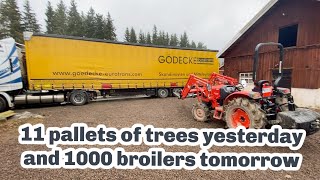
We finally cleared the yard. Five months later, the yard is clear. Look at that progress, moving things from A to B. Okay, dusty work this morning. We've cleared out teepee stuff and other junk and we're setting up the brooder for a thousand bears coming Monday. So the brooder is set up a few days in advance to keep it warm or get the bedding warmed up. And we'll fill the waterers up on probably Sunday morning to get them warming up too. We're putting down sawdust, very dry sawdust, and then walking it to compress the surface a bit, get it level and firm, because the little chicks, when they arrive are too small to be able to deal with anything lumpy or too fluffy. We don't recommend straw for this reason. It is too lumpy for tiny chicks. They do much better on wood shavings. We have to then lower the lights down and set up for feeders and drinkers. Got a weigh station here and it's going to be the first time we've had a batch of a thousand for a couple of years. We've been doing smaller batches and still with a bird through ban, they are likely to go straight into the tunnel. Hopefully the ban will lift before they need to actually come out. So these boxes are all configured to be 10m2 surface area. And everything's obviously based on the regulations so that when the birds are three weeks old, you can have 250 in 10 square meters. So each of these pens is tessellated to fit the shape of the barn. And that gives us the right space. And we're trying to get the birds always out onto pasture in three weeks time. We can be very careful Temperature records in here often at the start of the year. Certainly when we're starting early like this, it's a big deal just to get the building warm enough, it needs to be about 32 degrees under the lights. And so that's why we start putting the lights on a couple of days early. Now I have explained precisely how to do this in dozens of videos in the past. If you look back on our channel. Also written extensively in detail about all of the considerations in our book Regenerative Agriculture. So you can check that out if you haven't read that already. But we would expect highest mortalities in the first batch of the year. That's always been the case here because there's no biology in this carbonaceous diaper, as Joel Salatin would call it. And so what we actually do at the beginning is leave the bedding dry like this. We follow our nose and our eyes. As the birds get bigger, they start shedding exponentially. So we're adding litter according to what they need. And you can do that by, as I said, sight and smell. Use your senses. But then what we do is we flip the bedding. So in the industry they would take out all the bedding, sterilize the entire shed with chemicals. What we do is we take birds out, add a watering can full of water evenly across this 10 square meters, then we will fork just lightly. We don't turn the bedding over, we just fork to make sure it goes in. And then we'll add another couple of centimeters of new bedding before the new birds come through. And then we found that mortality always goes down because you start to have biology. Think about mimicking the biology under a mother hen's wings. She's sitting there with her wings over her chicks who run out and come back in and there's a whole lot of biology going on that keeps that system healthy. It's biology and microbes that keep all systems healthy when you think about it. Okay, Saturday morning, just cleaned the yard up. 11 pallets of trees. Perfect. Well, I would say that is lucky we cleaned the yard. It's also very lucky that we have a tractor because they didn't tell us we needed to have anything to unload it. But we would have been stuck without that. I've gone for, well, all kinds of things. A lot of bare root currents, but I've tried to get a lot of potted things because that takes the pressure off having to plant everything in a manic dash which we just couldn't handle right now. Some berries to replace varieties of gooseberries that just haven't done well for us. They haven't grown much. I've got a huge amount of aronia to go on the backs of tree lanes to produce a crop, crop for jams and wines, etc, a few nut trees. And then we've got a whole load of oaks and there's some specimen big birch trees I'm making an avenue with just for, for fun. But quite nice plants. They seem like they've had a big old journey from Germany, but they seem to be. Yeah, these are root balls so that keeps them good. So it's only the currents that are bare rooted. So we'll have to get them in the ground. Well, it's thawing up so pretty soon. Few spot plantings for the windbreak. It's the only time I'll plant spruce just to block up the winter Winds. Unfortunately, this truck is way too big. Now. They never tell us what size vehicle is coming, which is a pain because they've totally mashed the front lawn. And we're probably going to get in trouble for this because the road is. All the ice is melted that the road is super soft at this time of year and you're not actually allowed vehicles this big. And so we'll probably have to pay for some repairs and hard to avoid because we just don't know what size truck is coming. But this is obviously a very heavy, heavy vehicle for a little soft road like this. Seeds are getting full. Got some little rice germinating. Chomrong rice from 2,200 meters altitude in Nepal. Hayayuki Krasnokovski. And some weird numbered rices. It's gonna be fun. We got lots of chards, kohlrabis. It's nice. We didn't have kohlrabi last year. People don't really know what to do with it in Sweden. But it's such an incredible vegetable. It's almost like a melon. Really nice. Kohlraries, leeks and brassicas. Cheeky rosemary. And yesterday, Selma seeded all the tomatoes. That's a big day. A big milestone in the year. Got a lot of different cherry tomatoes. Trying idli again after our experiments last year. That did not turn out to be idli, but that's my favourite tomato of all. So hopefully we're back to normal. I noticed that some greens here is green. The rice. Yeah. We're gonna have paddy fields. Do you like that idea? And we're gonna live in a lot of greens and a lot of trees. We just got thousands of trees and bushes to delivered. You gonna help me plant them all? Yeah. Nice. What do you think? We need to plant them? What do you think? What do we need to plant the trees? Soil, water and a spade. Okay, so lots more birds in the tunnel now. That's a good sign. Still a lot in the eggmobile. They're getting water changed in there and feed. We've been on the phone with Carol who's been helping us to sort the timers out. So lights and doors are automatic. I think I had them on back to front. So we did get the yard all tidied up. Moved all the timber for the second teepee down there. Found the instructions for this teepee. It's going to be quite logistical putting it up on this deck. We've got canvas under there and some of the different pieces. It's going to be a bit of an Adventure putting this up. These are the wings that stick out like a witch's hat. So it's going to extend a couple of meters out from this platform to give you a sense of the scale. Pretty impressive. It's hopefully going up next week, but on the other side of things, we've just got the yard filled up again. So agroforestry at Riddsdale. We've got all of our tree lanes running top field in the back, front field here. Mixtures of apple, pear, plum, cherry, different berry fruits either on both sides of the trees or on the front. Got an orchard. Half the farm is actually forestry, as well as all the new forestry that we purchased this winter. So what are we doing with more trees? Well, different things. There are aronia here that are going in place of hazels that got nubbed out by voles or the drought that we had. We've got a few thornless BlackBerry, which we've never had here, but the neighbour's got some wonderful rampant growth. Thornless blackberries. We thought we'd give them a try. We've got some bareroot currants. These are black currants of the varieties that we prefer to replace, some that we don't like so much, as well as some hinamake red. That's a gooseberry, which does really nicely for us to replace green gooseberry that's just never really grown since we put it in. Then we've got a lot of American blueberries. We've got some trees for filling in gaps in windbreak, some apples that are sort of ornamental apples for pollination. Three different rhubarbs that we're actually putting in the east and west beds in the market garden. We're turning the whole east and west beds that are slightly elevated to the sun. They get very hot and dry, you'll remember from previous seasons. This near side is all in flowers and asparagus. We're putting the far side into chives, rhubarbs and things like that. I've got some ornamental trees to put as avenue plantings, further using unutilized parts of the farm. Now, many of you will have heard me speak about the benefits of bare root plants in that they are much cheaper to send around the place. A currant like this is worth a couple of euros. But the downside is they need immediate care. These need to be kept moist and get in the ground as soon as possible. I've spent a little more on potted plants to alleviate the stress at the start of the year, because these obviously, while they might have detriment to their roots. I've chosen potted things that are pretty hardy, like Erronea. You can drive a tractor over it and it will still grow fine. So not so worried about root balled container grown plants there because it relieves the stress of having to get all these plants in the ground next week. My experience over the last years in Sweden is that the weather fluctuates so wildly year to year. I mean, we can have snow in June, folks, so it's happened before even. And yet we've got an early start this year in terms of all the birds here. We've got a thousand laying hens, sorry, a thousand broiler chicks tied, turning up tomorrow morning and we got all the yurts and structures to build. So I wanted to specifically alleviate some of the stress for spring planting. All this bare root stuff needs to get put around the north side of the building, hopefully slow it down a bit. I'm going to keep the roots moist by wrapping them up and just spraying them with water. I'm not going to bed them down in compost, which you normally do, you heal them in. I don't want their annual roots starting to grow. When you start to see all these white fine hairs, you might just see a few popping up on some of them. Then it's very easy to damage them when you plant them out. And so I want to alleviate that because the ground in the fields is very wet. So my strategy is keep them moist, put them in a more shaded spot, get them planted next week. Basically excited to try highbush blueberries. Now Sweden's full of wild blueberries in the forest, but these are much bigger and definitely marketable. And through the Rico rings, things like that, we've also got a bunch of ornamental plants. So we've actually got this alpine Ribe species which is commonly it's a non edible like currant like leaves, but it makes a wonderful low hedge that's going to go as a hedgerow around the front of our garden because we've always been a bit concerned with a young child running out. Where we have the lime trees that are pollarded around the front of the drive, we want to fill that in between the trees with a hedgerow so that no one runs out the road and gets squashed, etc. So lots of planning to do, lots of structures to build, lots of chickens to introduce. Now I have talked extensively about our tree prep procedure, putting trees into new pasture in our book and on videos a long time ago. We're using things like root Inoculants for mycorrhizal fungi as well as micronutrients to get that fungal interaction happening with the trees. Lots of peer reviewed studies showing mycorrhizal fungi can increase the root zone of trees by 5, 600 times within a matter of weeks. Obviously those natural associations happen anyway, but it can take 5, 6 years for them to establish. On the tree plantings we're doing now, we're planting a lot of this stuff back into land we prepared originally for tree plantings. We're replacing things that have either been eaten or things that just haven't performed that we want to put in things that we know perform better. And so we won't be doing very extensive work. We'll be getting those trees in the ground fast. We've already established mycorrhizal fungi in those lines. We've already put down lots of organic matter and trace minerals, etc. So we're just going to be planting at a rapid pace, maybe some light mulching, etc. I'll do some video stuff as we go and get things in, but we won't be putting the sort of time and procedural work in that we do when we plant into truly new ground. We were doing batches of 500 birds last year and so it's been a while since this brooder has been fully operational. These are four 10 square meter pens which is just big enough for 250 birds in each. At the age they leave. It's all based on kilos per meter squared. So when the birds are three weeks old, they're just reaching the limit of what we can put in here. Birds come tomorrow. We've had the lights on since yesterday and this is warming up nicely. We've got a thermometer here. We can just check temperatures on the backs of the birds and under the lights. Oh, seems like the battery's gone on that then. We have our cheat sheets here. This is last year's cheat sheets, but we have printed out folder with record keeping. I'll just bring this out into the light. You can see so down the side. You find this in our book Regenerative Agriculture. The number of birds and then each day the amount of feed, how many times to feed them, the amount of starter to grain, etc. And so it allows you, if a couple of birds die in a Buddha, you can easily calculate the food without needing to calculate it. We use very precisely weighed out feed measurements and we find that that's much better than giving them access to unlimited feed for a certain amount of time. I say that every year when we make videos containing broilers, etc. That's really been my experience. It's worth the extra time to weigh out, feed and really be precise. You get much better performance from the birds when they're fed a few times a day and they get hungry in between they forage a lot more. That's really important and it's something we stick to here. Now, those boilers were will end up in this tunnel if the ban hasn't lifted. Now we are still seriously hoping that ban will lift by the time birds go out or very shortly afterwards. These broilers will be run till late May and if it's still the case that they're in the tunnel at that time, we will cancel subsequent batches. Probably because it's going to be very hard to keep good conditions in there. But we'll see. It's there was a week without cases, but then there was another case right in the south of Sweden. It's unpredictable how things will go. As we've said in other videos, it's always lifted at the critical time for us. Except this year we're early with both chickens and broilers because we took a winter off without eggs. We want stock and our customers to get their supplies back again. And we have no stocks of frozen chicken, etc. And so that's the plan. Will keep you updated. Who knows? It's going to be stressful and interesting and it will be the same for thousands of small farmers around Europe. So I think it's always good to share these things. Whatever's going well, whatever's going challengingly but exciting time, lots going on, super busy days in the. In the walking veg chiller, we got a hundred apple trees. I got a really nice deal from a local grower getting rid of excess stock. These are field sized trees. They're growing on Antonovka and good varieties for here in the cold. We've got all of our tent teepee canvases and our new yurt canvases made by a local sail maker. These are extremely nice quality sowings that I can't wait to show you up in the forest. Lot of planning to do folks. It's that time of year. Well, I've spent a long weekend in the office and I have finished putting in the extra projects for the Ridgedale builds book. We're now up at 210% funded nearly. Folks, it's incredible. Thank you so much and it's been really inspiring to get the plates of this together and I'm getting it printed out again as a mock up book. So this is just homemade. I get back the pages and I use an angle grinder to cut away the edges of the paper to give it surface area. And I glue a cover on just so I can feel it in my hands like I did with Regenerative Agriculture. I printed out dozens of these. It really helps to hold it in your hand and to feel the book and get a sense of it. But every project is now in. I want to print it out to go through the final editing so that we can really check. Everything's good to go. It's been such a massive project. It's a huge file right now. It needs compressing down a bit because. Yeah, really excited to bring that to you folks. So over on Kickstarter, I was updating people. I've been speaking to the printer, looking at whether we can do spiral bound or hardcover book. I want it to be able to lie flat open on a desk. It's pushing the edges of what's possible with spiral bounding because it's such a thick and heavy book. But actually on an update I put on the Kickstarter campaign, all the responses immediately said we want a hardcover book. So I think that's the decision we'll go with. We'll put this in a thick hardcover and because it's such a wide spine book, it will sit flat on the desk and it will last way longer. I think with such a heavy book, the paper would have to be very thin for spiral binding and it will just start falling apart and we don't want that. We've got just less than two weeks to go, folks, if you want to get your hands on a copy of the book. With all the amazing projects in here, with detailed CAD drawings and measurements and cut lists, you can find how to build all of these things for yourself. Thanks so much folks for your support. Look forward to some videos in the coming weeks. With all of the planning and building we got to do, it's going to make for some great footage to share with you folks. So thanks very much folks. See you in a video soon.
More from Richard


A review of short and intensive season on a mixed farm and restaurant/event space in Sweden






Alskade Kyckling Exploring complexities of poultry production in Sweden and what we stand for


