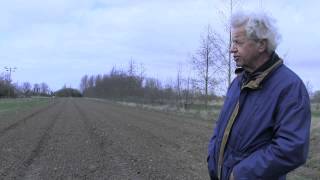
Martin Wolfe discusses his work on disease-resistant crop varieties and variety mixtures, which were widely adopted in East Germany during the 1980s before collapsing after 1989. He describes his shift to agroforestry in 1994, planting alley-cropping systems with coppice and timber trees that sequester carbon while supporting woodland birds and requiring no external inputs.
Questions this video answers
1984
1994
1997
About 350,000 hectares in 1989 down to about 20,000 hectares the following year.
Approximately 12 metres (with one system at 18 metres).
Chapters
From my PhD at Cambridge, and those times I got particularly interested in the kind of population biology of plant pathogens. Particular one being powdery mildew, which attacks wheat, barley, oats and so on, from the point of view particularly of the way in which a pathogen was able to overcome new resistant varieties as they were produced by breeders. Problem being, of course, that as soon as a new resistant variety was produced, it was advertised, lots of people got excited about it, everybody started growing it. And of course, once you establish a large area of monoculture of a particular resistant variety, you then start automatically selecting for mutants or variants of the pathogen which can overcome that resistance. One aspect of that that got me particularly concerned about what was going on generally, was when a number of chemical companies started announcing that they had new systemic fungicides which would deal with the problem completely. The breeders could stop worrying about disease resistance, we could use the fungicides and everything would be great. Wouldn't it seem to me obvious logical nonsense in exactly the same way, because just as there are variants in the pathogen overcome resistant varieties, surely there will also be variants that will overcome the effect of fungicides. We heard that one of the companies at the time, which was then called ici, was producing a new range of specifically mildew fungicides. So we talked to them and managed to get some samples of these fungicides before, this is important, before they were introduced commercially. And we used those small quantities of pre released fungicide as controls to test isolates of the pathogen that we were picking up from all over the country, really, using a special kind of spore trap fitted on a car roof, which was great fun in itself, actually produced a lot of information very quickly. We did that work and lo and behold, we found that there was indeed resistance to these fungicides already existing in the pathogen population before the compounds were introduced commercially. What we then realized and discovered was that within the chemical company there was clearly a continuing battle going on between sales departments who wanted to sell as much of this new material as possible as quickly as possible in order to get a return on the investment, and scientists who solved problems and therefore were prepared to think about strategies. But also certain of the science group didn't believe what we were telling them, and they went to extraordinary lengths to produce experiments which suggested alternative explanations for what we'd found. To cut a long story short, I mean, the chemicals were used commercially, they weren't used in the best way they could have been, and they were lost to the industry fairly quickly, not quite as quickly perhaps, as some of the Resistant varieties, but they were lost. But that sort of insight into what was happening in a large corporation supposedly trying to do something positive farming really made me think, and has made me think ever since. That then led to the development of the work that we did on variety mixtures. As I was describing, if you just make a mixture of three different resistant varieties, physical mixture of the seed and plant it, you get an enormous dramatic reduction in the rate at which the disease will spread through a crop. Yeah, it's more complex than that, but, I mean, that's the basic principle. We did a lot of work in that sort of direction, which was taken up by the East Germans, so that during the 80s, the whole of the spring barley acreage in East Germany was grown as mixtures very successfully, led to massive reduction in fungicide use and therefore fungicide expenditure, which was concerning the East Germans at the time. That disappeared practically overnight in 1989, when the war came down, the Berlin Wall and unification in Germany occurred. But it meant that the dominant West European way of doing things, with massive monoculture, not only of varieties but of fungicides as well, was allowed to come back in and dominate what was happening in East Germany. The scientists in East Germany who'd been involved in developing the Stormy Obsidian were really frustrated and angry about the whole business because it went from 350,000 hectares in 1989 to about 20,000 the following year. Absolutely extraordinary. But it was then actually in, I remember fairly exactly, it was at a staff meeting in Cambridge at the Plant breeding institute in 1984, senior staff meeting, where one of the physiologists just happened to mention the word agroforestry. That really got me going in terms of thinking about it. In fact, not long after that, the Plant Breeding Institute at Cambridge, as it was then, was effectively handbagged by Mrs. Sacher and closed down. That drove me to look for another job and I was very fortunate to get a position at the ET hau, the Swiss Federal Institute of Technology, in Switzerland for nine years. So Anne and I moved to Switzerland at that time. But we really did get an opportunity to look at the work of the Swiss Federal Institute for the Swiss Institute for Organic Agriculture, called Feeble, which was very interesting indeed. There some very good work, very good people working there. And I became responsible for introducing a course in agroecology at the etihauer. But all the time I was kind of thinking about the agroforestry, how we could do that. I tried to make a sort of approach to that in Switzerland, but it Proved to be extremely difficult, mainly because of the incredible price of land. So we actually started planting in 1994 while we're still in Switzerland. We didn't come back full time until 97. By then the trees were certainly. The hardwoods down here were really nicely established. The systems that we've got here are all alley cropping systems. So in other words, lines of trees separated mostly by about 12 meters of crop, alley cropland, all orientated north, south to minimize shading. That's the basic structure. Within that basic structure we've got two coppice systems. One with hazel, one with willow. The idea of those being that particularly with the willow, you can harvest from a double row willow every second year. They're growing in these narrow hedges with little competition on either side. They grow very, very fast and they've withstood a two year cropping cycle now since 1998. So with most of that material we use for chipping to be used in our wood chip boiler to provide simple heating and hot water. But we also sell a lot of willow as well, which actually pays for all the harvesting and care that's needed to grow the crop, as it were. Then there are the two Hardwick systems which are really producing timber, which can be used for building furniture, anything really. And then the other systems really are what one could call, if you like, fruit and nut. Using trees that produce fruit or nuts. For instance, in Northfield over to the west there, we've got a mixture of walnut and plum. We have a wide range of varieties, which means that we get a long season of plum production, from the early ones to the late ones. Walnuts, they're also coming on stream nicely, but the squirrels have noticed that as well, so we have to deal with that problem. But you know those three types, if you like the fruit and nuts straight from the trees themselves, long term use of the timber or a short term coppice approach, all valid and useful in their own way. So where I'd originally thought we'd look at all these kind of separate systems, well, I feel what we all feel now very strongly is that a farm that has all of the systems together is even better because you're more insured against the weather, you're more insured against the markets, everything else. It was a stab in the dark, going for the 12 metre size, but in fact I think it was a rather good stabilizer actually. We have got one system which is on 18 metre alleys rather than 12. But my feeling very strongly is that 12 metre alleys give you A very intensive interaction between trees and crop. As soon as you go wider than that, that interaction drops off quite markedly. I think probably. 20, 24, 28 meters would be the maximum you really need or want to have. What we call Hazlefield for a fairly obvious reason, fairly well surrounded by hazel. And this is what's called an alley cropping system. So we have an alley, which is nominally 12 meters wide, in which we can grow standard organic crop rotation. But the whole thing is orientated north, south. The reason for that simply being that we minimize the shading. They're wide enough for all standing machinery. The one bit of modern farm machinery that won't fit very easily in here is a sprayer. But since we don't need to use sprayers, that's no loss. And the trees. Well, it's. In each case, it's a double row of hazel, what we call production hedge. Well, it was all cut by circular saw on the back of a tractor. We. We have a power takeoff driven chipper goes on the back of the tractor so that we can chip hazel willow, blow it into a trailer, carry it back to the farm into a large hopper where it's fed automatically into an Austrian wood chip. And you can see from these white canes, they mark the ends of plots. So there's about roughly 60 small plots in here. So it's a replicated trial to look at wheat bean mixtures. We've had experience before that wheat bean mixture is a very reliable crop. You can't necessarily predict whether you're going to get more wheat or more beans. That depends on the season, but it is reliable. One of the things that really concerns us here is that in a ridiculous kind of way, in this country, we grow quite a large area of beans for human consumption. And all those beans are exported. They're exported to Egypt, North Africa, Japan, all over the place. And we don't eat them. We import a lot of green beans from Africa, don't we? Yeah, yeah, yeah. We think we need to be finding ways of really supporting and pushing production and use of these sorts of beans. In the country itself, wild animals are grazing grass on hillsides or using up waste food or whatever it is. That's fine. But as soon as you start committing the production of cereals as a crop to feed animals, then it becomes very inefficient. This is alley cropping again, exactly the same kind of layout as before, but this time we're using hardwood trees rather than the rather softer coppice material. It's a mixture of essentially Seven different tree species actually, all laid out as a randomized block design so that we can do experimental observations on neighbour relations between, between the different tree species and that kind of thing. So oak ash, wild cherry, sycamore, Italian alder, small leaf lime. Why do we have this mixture, this range? Well, we don't know when we plant trees like this, what's going to be popular in 50 years time when they are mature. Also, in terms of tree interactions, we know a bit about some of these interactions, but not enough by having the trees in this kind of arrangement. What we're doing in essence is if you like growing woodland edge, if you ask ecologists where the action is in the countryside, then it's woodland edge, known as the wood forest or woodland, is trying to spread outwards and whatever's outside is trying to spread inwards. Then there's lots of activity and interaction going on. The understory we've left to run by itself, which has been interesting in itself in the sense that I was very nervous at the beginning when we started this, that we were underneath the trees, we were building a reservoir of arable weeds, which was going to be a real burden for the cropping system. And initially that looked to be the case, but of course you have to be patient with these things and in, well, very few years really the whole thing started to evolve and change so that now we've got the kind of stagnant, standard woodland edge understory species and the arable weeds which require disturbed land, they've all disappeared. Not only that, but that woodland edge habitat has provided the perfect habitat for all sorts of small rodents, beetles, you know, you name it. The ultimate being that birds like barn owls, tawny owls and so on, are very happy living on this land. It provides all that they need. We've got a really complex ecosystem or set of ecosystems building up here. So although we're only 60 acres or thereabouts, the bird list is something of the order of 50, 55. On this relatively small plot of land surrounded by big broad acres, monoculture, where there are relatively few birds. The crop rotation that we've got on this farm is not a commercial one. The reason being that we have quite a lot of EU project work on cereals, where we're trying to develop cereal populations. Well, in fact, going to the opposite extreme, rather than having a field where every single plant is identical to every other, which is nonsense in biological terms, the sorts of crops that we're trying to develop, every single single plant is different from every other genetically. Our wheat Crops are hugely heterogeneous. Now, to do the experimental work, to develop all that kind of thing needs lots of these small plots on these alleys. And if you have lots of small plots with different treatments in each small plot, it means that the end of the season you've got a real patchwork of weeds, no weeds, more nutrient taken out of this patch than in that patch, and so on. So what we need to think about is how do we get that plant back to some kind of uniformity. So for that reason, we have a, after the cereals we have a two year lay and then a year with potato. Then after the potatoes we have another two years lay and then we go back to cereals. So that by that time things, you know from experience, things are pretty uniform again. An important point, which I sure didn't underline really about this farm, is that since we converted it fully to organic at the end of the 90s, we have brought no inputs onto the farm at all. Absolutely nothing. The way that we modify the fertility around the farm is when we're in the lay phase, we harvest the grass, clover mix and take that to a site where we can make it into compost. So the whole thing becomes a fully functional, complex ecosystem delivering all sorts of things. The yields tend to be slightly higher than average, but they're consistent, whereas many individual monoculture varieties between seasons, if it's a dry season or a wet season, so it is a way of mitigating climate change to some extent. The trees in the system as well. What we're doing here really is capturing carbon and storing it. And provided the root system is undisturbed underground, then that's a huge carbon gay which isn't in the atmosphere. And if the timber is used for building furniture, no more permanent sorts of products, then carbon stays captured.
More from Richard


A review of short and intensive season on a mixed farm and restaurant/event space in Sweden






Alskade Kyckling Exploring complexities of poultry production in Sweden and what we stand for


