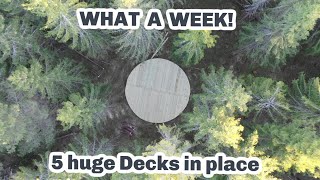
Richard Perkins documents a week building forest platforms in freezing conditions, installing bases for 9-meter yurts and teepee decks. Each deck requires 2.5 tons of timber and 4.5-meter beams that need mid-span supports on steep frozen slopes. He uses a Rhino winch vehicle, gets new yurt canvases sewn, and previews larger 11.6-meter decks coming next.
Chapters
It's another below zero morning and we are on a mission to see if we can get all the forest platforms finished by the end of the day. Okay, so I think last time we checked in, we've got the three small teepee decks done and cleared up that side of the forest. This side, we're working on the 9 meter yurts. And one of the commenters on the previous video was correct. We've had to come in and put extra supports in the middle of these long beams because they're four and a half meters. So we had to fiddle around with that for an hour today. But we'd already got a bunch of decking on yesterday. We've just gone because of the situation with how far we'd progressed with the building, we've just stuck in posts and beams and connected each of these beams to that post, done that on both sides and that eliminates any bounce. Now the floor is certainly strong enough anyway, but it was a little bit bouncy that we don't really want that movement. So we've done that on this side as well, under here. And now we're progressing on. We should be able to do this in a couple of hours and then hopefully we'll leave enough time to make a really good start on the other yurt and we'll be able to get that support bracing in much better because there's no decking on that one yet, so we'll see how the day goes. But these are mighty decks. There's about two and a half tons of timber in these decks and it's important that they are sound and aren't wobbling, aren't moving. We've had a bit of issues getting timber up here. You can see possibly, I don't know how well the camera makes this up, but this is a very steep slope that we've got to bring up all the decking on. And essentially underneath this moss is just frozen ice sheet. And it's rather steep up here, so I've managed to get loads up, but I've had to use a winch to help pull me up from a tree here when I've just lost traction. The rhino is incredibly powerful. I'm super impressed with it as a general workhorse around the farm, but it doesn't have much weight, so whilst it can pull a couple of tons with no trouble, it's not raided for that. I must stress it's rated for pulling three or four hundred kilos, but we pull our egg mobiles, which must weigh a ton for the last years with it. And as long as you know how to drive it carefully, the fact that we're only going slightly forward every day, it's not so much stress on the machine. We've never had problems with this machine other than people driving with the handbrake on, which is €120 a time, or pressing the diff lock when you're driving. And that's a big €1500 mistake. And that happens quite regularly. I've treated myself to some new seat covers that I'll put on here this year because this absorbs rain and you get a wet butt. But if you go and buy these seats, about €180 each. The thing is, with these machines, I mean, we bought this for about €10,000 with 500 hours on it when we first started the farm. It's been well worth the money. We've used it in place of a tractor basically to do all the sort of fast, quick operations around the farm. Totally invaluable tool. Way more traction and pulling power than a quad bike. But they make their money on the parts. If you go out and buy all the parts for this machine individually, it cost you over a hundred thousand euros. So you can see that's where they make their money. Still, we managed to get wood up. If we stick to about 25, 30 of these decking boards, which are about three and a half kilos per meter, then we can get it up here. We're going to try and find a new route to this platform. We can't get up this steep bank, but we can probably come up the big road here and make our way through the trees because we've got a narrow load, but we'll get to that when we get to that. Okay, next load going up. That doesn't look like a lot of boards, perhaps. Maybe it does to some of you, but that's probably 450 kilos or so. So we'll see if we make it up the hill. We've still got probably all this to go up for this first yet, and then all this for the second yurt. That will then reveal the big timbers that will make up the frames for the yard finally. So back to Winchin. You can see it's pretty steep to get up here. And look, we're on just frozen layer right underneath the moss here. So it's just skatey. I've got no grip on my boots. It's treacherous, but we'll make it. Got us a pair of soundbox. These are maybe a little bit overpriced. For Bluetooth speakers, but they last for about 35 hours. They're very loud. The aim with these is to be able to hold trainings while we're so social distancing, you know what I mean? And to be able to do dances and events and take them to the west coast and have parties in our little bay. Why not? But it's great for working outside. Podcast time. Alrighty. Done. Look at that. This is a huge deck. It feels a lot bigger than the previous ones. We're starting to get aches and pains now. A lot of repetitive motions. Ah, what a beautiful thing. Lunch time. Okay yet. Number two. So this is our solution. Might not be the best, but it's what we can do in the circumstance. We've got a bit of wobble in the outer quarters because the length of these beams, four and a half meters. So what we're doing, putting in. This previous year, we put in three posts and beams, but this one we've got longer timber. We've actually gone from the corner post to another post in the middle. We're going to do the same there. And that just holds up these beams really nicely. So I'm going to connect the beams to the beam underneath. And this is obviously a taller platform. It's the tallest one of all. Except for the huge teepees in our yard, they'll be even bigger. I might even choose wider dimension feet for that one. But once we got the angles to support it, I think we're going to be good to go. We're not going to get this done today, but we'll see how far we get. And William's here for a couple more days, so we've definitely got the opportunity to finish this and mark out the big TVs. That's the supports in. So that really makes the frame rigid now. Can't do it easily on both sides because of the angles, but there's no wobble in this frame, so it's good to go decking on. All right, we got half a ton of timber on here. Not sure I recommend others to do the same. We're overloading the machine a bit and we are going totally cross country. But we got to get this timber up here, keep things moving. Made it so you won't be able to make out our pathway, but somehow we're getting up across the ice, up through these trees, just clearing the sides of the trailer with these four and a half meter boards, and then we're able to get down over this log. Now, this is the tree we felled the top of it. We haven't been bothered to remove it. We're just hopping over. That's the beauty of this rhino. We've got base plate armoring on this so you can hop straight over things like that. And it protects the chassis. So that's good as long as you don't doink the ankles. But I haven't been, I haven't had the energy. I'm getting so tired after this week's work. And then we're able to get down this ditch. So we couldn't get up here and certainly it's too steep with a heavy load. But we can get down here and out that way so we can do a whole loop back to the farm. So it's perfect. So nice to see the forest coming in. The vision coming into manifestation. First injury of the day. Put a T25 drill bit straight in to me finger just where I need to hold screws. So good. We're doing okay. We got little sore backs, little sore knees. Pretty good progress there. Now, before we put the yurts up on these platforms, we need to put a lip wood bent around and that's to hold the khana. The crisscrossed wall sections of the yurts, they butt up against it and make the circle perfect on the base. And this winter I actually employed a local sailmaker to sew new covers. I always, when I used to make yurts as a small homespun business, I would use an old Singer sewing machine by hand. I would work on the slide using a tarpaulin to create a slidy surface and drag 50 kilos of canvas down, doing a seam as I went. And I used this kind of seam that you have in your jeans, but with double stitching, not triple stitching. And I got dab hand at making the seam with one hand whilst spinning, man. And that's exactly what we did with our big yurts. Johanna and I made the two 9 meter yurts for about €4,000 in about two weeks. And she helped with the sewing of the canvas in the last few days. And I did all the woodwork. And if you go out and buy a yurt like that, there's about €20,000 here in Europe. So it's a really good deal. And it's been amazing spaces to have on the farm. They're going to go up here, but they've got brand new canvases. We've had ours outdoors for seven, eight years now. And whilst they're still working, they start to get little wear holes and we put silicon in the gaps, etc, but because all the tent teepee teepees that we've got in this beautiful olive drab color, we decided now's a good time to switch out the. To switch out the Y covers, have some new sets and have everything in the same color formation. It's going to look really smart and neat. And because we're renting these out, it's important that they're looking top notch. And the old white covers are getting quite green with algae. They'll be great for replacements. Johanna's got an old frame over yet that she started building before we met but has never finished. So maybe they'll go on that one. But super excited to see them. They're going to blend in super nice to the forest surrounding here. It's going to be really beautiful. So this tree that we found is about 40 years old. It's always interesting to look at tree rings. You can see here. This is a tree that's grown up in a plantation in shelter from the wind. Often when you cut down a tree in a strong prevailing wind exposed area, you'll see the growth rings oval out with compression on the side of the wind and better growth on the leeward side. You can see this has grown up protected. It's interesting to look back and correlate the growth with the climatic data for the region because you can see good years of growth and bad years of growth. It's always interesting. There's some trees in here that are probably 10, 20 years older. There's a bit of a mix. All right. We're going to call it a day. Lights fading but I reckon that's an incredible weeks work. William has been a start. Couldn't have done that without you. It's been long but we've achieved an awesome week's work. I think to have this platform completely finished, the three platforms over here completely finished. This one we'll be able to do by lunch tomorrow. And then we're on to putting down the markings for the great big decks that are going in the yard now. They're going to be 11.6 meter diameter. They're going to be huge. We're going to take the lessons from today with extra bracing underneath to make them super secure. One of those is going to be on flat ground, low to the ground and the other is on a bigger slope than this one. So we'll take what we've learned from building these and make those super sturdy. They're interesting because unlike a yurt where the weight is very evenly distributed around the whole slope. The teepees are probably much lighter, even though they're huge, because they're only made up of a bunch of poles, without all that hefty roof structure, etc. But all that weight will be concentrated on one spot on the ground. So we'll have a think about that and see if we need extra reinforcements in places. But I am done. We are spent. I am spent. It's been a long week, but I'm super happy with the progress and it's just. Yeah, it's been amazing to really push this vision forward. Beautiful days. We've got a few more sunny days and then looks like rain is coming. Still frosty at nights, but the seedings underway. We've put in all the leeks, the spring onions, using the paper pot system for that. And next week it's kales cabbages going in. So I'll take you on some video tours of seeding when we get round to that. And yeah, you can find out more in our book in the links below. Regenerative Agriculture. We're shipping that around the world, or there's a PDF version for instant download. You can find out about online trainings, free trainings, paid trainings. We just finished the Regenerative Agriculture masterclass that's run for the last two months. It's been an incredible experience, a lot of amazing work people have been doing and we'll be running that next winter. So you can sign up on Richard Perkins Co if you want to be told when new announcements are being made. And we'll look forward to seeing you in a video soon, folks. Bye for now.
More from Richard


A review of short and intensive season on a mixed farm and restaurant/event space in Sweden






Alskade Kyckling Exploring complexities of poultry production in Sweden and what we stand for


