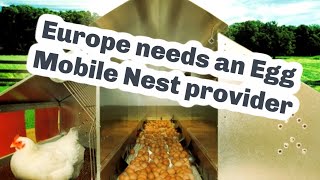
A YouTube video by Richard Perkins (Dec 18, 2020) describing a collaboration with Bruno (Green Tools Tech) to design an automated, low-cost rollaway nest box for eggmobiles used in pastured poultry. The prototype is modular (1.2m units), includes detailed engineering elements (e.g., 7.7° angle, parts list/laser-cut counts) and is early-stage — intended for feedback, prototyping and potential Europe-wide manufacture.
Chapters
Welcome back to another episode, folks. Now, if you've been following our channel over the last years, you'll know I always have a whole load of projects on the go and often there's dozens of projects happening that you never hear about. But today I wanted to tell you a little bit about something we're working on regarding eggmobiles and automated low cost nest box. One thing I'm interested in doing is funding the rapid prototyping and design and manufacture of nest boxes designed specifically for people with eggmobiles doing pastured poultry and see if we can't get something that's shippable all over Europe. To you folks, it's been amazing over the years to see how many people have picked up our simple low cost eggmobile structure. And you'll remember recently I made a video detailing some of the designs around the world that we've inspired. I've seen hundreds more and it's a real pleasure to see all the people's feedback who have read our books and have started their businesses with that. Here are the first 50 that got sent in. Thanks so much everyone for that. It's so cool putting a video together of all your eggmobiles inspired by Ridgedale design. And it would be so cool to be able to help to pioneer a new rollaway system for super hygienic efficient egg collection and be able to get that out to people at low cost. It would be, yeah, such a gift to the world and Bruno's the man to do it. The eggmobile has been a great success that hundreds of other farmers have taken on and are employing with great success all over the world. And our nest boxes are simple, low cost homemade rollaways. But it would be so cool if they could be automated and have a higher level of functionality. So I turned to my friend Bruno over in Croatia who runs Green Tools Tech to see if we can't come up with a modular design that could be shipped out at a reasonable cost to people across Europe. Now for those of you that don't know Bruno, I met him in Croatia when I was over there running a workshop at Zeno Organic Farm with David Page and I interviewed him on the Farm Like a Hero experience. He's a tool maker and innovator in the permaculture and regenerative ag space and he's busy shipping out broadforks and gridders and all kinds of market garden tools you can find on his website in the links below. But I sort of challenged him to see if he could come up with a design for a modular nest box system based around 1.2 meter standard units so that people can purchase the right size for their flocks and eggmobiles. And so it's something we've been working on. And I'm super impressed with Bruno's work. So I asked Bruno if I could share a bit of the video he's made recently of presenting the design he's come up with so far. This is still a really early prototype. There's too many working parts, too much fiddly faff stuff that needs to be trimmed down. Looking at using rivets instead of screws and things like that, trying to make it simple and low as possible. But I'm just super impressed by Bruno's work. And I think you'll agree he's done a great job with starting to really think through in detail how this could work.
You can see there are lots of details, small little details worked out. Like, you know, all the holes for the bolts. There's slots somewhere instead of just round holes. I worked out all the tolerances so the things can slide on top of each other. I worked out where I need to weld and where I need to put the screw, like here, like connecting this perch. So you're familiar with the boxes themselves? Yeah, I worked out the angle of 7.7 degrees. I worked out the egg space, the part that added a lot of complexity. And as I was working on it, it became more and more complex. So, yeah, I added this system of automatically getting the chickens out during the night, and I came up with these kinds of structures, and they are held by this rectangular tube, and it's inside kind of bearing. I will probably come up with a better solution than this. This is way too complex with lots of parts. So by turning the rectangular square tubing, you can adjust the angle of this thing here. So I designed it in this manner, and it consists of two parts. I mean, four parts, two of those and two at the bottom. And so as you rotate the rectangular tubing, this thing here turns. So this is just the visualization. And as you turn it outward, it locks. It becomes sort of rigid because of there's a. There's a pin here, there's a rod here that doesn't allow the motion of this. So there's. There, this is that rod here, this one. And so as you turn it outward, it becomes rigid and it sticks out a little bit. But as you turn it inward, because of the gravity, this part here stays in the upright position. And this allows to make use of the space as much as possible. Because if this was all in one piece, if it was rigid and you could close it up to some maximum angle and that would not make up enough space for the chickens to lay eggs. I just. I suppose so this could be turned even a little bit more and lifted up so that there's. So the whole area here is free for the chickens. And yeah, as I said as I was adding functions to became increasingly more and more complex. And I don't think you can even get a feeling of how complex it is by just looking at the drawing. So I'll show you the parts list. It's a mixture of part list and processes list because I have to have both, so it's easier for me to keep them in one spreadsheet. Here I can adjust the number of sections that each eggmobile has. You know that we discussed 1.2 meter sections. And then automatically I can get here the number of parts that are needed. So only laser cut parts, you can see that they're 458. That means that is for both of your eggmobiles and all of the sections, the segments of the egg boxes. So, yeah, please let me know what do you think about the design?
So whilst this is in the early stages of development, I thought that's a great time for you folks to have some input in the comments below. And I'm also very curious what you would pay for an eggmobile setup suited to your eggmobile, say 350 hens, our standard Ridgedale design. What would an automated nest box be worth in such a setting? So lots still to think about and Bruno's already well on the case with that. I'm looking to fund the process of getting the prototypes made and testing them as well. But my dream is really to be able to get something as a product available for people around Europe. And it depends on a lot of things, including price and how willing Bruno is take it up. But I thought it's well worth sharing this part of the adventure and just let you know some of the things that go on behind the scenes. I often have many projects like this going on that I just don't tell you about until they come to fruition. And many times they don't because it's just too complex. But I'm really passionate about trying to get solutions to people and to be able to collaborate with other skillful people to get things like this together is an awesome joy and a privilege. And so I wanted to share that with you. That's it for this video, folks. Thanks so much for watching. Don't forget to hit subscribe if you haven't already, and you can find out a whole bunch more in the links below, including our book Regenerative Agriculture, as well as online trainings and free offerings there in the links below. See you in a video soon.