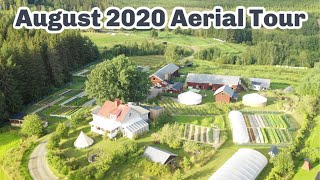
Richard Perkins films an aerial tour of his farm on August 11, showing teepees, yurts, market gardens, grazing paddocks, and compost operations. He walks through practical decisions like buying used yurts and managing compost turnover, and mentions an upcoming Joel Salatin master class.
Chapters
All right, well, it's 11th of August, folks, and I'm just sitting in my hammock with my drone and I thought we'll give you an aerial tour of the farm in August. Just come off the phone with Thore Jaarde over in southern Norway. I made a video back with him on YouTube a couple of years ago and I've been loving the Farm Like a Hero tour. And for those of you that are watching, we're approaching the 100,000 subscriber mark, which is amazing. And many of you are not over@farmlikeahero.com with us. So please consider coming and joining us there. It's a very low cost membership site. It's €99 the rest of the year. We're interviewing 75 of the best regenerative farmers in long form conversation. And we've got weekly Q&As with myself about any topics to do with farming, wherever you want to go with that, as well as a private learning group. So come and join us over there and I'll give you a little tour now of the farm in the middle of August. You can see on our front lawn we've got the teepee up. I can see my daughter Grace just running around there. She'll probably be up here soon. This is one of three tent teepees that we've had. Hey Grace, I'm doing a video, you want to join me? Okay, come and sit in the hammock. This is one of three 10 teepees that we've got for doing like an Airbnb. Here's Gracie, come over from England. Gracie, last time people saw you on the channel, I think you were doing your acorn challenge. Do you remember? We got all those amazing acorns and people have been growing oak trees all over the world from that. Anyway, look, here's the 10 teepee. So we've been sleeping out in that. It's very comfy and I love yurts and things. You can see the two yurts that we used as our classroom and dining room. But we bought these three to rent out. They were normally about two and a half thousand euros. We got them for €400 a piece. So we bought three of them. They were seconds because they're sun bleached, but that's no big deal to us. They'll be sun bleached the first year you put them up. Beautiful space. It's got great ventilation. You can put a wood stove. I've got a wood stove for each of them and I just bought a spray gun, an airless spray gun to paint this roof black. Because ever since we moved here, I've hated this horrible red roof. And that will just prolong the use of it. So I've just been investing in climbing harnesses and safety gear because eventually I can paint all the roofs of this barn. Now, we got quoted by a painting company just to paint the red roof that you see here. €1,000. The climbing harness cost me €1,000 and the paint's about €100 to do that roof. So much better investment. In my mind, I can hear Ragnar in the background. We're just going past the compost bays and we'll see if we can get a look down in there because we just sieved the first load of compost. So two turns. Here's Ragnar coming. See that middle bay there? That's all been sieved. Sieved. That's two turns in 12 months. And it's beautiful stuff. So that third bay. In the third bay, we've got this year's fillings, and we're tapping that off with some old silage. Now the first bay where that material was sieved out of is getting filled up again. So probably about 10 cubic meters a year we can fill out of here. I see little Ragnar up there, and Grace wants to show you her snake eggs. They've had grass snake eggs that they rescued from the compost. But I'm not going to be able to get too close to there. But they have been hatching out and they've been watching every morning. It's a good 30 grass snake eggs in there. So they've been taking good care of them. We'll zoom around, look at the gardens now. It's looking pretty beautiful in here. The irrigation's on right now. You can just see on the left of the picture. We'll fly through that. Hopefully not getting too wet. So the gardens are eased off. Now it's mainly about replanting the odd bed and harvesting. Pretty bountiful time of year. We'll zoom up in the air now and you'll see the new north be. So we got a bit of extra wood chip on during the farm scale design course, and that really makes it all pop. It's been dry again now. We've been having a lot of dry weather. I think the crew are just having dinner over in the yard here. We've been eating outdoors because it's so nice and sunny. They're in the little green tent in the middle of the square there. That's where we've been eating our meals. Nice job keeping the grounds up. Kept this year with grass cutting, etc. See the crops in south beds, these are the paddy ponds that we've just basically never kept up the maintenance of because rice is photosensitive so it doesn't grow well here. We actually got rice to seed up here at 59 degrees north by giving it night blankets and covering it up at night times. But it's not very efficient way to grow rice. Bit of fun. You see the east beds are all down to asparagus and the bottom eight beds there and then flowers in the top. And we've decided we're going to put west beds that are here into chives, rhubarb, other perennials because these beds get very dry and hot. We just don't need those beds in production. So I think that's the change that will come next year. Right in the middle of the picture now you see the veg chiller that's been working wonders at the edge of the veg packing station this year and that's been a great move. That's in the middle of the picture now. Next to the workshop is the old chiller room. It's not very far away from the washing station but that little bit of distance done many times a day on a busy packing day adds up over time. But you don't want to be doing that. So we'll fly out now and we'll go up in altitude a bit. Alright. Just had to empty the SD card there. You can see front field's in good recovery. Front field got a bit battered in the winter as I've said before by having bale grazing going on in there. So we've just been going through there less intensively this year. The wind breaks up and looking beautiful here. Amazing how quickly that's grown up in the years. And top field where I made a video the other day just showing the recovery. You can really see it's bounced back over the top of that grass that we laid down when the grass was over the cows backs. So we'll be grazing back in here in about a week's time just before Joel Salatin arrives at the farm for the master class. See the boilers on top of the hill there on their trajectory from west to east. And we really wanted to focus a bit of fertility up on the top of this hill. It's just pure sand under there. This whole farm was underwater 10,000 years ago and what you find is the soil composition is very different in different parts of the field. Clay in the middle of the sort of valley shape, as it were, and then sand, just pure sand on the tops of the hills. So this land here was like a very infertile wildflower meadow when we got here. But it's really turning around with the broilers. You can see they're just starting to react to the drone now and they're all running away under their covers. I would expect the layers to already be hidden away. If we look over there, you can see they pretty reactive to the drone. I've always trained the new layers to hide away. And you'll see as we get closer, they'll run underneath there. I don't want to go too close that I might spook them out of the fence. You see all the nut trees, they've had a new mulching and then the recovery is starting to happen. Back up at the top of the field there, Very nice time of year. We'll just spin around quickly. That's not too dizzying for you. And we'll go over and see where the cows are at. They've been over in the neighbours. So we've cut the neighbours land now for our winter feed. We've still got some supplies of wind feed that you see there, but they perhaps spoiled some of those. You can see the cows and sheep here in what we call K1. We had them up in the forest paddock, so they actually really enjoyed being up in this paddock and in the cut forest. We let them there for a few days. You can see the clear division. The neighbours fence line is where you see all the yellowing vegetation. And to the left on that straight line, that's all our land. So we've run them through there for a few days and we've got the male sheep left behind up there. And we're just running the cows and sheep through what we call K1 before we run off to K2 again later in the year. So this is K2, quite a big field in K3 here that leads up to the neighbor's house. We're essentially stockpiling them from the start of August until the end of October. And our aim now, once we've grazed through the land that we're on with the cows and sheep now, is to come back to our land and just go slowly through our land for the rest of the summer now and then we'll have until probably late December to graze through our land. So just panning back across, you see everything's in pretty lush growth at this time. We've had some nice sunny days again but plenty of rain recently. Just fly you over the pond. Hopefully we won't scare those birds that are down near the pond. They're looking like they're huddling away. This pond's just been amazing to see the amount of growth going into here over the last few years but it's all full up and supplying the market garden right now as the pumps are on a lot of wild birds and amphibians. Beautiful summer's evening. All is well on the farm. All right well that's it for the farm tour folks. Hope you enjoyed that. Gracie's got her favorite cat monkey here. I don't know if you'll make her out. She's the best cat Norwegian Forest cat. Hope you enjoyed the tour. We'll update you in a video soon. Thanks so much for subscribing, sharing liking our videos. Amazing to be near the hundred thousand subscribers mark and we'll see you in a video guys soon. Bye for now.
More from Richard


A review of short and intensive season on a mixed farm and restaurant/event space in Sweden






Alskade Kyckling Exploring complexities of poultry production in Sweden and what we stand for


