Automate your Egg Mobile (cheap and robust)
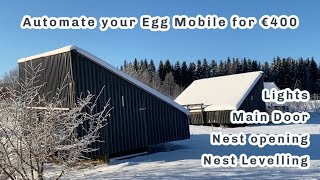
Richard Perkins and Catal Mooney built cheap control boxes with timers and relays to automate Ridgedale-style eggmobiles. The setup keeps things simple and robust, avoiding unnecessary complexity. Perkins also covers winter farm notes and upcoming projects including online trainings and a Kickstarter for a farming primer.
Questions this video answers
400 by 200 (units implied millimetres).
€100 for a three-month sign-up.
-17 (degrees; stated as "-17 out here today").
In about a week to 10 days from the video date.
Chapters
What's up, folks? Welcome back to another episode. It's -17 out here today and it's actually the first time in years it feels like we've had a winter like this. Proper Swedish winter. Oh, it's so beautiful. And it really is nice to be reminded of just how incredible it is to live in such a place when the weather is actually like this. We've had more like English winters the last few years, which is a bit gray and muggy and nothing really happens. There's a whole bunch of things I want to update you on today, so let's get cracking. So, whilst the cold weather is putting my building projects on hold, things are not stopped in the background. So, you know, I've been working on these nest box designs with green tech tools with Bruno over in Croatia. I've also enlisted the help of Catal Mooney from Heather Hill Farm over in Ireland to help with the automation of these eggmobiles. Now, you've seen Catal on our channel before and he pioneered a low tech, robust way to automate functions in these eggmobiles, like turning the lights on and off, opening and closing the nest boxes, levelling the nest boxes, and opening and closing the doors. Now, there's many ways you could obviously do that, but he's developed and now refined a really robust, simple, low cost solution for you. And he's putting together some control boxes for our eggmobiles. And then the beauty of that is that we can integrate them with whatever nest boxes we choose. So my thinking at the moment is that I will trial out a few different options and document all that on YouTube so that you folks can get the benefit of that experimentation. Now, we've seen hundreds of Ridgedale style eggmobiles all over the world and Kato has gone to the effort to put together a short online training of his own where he shows you step by step how to build and where to get the components to do this work. Now, you need also a solar panel to charge a car battery inside the eggmobile as well as actuators for opening and closing. So he's showing you specifically how to build a control box with timers and switches and how to wire it up and do that properly for a simple, robust chicken proof system. And so I'm putting links to that in the description below the video. So I think it's a super low cost training. It's €100 for a three month sign up. You've got all the information there you need. And what's more, when we start to install these on Our egg mobiles. I'll document that process fully and you'll be able to see what that looks like. So it's a really nice job from cattle. He's the sort of guy I wish I could have employed here on our farm. He's super smart and on point and I think a lot of you that run eggmobiles like this will get a lot from what he's been able to put together and can offer you at a very low cost online training.
These boxes are 400 by 200 and all your wires are labeled here. So you connect up to lights, door, everything. And this is your panel. So everything is nice and labeled inside. Very simple, only three swatches. There are three timers, four switches and a charge controller. So very little to go wrong with it. And all labeled. Well, I put a pair of specs cover on them because sometimes if a bird craps or anything on them and you're touching it so often, it's nice to have a wipeable surface so you can keep it clean. The reason why I don't have see through pair specs is because when you're leaving the egg mobile in the evening, you need to make sure that these guys are set to auto. They're actually on off there at a minute. But. And I've done this even for myself, I'm going to change mines over to these because you need to come along in the evening. If there's a glass and you just glance in, you could miss it. Whereas you've got to open it, you've got to check auto, auto, auto, and you've got to make sure that the nest box is set to open and you check that you see it. I'm good for the evening. I've sealed all around here so that no one can get in and flip this one around. Quick look at the back. I also have. It's going to come to you with no knob on it. I'm going to take the knob off for transport. But it's just got a little piece of steel here which the magnet catches so that it clips close. This is what it looks like, sorry, with the light. But it's basically, this is the job. So it's very simple. There's just two relays in the back and our switches.
Well, I think you'll agree that's an amazing job that kettle's done to put that together. Some people have mentioned raspberry PI and other ways that you can work with automation, but really, I think Qatar's approach is really smart. You want simple and robust and you don't need any more automation than that. For the last six years we've been running these without any automation and that works just fine. It's still one of the lowest input enterprises that you could run in terms of the money you get out for the work you put in. And so up to you folks what you do. But I think Keto's done a superb job and it's the way we're going to go with our eggmobiles. Well, it's that time of year where a lot of people have started to inquire about our trainings on the farm this year. Now we have got a whole list of trainings we'd like to run, but Sweden has just announced new laws last week which give them power to affect small businesses, which they've never had before. It's always been government recommendations with no legal comeback. So we're trying to find out how that affects us because our business is quite unusual in that we have workshops outside, especially with our new teepees that lift up and have basically open space underneath. And we have an outdoor kitchen. So we don't know what rules apply to us and neither do the lawyers that the government has working on this. So it takes a bit of time. But we're hoping if we can follow the rules, say, of a restaurant or shop where you have to guarantee 10 square meters to each person indoors. Because of the upgrades in our infrastructure, we should still be able to run courses for a decent amount of people. Now, we need to confirm that before we put them online, but we're hoping to run most of the trainings that we had previously thought we would this year. And we're really excited to be able to host people in a Covid safe way, as far as we can tell what that is. So please stay tuned for that. As soon as we know. We'll be talking about it on social media as well as here on YouTube. And we really hope we can get to meet a lot of you at the amazing trainings we've always hosted on this farm. It's such a special thing that we love to keep doing. So the animals got their winter coats on. Now, some people mentioned on an Instagram post I made about trees being ring barked here, and it's particularly these young spruce that you see and the sheep are nibbling them to get nutrients. Now, do we mind that? Well, no, not particularly, because it's only the young spruce around here. You can see on this tree here, which is larch, which is what this little plantation is actually here. For they're actually using that for rubbing as opposed to chewing off the bark. So it's only these young spruce that they're touching. Now, I don't mind because we're going to actually clear out space in here in order to put a much bigger winter shelter. Right now the winter shelter is over in the trees in the background. But as our herd grows, we need a bit more space and we could upgrade that facility by putting a concrete floor. Perhaps that will enable us to pick up the winter bedding easier for composting it down to put it back on the market garden. We're getting a small compact tractor next week. I'll show you that when we get that. But that's going to help with these kind of tasks in the future. Now, it's mainly up near the feeders that they are doing that chewing. As you get away from the feeders, they're not touching the trees. And so we're not too bothered about it at all because this is actually a larch plantation with a lot of older larch that will be good for timber. Eventually this will be cleared and put back to pasture. Now, some people have been asking about how we water the animals. And this year and as well as last year, we're letting them water in the stream. Now, I'm the first to say that typically you shouldn't let animals into water bodies because of shitting and urinating in the water. However, as you know, if you keep cows and sheep, they spend nearly all their time up at the feeders up there. And so there's very little manure on the ground. I see some manure here and that's what I expect throughout the winter because they're spending most of their time up here, they're not going to be shitting and urinating in the water supply and it's iced over, so they just need a little hole to be able to get to. Now, there are other options. Obviously, if you have electric supply, it's easy to keep water unfrozen and then running water is typically the best option. So if you have a full falling stream, you can easily run water through a pipe and then have it go to a bigger dimension pipe that's open on the top and back to a small diameter pipe that leads back to the stream. And in that way you can keep water running to minus 20, minus 25. We could in theory do that here, but because of the stream and the way it freezes up each winter, I'm not so bothered. I don't feel concerned about nutrients going into the water body because we'll also pick up the bedding from around the feeders and use that as compost. So it's not a concern that we're going to be leaching nutrients, etc. But different options there depending on how you're set up. Well, with the temperatures as they are, the ground is frozen and it's not really ideal for working on building projects. So I've been turning my attention to books that I want to get together this year. We've got a lot of exciting things to work on this season, so one of the book projects I'm working on is turning what was the Hero Experience book into the first of what I hope becomes a series. So I'm going to be launching a Kickstarter in about a week, maybe 10 days time to see if there's genuine interest in this project. And then I would make further books in this series because I think it's such a great resource for people that are new to farming or in their first few years. So really excited about this one. Now these things can take a while. I spoke to my printer yesterday because we also need to get another big printing of Regenerative agriculture done. This 750 page book is a lot of material to print, so it's a couple of months runtime to get this printed in large volume and shipped here. Those of you that haven't read this book yet, it is the manual for defining an era in the words of Joel Salatin. You can find that in the links below and all further book offerings will appear there as and when they come up. But keep your eyes peeled for the Kickstarter. I'm really excited to launch that very soon now, due to a lot of your positive responses, I've started working on the basics of a framework for a book about Ridgedale designs, how we built all these structures and we're just ironing out how we go about detailing and presenting and communicating these ideas with people. There's a lot that goes into putting together accurate plans that are easy to follow and replicate, and we're going to be doing this for about 20 different structures around the farm and look forward to seeing how that develops over the coming months. Well, that's it for this video, folks. I hope you're excited about some of the books we've got planned and I hope to meet some of you at the farm. Don't forget we've also got a whole bunch of online trainings linked below. We've got our Farm Like a Hero package which has got over 100 hours of long form conversations and amazing resource for new and want to be farmers as well as our short online training Start the Right Farm which is very much a business and holistic context, focus training and then you can sign up for the next edition of the Masterclass that will be happening in winter 2021. See you in a video soon folks. Bye for now.
More from Richard


A review of short and intensive season on a mixed farm and restaurant/event space in Sweden






Alskade Kyckling Exploring complexities of poultry production in Sweden and what we stand for


