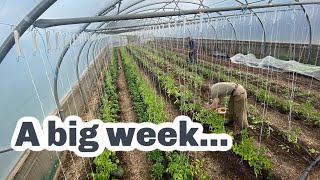
Richard Perkins updates on slaughtering two batches of broilers, processing 400 eggs daily, and transplanting tomatoes and cucumbers into the greenhouse tunnel. Bird weights hit 2.2 to 2.4 kg, and he's treating tomatoes with Epsom salt drench while managing pest issues in the garden.
Questions this video answers
May 22, 2020
About 400 eggs per day
Many birds in the 2.2–2.4 kilogram range
About 25 seconds per bird (≈2+ birds per minute)
Five tablespoons per 10 liters of water
Chapters
Welcome back to another episode, folks. It's been a long week and happiest Friday now we've slaughtered two batches of broilers. They're all packed and off the farm now. We've put out the tomatoes today. Finally with good weather, no frost in sight. And it's a bit of an update about the gardens and other things going on at the farm. So I hope you enjoy and have a great weekend. So currently up to about 400 eggs a day. Still little cute eggs at this point, but they'll be quickly ramping in size as well as number now. But great to have fresh eggs again. We've been eating a lot. Okay, day two, we're doing the birds in two batches this time. We typically will slaughter over three weeks to even out the weight of the birds. The males obviously growing a lot quicker than the females. But due to the planning of leaving to be on the, I scheduled in to be back at the farm for two slaughters. Also we have then the packing that typically happens on the day after. So that added a few days that I knew I'd be back at the farm. So should be a bigger variation in the weights in this case. And because we're slaughtering the birds a bit older than typically, because we had a slaughter inspection before we started, the birds are coming out a little larger. So we've got quite a lot of birds in the 2.2 to 2.4 kilo category. Well, these cukes and tomatoes are getting rather large in here now. It's not ideal to have these getting so large and even producing their first flowers in here. These are, you know, up to 80cm tall now. But however, we've held off with taking them out because we've seen, unfortunately, I've seen already dozens of people that put their tomatoes out early in Sweden and have lost them. And it's been frosty up till recently, so it's just too early. What we'll do is pinch off the first flowers and make sure they've only got a single leader. There's a couple that have developed two leaders and get them all strung up. So it's going to be five rows of tomatoes and three of cucumbers in the big tunnel. So a little milestone within the season now. So it's chicken packing day. We're averaging about 25 seconds of bird, so you can get two and a bit burgers through every minute. We're using these hot water shrimp bags as we've always done and we're actually sorting and packing straight into weight Categories that we sell in because of the new freezer process work out really well to actually sort the weight categories in the chiller. And then the process we're doing here, Akos, is passing the bird to me to make sure I don't get chicken on the outside of the bag so my hands remain clean. And then I just have to expel the air table tie that and give it a second or two in the water, which is set at 90 degrees. And then I can just trim that off. Good to go. Beautiful birds coming out. Big birds because we were a bit late slaughtering us back. So, like everything, it's the little hand movements that make the difference. And you'll see how Akos is presenting the bird to me in exactly the same way every time. And then he's moving his hands to compress the legs because I haven't got any grip. Obviously I'm just trying to get the bag around the bird. And then the hand movement I'm doing to, to wrap and squeeze out the air. It's the most effective way I can find to do that process as quickly as possible. Not sure you're going to hear a word over the crinkling plastic. In that way. With that handover, these bags remain clean and my hands remain totally ungreasy. So there's no trace of chicken on the outside of the bag, which is really important. And then on the other side, I'm passing the birds up to Scales here. Christian then takes the weight and drives the bird. Alex is putting a label and coding on it. And then we're packing into the freezer crates in the respective weight cab room. Okay, so hour 15 minutes, we've got all the birds done except for the ones that we're smoking now. We've got organs, so that's livers, hearts and necks that we're going to pack up. And let's go and have a look at these birds. They're very nice birds. They're packed at five or six to a kanga box and then packed in a way that the labels don't touch or get wet in the freezer. Because even though they're freezer labels, if they get wet, you always have big trouble. So these are off to the freezer space and cast them now and we'll clean down, get the birds in salt, in brine, ready for smoking. Okay, lovely. Straight in here. And because they're very soon in the chiller, they're still at temperature and we'll keep that temperature until we get there. So weight categorized, grade categorized, Straight to the chill. Space birds for smoking, fresh birds for picking up. Already gone out. Beautiful. So out of the old in with the new. There's no large birds on the fields anymore, but we've got the next batch in here. Slightly slower turnaround than normal. We normally have one batch out, one batch in, but we've got a bit of space between batches this year. These are doing really nicely. It's been getting warmer now with the day's temperature increasing, so we're leaving the door open with a mesh here to be able to just make sure they get good airflow and the temperatures are good. We've just raised the lamps up today and they're starting to really grow. Sarah, Let's look in here. Sounding very French. Beautiful. So last year we grew a lot of lettuces underneath our tomatoes. This year we've got mustards, mitsuna, scarlet frills, and it's been the absolute best year ever for not getting flea beetle damage. Look at this mitsuna. It's absolutely perfect. And we have never ever grown mitsuna here without flea beetle holes. We have grown giant red without it once, but normally this gets devastated by flea beetle. This is the best way to eat side of this, shoving it in your face like that. This is the regrowth farm, Scarlet Fields. A mitsuna that we cut 10 days ago now. So you can see pretty good regrowth, super spicy, very nice. One of my favourites, in fact, three of my favorite leaves. So transformation on the flea beetle note, this year we we're not getting any trouble with kales. However, we are getting trouble with compost and it's something, it's a hot topic, problems with compost. But you see all these little seedlings, we think they're young pine seedlings. We're actually going to write to see if they will refund us because that's not so good. Beautiful Pak choy is coming and we're going to see some bigger ones over here. There's a couple of slug damaged leaves, but we had these riddled with flea beetle in the previous years, so hopefully we'll have some really good Pak Choi coming out this year. We've been sending out salads and going through getting the bigger radishes, but there's definitely some nice radish gone out of here this week. And under this one we've got Bacchus, which is a really nice relish, sort of purple. So lots of veg coming on now with the few warm days we've been having, it's Starting to feel like summer is slowly emerging. Lots of crops in the ground since the drone footage, which was a few days ago. There's quite a few more beds filled, but everything under inset net or row cover at this point. It's been a slow start because it's been very cold. I think a lot of people have been having those problems. But I think we made the right start decision with the tomatoes, to not put them out till now, even though they were getting a bit big. But really nice to see Nebraska growth this year. There are different ways you can do tomatoes. A lot of people bury strings under them. I've always just done a big wide knot that will let the stem grow and then wrap it a couple of times on the main leader you can see here. And I don't put any tension on at this point. We're going to water these in with Epsom salts. And they're more closely spaced than the drip. The drip emitters are at 30 centimeters, whereas the plants are at 22 centimeter centers. But once they're established in, they'll be fine and they'll root quite aggressively out to the water. And that's been facilitating us to be able. With two rows on the 75 centimeter bed of drip, we can then grow salad crops below, at least until the plants are pretty big and established. What we'll start doing then, as these grow up now, we will take off the lower branches first up to about knee height, later up to waist height. Taking off the first few flower sets, always pruning suckers on a weekly basis and wrapping them. Some people like to use clips and things, but we found that they just get left everywhere and not looked after. So we just use wrapping and that works totally fine in the beginning. They don't really need any pressure on them. They just need to get bedded in then. And then we will. Probably in a few weeks time, we'll start taking off the lower branches as they put on a bit more new growth as they're in fresh ground. So in the small tunnel. First beans and squash event. Very nice. Okay. I was going for the big release, but they're reluctant. Okay. Made it this far. Now, the gardens aren't peacock proof, so we're gonna have to watch these guys. I think they'll be hanging around here for a while. They probably just go back in where they've been. So final watering before they go out for transplanting. I'm actually doing interviews this afternoon now on the hero tour, but we will catch up with these folks later. Hopefully they'll get them all in today. It's that time of day, so we've got evisceration remains that we pour in here. It's not the most fun job in the world and you never know what's in that tub when it comes, but that's what we have to do. Okay? Okay, cleaned down, good to go. So two slaughters complete. All the birds in the chillers freezer or in brine for smoking. Slaughtery packed down tomatoes going on. It's been a busy week, but a lot done and the weather's getting good. So super excited. Okay, look at that. Okay, important information. This is Epsom salts. Tell me, what was that again you're doing? I'm watering all the tomatoes with it so we don't get like black asico spring called the black rock. Black rock end rock. Yeah. And what's the amount of Epsom salt you're putting into the water? It's five spoons, five tablespoons for 10 liters of water. Cool. That's the information you need to make sure you got enough magnesium. And we will just put that in as a drench straight on as a foliar drench all over the mulch. And you'll remember in old videos if you watch the channel that we had blossom end drop, but interestingly enough, we only actually had blossom end drop in this and this bed. And that's probably just due to the composition of the subsoil under these areas. This was all dug out level from the subsoil, but we're doing five rows of tomatoes this year, then three of cucumbers, so shouldn't have a problem. But we always like to water in with Epsom salts, and then we have enough to put on, you know, later in the year if we need an extra dose. Beautiful. Okay, that's all I've got time for in shooting today, folks. I think the tomatoes will be done by dinner, but I've got to turn this off and get editing. I've been doing over 15 hours of interviews now for the Farm Like a Hero Experience as part of the busy project. Even though we're not on the road, I've been busy working and I'm super excited for that because we've been talking to amazing people doing incredible stuff. And really the point of the unsung hero tour, as I was originally going to call it, we're now calling it the Farm Like a Hero experience, was to highlight all the amazing stuff going on in Europe, because people often look to, you know, famous people on YouTube or whatever over in the States, but we have got amazing stuff going on here and I think it's going to be mind blowing just to see how many people are quietly getting on and doing incredible stuff. We've had a massive diversity already and we've only just started, so super excited for it. I'm really excited to launch that soon. We're having some technical difficulties but we will let you know as soon as that's available and get you all involved in the network. And we're creating a book, a PDF book of all the farms that we talked to this summer and can't wait to see where that goes. I'm having a lot of fun with it so I hope you will get a lot of benefit too. Whilst we won't be filming farms on the ground, we're having long form conversations about topics that matter and that's the important thing as well as building networks and community between us and sharing ideas and insights etc. Just hit over 90,000 subscribers. So thanks so much for watching our videos folks and it's great to hear your comments and feedback thoughts over the years and I'm excited that this has brought so much benefit and has influenced so many farmers. That's been the intention since I set out the channel was to just share what we're doing and hopefully inspire others to take action and take responsibility and plan their systems and business and life well. So thanks so much for your subscriptions, your likes, your shares, I really appreciate it and look forward to seeing you in a video very soon. Bye for now. Sam.
More from Richard


A review of short and intensive season on a mixed farm and restaurant/event space in Sweden






Alskade Kyckling Exploring complexities of poultry production in Sweden and what we stand for


