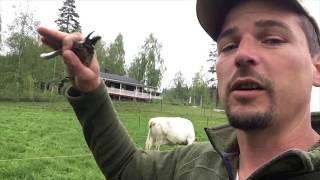
Richard Perkins documents 500 Ross308 broiler chicks arriving at his farm, their brooder setup, and hens adjusting to pasture. He covers grazing plans for cows, makes a 10% brine ham, and announces an upcoming permaculture design course and €89/month online training.
Questions this video answers
500 day-old broiler chicks.
Ross308 (a Cornish-cross style broiler).
About 32°C under the lights (observed local spots 33–35°C shortly after placement).
10% brine with a little sugar, cured about two days.
€89 per month (month-to-month).
Chapters
So in today's video I've just picked up 500 day old boiler chicks and a few clips of the last few days as the hens have been out on pasture getting used to their eggmobiles. And everyone's arriving for the internship and farm scale permaculture design course which is beginning early tomorrow. Second morning, bunch of birds already out. Mr. P has slept the night on the arch of the eggmobile. But I expect we'll see a lot more birds coming out. They probably won't venture very far until the evening and I would expect in the evening they will start to really come out and explore the surrounding a bit. So here's our new wash station. We just do a tie system. It's hot water and then we bring cutlery in a bucket here and we soak it in hot water and then first soapy bucket just gets rid of excess on cutlery and plates. Then you have a hot soapy for washing, then you have cold for rinsing. Cold rinsing stuff gets rack and Thai people can keep this. They have a lot of greasy food and they can keep this clean all day. Only ever changing the hot water. We found with Westerners you have to add one more hot water bucket and even then a lot of westerners can't seem to handle the system. But it's the most efficient way to wash up the lodge people. In my mind. This is forest raised heirloom pig smoked ham. This is a vacuum packing machine. So the ham was salted, 10% brine, little sugar for about two days and it's quite salty. But we tried it this morning and it's very nice. All right. This is the finished ham, vacuum packed. This is Ground Nation playing aeration music. This is lasagna about to happen. We've got cheese for the top. We've got a wholemeal sauce. We've got our grass fed beef stewing away. Things are allowed to get serious in the kitchen. Turning the brutal lights on. Start to warm this up chicks come Monday. So a couple of days just to warm it up in here. Temperatures fluctuating a lot at the moment. Just going to have the three brooder boxes and save the fourth one for turkey chicks. We're doing poults that we'll put out in the barn brooder until they're ready to be out. And then some day old turkey chicks which we'll have in here, Get off my patch. She's the boss cow. So hens are out behind me and they're getting braver every day now. They are starting to explore early in the morning. You see they're coming out to the fence line and this is typical the first few days as they're getting used to the spring and they're starting to eat more and, you know, really learn the rhythm and they're going to bed. Well, it's about 10:30 at night that we. We come up, we put lights in about half eight, quarter to nine, and they're all in bed at half ten. That will peak in the summer, you know, just after 11 o'. Clock. But we're only a month away from the shortest day of the year. So it's. It's pretty, you know, it peaks and then it starts to get earlier again. But it's a long, late summer for some of us, and, yeah, it seems to be going good. Cows are happy to be on the grass in Nutfield again. We've got some emergence of young nuts here, but there's also some interesting apples. There's Malas aversii, the original apple from Kazakhstan, grown on its own seed. And we have some Bittenfelder, which also is growing on its own seed. And some of the nuts are just coming in. We've put in some of the older chestnuts this year, but this is an original nut from seed just sprouting into life. So things are starting to happen. We've got lots of forage, we've had some damp weather, and the cows are more than happy to be out. And they're really loving dandelions at the moment. They're just taking entire dandelions as they go along. So we're on. We've created a plan to move quite fast at this time in the year on our grazing plan to go around the whole farm. We've only got four cows here right now, so we're kind of grazing about 4 hectares. The neighbor's land that we were grazing last year. We're going to take that for winter feed. And so we're only doing turkeys over there, we're not grazing over there. And this, this land that we have on our farm is more than enough for these cows. We're gonna have a bull in here soon, and that would be equivalent to two cows, but plenty of forage to manage. So currently the plan is to make it around the farm twice quite quickly to keep the grass vegetative and manageable for the chickens. And then we'll start to slow down as the grass starts going slower. But I'll make a video about the plan when we've got it down in more Detail, detail. So it's quarter to nine. We're coming up to put these lamps on in the eggmobiles. Mr. P is here, Saku is here. More chickens are out now probably I would estimate half of them are outside underneath. And 1030 seems to be the time to put them away. They were all in Bar One at 10:30 last night. So 10:30 at night, chickens are asleep. I doubt you'll be able to see much but cows are looking expectant every time we appear. But time to close these girls up. So early morning for me tomorrow I'm going off to pick up the first boiler chicks. So I'll be gone before dawn, back in the afternoon and all of the people coming on the PVC and internship will be arriving tomorrow. See how these girls are roosting. Hello girls. So we just use a simple little working light, 12 volt light. A few birds on the floor here. See if you can see most of the birds on their wrists. Beautiful. Doesn't take long. That's the thing with layers. They're creatures of habit and you just got to make sure everything's in order and they soon get to the rhythm of things. This is, you know, it's half ten at night now and this is about as dark as it gets. It's hard to pick this up on, on camera obviously, but it's dusky and it's about a month away from the longest day of the year. But it's, it's really beautiful after a long winter where it's just dark, you know, we have the equal opposite darkness where it's just, it's so dark that if you come from a more southerly climate it's, you know, it doesn't mean a lot but, but it's the equal opposite of this. This is as dark as it gets and it's beautiful, it's very peaceful. It's very nice to be out late at night. And that's the danger of farming at this latitude is you, you often find yourself turning around and it's 10 o' clock at night and you're still up on a roof with a screwdriver and you know, that's the way it is. But yeah, busy times. We got a course coming on. It's going to be super exciting. New chicks at the farm. We're in full operation mode so look forward to sharing more of that with you. So, first batch of boilers. That's the building where I'm picking up from small batch of boilers this year we're doing 500 in this first batch. And all of the folks arriving for the internship and PDC are arriving today. So it's a busy day. We've got all animals on farm now except for the turkeys and exciting to have boiler chicks again. So we're just gonna pull in further up around the corner now. It's a little bit of a drive. This is where we always pick up the chicks. And I'll go and check in at the reception here. Looks like all the deliveries have gone out for the day so I hope I'm not too late. I Left at about 6:30 this morning but. And I'll check in here and we'll go and pick up our boxes. They're packed in crates of a hundred little cardboard boxes. When you have such a small amount. We'll go and see if we can get in here. So 500 cheaping ticks. Always amazes me how small they are when we first get them. I'm going to spread them out in here. Okay. This is how they're going to sit on the way home. So these are Ross308. It's kind of like a Cornish cross, but they have. They're day old so they've not eaten or drunk and they're huddled together nicely so they'll stay warm. I don't need any heating in here. Some of these will leave this facility and go many hours in a truck to facilities like big industrial facilities around Sweden. We've got a three hour drive but they will be fine. We've done this in the heat of summer and in really cold weather. So basically now I'm closing that up and I won't be stopping for giving them water or anything till we get back to the brooder. The brooder is sitting at about 4:32 degrees under the lights, which is perfect. That's the temperature we want to get them in. Now you can see old videos from the previous years where I give a lot more information about the Buddha process and how we deal with all that. And I won't just repeat things each season so you can look back at some of those videos if you want to see more details or different perspectives from previous years. There is a lot of details of how to look after young poultry, including layers, turkeys, boilers in past videos. But the best place to get really concentrated information is on our online training. It's €89 month to month subscription. You can stay as long as you like. And that is packed full of information, hours and hours of footage about all aspects of farm design and managing our farm, spreadsheets, etcetera and that's the best place that I know. Hundreds of people have been getting a lot of benefit from that training. It's, you know, it's put together with videos, about 80 hours of video that aren't on YouTube. And it's not the most polished online training, I'm sure, but I do think it's probably by far the most comprehensive and it's definitely the lowest cost and most accessible price wise. So that's a great place for you to check out more information if you can't make it to the farm. You've got everything you need to know there to know the ins and outs of how to fine tune these operations to do good to the land whilst making profit and having a good life, making wonderful food. Now, I know a bunch of our viewers also raise poultry. A lot of people in America using this model. But we are very clear about managing the feed by weighing it out. Now, it takes more work and I know a lot of people like to do unrestricted feed for a restricted time. But I've said so many times, it's much better for the birds to have very scientifically weighed out portion feed, both for egg producers to maintain constant production and for broilers and to have that feed dispersed throughout the day so they get hungry in between. That, in my experience, leads to much more foraging, which leads to much more vitamin and mineral content. A lot of people get confused thinking that pastured poultry will massively reduce their feed bills. And that's not the case. They're not getting any energy or carbs in that way. They're getting vitamins and minerals. And that's like your vet replacement fund. That's what creates healthy birds that don't have leg problems, don't have digestive problems. And that's partly with their movement every day onto pasture. They develop healthy legs, but that's an important element. I've seen people give free access to layers and the birds just do not forage in the same way. Likewise, I've seen that with boilers and it produces inferior quality birds that are dumpy and heart attack problems, that sort of thing. So we're very specific with our feed and I would always recommend that to people because these are high production birds. They, you know, it's like a good analogy would be if you had a racing car, you wouldn't put typical normal fuel in it. You want high quality fuel that is designed for the engines engineering, as it were. And that's the same with these birds. You want to put in exactly the right feed and it's something I've said also repeatedly is where we can take from the industry because the industry has got masses of data about poultry production over decades and the alternative movement hasn't produced that sort of data. And so we take from that data and we have to also bear in mind that it's not totally translatable. Our birds move a lot more and they eat a lot more natural forage. So yes, it will replace some of their diet, but I don't think you should think of it like replacing some of their feed bill. If you have five chickens in your backyard and you're feeding them compost and food scraps, that's a totally different thing to raising hundreds of birds in a small space. They need that feed in the right amount. And so actually we use pretty similar to the industry for our feed rats and they just get more feed because they're moving around, they're burning energy, so they need a bunch more food. So that's important. We've got our pastured poultry masterclass weekend running twice this year. That was a really successful training last year, looking at all aspects of layers, turkeys and broilers, including getting into the slaughter and everyone learning how that operates, looking at sales, marketing, businessing, business plans, etc. I mean, it was a really full power weekend last year. So you're well to come and join us for that if you considering starting up Parsu Poultry. Quite a large amount of the people that came on that training last year started up this year, which is fantastic and I hope I'll get to visit some of them. Maybe not this year, maybe next year. We'll see. So a little bit noisy. They've just been put in so they're a little bit freaked out. Temperature under the lights is good. It's up quite high in places between 33, 35. That's fine for us. We want them about 32. We're just going to let them settle down now. We've introduced them to water and we'll come back and see if they quieten down once we've left them alone in a minute and have all the doors shut properly. So that's it for today, folks. I'm signing off. Just taking a restful moment before we get started with the farm scale permaculture and regenerative agriculture design course. It's become a renowned training and a lot of people from all over the world have gone through this training and gone away to do amazing things. We've got a great team from all corners of the globe, from Canada North America, down to Argentina, all over Europe, and some people arriving into this evening. I'm going to get started early tomorrow. I'll be making updates whenever I can, but this training is intensive and morning till night, so it's it's going to be hard to make little videos, but I'll try and get out and make something. But thanks so much for watching folks. I really appreciate your comments and shares and likes. And don't forget to hit the subscribe button if you haven't already. Look forward to sharing more with you in the video soon. Bye for now. It.
More from Richard


A review of short and intensive season on a mixed farm and restaurant/event space in Sweden






Alskade Kyckling Exploring complexities of poultry production in Sweden and what we stand for


