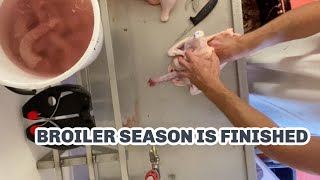
Richard Perkins wraps his broiler season after processing 300 birds and outlines the cleanup: scrubbing the slaughter area, fixing pens, prepping crops for frost. He reflects on the real costs of running a small farm and the burnout that comes with it.
Chapters
Welcome back to another episode, folks. We've just finished the last slaughter and pack of chickens. So the boiler season is officially over. Just after the course we've just had. We had a load of people on for slaughter and that was a great experience. And we took birds out of the sads and pens. We then switched over the remaining birds to our roller pens. These are just salatin pens lifted up with a bigger roof and wheels that work really well, as I've said many times, for batches of a thousand or more really. But we put half the birds in here and raised them up to the end. And we've just been through the slaughter process. You know the drill. But I'll just roll on a few shots of that last slaughter of the season. It's it, It's. So there we have it. There's 300 odd birds here. That finishes the season for us last boilers. Quite a big weight differentiation because we've done them over two weeks, but happy to have that wrapped up and dusted. So it's always nice to get that process wrapped up for the year and get the slaughtery cleaned down in a really good state to be left over the winter, get the pens packed away, repaired anything that needs to in there. So that's been nice and it's good to see the season is way over its peak now and we're starting to go down in easefulness. And it's getting to that point where frost starts coming in and the season starts slowing down, which is really nice. It's been dry and sunny, but it's been first frost, light frost. So this time this space is totally empty. A few tomatoes ripening out and we'll possibly put some winter squash for homestead use in here just to harden them off. We had the first frost today. Typically first frost comes first mid September, but that's very variable up at this latitude. But very light frost. Not a killing frost today, but that changes things. And it's going to be time to cover up certain crops as well as get in the pumpkins for wind storage, get them hardening off. So cows and sheep have come down through most of top field now. Scanson the bull is going for beef soon, I believe, because it's great manure coverage. So they're taking quite a bit of the forest. We're basically working through here now and then. We've got some beautiful regrowth on the neighbor's land and that should lead us all the way through till probably December time. We've got the male rams up in the barn because Winston's got sore ears and face and should be fine, but just needs to get away from the knots, the little midges that bite on their ears. Looking good. Some really nice regrowth. And they're taking it down, leaving enough armor for the birds which are coming on right behind. We've got both eggmobiles here now. Now there's forestry machines working all around us. I don't know if you'll make it out and the noise in the background, but basically all the hills in the distance around the entire farm, as far as you can see, aim to be cut down in the next four years. It seems those forestry machines, good half million euros each and they basically, to make the economy, they run them 24, 7 and they have to be cutting trees around every 40 seconds to make money. And so quality of Swedish timber is going down, the expanse of clear cuts going up. And I'm doing my hunting license starting next week. So a few of us are meeting up Joe, who's the compost man, who's been on our videos, as well as Alex, that's here. We're going on the short, intensive English language hunting course, which I'm excited about. I don't really want to join any hunting clubs or anything. I just want to be able to fill a freezer with wild game from the farm. So deer that come in. I'm going to be planting a little plot of kale at the end of the market gardens and just taking the deer for the family freezer. But yeah, I'm just thinking forward to basically how it's gonna. I mean, we're going to be the only island worth landing on and we kind of already are in the way. But I can imagine many deer and young elk coming our way, so that might work out really well for the hunting. You can see the birds are enjoying the shade. See how few of them are out in the sun. There's a few up at the drinker behind and they do enjoy the shade. So on their way back through. So you can see this is the armoring that's left after the cows have been. So there's a good amount of litter and all of the litter that we laid down in earlier videos in the year has just broken away. This soil surface is just pure worm castings here. It's unbelievable, really. Just beautiful. And so that's laid down ready for the birds to come over. And you can see the sort of impact they have scratching up some of that material. You can see they've taken some of the material, laid it out on top. This will be the last pass through here this year. Birds are in great health still. That's what you get for being out on pasture eating the right diet. This one has escaped, so I'm putting it back in. So I've been having a great time running the farm like a hero experience and a lot of the conversations have stimulated further thought and discussions outside of that whole space. And we talked a lot about leadership and how lonely that can be and all the different elements that make that really challenging. And it's something that I've had battles with over the last six, seven years. And perhaps I'm in a different position again in that I'm not just leading a team, I've been leading, mentoring people, coming on long term trainings, going through all kinds of emotional processes. But based on what I was talking about in the last video, my exhaustion burnout, as well as responding to questions I get all the time of people being surprised how much we've achieved. And I thought I might do some videos about. I've been doing a lot of psychoanalysis on myself. I'm not sure how that's gone, but I've been thinking about sharing some of that because I think it will be insightful. Some stuff about the challenges of leadership, the cost of success. And whilst I'm perhaps in a different boat to a lot of people who are watching this channel just wanting to follow through for inspiration for their own farms, I guess I'm in a different position in the sort of, you know, as an influencer or figurehead and I know many of you might be as well and you know, we're all in whatever positions and networks we are. But yeah, I thought to share some of it because one of the troubling elements behind it all is the changing of our context. And Johanna and I have, you know, a lot happened since we moved here and our contexts have definitely changed. But our contexts have also been quite divergent for the first years and I feel like they're starting to align in a way that potentially could be more easeful. But it's been very tough and you know, I think I've pushed her to the edge many times and I guess that's probably been reciprocal. It's very tough running a small family business and a farming business and having so many people in no private space and you know, also in this sort of funny role of being an influencer and putting out books, etc. It's been a lot and there's a high cost to that. And so I thought I will try and formulate my thoughts better and share some of that because I think it's important and valuable stuff to reflect on and I know a lot of you have a lot of life experience and insights to share and reflect too in comments, etc. But I'm thinking, yeah, I'm going to try and write some stuff down and get my thoughts clear and share them in a way that could be useful and instructive for other people who are sort of following the pathway we've laid forward. I feel like we've laid a pathway forward for farming and small scale production and business, but we've also laid a bit of a pathway in the sort of outreach work of marketing and self publishing books and documenting work and you know, the outreach stuff that we've done. And yeah, I want to speak a bit to people that are pursuing that too, because I think some of the risks and some of the challenges that I and my family face are a natural consequence of some of that stuff and I think it's good to talk about. So I'll try and do that in the coming weeks. I don't know exactly what that will look like, but it's something that's playing heavily on my mind. I haven't been doing many farm updates because that's not where my head's at. I'm trying to redefine my context and I think it'll be interesting to try and share that in a coherent way that could be beneficial to other people. Okay folks, that's it for today. I think I'll do an aerial overview tour again sometime. I haven't been totally consistent with that, but I really wanted to have like a very regular series of aerial footage so you could really see how the season develops and moves and changes in our short growing season. Don't forget, you can find out a whole bunch more in our book Regenerative Agriculture in the links below. And super excited to soon be announcing our short new online training, Start the Right Farm. I'll tell you more about that in the video soon. But that's going to be a training for people who are in that planning phase and putting their dreams into reality and want to reality check what they're doing and start with a very solid foundation. But don't want to take our full online training, which will only be launched again as a live event this winter. So stay tuned for that. Hopefully by the end of the week. I'll let you know about that. See you in the video soon.
More from Richard


A review of short and intensive season on a mixed farm and restaurant/event space in Sweden






Alskade Kyckling Exploring complexities of poultry production in Sweden and what we stand for


