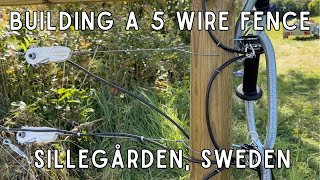
Richard Perkins builds a high-tensile five-wire fence at his Swedish farm to protect sheep from wolves, with help from interns and a €7,000 subsidy. The video covers material choices, corner bracing, energizer setup, and voltage testing, showing how to construct a fence that works and how to train a team doing it.
Questions this video answers
€7,000
10.2 kilovolts, 15 joules
Energizer rated for ~18 km of fence; ~10 km (or 8 km later said) in the loop currently
140 meters
€10 per year
Chapters
Welcome back to another video, folks. We have had a great start to the week fencing the two main paddocks at Siligon with the interns. We've just finished our nine day regenerative agriculture training which is the start of our internship program. Now we're doing a bit of team building, team bonding, working out how to work together, communicate and learn some great fencing skills, working with high tenso. So we've been blessed by glorious weather, but it is feeling autumnal now and starting to get cold at night times. Now. We got funded for this fence and so we have to get up in a certain time and have the fence inspected in order to get the payment back from the government. I'll tell you about that. There's two types of subsidies in farming as far as I'm concerned. One is destructive and that's farmers getting paid to just leave their land or cut it with a machine and not actually farm. I don't think that's great things thing for the food system or for effective land management. But there are subsidies for building ponds and constructive wetlands or fencing for example, I think are constructive and useful and help us use the land more effectively. So I'm a big fan of that. So we took about €7,000. You take a fee per meter of fence put in and this is specifically for wolf protection because we're in an area of very high wolf activity here in Vermland in Sweden. And so this is to give protection for wolves with sheep particularly. And so we have to build the fence to specifications. There's a couple of ways you could do that. You could use net like sheep net, high tensile net or minimum five wire high tensile. So that's what we've chosen for. When I was doing the bill of quantities to design the fence, I could just build it for the amount they're funding. So that was perfect. So I'm going to show you around, show you some little things that we're doing. So it might be interesting for you folks. Well, so you get a line of the land. There's the restaurant and the yellow house in the back and the dance hall. And we have this pasture all the way down to the mighty lake. Freakin. And we have the pasture all the way down to the house. You might be able to make out in the background. We also rent two paddocks from the neighbour for €10 a year as a peppercorn lease. But we really wanted to have wolf fencing here to be able to bring animals close to people at the restaurant. We imagine having an Egg mobile and sheep and maybe even cows here. So people can really connect to their food in a very visceral way. Now this is an avenue. Avenues are protected in Sweden, so it's our duty to keep this avenue in place. It goes all the way down to the lake. A lot of people currently love walking down here in the mornings or evenings. And right now it's open for the public, although it is private land. So we wanted to leave a bit of the vegetation and we likewise wanted to leave access around these buildings in case we need that for events. So we started with a pedestrian gate. Now in the beginning we're using electrical gates because they're cheap and we don't have the budget. But we actually want to build pedestrian gates that are timber, that open on an angle, so they automatically close themselves. So you can't ever worry about anyone leaving a fence open. But this is for now because they have to come and test the fence before they give us the money back. So most of the gates follow a similar pattern. You can see these black wires connect all five wires together. And then the insulators are not electrified. Then we have the gates. Spring gates are connected electrically on the lower pegs there and they're connected into the second wire. And then we have another wire that goes down under the ground and connects to this ring. So at each side of any gate or fence we're going to connecting all wires just for better conductivity. We have an energizer that can power about 18km of fence and we've got about 10km in the loop so far. So fencing is all about corners and pulling lines from corner to corner. It's where you put all your time and attention is building up gate posts and corner assemblies. And then the infill posts, as I'm walking along are just holding the wire up. Potentially we're using this really nice square screw in insulators where the wire just can't jump out of it at all. And that's very nice because the cheaper insulators that you screw in, they often pop during the winter. It's so cold here and plastic gets brittle even if it's UV treated or whatever. We're streaming around the ground to give us a testing opportunity with zero vegetation touching the wire. We want to know this meets the government standards. So there's regulation around the height and the distance between the wires and the voltage, etc. To make sure we get your money back. So there's no guarantee you get the money back from the government body here until they've come and inspected and they say, yep, this meets the standards and is built correctly and built in a way that it will last. Here we're coming out to a gate that crosses over to the other paddock. It's quite interesting if you look in here, this is a bit like how our fields were in top field at Ridgedale, where the lower part of the field is full of sedges and if you get down between the grass plants, it's full of moss. That's a sign in this climate, possibly compaction, possibly acidification and waterlogging or a combination of all those. Over at Ridgedale we have zero sedges and zero moss in the fields. And that's through the scarification action of all the poultry over the years as well as the keyline plough and good grazing management. That's exactly what I would expect to see here once we get our farming activities going here maybe next year. So we ended the first year at the farm building 3 kilometers of net fence that's nearly 2 meters high for elk, lynx, wolves and deer to stop them coming into the pastures. Subsequently, we've built about 7km of five wire fence like this in the forest paddocks we have at Ridgedale. But it's been some years since we've done fencing and it's something I really enjoy doing. I like to do this as an exercise both in doing something that needs doing, learning a bunch. Everyone can learn the different knots and all the little considerations for design and creating a bill of quantities. But a big thing in our internship program is people learn to work together, learn to delegate, learn to communicate in a different way. And that's an important part of this whole piece. When we're working on small farms together, communication is key and so it's a really nice exercise and the team have done an incredible job to get this done. We're basically lunchtime on the third day now starting from scratch with basically no one having previous experience. So I think an amazing effort and the fence is very nice quality. I think it's going to pass the inspection, no problem at all. So cracking job by the team. So here we are down in the bottom corner of the paddock and this is another pedestrian gate that I'd like to have as a self closing wooden gate. But this is the pathway coming down the avenue that gets down down to the lake here. It's a funny property because we own half the beach and the municipality own half the beach and the pier. But I'll show you down there because it's Quite special. We're creating a path next to the path, and it's not for public, it's for us if we want easy access in and out. At the corner of the field, this is the main path. And you can see this beautiful avenue that leads up to the restaurant. But I'll just show you down on the outside where the beach is. As I said, it's a funny property. We own the actual road that comes down here, but it's designated public access for water, which is very common in Sweden. So it's kind of a public car park there. But we actually own nearly all of this beach and the municipality own these changing rooms and there's some toilets there. And they own this pier going out into the water. Friken is an unusual lake. It's 140 meters deep. Sweden's a country with several hundred thousand lakes, but they're all typically shallow. The mighty lakes and this lake are particularly deep. And you get a lot of interesting wildlife here. There are landlocked salmon, there are big brown trout, and there's the burbot, the larkin, which is a freshwater cod species which used to. I think it's extinct now in England, but still exists here in Sweden. That's something they used to serve at the restaurant back in the old days. So a couple of things going on here. We have a short run from this gate up to that gate that leads to the other field, and then a short run up to the top corner to the pedestrian gate. So they were not even stretched with the fence strainer. They were just tightened on with the ratchet turnbuckle insulators. But then the main run is another corner that goes up to a gate where a tractor or vehicle can come in at the top. That's a short run too. But the main run goes round the corner, round three kind of corners where the strimming is going on now, where there's an electric post, we have to protect the wires and then it runs all the way down and pops back to the corner post here. So the way we've handled that is pulled wires to the midpoint and then we've stretched the wires together and tied a Texan brown knot to join the wires. And we do that because if you were to tighten such a long length through several corners from just one end, you'd find it's exceedingly tight at one end. And then you come to the other end and it's slack because of the friction through multiple corners. So it's much better in that case to pull the Wires to the middle and stretch it that way. We also have the option to tighten again at the top on the ratchet, and that tends to work pretty good. One thing that's beautiful about having this incredible restaurant is we have our breaks and lunch and meals in our own restaurant with amazing food our chefs have prepared. So it's fantastic. So coming into the second field, Josh is just finishing up a corner with insulators. We're basically ready. We have a gate post that runs down to a corner, up the neighbour's property line to the corner, to another corner, to a sort of change of direction back up to a pedestrian gate that goes into the back of the stage area and then the corner here. So we're at the point now where we're ready to stretch wire. We've been bringing up tools with the rhino and the trailer every day, but what we're doing on this side, because we have such a long stretch around here, is pulling the wires to the middle again somewhere here, stretching them and tying them in the Texan brown. And then we have a short run from the pedestrian gate to this corner so we can stretch that with the fence strainer. It's going to be really nice to have animals back in here. There's not been animals on this land for the decade I've lived here, but probably decades before that. But this place used to be a farm that served food in the community in their. Sorry, in their restaurant. But I don't know the details of how that looked in the past when they built this place up over 100 years ago. But it's going to be magic to bring back animals and life in that way alongside our concerts and beautiful food that we offer. So I'm tying the end knots in for one end. So on this side of the fence we have these ratchet tighteners. Then on the other end we just have plastic inch loads, tire termination knots. I'm looking to keep from wire to form the bend, and as I pull it in and across, it creates the end. And then I'm going under and I can wrap that off and that makes a good termination knot. Then I turn my hand up and spin along the wire to snap that off without a sharp edge. Then I'm just putting my insulators in about the same distance. I can form a kink and I can just do a slip knot at the end like this around itself and snap that off there. And we see that's a simple way to terminate the fence. So, same pattern again. We've got ratchet insulators here so you can tighten up the slack out of the fence. These are adding a cost to have these on every loop of fence, but it's a really nice touch. So we stretch the wires with standard wire stretchers to tie them into this and then as we get seasonal variations in the tightness of the fence, we can pull that slack in. So you've obviously got a bit of the wire that's non electrified and then the electric wire all connected down and that is connected under the gateway to the next ring that are all connected together. And it's also connected under this pathway to this ring. So we're running it all as one big fence. So you can see how cluttered that gets. So it's nice to just keep things organized when you're putting fence together. We're using nail pins and also cable ties just to keep everything good, making sure that no wires are touching in the wrong places. And so there's a lot of little quality control inspections to make sure everything is going good. Up on the top line. Our property line actually goes around the back of these trees and it actually goes a little bit further into the land that the neighbour's been cutting. But we're fine with that. We just want to fence our pasture in and we're not worried about the extra few hundred square meters. We don't want to fence in the forest because we want to be able to have this as hot wires that we can fence across the field just clipping in and not have any hassle with the grazing because we don't know how that will look if we're managing two farms at that time or not. Here we've got some changes of directions. Very challenging saw. It's very compact, but we're using medium posts to get us around those corners. And probably with the length of run we've got and the tension on the wires, that's going to be enough. If it wasn't enough, you would typically put another post to another post down in the ground to give it a lot more strength. Likewise, if you're coming the opposite way into your field, you'd have to do that into the field. But that's the way you solve those kind of problems. Our spinning jenny. This is Nicholas. Some of you that have been long time followers will remember Nicholas from the first five years. He's back on a visit, but we got him helping again. He loves it. This is the spinning jenny. So this is how we pull out wire efficiently along the length of the fence line down here. Very helpful tool. Okay, powering the fence. So we've got an energizer here. 10.2 thousand volts, 15 joules should be geared up for the length of this fence. So we've got our earthing now. Earthing is super important. We've got 10 meters of ground rods connected together here that go off around the corner of the building. We've chose to put them there because it's an area where the grass doesn't grow very much. It's a bit protected that people won't be tripping over it. It's easy to find and maintain. Right now we've just got the live cable running above ground. Obviously, we're going to bur that if we've tested and everything's working good, that is going to clip into the fence here. And these two main circuits will be one connected circuit eventually. We would like to build a fence out around the forested patch which may become a pig paddock in the future. And we would like to put a fence down on a small paddock down on the other side of the land that may as well get grazed to maintain that. So pulling wires and tightening them. And then we're basically done with the whole project once we tested it. So we're just pulling out wires. Victor's pulling out the wire just wrapped around a bit of wood to make it easy to handle. Sometimes you can pull two, even three wires at a time. But it depends on how many corners you got to go around. A few wonky posts. And that's just because the ground here is so difficult to work with in different places. Very different soil types here. Because we're quite new soils, they were underwater 10,000 years ago. So you get areas of very soft, workable, nice clay loams, Then areas that are like concrete. And it's very, very variable. So we're just pulling these out and meeting the other wires that coming in. And we'll tie them off with Texan brands. Fence inspection. So corner built the wrong way round. Same with this one. So these corner braces must be the opposite direction. They must start in the bottom of the end of the fence. And that's because we're pulling a wire against this post, which is pushing the bar against this post, which is pulling against the wire this way. So these need to be replaced the other way around. And hopefully we don't have that in any other corners. That's why you need to check everything. Double check everything. All right, lunch is on. We get to eat in a beautiful restaurant. Chef's been making some salads, and I Think we've got beef today. Fantastical. Look at that. Some vegetables from garden. Possibly more of the same rice. Wonderful. Look at that. All right, Very nice lunch. I'm just coming now after the mistake on the corner to check all the corners. I've been checking the wiring, but not the support braces. That's something to say with organizing jobs like this. When you have too many people for the job, lots of little mistakes can creep in and Chinese whispers, and it can end up being a nightmare. It's a lot to organize workflows when there's too many people for a job. And often farmers are working without enough people for the job. But in our educational programs, we often have too many people. Now, an ideal number for this job is probably three. And you can then keep a workflow going and not make any mistakes and just work methodically. When there's too many groups doing too many things and people asking each other how to do something, and then miscommunication is happening and eventually you get nothing tied incorrectly, directional things wrong, wired up incorrectly, it can go crazy. And that's a bit what my role is. Over the years at the farm has just been to really manage workflows and just keep an eye on everything and keep track that things aren't going haywire. So there are easier ways to build a fence. There's obviously many ways to build a fence and different styles in different countries. We're going for 7 meters between our poles just to keep the cost within the budget. Here we typically go four or five for longevity. The more posts, the longer live the fence. Typically in other countries, like America, Australia, you get much bigger runs between the posts because farms are obviously more extensive and saves on money. But technically it's a very good fence. I think they've done an amazing job. And we're just going to tighten the last wires before we can test the circuit and see what voltage we get across it. So tying knots in high tensile is all about getting kinks in the right place. So I'm making a kink here so that the knot will form precisely where I want it to. What I need to do now is pull this wire around on a horizontal plane, letting the wire form that bend tightly where I started to form it, and I come back across that line just to create the tension in the line there. This line that was vertical has now got to sit down and go under. It's basically a type of figure of 8 knot. So everything goes over, under, over, under. This one now has to come under and I pull it up and around and crank it. And that's created the beginning of the figure of eight knots. Now, if I take these two, this one went over, now it has to go under and I crank them opposite directions. Now that creates a stopper knot. So this isn't a finished knot, but it allows me to release the tension on that and walk this gently back off until the tension is gone. Then I can crack that and release it from the wire and finish my knot. So following the same principle, this has to now go over and this one has to go under to keep following the same pattern. If the fence was super tight at this point, I could crank them in opposite directions. But because it's not super tight, I'm going to hold it with my fencing plier, form a 90 degree handle, wrap that off, letting the wire bend where it wants to bend. Then when I snap it off, I turn my handle sideways and crank along the wire and that makes a smooth knot end that can't scratch an animal or cut it in any way. So then I do the opposite direction on this side. And this is a Texas brown. So it's a standard knot for joining wire. It retains a lot of the strength of the wire. Make that figure of eight in the corner brace here. And you can imagine if you're pulling a fence wire on this post that's pushing against this post, that is pulling from the base of that. It's very strong. And so the turnbuckles we have got here are very short, which means we don't have much option to tighten. Now, even when you pull as hard as you can on the wire, it's still not tight in terms of high tensile type. So the way that we get the tightest starting point we can, we obviously open this up fully where we work out. Where do we think we can get this to kink to? And then I already pre kink it. And that means when I go to strike this over, I can crank it down and it will meet that point again. And that gives me an already fairly tight thing that I know will get tight enough when I crank that over. So then I can chop that off, formulate my handle. Now, you could do a stopper knot here. I'm just doing a slip knot because it's not, it's got nowhere to go, basically. And it's not taking extreme forces like the fence wires do. So then cranking along the wire, let's take that off and we can just tighten this up. Now turn the fence on. So now moment of truth. We'll see what voltage we get, if any, from our fence. 6.8 thousand volts. Now, that's running both fences. There's actually eight kilometers of fence. I'm happy with that. If we get down the other side, that's good. So crossing over to the other side. Test here, see what we get. 6.97. So everything is functioning. I would say 7100 down here. 7.2. Beautiful. So I'd say perfect. Done for the day. Okay. That's impressive. Very nice job from the team. I managed to go and turn the fence off for now. There's no livestock, but what a wonderful job. Now we get to play football. And then I'm running a pizza night for the crew here at the restaurant. Okay. We're in the kitchen tonight celebrating our friend's build. Pizzas are going up. Beautiful. Okay, that's it for the video, folks. Thanks for watching. Hope you found that useful. We enjoy fencing and a really nice job with the team. Look forward to seeing you in a video soon.
More from Richard


A review of short and intensive season on a mixed farm and restaurant/event space in Sweden






Alskade Kyckling Exploring complexities of poultry production in Sweden and what we stand for


