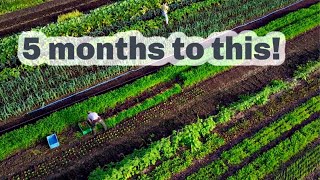
Field interview by Richard Perkins at Mikael's Danish farm (with Anders and Katrine) documenting how a multi-family group built a working organic farm in roughly five months. The video covers infrastructure assembled (polytunnel, walk-in chiller, chicken caravan/eggmobile), production metrics (beds, compost, birds), market activity (weekly town market, local customers) and operational practices emphasizing planning, time-and-motion efficiency, and modest, well-chosen investments.
Questions this video answers
About five months.
90 beds.
About 700 litres of compost per bed.
About 440 birds; ~15 minutes to move them.
Approximately 415 kilograms of feed.
Chapters
So I've made it to Denmark to Mikael's farm where he's running with Anders and Katrine. Mikael was one of my favourite farm managers we've ever had at Ridgeddale. And Anders and Katrina are both highly skilled, super amazing work ethic people. And I knew when I first seen them together in the winter they would do something amazing together this year. And I can't think of a better team to be honest. So let's have a look around their.
We are currently six. Six families living together here, working together in different enterprises. Newest enterprise here is this farm enterprise that I started this year together with Anderson Kantry. 35 years ago when this place.
Started.
It was based around an institution. Working with people with that needed like what do you call it? Care with their mental like schizophrenia and stuff. And now there are a few other enterprises. There's a wine club here and like a rent out place with a commercial kitchen and stuff. So we are living together and working together here in this little community.
And you're one of the main children of the place I guess that got a big interest in. In sort of the future of the place. Yeah.
So me and my sister actually we. We have both moved back here.
Yeah. After we've been living in Gome. It's a beautiful place to be and you've got about 30 hectares.
No, 20.
20 hectares and 25. Okay. And it wobbles itself around. It's called a wobbler. A wobbler is the XL and so they've never sold any in Denmark before. So they gave you a free trial and that's running off your. Well two different sandbags for the row covers and things.
This is more for the row covers. This is for the larger plastic to.
A tarps that you're killing weeds with. And do you like it? Is it efficient? Not really.
I mean it's. Are you saw the clips on.
Yeah.
I like using just clips on the hoops.
Like a metal clip or something in the ground.
Just like you can get these heavy duty plastic clips to hold on hold together wood when you glue it.
Ish. Yeah.
And they would just clam on.
But the wires work nice.
No, they work very nice.
Yeah. I like the sieve seller.
It's really, really good.
And you've got built in drainage in the floor. Yeah.
And it's all draining just out the wall. We put in these fans for drying greens and leaves and working really, really nice. And packing table over here.
Very nice.
And then walk in cooler.
This is the one you made. Cool These are good now from ebay. Yeah, I just found that. I had a stair set. Yeah, cool. So you had a walk in chiller that you just put back together.
We had the walls and we bought.
The floor and the ceiling. Just wood and insulation. And then we had. I mean the. The room itself. We got it for €1200 including this big one.
Okay.
16,000 BTU in the cool bar. But that's not including the hours.
No.
The money we spend on getting an electrician here to put in. That was very expensive.
So Coolbot's overriding this and you're saying it gets down to 5 degrees in 10 minutes?
Seven minutes.
Yeah. Yeah.
It's got the thermometer here for the room and then here is the heating element overriding the thermostat in the air conditioner. And it's really working very well.
You use these for the chilling in the room.
We use it for all storage and market and for many of our.
I love it.
Two different sizes but they all fit into each other.
Other.
Yeah, Always a lid on.
Are you happy with the bed size?
With 25m works very great.
Perfect.
And it's the. It's the size of the top. Well, we got tarps in what was it?
50M.
Long or was it 25? 25.
Yeah. You could either buy them in 25. No, in. It just made it really perfect with.
The size of the. Of the tarps. Yeah.
So they're 10 by 25.
One of our interns, Jasper is setting up in Germany next year and he's going to really rock it, I can tell. But he. He was thinking to go more shorter beds like ours. But I was saying to him you should check out 20 meters at least.
Or 30, go for longer beds.
It's just efficient. But you're seeding everything in here. Yeah.
Every Monday. More every Monday. Katrina is doing the weeks of the seasonings of the week.
And you're doing lots of micros too?
A little bit.
We've had good luck with us. What are you managing to sell them for?
200 Danish a kilo.
Yeah. That's nice. And it's not too expensive? No, no. I think we sell ours 260 and there's people that sell like there's a guy, a friend of ours in Stockholm selling 400 kilo. But to restaurants in Stockholms. But it's very nice to run through the winter. Like it's.
This patch is.
I don't know, it burned off or something. It's really looking bad on the.
I see on there.
There's also a lot of birds coming, eating.
Oh, yeah, yeah. This balance, I forgot to take it apart early enough so it was completely grown together.
Yeah. And how's the reality of. Has it been for your like. Like, it's a lot to take on now in your season. Are you all still good friends?
It's been going impressively well.
I mean, very good team.
And it's fun when you sell all your produce. People keep calling and we try to look around and see if we can harvest more here, here, here. If we weren't selling, it would be absolutely.
I mean, our success is definitely helping on the loop.
What's the reality of your time? Like, are you. How's it going according to your plan? The veg garden's going really well.
Yeah, I think it's good.
Yeah. Yeah. Do you get time for rest and Sundays off? Yeah. And you. When did you start? Early mornings. Half. Six. Six. Six.
Sometimes six, sometimes five.
I start at five. Moving the animals.
Yeah.
And I move them before breakfast. Breakfast.
And so here's a theme of the moment question for you guys because a lot of people that will watch this will be very inspired by what you've achieved in your first season. And something that we've been talking about a lot like with the interns and at our farm, as you know, it's like planning, but also like time and motion studies and efficiency planning. And there's quite a lot of people come through this year that are going off. Thanks. First, red pepper. There's a lot of people going to start their own things. Right. And I got a feeling not everyone got their heads around that. Like, why? To push yourself to see how quick you can do each job. What's your reflections on that kind of thing? Now Anders has been working at Neversink, so he really knows about time and motion studies. And you've all heard my spiel on it.
Connor always said that the farm is not running on how many hours you deliver, but how much work you deliver in the hours. He's like, we can have short weeks. Like, every farmer was amazed that we only did 45 hours at never Sync and did so much work. But when it was we met, we were in at 8 o' clock every morning. And I think throughout the season. I was maybe 80 seconds late throughout the season season and two minutes past eight, I was harvesting radishes.
So it's like no singing songs, just.
Work being super efficient at the time when you're there and just rest.
And then we had time to rest.
It was pretty important. No yeah. And I think it, like you, I imagine you've had a lot of fun this season. It's a reality check for people now. They really need to know the importance of getting efficient, finding the most efficient ways to do whatever it is you're doing.
You can easily find yourself. Like, I have days where I just find myself walking a lot back and forth and using time and like.
Yeah.
Doing a lot of small things.
But it's just.
The most efficient days, I think, is when we make a plan and we have it, like from one to three prioritized, and then we just, like, we all know what to do do, and we just go from one job to another. And so I think, yeah, planning. And I'm also taking time in my job so I can, like, compete with myself.
Yeah, yeah, yeah. This is very nice and very important and it's fun. Yeah, yeah. I find that the most fun at our farm is when people are stepping into that spirit for themselves. It's like, it. That's fun to me. It's not work anymore. It's fun. How do you organize yourselves? Like, you made a lot of planning before you started the season. No.
You spent basically three weeks, first thing.
Making spreadsheets and sorting out the overall plan.
Decided to work together. We sat down, we made our holistic context. And then second day and three weeks ahead, we were just sitting in front of the computer making spreadsheets and plans.
This is your Copenhagen bike or Christiana bike. Yes. And you use that for carding around the. Yeah, flats and things.
We put on more pepper.
Green like pepper.
Yeah. I love pepper. Thanks.
So when we transplant, we put on this.
Awesome. It locks it in.
How many trays can you carry then?
Super nice. So you can scoot out around to the gardens over the back.
Steady road.
It's very nice.
Very nice. In my turn, I've lost five boats so far. So this is Mika's chicken caravan from Australia. So this is like a Rolls Royce super automated chicken mobile. What's the things you love about it, Mika? It's got skid feeders, so you can. How much feed do you get in then?
415.
415 kilos, which is enough.
It's about enough for 10 to 14. 10 days. 10 days. I think a huge benefit is the big open sides and the adjustment, adjustability of the wings.
So that gives you some weather, shelter.
It gives me weather, she shelter and it gives me a big area for the birds to be very protected from aerial predators.
But also more shade as well.
Lots of shade.
But you're saying that the big opening allows the birds to get in and out really easy. Yeah.
There's no competition like in the hierarchy, getting in and out of the opening.
Yeah. So that opens just on a simple gastro. Yeah. So this is very. Yeah, it's nicely made. No, it's very nicely put together. So these nest boxes are more like what you see in the commercial industry. They're automated. You can see videos of the chicken caravan online. But this is probably one of the first ones in Europe. No.
I think so.
And these are automated. So on a timer that's powered by solar up on the roof, these will open and close, which saves you having to be there first thing in the morning. And then similar sort of nest mats to what we use. And they roll down into this central conveyor belt and you collect them in here. So you're typically. What time's the nest box is open? 5 and you come down and what time do you come and open up? So the feed is. You just leave them open all the time and that's what. Whether the birds are in or out. Okay.
And I only have to go and fill them up every nine or ten days.
Yeah. So you can drag all that along with the tractor. Yeah.
So right now it's. I mean, right now it's not connected. I could have it connected. So the skid feeds were just pulled behind the camera. I haven't done that yet because I'm a little afraid of it being super, super long to get around. I mean. Yeah, most of my fields are pretty wide open. So they can work out.
One question I had for you. Just because I saw it has single wheeled axles. That has been a major problem for us. We needed to make double wheels. Has that been a problem with sinking at all? Not at all.
Because I have those big tires on the tractor.
So. Okay, so this is the business end of the.
This morning I. It was just for curiosity. I went out here. Well, I was out here anyway, like halfast8 and I took the eggs that was there. Just so I get a feeling about. In what time they're laying the most eggs.
Yeah.
Because right now the nesting boxes are closing at 4 o'.
Clock.
But I believe they're done collecting eggs way, way earlier.
So this is about as high tech as you can get before you start being fully automated. But this simple hand roller goes all the way along under the nest boxes and allows you to retrieve the eggs without disturbing the hens in any way and without doing a lot. And then you can immediately sort Any dirty eggs out from the rest of them?
Crack, dirty and like large eggs.
Yeah. You get some monster eggs, I guess.
No.
What is going on? Yeah, I have quite some big eggs every day, and I sell them at a very good price at the market. People love them. They sell out in about 2, 2.
Hours at the market. And you've got this, the whole nest box can. It has a little spirit bubble there, and it can be leveled according to the topography. And then Mikolos has got these lovely egg carrying crates which they sell along with the chicken caravan. So you've got these side holes that you can easily put in crates.
Italy, where they're produced.
Okay, very nice. Now, they're not cheap, but they definitely look after eggs if you're taking them in the back of a vehicle or on a bumpy bike. And how did you find it when you first got the birds laying and the shells are perhaps not so good? Did you have problems with the mat getting gummed up and. No, no.
I'm trying to shake the nesting mats once a week, but I'm not really doing it. I washed them once just to see if that would make the white eggs a bit cleaner. I mean, they're really clean, but when they are. When they're wet coming out of the cloak, is that called the cloak? I was thinking that maybe the dust on top of the mat would stick to the.
The egg and that was.
Would make it a bit dirty. But actually, I find that what's probably making the most dirty is because the hens can just get their beak in through the gap where the egg is rolling through. So especially the white hens that are much more thinner, but they also. They have a much stronger instinct for sitting on nests.
Yeah. So they're trying to get in there.
And pull eggs back that they can sit on. So it's the dirt and the cow manure from the. Well, maybe not cow manure, but the dirt from the beak that are making these black stripes on the white eggs because they are just trying to take white eggs.
So it might be a little hack to put a little bar in. Yeah, yeah.
Maybe if the egg school can roll in and this.
So this unit is running off the roof and you set the time for climbing. And what's nice about this is a pretty standard commercial nest is that these doors will open and close really slowly. Mikael's farm is all organic certified. The property has been for a long time, so he's had to add these nest boxes on. To meet organic certifications, you need a certain amount of nest boxes per hen. It's a bit of a silly thing, you know, in the sense of these nest boxes are super good for the birds and it. You know, it's a thing you have to do to meet regulations sometimes. There's regulations about everything. But this is chilled out. I like having a bite. It's nice to have annoying. Some of the cows down here. Yeah. I saw you had a. In there. It's very lovely spot. It's very windy spot. Some shelter for the field here. But the gardens have been getting windy now. Organic, So. Nice board fork. This is the full 75 centimeter one. Where's the.
Where'd you get it from?
France. Are you happy with it? Yes. It's not the deepest tine one, but it's nice for your heavy soils now. So you got heavy clay here. So. But 700 liters. That's. That's a similar rate to we've been putting on, I guess, because your beds are. Yeah. 25. A little bit less, but good amount. Oh, like what you've done with the place? 50. 55 riders. 55. And you're thinking then maybe drop that down.
Yeah. To 20. 25 years.
Yeah. What do you think of, like. Are you gonna scale up the gardens or are you gonna.
I'm thinking to this just in a. I mean, now I would like to do it, actually. Like to prepare that last bit of sections up there. There's like one strip more to do.
So you've got all this compost over here. They've been using the backhoe just to. Yeah. Lay it out with wheelbarrows.
But I'm. I'm probably borrowing a rototiller for the. For the tractor.
Like a small one.
Yeah. From a friend. And that would do a very shallow rototilling and seed, like a very dense cover. Like a diverse cover crop that will die off in the winter and then like late autumn, I will just flay. What do you call flame mode?
Flame weeder.
No, mow it.
Oh, flail.
Flail. Mow it and put tarps on and have that as the last bit of the garden. Coming into production last year, largely in.
Grass for the calves.
Right now it's this year. Next year is 10 hectares and in two years I will. I will lease the other 10 hectares.
Yeah, yeah. And right now having, like. So I came here in February and this was all just grass and you had the cows and you were just importing the egg mobile, weren't you?
Yeah.
And so a lot for these guys to set up in this. And how long have you been on the ground? Like five months. Five months. So pretty amazing what these guys have achieved together.
We've been putting down 90 beds.
With.
700 liters of compost in each building. A 29 meter long.
You didn't have a backhoe at that point, did you? No.
The bangle came much later for this part.
Yeah.
Putting up the big polytunnel, building washing station chiller. Assembling a chicken caravan. Getting hens. Starting holistic grazing with cows.
Yeah.
Getting ready for market.
Getting ready for market.
Yeah. Setting up a whole market. Setting up the market, branding and business.
And setting up an egg peccary. That had been lots of regulations still going on. We have been taking over the organic certification so we have had control and just general stuff that you always have when you're starting a new business. I mean that's a lot of administration and things you need to do.
And right now, this far into the first season here, what's your vision for five years? Where will you be then?
Well, I will have a micro dairy on the farm doing this new cool stuff I'm super excited about called cold pasteurization. So it's a completely new technology that is.
Yeah.
Really, what do you call it? Revolutionary pasteurization of milk. So I'm super keen on milking my cows. I. I mean we had a. I had a crazy moment in the beginning of this year when I. I thought I would start milking this year. I'm pretty happy I didn't.
Yeah, it's a lot to manage. No, but do you feel like you've been able to keep a handle on everything?
Yeah, I mean I think, but I think this is. That have been maximum really. I mean, but I think we have been doing really, really good and I've been doing really good.
So it's beautiful.
But I'm happy.
I'm not.
I didn't start milking this year. Yeah, I mean I wouldn't be standing.
But longer term when you have more people here, like uncomplimentary kind of enterprises, that sort of thing. Yeah.
So I imagine the market that like the gardens here being three sections, so third one up there, probably some more tunnel for nursery and winter production and dairy, maybe one or two more eggmobiles and then that's.
So going back to the institution basis, some of your market is growing for the institution who have always prioritized buying good organic food so you're able to meet the supply.
To be honest, it's. I mean it's a very good Customer. Because it's taking what we have.
Yeah, there's not a.
There's not a big.
What do you call it?
Demand. Yeah, but it's not one of our biggest customers at all. I mean, it's.
So where are you selling? Who's. What's the main marketplace? You've got a nice little market stand.
We have a little cheap at the market.
We have a. Yeah, we have a. I mean now after just two and a half months, we have a really, really nice market at the town in the Roskilde, at the square in Roskilde. And I mean, that little stall we had there have just been doubling. I mean, in the beginning we came with a 3x3 tent. Now we have three by six, we have five tables, bringing a little less than half a ton of produce every week and selling it. And we have 170 customers through the market each week.
And what's been your approach for advertising? Just working with Facebook and your website.
Anders have been doing a really amazing job on working on the local newspapers. So I think we have had two or three mentions or articles in the local. Local newspapers located in the area of Roskilde, which is like half an hour away from here, and. And then that. So that's one set of selling or customers. And then the other part is schools, commercial kitchens, canteens, restaurants, stuff like that. And that was just. Yeah, in the beginning of the year. I mean, again, Anders, he picked up the phone and he just called him.
Anders is an awesome engineer. What did he make? It's our roller. Yeah, very nice.
We only have the four row pinpoint cedar. So we need to roll it.
Yeah, like the Swiss one.
Yeah, yeah.
So you're doing everything with that cedar. A board for roller. You got a nice rake and. Yeah, nice.
And the cobra.
So you had your last calf today?
Yeah, it just popped out easy, as it should. So it was standing down here trying to drink from the bull. When I came back from lunch, it looked really funny.
And the bull isn't yours now?
No, I borrowed him from a farm not far away. He's the breed from North Italy. He's a breed called Piemontese. And so he's a part of our breeding program. So right now I have actually the three of the four breeds I want to mix together is represented on this field.
Really cool. And what's the breed you're mixing?
So it's the breed that was already here, which is a mix of everything. Then it's the Danish red dairy cow, the Piemontese, and an African Cow called Tully.
So the aim is to breed double muscle genes to Danish milk.
There he goes.
You want Danish tasting milk that's a lot better for beef at the end of it. Yeah. We're just gonna move the eggmobile. And it's five o' clock in the morning. There's a hare that's been chased by a fox into the electric fence and Foxy's managed to get the front end off before. He's probably got a shock himself and disappeared. You got a lot of hairs here now. Yeah, lots of them. And do they eat your vegetables too?
No, but the other day we saw three hair babies hiding underneath the kale. Let's get on it, mate.
So the cows were here two days ago and they've left quite a. Quite a nice density of manure. So the egg mobile is moving just to this patch here. So these are the skid feeders and up to two weeks of food skidded around the field. Beautiful. It. It's. So 15 minutes to move 440 birds. Pretty ideal. And they've got some nice leftovers from the cows. Happy birds. Happy eggs. Beautiful morning. So it's very nicely made unit. One thing we were talking about yesterday was how you could automate the opening because it's very nice to have automated nest boxes. You see these opened at 5. This is the flap that opens out to allow them access. And these just make it a bit darker for the birds. So it's a safe space because with any mobile eggmobile it's the consistency of the space in the nest boxes that gives them security because hens like to lay in a safe known space. So that's the only constant thing in their changing environment. But it would be quite easy to. You can buy electronic rams, about $150 each for the power needed to lift this door. But then you could have automated opening for days that you're not moving. I think Mika's moving every couple of days behind the cows. You can also buy these pieces. And these egg conveyor belts are not cheap for a conveyor belt this long is about €400 the price I've seen. And nest mats are industry standards. You can buy then. So you could fabricate this sort of unit yourself. I calculated it would cost about €600 for what? An egg mobile. Our size. So if we have four next year at our farm, that's, you know, €2,400 in nest boxes. Which. Quite a big investment. It's for us. It wouldn't be necessary. But I do like the fact that you can collect eggs without disturbing the birds. It's a very practical setup by using this basic roller. Very nicely designed and nice to be able to store egg cartons up here. Mikael, it came flat packed on pallets, right? One pallet. And how long did it take you to put together? I was pretty doing it on my own. Yeah.
I had a little bit of help from a friend and it took me, I think it was six days. One person.
Six days. One person. Yeah.
And now when I know how it's done, I can do it.
One person. Very nice. It's a beautiful sunrise. We just moved the chickens. It's their harvest day today. So I'm gonna catch some footage and help out a bit in the meantime. Really excited to be here. It's amazing to see these guys working together. They've just done an amazing job and I think, you know, inspiration to anyone starting out. They put in about €60,000 to get everything established this season. But these are mostly long term investments. They got their new cow breed going on, 400 eggs a day and a lot of edge and they're able to sell it all and they could do more. It's just enough to manage right now and plan for expanding next year. Beautiful, Cal. It's really sweet for me to see these guys working together. I came here to do a short two day training in the winter and there was nothing here at all. Like everything's literally been built this spring. But I went with Mikael on the way out of the country. I went to Copenhagen to meet Anders and Katrine for dinner. And I just knew in that instant they would do something together. Now Anders and Katrina are looking to start up their own project. And I think rightly so, they've got such a driving capacity to do that for themselves. But I think it's been an invaluable experience for them all this year. And, you know, a lot has been learned, which is fantastic. So they haven't been using tarps much, but a little bit to establish new beds. There's a lot of couch grass here as well as buttercups and all the other standard pasture weeds. And they say they're not putting too much time into weeding. It's always a bit of weeding, like the pathways here. But then they use the wheel hoe just to rip that up. And it's. It's looking beautiful. I mean, it's a really nice achievement for five months of work. This was literally lawn when I came here. So this is the tunnel that they put up. It's from first tunnels. I should start asking for commission because I've helped sell a lot of these tunnels from the uk. I really like their service. Not sure I like their end wall construction, to be honest, but it's, you know, it works. But this is the size of tunnel we're getting at the end of the week at ridgedale for overwintering 1500 chickens. Have a look in here. It's just full of tomatoes and tomatoes that are soon ready to go. They're harvesting 50 kilos a week at the moment. But they will soon have ridiculous amount. Using tarps to prevent weed and keep the ground warm with some drip tape underneath. And they've got a really nice clip system. So they use a Dutch system, metal wires that come down half the length and these really nice clips that back onto the wires. I bust this one now, like so. Very nice. They've kept a really tidy space in here, but just oodles of tomatoes waiting to be harvested. There's a lot of money in here. So we're going to be using our tunnel to put up to 1500 layers in next year we'll be scaling up layers, but then in the summer it will look a bit like this. And we've learned to start our tomatoes a month earlier now because of the last two seasons. But we've got restaurant orders already for dozens of kilos a week. This is the way to do it. Morning, Anders. Good morning. What are you doing? Harvesting cucumbers. Cucumbers. Very nice. Yeah. Every morning this row is getting better. They're good looking plants. Yeah. How are you doing all your record keeping and.
At the moment just try to keep track of what we harvest for each market and how many units we're making, how many kilos it is if we gonna sell out at the.
Market and then at what time and.
How many units we take back. So when we get back we can just easily calculate if we had this many kilos back and forth and how many we sold. Because we started out with a cashier where we registered every sold unit. So it was one zucchini for that person, two kilo. But it was too time demanding for Mikkel to tap everything in. So we changed it a bit.
Bit.
And now we try to keep track of what's selling on the paper. It's gonna work and it's a lot quicker.
So it works really well. Guys, it's harvest morning. You've put quite little into tools now. You've got very simple tools. But how's that working? Are you happy with the tools?
You got absolutely. They're working perfect. We don't really need many more.
You're talking about a paper pot transplanter. Yeah. You're up at the sort of bed length where that would be efficient now. Yeah. Any other tools that you think, ah, we must have one of them.
It would be fun to try the til and see how it works in this system.
Yeah.
Like just when we put out compost and see if we can get a really nice seed bed.
Yeah. I might sell you my tila because I don't think I'm ever going to use it. Yeah. So who's the tents made by? Aesop. And they got seven year warranty. Yeah. Yeah. Very nice. What do they cost? Do they.
It's.
What was it, €300 each. Yeah. And you have two of these with five tables to make up your stand. Beautiful stand these guys make. Have you got any footage of you on the market I can put in here?
No, we only have photos.
So breakfast time on harvest day. How much are you harvesting today? This is a Danish toaster. Funny old thing. How do you harvest? Do you harvest for to order or you just know what you're gonna sell so you've got a good idea what you need and you just out and get a weight based. Yeah, yeah. Feeling ready for the day?
Absolutely.
Just getting our load of butter and we will rock it.
This is how they do butter loads. It's butter that fuels the farm. No, absolutely. Look at that. There's no cheese so you make it up with butter. So it's harvest day. They harvest on Thursdays for the Saturday market and then they harvest. Katrine stays home and harvests on Saturday for the Monday deliveries to restaurants. A lot of good veg. They're doing an amazing job to be able to sell it all. And they're not gonna. I think they're gonna expand some new beds later this season, but then put in a whole new block like the one here for next year. Very impressed with the way they've managed to organize and that efficiency comes by not having so many people. They've had a few of our old team actually turn up and just help for a few days, which they really appreciate. But having just three people really coordinates things and allows for efficient operations. That's what I'm really looking forward to next year is just having less people on the ground. So what's on the list today? So we are harvesting and washing, packing.
All like roots, carrots, radish, beets. We are picking some of the chard, harvesting beans and then we Got a small delivery this afternoon. I'm going to Copenhagen anyway, so I asked one of our customers if they needed something for the weekend.
So cobalt on. It's nice, five degrees in here, perfect for storm and beds. So you reckon it's been about €15,000 invested in polytunnel irrigation, market stand stores, promotion, irrigation, chiller, washing station. And you're aiming to grow 35 odd thousand tools, things like the harvesters, etc. And so you're aiming to double the money at least just in the first season and extend it by half again next season. So it looks good.
Looks really good, I think.
What would your advice be to people thinking about starting up who need that kick up the bum to really get going?
I think it has been really useful for us to start out with quite a diverse amount of vegetables and then getting to know your market very well and then find a few bigger customers and get a really close relation with them and just try and just try and meet their needs from day one and just really go out your way to make a super nice job with them.
Yeah. And you did consider a cse.
They will be your friends for years.
Yeah, yeah, for sure. And you considered the csa, but it's working really well at the markets?
Yeah, I thought the CSA would be a good thing. But in our context and in the Danish customers context, I think the market and how we're doing the market is much more flexible and it suits the customer much more. So I'm now considering not doing sticking with that.
We've been doing that with Ricoh and people really value that choice to be able to choose what they want to actually buy and it fits the sort of modern convenience and these guys have been doing. We saw their little sign. This organic standard is like the header board header which is. They're the only organic people on the market. But everything's bunched to value. So one bunch for 20 crowns, three for 50, 10 for 150. So that's the biggest discount you can get. Very nice.
And people are basically putting together their own CSA share every week when they.
Come to the market. Yeah. So people have the choice and flexibility, but you can still plan for the like it a lot. But you've got. In Denmark, you've got some serious home delivery service now. Big company that delivers nationwide and can deliver anything basically organic.
They're serving 42,000 families on a weekly basis with like CSA type vegetable thing. But they're also doing meal boxes where you get all the ingredients for recipes. That's in the box. So they're doing like different things and it's very, very flexible through their website.
And it's a huge distribution service. But you got customers cancelling from them and coming to you because you're offering a flexible, fresh service.
We've had customers coming to the market asking if we would be there every Saturday. And of course we will be there every Saturday. And then they say, cool, then I'm gonna cancel my subscription and I rather come here and buy super local, super fresh produce every Saturday morning.
And you're dropping a few thousand euros of product on your Saturday market. That's awesome. And you're saying you had ten grand of sales last month? Yeah. Very nice. Something I always say to Mikael is to people, once you get going a, that's when your learning really starts. But also people start getting attracted to the place because something's happening. But you've had the famous restaurant Noma here. Yep. What were they doing?
They are just on the most amazing travel I can think of. So they're basically going around for half a year on a inspirational travel all around the north of Europe. So it's all of Scandinavia, Greenland, Iceland, Faroe island and just. Yeah, getting amazing experience and inspiration. Meeting farmers and meeting farmers and producers and fishers and wildlife experts and you know, they're just going around getting inspired for when they start Nomad 2.0 in December. Check these beauties out.
So Katrina's quality control. Yeah. Anders is on washing. You all harvest. And Anders does washing and then packing.
And putting in chairs.
And Katrine is making sure everyone's toeing the line.
No, me and Katrina harvesting.
Who's the boss? Yeah. So this is part of the institution. It's a really nice property on the edge of the lake here. And I want to just go show you the Willow cleaning system that's over here. It's a toilet cleaning system, living biological one. They also have these really nice root cellars built into the ground here for storing a lot of produce. It's great for me to see these guys so proud and working well together. And I knew they would smash it this year. And it's really nice to see that their market's been. Been a great success. They've done it really smart and Yeah, I just feel like it's, you know, this idea of succession where Miko really is a driving force along with his sister of this place having a new generation with new ideas, smart agriculture. And Miko was saying when Noma came, they reflected back that of all the farms they've visited in Scandinavia so far they really talk about agriculture in a very different way here. They can tell that something different is going on that's really testing me to the, you know, the entrepreneurial startups that are happening now that, you know, there's a few of us representing here in Europe, you know, using some of the great models from around the world that are profitable and rapid to implement and making money in the first year. There's a nice big solar array here that powers this place and behind is the willow system. There's five beds of willow that are coppiced alternately. So all the sewage from up to 50 adults is processed here on site. Very nice. It's been a sheer pleasure to see these guys in action and what an amazing job they've done in five months now. I've got really high hopes for the future of these guys, all of them, whatever they end up doing longer term. Some of my, you know, highest hopes in these guys. But it's been a real pleasure and I'm off to Luxembourg now. I'll be there tonight and I'm off to see my dear friend Marco and Peter's another past student and they've set up this wonderful CSA there first sort of venture like that in Luxembourg. So it's going to be fantastic. Next couple of days. We're watching the sea eagle that lives in the woods fishing. It looks like it's caught something and it's flapping to try and. Oh, there it goes. Beautiful. That's a big bird. Two meter wingspan.
Yeah, 220s.
Amazing flying door. There's the other one. Wow, beautiful. So more carrots. More carrots, More carrots, more carrots.
Three onions.
Very nice. So bunching in the field and then washing over the sip. Very simple, very nice works. Very good. Hello, beautiful. So I'm on spring onions and we're bunching in the field with just a loose band, trim the roots and then take off to the wash station. And it's really nice to see how efficiently they're running and it's really, you know, for people that are wanting to start up, really look at these guys because they've just started with a big bang in their first year. And that availability of information now is just, you know, it means people can start up based on many people's lifetimes, work to get rolling efficiently and profitably in the first year. You've got to make money in the first year or it's not worth doing, you know. And it's, it's super smart the way they're doing. Everything's like, worked out for optimal efficiency. Veg is going straight from here to the peccary in the van, boom out of here. And it's really great to see. I mean, Mika was an amazing farm manager, but really mostly interested in animals. He went to a farm in Chile after he left Ridgedale and grew veg most of the winter, which he wasn't expecting to do, but he fell in love with it. And then Anders was a really amazing intern. And then Katrine, he stayed on as a farm manager and Katrine came as an intern that year too. He went off on a trip to Rodale and then to Neversink Farm and gained a lot of experience from working super hard. Katrine's been at ag school here as well as Andersen working at a farm in Norway. But just to see them, like, hit the ground with, you know, a relatively low amount of experience, you could say, and hit the ground running like, this is very impressive. Very nice boxes. Very nice boxes. So 40 kilos of carrots off 7 meters of bed. Yeah. It's all right, isn't it? Absolutely.
24. Ah, there's additional.
So it's down to 2 degrees now.
Swinging a bit, going from six to two.
It quickly goes up. It's just in opening the door now it's gone up to 3.38, but I'd say it's pretty sweet now for the electricity use. What's your take on how it's been going on this, the market and the response of the people?
It's been amazing. Like, everybody who's coming is super happy about it and surprised that we do all of this ourselves. And, yeah, the response has been absolutely great.
You're quite unique in that you do everything yourself. You're not selling other people's veg now. You're just only doing your own stuff.
Yeah, we had potatoes once at the start of the season, but it didn't really matter. Like, we have so much abundance of stuff.
What have you learned about crops that don't work? Like, Mika was talking about shaving off some crops next year. Like, which things are you seeing that you just see aren't the main things you want to be doing?
I think we have really good crops and I think we are almost at the right amount. But it's just tweaks to do and you learn that. Okay, a succession of radishes should be big and you should have too many. Don't try to push it. And like, it's just small tweaks.
I'm not maybe.
I think I would do a Very, very, very similar setup. We have a few crops like pepper, peppers, and eggplant, which we are aware of, where it's mainly for fun and to have it ourselves. But it's a good crop to have by yourself as well.
You happy with your wash station? Absolutely, yeah, it's good. It's very nice to be able to work from both sides now. Yeah.
And it was surprisingly easy to set up, and it's working better than we.
Could have ever planned. So you just have spray downs here that drain out and then a chill tank for dowsing off the heat before it goes in the chiller. Yeah.
And a drying table and packing table.
Yeah.
And the cooling room just there. So you just turn around, boom, it's in.
And then when you load up the van, you're just wheeling it out straight out the back door here.
Now it comes to here.
Oh, you bring the van right in. Yeah. Off you go.
Small truck to get it out. We haven't yet made the ramp, but I'm not sure if we know.
So that you can utilize a little dolly like that. Yeah.
Take out the stacks.
Yeah, yeah.
It's perfect.
Yeah.
And prepare the car the day before and just need the vegetables to go in. It's easy.
Yeah. How long is it that you're at market? Like, five, six hours.
Six hours?
Yeah.
And the drive is maybe half an hour, 40 minutes.
Yeah.
So it's not that it's a super long day, as I was used to in America, it was the longest day of the week and you did 12 or 13 hours. And that's very common. You drive around, you have long markets. But here it's easy. We plan to get home from the market and get some harvest done for the next delivery on Monday. So it's a double day. It's really good.
You're just saying you're getting 170 people coming to market. Yeah. What do you reckon the capacity is? Like, you three are an awesome team, but what square meter of bed do you reckon you three could run if you weren't focused on any other things? If you were just doing the veg garden, no chickens, no nothing. What sort of size do you reckon you can handle?
Oh, that's really hard. We did like. We set up 10 sections and just the setup part takes a lot of energy.
Sure. But the running bit, once you got it going.
Yeah.
What do you reckon you could double it?
Yeah, yeah, absolutely.
With the paper pot.
Double it. Oh, you can triple it. Yeah.
But question is, how much do you want inside and how much outside? And how do you want to plan your business? Yeah, so it depends, But I think 10 section is a good start of.
You because you need to establish everything. Yeah.
And then we, we had 18 sections at neversink and he was closing some down was the opening. He was planning to take it a bit down and put more into houses and do more expensive crops in the houses. So it depends what you like to.
Grow and how you want to grow.
It, but it's surely manageable.
So you guys are really bringing some of this stuff to Denmark for the first time now. When I was here in the winter, we were talking, talking to the Eco Village, big organic grower. And we worked out that their production is 40 times less productive than what we're doing. And definitely what you guys are doing, it takes them 40 times more space to produce the same value. So this is like, you know, this model is very familiar to perhaps some of the viewers, but it's new here now.
Yeah, absolutely. People are so surprised to see us having such a wide range of products and vegetables. And I remember people making fun of our shopping baskets and the first market they were like, oh, you're really into it how you're buying baskets. And I'm like, yeah, if you want to, if you want people to buy a lot of produce, you need baskets.
Of course.
And now during a market, all the baskets are out. We have five people filling baskets.
What's the. Which baskets you use?
They're in the car.
We can go to not move it around.
Yeah, yeah, but it's just a regular shopping basket.
So you really, you guys have benefited from just identifying the key tools and key efficient things that make it all run smooth and efficient. And it's not big investment stuff, is it? It's just smart investments.
Yeah. I think we've been trying to do the right investments and pay it off over longer periods. That's why so excited to have tables for 10 years warranty. Like it needs to last 10 years, 10 with 7 year warranty. And you get free spare parts if anything breaks. It's like that's what we need. Pay it off over a longer period and get it right the first time. And it's an easy setup, it's an easy takedown. And you're happy every time you put that tent on top of your van. You're happy because you have the best tent in the world.
Yeah, it's good. It's cheaper to spend money and get the right gear if you. And it's really beneficial to something. We tell our interns to go and see the best places that are doing whatever they want to do and see which tools and things are working. Yeah.
I've been to a farm which had more than 20 kinds of toads for produce. And we were looking for lids all the time, lids everywhere, what size would fit. And I went to Neversink. They only had two kinds of toads all the same.
And the lids can't come off.
And the lids can come off. Never ever that kind of problem anymore. It's amazingly good.
Those little details add up to days off and evenings out.
Yeah, absolutely. And the frustration is out because you know you got the right equipment, you don't need to bother about thinking, oh, if we had invested differently. You did the right investment and you're happy every day ever since.
And you're really loving this salad knife. Yes. This is your favorite one.
Yeah, this is the one we use.
That never sink because you lift up and you lift it up and you cut on the end.
Yeah.
So you're not trying to get around it, it's just underneath.
Yeah. And what do you use this little pecker for?
Oh, it's for the tomatoes. It's for the pruning. I like it for pruning tomatoes because if I need my fingers, my fingers are here and I'm going to need a scissor. It's there, so I don't need to move it around.
Yeah.
And if you really need to be careful, you can spin it. It's out of your way and you don't puncture any tomatoes. I love it.
So a lot of beans to clear, really. Like these apple picking baskets and these crates are definitely going to invest in some of these. It's really nice to have a lid integrated and they're just high quality. They'll last forever. So now we're building up our freezer room too. We're going to put a cool butt room and it's a lot bigger. I think there's some good investments to make. So I'm off to Luxembourg. It's been a real pleasure to see you guys working so beautifully together and efficient and a lot of you watching this. If you find this inspiring, what these guys have achieved in their first five months, then where can they go to find out more? You got a website and a Facebook page?
Absolutely. So our website is J O R D B U B I U G. How do you say that in your book?
I'm gonna link that below because it's hard to say in Danish. And you got a Facebook page and Instagram page. And I really recommend for those of you about to start up. You think so really follow these guys and you can show your appreciation, go and like them on Facebook, etc. But they'll be making a lot of decisions and refinements with all the knowledge they've gained this year. So it's a great stage to follow a project that. It's where most of the learning takes place, in the refinement.
Absolutely.
Thanks for watching our videos and I hope you enjoyed this one and looking forward to see the next episode from Luxembourg.
Thank you so much for coming, Richard.
Yeah, thank you. Real pleasure. Yeah, it's always a pleasure.
More from Richard


A review of short and intensive season on a mixed farm and restaurant/event space in Sweden






Alskade Kyckling Exploring complexities of poultry production in Sweden and what we stand for


