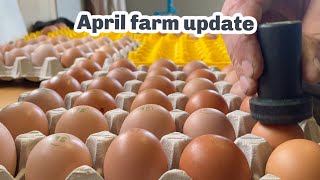
Richard Perkins walks through his farm operations: bird-flu restrictions are holding back a second broiler batch, Viola the cow might be pregnant, and he's managing seedlings in the greenhouse while fixing equipment and dealing with staffing costs tied to biosecurity rules.
Chapters
Welcome back to another video, folks. It's another beautiful sunny day. I've just come back from Stockholm. I've been off doing repairs and little shopping missions. We've had terrible winter weather again. Snow and driving rain. But back to glorious sunny days. And everything is growing. Lots is happening on the farm. Chicken's all good. So new cases of bird flu have happened. Hungry chickens ready for breakfast. Little updates in here. Today's first egg. The guys have been putting little flaps on the front. To make it darker inside. This egg mobile had been laying into the box well. But in the other eggmobile, I believe they are laying some in the corner of the eggmobile. Where it's quite close to the ground. So it's a nice dark corner. And so they've been digging that out while I was away. And we're just putting bedding down. We've been hoping that we'd be getting out within a week or so. But now with the new cases, it's unlikely. It's likely to go on for another few weeks. So we might move the other eggmobile. To pull it further away from the tunnel Onto sort of flatter ground. And lift up the sides of the eggmobile in that way that hopefully, as the chicken escapes, that hopefully we can make sure we get eggs in the right place. Hey, hey. Chicken nicking. Hey, mama. So at this point, the lambs are all out together taking a ride. Hey, tun. There's just one who we're keeping in a pen with her mama. Because she's letting it drink. But she's the new mama and she doesn't quite get it. So we've been coming and just holding her while the lamb drinks. She doesn't refuse him. And he. She drinks really well. And she's growing well. But we're keeping them together like this just to make it easier. To make sure he gets the feed he needs. We're going to have pigs arriving in hopefully a couple of weeks. But we will take these sheep up to the old pig paddocks. That's silver pasture now. And have them outside on silage. Still. As the grass starts growing, it's beginning to green up here. So to disturb your breakfast, Little beauties. Yes. We get these girls out. And we will have pigs in here to start turning this material over. So this is built up maybe 80cm deep on this side. And it's pretty much on ground level over there. So it goes down on a constant angle. But there's a lot of material that we can take out of here. And compost down to make some nice rich compost. It's been some strong winds, but deck number two is going up. It's got to be filled in and trimmed off. And in this space, we've taken away the raised beds here and this is turning into a washing station. Lots of building at the start of the year. In fact, a lot more building than we really planned in. It's jobs that go on. And we've definitely got a lot more administration to do with both the companies. So it's slow progress with some of these things because I'm taking away with doing a lot of that. We've taken down a bunch of the market garden fencing around the east and west beds that have turned into perennial crops now. And, yeah, that changes the space. It's nice, actually. We've put in the rhubarbs you can see growing up on the hill. Got strawberries coming in here, too, mainly because we have enough sun space for productions that we just don't need those extra beds. They dry up in the sun a lot quicker because they're orientated towards the south. And we have so much space with the south beds with north beds and all the tunnels, caterpillar tunnels. Anyway, let's see how the boilers are doing. And I want to get an average weight of some of these birds. Now, while I was away, there was terrible weather and super heavy rains and snow. And so I think late at night they did a little rescue mission in here and made a little trench to drain some of that water. It's very compact clay on this part of the farm and water was spilling on the side and they were getting wet, which is no good for boilers like this. And so what they've done is built a little wall and built little divisions to stop them all huddling together because it was getting cold, it was below zero again. And put up a few lights just to be sure, to be sure. There's quite a big change coming from the Buddha where the temperature wasn't even so the 18 at the end. And then coming out to a tunnel that, whilst there's no draft because we've got it all shut down on the vents, was very cold. Anyway, what I'd like to do is take the scales and just weigh a bunch of the birds and take an average, get a sense of how they're developing and how this is all looking. But smells good, looks good. They're doing a great job in here. Okay, so this is grain and starter feed mixed up to even it out. You don't really want to have all the grains sitting on one side and the pellets on another because they will cherry pick feeding time. They're averaging 0.98 kilos. So just for reference, the laying hens press my hand. The laying hens weigh probably 1 1/2 kilos average right now they'll go up to 1.6, 1.7. These birds are already weighing a kilo. They are 26 kg days old. Unbelievable. Still feathering out. And that's why these guys have put the lights on. Just with the sub zero temperatures. Big shock after the Buddha. Now in the field pens, they would have been out in this sort of temperature, but they would have got straw to bed up on. And they've also got a lot of shelter around the edges and the top of the boiler pans. That keeps a bit of heat in. But I'd say it's a bit more luxurious in here this year. Okay, difficult decision. So batch 2 broilers are meant to be picked up on Monday. That's a thousand more birds. Christian, who lives in Uppsala, is headed that way for the weekend and so is planning to pick up the second batch. But we've got a very difficult decision to make. Basically, it's a significant part of the planned income. We've also got Dave here as an employee who we need to be producing the value to be able to pay wages. And he's only here for a short part of the season because we aim to finish the boilers come July and wrap that enterprise up this year. And so we got a tough decision. Do we take a thousand boilers which have three weeks in the brooder anyway? If the ban hasn't lifted at that point we might face having to cull those birds because there's nowhere to put them. We haven't got anywhere else to put them. We could make somewhere temporary, but it would be a bit of a logistical nightmare because it needs to be a space as big as this. We could in theory delay the batch, but then that will put on a big workload stress for someone after the point that Dave's left, including all the slaughtering, etc. So it's tough decision time. Trouble is, we've already booked those chickens because you have to book those eggs to be put in the incubator many weeks in advance. Given the new cases that have come up in Sweden, it's likely to be. I mean, I think the authorities were planning two weeks from the point where it'd been nearly a month without cases, which would have been about a week and a half from now. However, with the new cases even though they're quite far south. The likelihood of the ban lifting is low. But it's a difficult one because for example, in the north of Sweden there have been zero cases. And Sweden is a massively long country. You know, it's eight hour drive just to get to the south where the main cases have been happening. But we've seen across Europe in Poland, Germany, there's a lot of cases. It's likely that there's a lot of communication between European countries to figure out, you know, how the migratory birds are still moving, etc. It doesn't look good but we've. We kind of last week with having had no cases, we felt confident to pick up the second batch and roll with it. But there's always that disturbing thing in the back of your mind that we might have to cull those birds at three weeks old, which is horrible thing to have to do. But that's, that's what we're up against. We got tough decision to make in the next couple of days. So after that false spring alarm, it's now quite a few nights with below zero. So that puts things back in here again. But it's looking good, isn't it? All the tomatoes potted up, pretending like Summer's gonna happen one day. Alright, how many tomatoes is that? Summer's 600. So we're doing. There's room for thousand in that tunnel, but there's rows of cucumber and chilli going in. Looking good. Now some of you that follow the channel will remember we had troubles with our little idli, which is my favorite tomato of all the idli. We found seeds again for however they are growing very stumpy. I think that's the back. No, it's not those. Where's the idlis hiding the seaweed chilies? Yeah. Yes, it's. Yeah. No, I was reading the wrong label. So look, the idli, they're kind of growing without much of a stem. But they are a different kind of. They're more of a bushy tomato. But they are an indeterminate. But let's hope because if you remember last year they were definitely not. They were like mushy, weird, textured, wrong colored tomatoes that had nothing to do with the idli that you've seen in our videos. If you've watched over the years. We got very nice transplants. They've done a fantastic job keeping the temperature stable in this changing weather. Beautiful transplants. A lot of stuff starting to go out in the gardens under heavy fleeces as well as direct seeding We've got some little fix up jobs in here. We've got lights fixtures that need replacing, but they don't make these fixtures anymore. At the time that I put all this together, these were by far the cheapest way to put lights over plants. I'm still not a massive fan of led. I prefer having these tubes and they're cheap, they're easy, they produce a little bit of heat which is beneficial in our cold start season. So a little few jobs to do there. Look at this. Beautiful. So we've been going through the egg bakery today. We're getting quite a lot of eggs now. But what I'm doing with the crew is just looking through at how the protocols work for handling eggs, storing eggs, how we do record keeping. Got a cow folder to record the hen data. So we have daily record sheets where we're looking at how many hens are there, how many A, B and C eggs. A eggs are perfectly good, ready to go. B eggs have a slight crack or they're dirty and we eat them. C eggs are eggs that are broken, either laid in the field or we drop them, whatever. That gives us the total number of eggs and then we know what percentage are laying. We take an average of three trays to weigh 90 eggs divided up to get the average weight of eggs. Write any comments down then weekly, we'll summarize that on a Sunday just to get a weekly overview. And then when we're taking eggs out of the packery, we always have people write that down. So we've got a sense of the stock we have, etc. So right now we're looking at quality control because we're getting floor eggs. Now, you can't use water to clean eggs in Europe, but you can use these sandpaper pads. We like these very soft, flexible ones that go around the eggs easy. And what I'm trying to do with the crew is determine what is too dirty and what is salvageable. So for example, here's an egg that's got a little bit of dusty dirt on it, but it's not feces, it's just a bit of mud. But that can be sanded off very quickly and easily and it's a perfectly good egg. Some eggs are too dirty and we won't even bother trying to clean it necessarily. This sort of egg will probably clean up quite well with sandpaper. That is worth the time. You got to think, you know, this is €13 a tray of eggs. I know some of you in Europe are selling eggs for more than that. Certainly down in Germany, etc. But to be able to put a stamp on, it's got to be clean, free of any feces, feathers, mud, etc. So what I'm doing is observing the team and just seeing how we all understand quality control and standards, because that's so subjective. We need to, you know, think that we're all on the same page. And then I go through checking. So in the beginning, I show the team the standards I would like, the speed I can do the things so that we all move along and learn together how it goes to make it a manageable job. We are getting floor eggs because the eggmobiles are not moving, so the hens are finding little dark corners where the eggmobile is on a slope. So there's some dark corners, naturally, where they're laying eggs through the floor. Certainly in eggmobile, too. Eggmobile 1 is working great. And you saw in the clip, most of the eggs are coming where they should be and they're clean. And that's fantastic. We've got trays of clean eggs already sorted with the pointy side up. So you always store pointy side up. So when we flip them, it's the flat side up. And that's the way you store eggs for long shelf life, because they've got the air sack at the bottom there. And you've been watching our channel, you'll know all these things. We've taught hundreds and hundreds of people how to set up these layer enterprises. But what we like to do is work with clean trays of 30 eggs that we can then do most of that sorting in the field so we know they're not cracked. We do that just using our ears. Technically, you're meant to use a lamp to shine through them, but you can hear that. And certainly after handling millions of eggs, I know exactly what I'm feeling. You develop an incredible tactile sense of that. So right now, because there are some on the floor, we're collecting three grades of eggs, eggs that are perfect and clean and just need to be flipped and stamped. We're collecting eggs that just need a little go over with sandpaper. And any dirty eggs we're just putting aside to take to the kitchen for us to eat, and just making sure that those numbers don't add up to too many, because obviously we'll be losing money if we're putting eggs to the kitchen, although we need to eat eggs ourselves, too. So today, for example, we've just done. We're doing two egg collections, even though we're aiming with These nests to go down to one egg collection a day because they are laying through the floor. Like we've just taken five dirty eggs from one of the eggmobiles. We want to try and get these numbers down. So we're doing extra monitoring twice a day, see how that goes. It's a fiddly job this. Lovely day for it though. Beautiful, isn't it? So down to eight bales and one fresh for the cows and the sheep getting low, but grass is starting to grow. You see, where it's been short, it's growing. But now in the fields here, it's not really going so far yet. That's the way it is. And that's partly why we decided to take the sheep to Clutter because we've got more and more cows. We've got to start thinking about our grazing plan. We haven't made that yet because grass hasn't really started growing yet. We'll start to look at that today and I'll introduce the team to how we go about planning so that we can allow some questions to filter through over the coming days and get our plan together. But I'm hoping the sheep will go up to the forest paddocks and transition from haylage to grass and then go off to Cleta when the lambs are big enough. And in terms of the cows, we'll make a plan for that as well as having enough winter feed. So we had quite a good grass year last year and it was a only just enough feed. So that's what we're got a plan now for the amount of animals we're going to have this year. Hello, cows. So because we're getting so low on silage, we're actually not dropping the whole bale in. We are taking feed to them to reduce the amount of wastage. Hey, Moo Moos. You're looking beautiful. You're beautiful too. Hello, big mama. So we're not sure what's going on with Viola. She's the old girl along with Clovermay. We don't know totally if she's pregnant. We think she's pregnant but the others have all been. Yeah, she seems late. We can't work that out fully. She hasn't been in heat, so assume she's pregnant and in the last trimester the calf will sit right down. So you can't really feel it. Probably she's pregnant, just late. She's been a good mama up to now, haven't you? Although she's starting to develop some of the boss like tendencies of Clovermay in The last years, haven't you? Yes. This little one has had an injured foot, but seems to be healed up nicely. She had a limp when we were debating whether to splintered or not, but it wasn't broken. So we left her in the end and she's healed up good. It's windy. So down to the pump. We have successfully filled the siphon. That's working fine. I feel it made a lovely new lid for the pump. But the pump's not working. There's power going to it shouldn't run it dry, but you can hear power going to it. But something is not good. And I think it's probably the capacitor which sits in this top box. I've removed it now. The capacitor is what gives it an oomph of electricity to start turning it over. I took it all apart. The impellers are free. There's no corrosion. This gets drained every winter, so there's no corrosion. It spins freely. So my next port call would be a new capacitor and haven't had any luck finding one locally, but I can get one from the manufacturer. It's a Lewara pump. It's a good pump, but market gardeners need water. So I've got to get that fixed pretty soon. Well, this is verm land, snowing in the sun. So we're just home from Douglas. You've been having a lot of fun, haven't you? Big decisions to make about the boilers. The options are cancel the batch. But then we can't have an employee because can't afford the outgoings if we haven't got the incomes. It's so hard to know when the ban will lift because they've been, you know, talking with experts around Europe looking at migratory bird patterns. It's, you know, the birds are still on the move. As the weather warms and the birds settle down, they will open up. Obviously it's crazy because there's no distinction between different areas of such a big country like Sweden. You know, there's no cases in the north and yet they're under the same restrictions. Difficult. Other options are do a smaller batch and make a different space. You know, can build a structure. But the budget would be about zero for that because it would be very temporary. We could use the barn. So the sheep are coming out in a week, maximum two weeks up to the pig paddocks that are now silver pasture and we can feed them in there. Then they'll go off to Cleta. So we could easily have the boilers in the next batch in the lean to barn and then don't know when they get full size. That barn's not big enough. But it would be quite easy to extend the space. It's much easier than building a temporary space on the pasture, bearing in mind you're not allowed to move those structures. So it's just basically making a barn out on the field. But at least we've got running water, electricity, things that will help make it easeful. We wanted to put the young pigs in there to turn over that bedding, but it's not essential. The young pigs will be able to go straight outdoors. So that's what I'm leaning towards. And we said that if the band hadn't lifted, we definitely wouldn't do the second lot. But it's difficult decisions because then we wouldn't be able to have Dave here. And we love having Dave here. It's great to have it to the team. Ragnar's jumping out. It's too hot in here with a sudden. But yeah, we got eggs to sort now. But tough decision to make in the next 48 hours. Okay. Weekend is coming. We are out of screws. So we've got little end bits to finish on the other side. And we need one more pack of screws after all this building with one pack shot. But that's all right. We'll get this up next week. Hopefully get the next TP up. Sweet. Okay. We are on the hunt for any late laid eggs because we've got it all set to turn off at 2:30. But with the new flock, they're not all synchronized yet. I see an egg in here. There's an egg. There's another egg. There's another egg. Oh, golly gosh. So the hens will start to synchronize and start all laying at the same time. And they're usually all done by 2:30. But as they're beginning to lay, it's all a bit more random. And they lay eggs on the floor, as you can see. So we've just come to check to see how many are out because we'll change the nest box timers. In this case, it's just a couple, but until they start synchronizing and laying at the same time. Look, Philip's found a couple in the corners. You were looking under the hen. She might have been trying to lay one. That's a good thing about little farm kids. You can send them down little tunnels looking for eggs. They're eating the greens. It's willow. Very tasty. Okay, it's time for us to sign off. Busy, busy days. But it's Friday and we are looking forward to a nice, relaxed weekend. We're taking our weekends a lot more seriously these days, aren't we, Ragnar? And Ragnar wants to learn. But what do you want to learn? You want to learn how to use some tools? Yeah. Nice. Can we just start today? Can we start today? We're gonna have a nice fire today and relax. We'll start tomorrow. We're gonna learn how to use drills and screws. And you already know how to use hammers already. We're going to have some nice, fun and relaxed cooking. And. We could maybe if I finish up in time, but anyway, we gotta go and get on with that. Hope you have a great weekend, folks. Hope the weather's not as weird as it is here. And don't forget, you can find out all about the things we offer in the links below. Our books and our online training. Some of them are free, some of them are paid. You can sign up, find out more. See you in a video soon, folks. Bye for now. Don't.
More from Richard


A review of short and intensive season on a mixed farm and restaurant/event space in Sweden






Alskade Kyckling Exploring complexities of poultry production in Sweden and what we stand for


