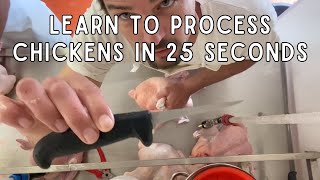
A practical, step-by-step video tutorial by Richard Perkins demonstrating chicken evisceration and post-slaughter handling. It covers knife choice and hand positioning, removal of oil gland, crop, esophagus, windpipe, organs (heart, liver, lungs, testicles), gut removal technique, inspection for disease, and chiller grading/weight-categorization procedures for packing. Also describes cleaning procedures and team roles during processing.
Chapters
Okay, so if you've been following our channel, you've seen this before, but it's always good to learn, remember, practice, etc. So always use a good chicken knife. These are made by, I think, Victorinox, and that's specifically a good chicken boning knife. You want a thin, slightly flexible blade that can be honed really sharp. And the positions of my hands are vitally important. Over tens of thousands of chickens have worked out the absolute most optimal way to do this process without any risk of cutting my fingers. I've only ever cut myself once in the time I've used this slaughtering. And that was an accident where I was showing someone something and did something silly with my knife over there. And you should never have your hands in the way of a knife. That's important. So we take the oil glands which contain the bird. So we're removing that oil sac that goes into the bin, turn the bird over. I like it at a 45 degree angle away from me. Pinch up the skin in the thoracic cavity. So we're just nicking the skin, not the actual flesh or cutting the breast meat. I secure the bird with my hand and rip the net skin down, grab hold of that crop and rip it down, switch hands, rip it up, tuck it in the back of my hand. And that allows me to use my forefinger to dig under the esophagus and windpipe, pull them out, pull the neck out, make sure the neck skins the right way round. And now the front end of the bird is released. Then I clench up with the palm of my hand on the key and cut halfway between there and the butthole. And I'm trying to get through this fascia, through this fat, to the intestine. The intestine sits right there. I can get my fingers in there. And I use two fingers to open that cavity up towards the edge of the table in case any feces comes out and I can wash it down. Then I separate the gizzard from the fat layer on top of it just by a scoop with my finger, reach my hand in, try and get everything out. If you've got small hands, you can get everything out in one go. I take the heart. I'm looking for any white spots, black spots, any sign of disease. If not, that's good to eat. I'm taking the liver without splitting the bile. And to do that I pinch the bile, the gallbladder, so that it's not in danger of splitting. And I take the livers to inspect them. They're good to Eat. Then with a little bit of tension on the intestine, I can pull this off the edge of the table so there's no risk of anything splitting and contaminating the bird. And I'm using natural line of the guts to just cut straight down, straight down underneath. And that's perfectly removed everything and it keeps all that lovely fat on the pubic bone. And this is what makes chicken, roast chicken particularly taste so good, is that thick layer of fat that we get from our birds inside. I'm taking the lungs in a scooping motion to get them in one go. So I do that in a kind of three finger twist, feeling the ribcage with my fingers and they come out in one piece, nice and clean. If there's testicles, this is a male, so I'll take them out. Make sure the last bit of windpipe is out. Holding the bird by its neck, I cut at the level of the top of the breasts. We'll keep the neck that birds an air quality bird. Off we go. Okay. Different perspectives. Always good to see things from different angles. Now this part in the process people often find really troubling. So I'm going to try and show you slow motion. I put my hand really gripping that bird. I'm in total control of the bird. And pull down. But this next bit with the crop, because the crop here is stuck to the breast meat with fascia. So I actually get my finger in and I roll it with my thumb onto my finger. Don't know if you'll be able to make that out. And then I grab up to clamp it with my finger and move my thumb further up so I can just pull downwards. It's not a lot of force needed, it's just a grip. Then I can switch hands, pull it back and there you can clearly see the crop, esophagus and windpipe. So you can easily now dig under those two and then pull that out like so. Same with the neck. So you see how the whole front of the bird is now released. Slight change in the chill room. This year what we're actually doing is weight categorizing the birds in the chiller. So we grade our birds A, B and C. A is totally perfect bird. B is slight visual damage but totally edible. Sellable seabirds are the birds that have a big rip in their skin or something from the plucking machine like that. So we would keep them to eat ourselves. And so this year we're going to do things differently. We've always just put in the birds in Numerical order. But we only test the first, middle and last birds for the temperature controls that we have to supply to the regulators. But we've decided to weight categorize the birds into five categories in the chiller to facilitate easeful packing. So we're going to see how that goes today. Okay, we've just begun. Everyone's got their rolls. Parrots are sculling and plucking birds coming in at a good rate and the birds look fantastic. So they've I would guess around two to two point. Yeah, They look better this touch. Or not. Okay, 11 o', clock, time for a cup of coffee. Having a quick break. Last birds on the trailer here so we're ready to go. Okay, birds look fantastic. We'll have a look in the fridge very soon. We're doing a clean down now trying to get this place feather free. Soak things down in hot water, then we foam it with the foamer that we use, then come back and rinse that after 15 minutes and squeegee the floor, get everything drying in. So great work today. It's. Okay. Birds looking great. Quite big birds because they went a few days over because we had our slaughter inspection. It's hard to know what the average will be but it's certainly a bunch of birds that are 2.2 to 2.4. So good sized family roasting birds and we're going to smoke a bunch of these birds too. The clean room job is always been the lower input job. You're just basically record keeping and putting birds in the freezer. The level of work in here has gone up because we're grading the birds in the actual chiller. But this will make packing much, much quicker because we'll have Birds within 200 gram Weight differences in the same crates that we can then put in the freezer. We're selling per kilo but we offer people a chance to buy larger or smaller birds so that's going to work really well. I'm just filling up the scalder for the packe packing tomorrow. Although I'm not going to be involved in the packing. The animal crew are doing that with Johanna. So mostly cleaned down, it's done. Just piece of foam inside here but we've got it feather three again and that's yeah, really good job. It's a little slower with a new team but for a first try with the first team, excellent job. We actually just all took on one roll for the whole time rather than swapping through her. We'll have six Floridas this year that are planned so everyone can try each station out. But it's good to spend a longer time in one position so you really learn that role really well.