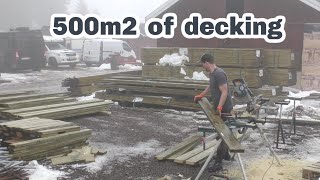
Richard Perkins cuts and moves timber in a snowy forest to build platforms for yurts and teepees. He works with treated wood, rollers, and a tractor on icy ground, building structures ranging from 7 to 12.5 meters across while figuring out site placement and dealing with melting snow.
Chapters
Welcome back to another video, folks. It's a bit of a misty, damp day. The snow's starting to melt. I've got the saw bench out and I'm starting to cut down the yurt frames and the teepee frames and get some of it up into the forest. And as we start to cut, we'll be emptying out the yard here. It'll make it easier and easier as we go on. Misty mornings. There's a few days now where it comes up above zero in the daytime. You can see the ice floes are starting to melt here in the forest and you've actually got a big drop down here. Interesting to watch water flows at this time of year and you see a melt effect. So this is my cut list. You can see I've got multiples there, three of these to make, and it's basically the same process for the yurts. Got my cut list there and the big T piece I've been estimating the amount of. I'm going to use 90 x 90 millimeter post to make the verticals like you see here. And I've just been estimating what I need to purchase because when the structures are flat, obviously you can have fairly short lengths. But certainly like on the yurt here, you've got over 80, 90 centimeter difference from one side to the other. And the platform's only getting bigger. So been doing a bit of maths with that. Okay, so that's the subframe minus the vertical legs of one of the small teepees. So this is a seven meter diameter deck. Three of these to make and then the others are nine and twelve and a half meters. So it's two long center poles. And then we've got all of our standard inner square cut posts. We've got 45 degree ends on the ones that will spread out to the angles of the octagon. And then underneath all that we've got 22 and a half degrees to make up the ring beam of the octagon. So I'm just set up with a couple of rollers to help move wood on. Now, this treated timber is much heavier than raw timber. It's got so much whatever crap it is, they put in there, copper and stuff to stop fungal infections. A lot of timber to move. But you can see now why I moved all these stacks around to be able to get to the four and a half or three and a half and then 5.4 I don't need until I've got all this cladding up in the forest. So I'M gonna start making some more. And then using a tractor, hopefully I'll be able to get up and drop them in place up in the fore. So that is three platforms cut for the small teepees. So these are all identical. Now, each of these teepees needs pretty much a whole pallet of this cladding for the decking. But one basically here, one here, one split up over there. Now, because the forest track is so thin in places, I think I'll take the tractor down, I can drive up a path this side where the small teepees are, where the yurts going. It's a little bit more off road, and I won't necessarily get all the way, but hopefully with the small teepees, I can get right up to the actual spot. So I want to test drive the tractor up there. Just check there's no fallen trees in the way or anything before I take a heavy load. Mark out the spots where the teepees will go, and then I'll know exactly where to place the wood. And by the time I've got rid of all the decking and these, that will open up a lot more space to start cutting the yurt platforms. Now, these have a laser light inside which marks the wood. But you might have seen I was measuring with a measuring tape and not using that, using the saw blade to actually measure. That's because when the wood is wet, so you have this to act as a dust cover. So this will give you a line when you're marking, and then you cut with that in place so it doesn't put sawdust in. But when it's so wet like this, the sawdust is so sticky that it just fills this whole thing that this basically doesn't work. You can blow it out with a pressure hose, but it's. You basically have to do it every time. It's just not worth the effort. So the other thing I could say is we used to have a. Well, we still do have a saw bench, which is basically a long wooden bench with a tape measure already built in that this piece of the saw fits into. Now, that would also be a lot more efficient in terms of not having to measure each piece, because you can just line it up at the tape measure that's already integrated into it. However, that thing is frozen under ice and I can't get it out. So I've just gone with adding a couple of rollers to facilitate longer wood and just measuring all. And it doesn't take long anyway. I don't know how well, you'll make that out, but that's around 7 meters diameter. So I'm trying to choose these flat spots that are quite clear already. So I don't have to take out many trees. It's very misty today. Can't even see out onto nutfield there. But this is a tractor path that comes up here. So it's a great way to bring wood up, hopefully. And it'll be a nice walking trail to come up. So this is the first small teepee and I want to give them some space in between. So my aim would be to dot them along up on this hill here. It goes another 150 meters back, but I don't want it too far from the farmyard. Also got a tree down that's blocking the main roadway there. I think the next spot is up here. Okay. So this second one actually pops out into the road, which I don't want, but I've got room to pop it back a little bit. Have to take one tree out here, but it's no bother just to put that back a couple of meters. I don't really want it sticking out on this roadway. Now this last spot, I want to keep it off this forest track and I've got to balance it between keeping away from the side and keeping a little distance from the neighbours. It's quite quiet over there, but if people are camping up here, they want peace and quiet. So thinking possibly taking out a couple of trees here and putting up the last one up here. Well, on second thoughts, I can't get up the steep hill that accesses this side when it's snowy and icy. But I can get up this road now. I've just chopped out this tree that's blown down and the teepee platforms are just on the other side. Now if I dump all the timber up here, it does mean I have to jump back and forth across the little gorge here. But I think it's the only way I can do it for now. I can't get up that hill and so that's where we're going to do it. Just clear this path and start moving stuff up.
This is actually the stream overflow.
Totally frozen.
We're driving on ice here, so I don't know how easy it's gonna be to maneuver. Well, that's the first yurt platform, TP platform which has to go here. But it's quite easy to get up over here. I'm just a little bit worried about the tractor still with tipping. I've still got to learn the machine and there's Big divots in the pathway from the forest machine that the previous owner has been using. And then some ice here that I don't know what's underneath that. So just taking it easy as we learn the machine.
Well, it's definitely a shame not to be able to get it right on the building spot. So that I can just keep churning planks into the build. But still very happy not to carry it up by hand. In the old days, I would have carried every single timber here up by hand into the forest. And whilst that was fun at the time, and I was fit and strong and eager, as I get older, it's very nice to be able to move heavy loads. I'm going to get the cladding up here and then work on the previous piles and just assemble everything in place so that we can start the builds in a coherent fashion. Not the cleanest job, but it's so uneven and everything's melting up. So good to get this done now before it starts to get too wet. This stream is overflowing, as you can see where it's iced up. But that's gonna thaw out now. So glad to get this up there now. Even if I do have to carry it from here just over there, that's not a big deal. There's nearly 2 tons of timber there. And I'm very happy not to have to carry it all the way up. Would have been nice to get it in there, but that's the way it is. I'm going to try and get the next bases up. And then it's time to go and collect Ragnar. So I'm not sure if I'll get everything up here today. But good progress. Happy with the machine. Good machine. It. Got all of the subframes up and got the decking from one of them up. So that leaves me with the list lot to get up there. And then I still have some 3.6 decking there, so probably half of that will go up. But now I've got all these timbers exposed, I can start cutting the yurt frames. Maybe I'll have a bit of time for that later. Okay, cut. Ragnar picked him up. He's playing. So I've decided to cut the yurt frame. It's a little bit bigger. Going to be hard to get that into the forest because there's trees on either side of the path. But we're only going halfway up. So I think before it gets dark, I've got time to cut the other one. Got all the offcuts here now, obviously, they're not waste. They can be used for stairs, although they're a little bit wider than we like for stairs. But other things they're good for is you see how the slaughter is held up by these blocks. Makes really good solid platforms for things like this or little stairs around the place. You can see these blocks here now, we've built the slaughtery without treated timber, but they've held up fine. But one thing I'm thinking, I think I mentioned in the video before, is this platform is going to be two and a half meters wider than it is now. So it's going to come out into the garden quite some. But what I thought would be really nice to do because this is a dining space, this is where we eat, and it's such a focal point for the farm. I thought it'd be really cool to build out some steps that are also like sun lounges. So you have like a series of three or four steps that you can sit on and that's going to be really beautiful. Lots of building to do. Job done for today. So it's not bad progress. For the first day of cutting, we've got yurts both cut for the sub bases. Obviously the decking will go up whole. We've got all three mini teepees cut and up in the forest and one lot of cladding there. So all I need to do is move this first pellet and then that will allow me to get to these 3.6s. That means I can get all the cladding up in the forest pretty easy. For the small teepees, I can get the yurt frames up and then I'm straight on the 4.5, which is the decking for the yurts. Once I've taken all that up, that will expose the 5.5, which is what I need to cut the frames of the giant T piece. So we're getting there. And all this decking will be in the farmyard here. So we will be clearing the yard soon and I'll be able to get up into the forest and start building. Now, I'm a little bit skeptical of putting these screws in because of the likelihood of the ground sinking a bit as it thaws out. The frost or the ice only seems to be about 15, 20 centimeters deep in the forest, so we'll see. But right now this whole week is going above zero. So I think it will really start getting to the point where I can install all those. Cut the posts at the same height using a laser level and crack on with it. So I'm hoping it will be smooth. I'd say it's probably, I mean, today's been the half day essentially. I've got so much admin work, let alone writing a book and all the other stuff going on. So I reckon there's probably, you know, another day's work just getting all the timber in place and getting all the components up there and cutting all the legs and then the building. It's going to take a few days, I reckon. Depends if I get any help. And so many other things going on in admin wise and trying to get this book done before the crew get here in a month's time. So we'll see how it goes. But I think good start and good to learn a bit how the machine is working off road in that kind of ground. It's, you know, it's definitely a learning point using heavy loads and certainly the tracks with these deep potholes. It's. You've got to be super careful not to tip. So it's being very cautious, which is how you should be. Roll cage up, seat belt on, all that. But yeah, good progress today. Happy with that and looking forward to seeing some of these structures come alive. It's going to be really nice. I expect next time Google Maps updates, you'll be able to see all of these platforms from space, which is pretty cool right now. If you look at our farm on Google Earth, you'll see it in the 2018 drought. So it looks pretty haggardy, but it's still cool to see. You can see a lot of detail on the updated version. Anyway, that's it. I've got to go and plant a few thousand tree seeds now. I'm not going to bother filming that because I need to just hit turbo speed before dinner time comes. But thanks so much for watching. Hope you enjoyed the little updates. I'm trying to just bring you with me while I'm doing stuff that's not office and admin work, that's pretty boring. And as always, you can find out a whole bunch in the links below. You can find our book and online trainings. There's free online trainings, there's paid ones, there's all kinds of stuff and we look forward to seeing you in a video soon. Bye for now. Well, pretty healthy pile of sawdust today. Just clean up the tools and it's a wrap. Ra.
More from Richard


A review of short and intensive season on a mixed farm and restaurant/event space in Sweden






Alskade Kyckling Exploring complexities of poultry production in Sweden and what we stand for


