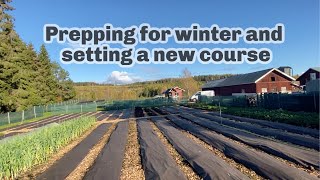
Richard Perkins closes down Ridgedale Farm for winter, covering beds and draining lines, then outlines ambitious plans for next season: hiring four staff and three apprentices, adding perennials and storage crops, building larger teaching structures, and buying adjacent forestland for camping and yurt events.
Chapters
Welcome back to another episode, folks. The season is really winding down here. I thought I'd take you on a walk around the farm on this beautiful sunny day. So things move fast. Winter is approaching. It's getting cold. Frosty mornings draining the water lines down there. And as you can see, a lot of the market gardens are closed down now. And this is the way we ideally put the beds to sleep. One thing you'll notice this year is we've had a lot of moss. You don't see moss in most garden beds. It's been very damp here. But what's happened here is we have basically covered up the beds with the old chicken bedding and then broad forked the whole thing and tucked them away. That's going to further break down. It's been sitting all year essentially. But look, it's full of earthworms and compost worms. Breaking that down into a beautiful. Look at that. And what we notice with these covers, there's so many worms. I hope you guys can make that out. Beautiful stuff. Soil protected, non woven geotextile on the surface. That protects the soil and keeps things active. You'll remember some years ago if you follow our channel, I pulled back these covers in spring when there was still snow covering the ground and the earthworms were active and going for it already. Even when it was basically zero degrees still. Some spring onions under here, but very nice. This is actually compost from the garden residues from the bays over at the end there. I can tell that because it's got a bit more sand in. That was at the bottom of the bays, but very nice. Here's a few of the last spruce seedlings that have been hoed out. Few onions here, but that's not going to be a big deal. But this stuff will just sit over the winter now. Protected. Perfect. Very bizarre seeing all this moss. It's not a problem for us. You don't usually see moss in garden beds. So the pack down has begun. It's really coming to an end in a couple of weeks from now. I'm actually not going to be here the last week of the season. I'm going to England to be with my daughter grace for her 10th birthday. I'm taking Ragnar on a road trip and it seems like the COVID ban has lifted up a bit. That makes travel easier over there. So we're going to explore the south and southwest of England a bit. Maybe I'll take you on a ride with us in a camper van or something like that. But I'll let You know about that when we get there. So team have done a nice job covering up the beds. We didn't get to that last year and it wasn't ideal. I think that led to a lot of the spruce seedlings coming along. Just the last kales, radish, etc in the ground now, some chard, carrots and that's all coming out pretty soon. Boiler pens have been stacked away for some time now and we've been thinking forward to next year now. It's actually the first time the broad forks really been used this year. We haven't needed broad forks for quite some time now. Interestingly, talking with everyone on the farm like a hero experience, which is still open if you want to join us for that until the end of the month for the episodes that we've been putting together all summer. But the consistent experience of no Dig growers that I've been hearing is that basically after two, three years everyone's finding the same. They just don't need a board fork. It doesn't produce any beneficial actions on the ground. So this is like a manual keyline plough as I've described it before. Typically good for very hard soils that are starting from pasture or whatever. Just like our beds have been formed. These were originally compacted heavy clay pastures. It was all really waterlogged. You can see the remnants of it on the pathway to the neighbour's forest here. And actually in these beds when I first were laying these out, this whole section, the two bed section here was underwater. We actually dug channels originally. You can just see the remnants of a couple of them here to drain excess water into this roadway. It's just amazing what no dig has done. The wood chips and all of this carbon rich materials just kept this soaked up. It's beautiful. Retains moisture really well even in the summer heat waves that we get. And so it's been beautiful just to see how you can really work on top of the ground to totally transform the situation. And that's another benefit of this beautiful no till approach to growing vegetables. So our south beds are almost completely asleep and I thought I'd tell you a bit about some of the plans we've been talking about for next year. Quite a few plans and Johanna and I need to slow down our work and have more people engaged on the farm to reduce our workload. So we're putting out four paid positions next year and three apprentice positions to support that. So everyone gets plenty of time and we're going to change the market garden around. So this south section is going to go into farm food or storage crops and we're going to broaden back up the range of crops we grow. Again. It's the thinking we have so far. We took away crops like garlic and we haven't grown potatoes ever, things like that, just because of the profitability in the small scale we work on. But we miss a lot of the crops that we took out and decided we want to bring them back in. And so that's a plan on east and west. We've already got perennials like asparagus and flowers, but we're thinking to put east and west totally into perennial crops like rhubarb and chives, etc. To complement the herb garden that's just falling asleep behind us here. And basically focus our attention on the north beds, the new and old north for the market garden. And there's some other reasons in there behind that. And we're thinking about possibility of pulling up these old beds and turning this into a washing up station as we totally change the yard around. So something that's happened. We've got our education yurt packed down here and our food yurt that you'll be familiar with if you follow our channel in the middle of the farm. But one thing we've decided to consider is to take a food truck, a sort of mobile food truck that could be used for events and things like that, and park it in the yard inside of the slaughtery and have a chef again this next year to take off the load from the farm, but also to work on the Ridgedale cookbook idea that we've been thinking about over many years now and to bring food production into the heart of the farm, make that role really visible. And it will also give us a space in order to do more preserves and certified kitchen spaces not in our home. So we've always catered for trainings etc from our house kitchen and as we get older, we just don't want that anymore. Now another thing coming up is we have outgrown our yurts. These are 9 meter diameter yurts that we built and we've outgrown them. So we're in talks with the local company that makes huge structures to replace these two, our teaching yurt and our dining yurt with slightly bigger structures that can open out so that we can dine with the vista of the garden and then take these two yurts and hopefully there's a whole nother plan around here. So this forestry is divided into two strips with this road up the middle. And if you look at this map from the 60s, you'll see. Certainly this part was part of our farm. I knew that when we moved in, because the lie of the land is very flat and then steeply comes off here. So this would have been cleared farmland up until the 60s or 70s or so when this was planted. Now, the neighbors always said that he's going to harvest this in the next 10 years, and the trouble with that for us is that he's going to end up needing to stack all that timber onto our garden space, which we've spent years building up now. So something that we're considering is whether we can purchase this forest and keep it standing. It's probably only worth €50,000 or so, and I think it rightfully belongs to this farm as well as this piece of land which the neighbors never used at all. And so one idea we have is to purchase this piece if it's possible, and keep the trees standing. Now, the bark beetle problem in Sweden means that we were probably quite lucky to cut down our forest up on the hill when we did. And it's been a big concern in this area as well as big parts of Sweden. And so that might encourage the neighbour to sell this to us. Now, he's tended to it for 40, 50 years, so he's obviously got sentimental attachment to it. However, I'm willing to purchase it at the price of the land and the timber value that he would get out. And my plan is to keep that timber standing and turn this into a camping site with the tent teepees that I bought this year, as well as both the yurts. Then we can have different events and people renting who want to come and eat farm food and explore the area, etc. And for me, I'd much rather keep this forest standing. I also want to clear the front row of trees because they are really eating into the garden beds. If you've been watching our videos regularly, you'll remember seeing a video where I detailed that they're just sucking the water out of the beds closest. And we tried to root prune, but we can't go deep enough by hand. So it might be good now to clear one row of trees. And then we would essentially create some clearings within the forest and have different tents set up there and be able to host other people's trainings and things like that, as well as have some beautiful spaces and put this farm back together as a functional land unit. It's been a long time since we've had fear of the pond drying out. You can see the water is flowing strongly now at this time of year. There's just an abundance of water and it just seems like we got it all in one bunch this year, which is challenging for gardeners but nice for the landscape. And we've seen great grass growth this year. It's been a wonderful grass year. Heading up into Nutfield now and I talked a bit before about wanting to make a new Eggmobile 2.0. I recently put up a video of some of your beautiful eggmobiles that copied from the Ridgedale design all over the world. But I thought it's high time because we're a demonstration site. It's important that we respond to things that we see going on in the field and we have a resource base that allows us to do that. So something I've wanted to do is redesign eggmobiles for full automation. Total low cost, self build, taking all the best features of all the best commercially available eggmobiles and making that available in plans etc for people to be able to go off and build them. So we're thinking of hopefully over the winter time, maybe early spring, building two new eggmobiles still powered by atv but with full automation features that also include full protection against bird flu and meeting all kinds of European standards that we don't have to meet here, the scratching space underneath, etc. So that's exciting for me. And part of my process has been getting engaged again with things that excite me from a learning perspective. We're up at the cows now. The cows and sheep and the chickens just got a bit flustered when they heard that. Can just make out in the background. We're going to say hi to Clover May. But yeah, part of my process has been getting re energized. Re excited about my learning edges because part of doing this routinely over and over and educating so many people in how to do these things is my learning doesn't really go anywhere because I've done it before, I know how to do it. And so a big part of redesigning certain things around the farm is to give me creative freedom and get my energy back and put it in the right place and build a better team that has the right support around me and Johanna to allow us to find a bit more balance. These beautiful chestnuts. It's a beautiful day and it's certainly getting to the point where we're needing to drain the water lines every night now. See some hungry chickens behind me. But it might be time to say hello to new style of eggmobile next season. And I'll keep you Posted about that whenever we begin. I was hoping to bring over a few colleagues who've been engaged with Richard L. Stahl eggmobiles and have made modifications themselves and see what we can do to make a new standard for European regulations for the Mead organic standards. This is the state of the grass we're in now in mid October. Plenty of forage on the ground and we're leaving an armored lair as we graze through. That's important now as the hens are following up the other egg mobile in the background there. And that's important to leave enough armoring that the hens don't have too big an impact with the wet ground that we've got. We did get a little bit stuck with this eggmobile up here. It's very wet on the ground. Even my 4x4 truck got stuck. It's been nice to get some inspiration back. I've been certainly through the emotional ringer. It's been a really tough year this year. In fact, it's been just a very bizarre year. I'm sure we've all had bizarre years with the COVID situation, etc. But it's just been a deep dive into all kinds of things outside and around the farm and really sort of thrown my thinking all over the place in terms of where to put my energy to serve the sort of burgeoning community that follow us and how to run this place. That it's leveraging the benefit of all the work we've put in, but giving us the balance, life and time, performance, family that we need. And so some great ideas have come up and I'm excited for that and I'm feeling a lot more energized and it's really nice also knowing that the season is finally coming to a close and we can really shut down a bit over the winter and take some much needed rest. There's also going to be a lot of planning and thinking about, but we're going to outsource a lot more things from this point on, hopefully. And so that's kind of to be super nice. I'm coming back through the entrance to the neighbor's land. This is the land we would hope to buy. Those of you that have been to the farm know that this is just such a magical little spot down here with the stream and often on trainings. People love to camp up in here, but there's some fantastic spots to put up the teepees and yurts that we could really host some beautiful events and just have a whole extra dimension to the social life here, which is really important to me. I've been feeling very isolated in recent years, just living in remote Sweden and not having had time to learn Swedish and not really getting out of the farm much to meet anyone. It's always really revolved around bringing people to the farm, which has been amazing. We've seen all kinds of incredible people coming through as well as lots of, you know, very interesting characters that pop up in places like this. But to build a bit more permanence in and these kind of things are important for us. That's going to be it for today. Just wanted to update you about a few things. I'm still working on the video putting together all the beautiful no dig gardens that people have sent in. There's quite a lot of gardens, so it's going to take a bit of a while to fiddle that together, but so excited to be able to put that out and just share the beautiful efforts that people have made all over the world with this style of market gardening. Wood chips in the pathways, compost on the surface. Beautiful, well kept, efficient way to grow vegetables. So I'll leave you with that. Thanks so much for watching our videos, folks. You can find out a whole bunch more in the links below and we'll see you very soon. Don't, don't, don't.
More from Richard


A review of short and intensive season on a mixed farm and restaurant/event space in Sweden






Alskade Kyckling Exploring complexities of poultry production in Sweden and what we stand for


