Cows back on our land, moving birds and building a bubbler
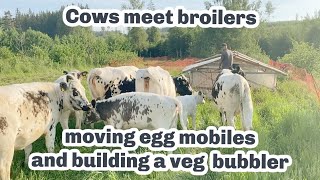
YouTube vlog by Richard Perkins (published June 7, 2021) showing practical farm operations: moving an eggmobile and poultry fencing, bringing cows back onto the property and planning their daily moves, setting and testing electric fences (multiple voltages mentioned), managing broilers (water, shade, compressed slaughter schedule), and building two bubble tanks (bubblers) for wash-pack operations. The video also promotes a Regenerative Agriculture Masterclass (registration open until 10 June at 18:00 European Time) and offers free downloadable CAD plans, a PDF book and enterprise planning sheets.
Questions this video answers
10 June at 18:00 (6:00 PM) European Time.
June 7, 2021.
300 kilos (rated).
At least a ton and a half.
Nearly 8,000 volts.
Chapters
Welcome back to another video folks. Early morning time to feed and move the second egg mobile. Going to give you a little look around the farm today. So a simple process takes 15 minutes with a pair come up and one goes off to the other. Eggmobile checks the nest, feeds the other with the machine, takes down the first net at which time second one comes in, takes down the other net. I've already laid it out in anticipation of the next paddock. Eggmobile moves Energizer Waterer set up the fence again. Off. We're always trying to park on top of a hill, so we've got gravity to help us with moving because we're pulling at least a ton and a half with the ATV which is rated at 300 kilos, but that's the way we've been doing it for seven years. Works well enough. Beautiful grass. Putting up poultry net. What we do in long grass is just use your foot to press the grass down and you can pick the fence up with your hand. So you don't need to bend down ever. And then the trick is to pull it tight with your foot. And you can see no chicken can escape from under that. Now when we've had lower powered energizers, we've had to peg down the fence at a certain point in summer when they want to get out of here. But that adds a lot of extra movements and we don't want to do that. So now we've got better powered shock boxes. The trick is to get the net tight and you do that with your foot and then that bottom line is tight that the chicken can't get under it. So you don't need to cut your grass. That's crazy business. And ultimately you can use your animals to cut the ground in front of of the nets. We're actually moving the cows back onto the farm today in front of the broilers that are working down top field. One of the big benefits of the automations that we've put on is to be able to have automatic closing and lights. And that's quite important. Right now we've just moved the timers back to midnight up here at 59 degrees north. It doesn't really get dark at this time of year, just gets dusky. So the birds are not all in until about midnight. And those automations save someone having to be awake at that ungodly hour all through the summer. So door is not set to open to seven o' clock at this time. Just gonna let some out the back. Good morning girl. It. So we've been running running a miniseries that's open till the 10th of June. You can get free CAD instructions step by step instructions how to build your own rollaway nest boxes for up to 400 hens. There's also a free PDF book of the whole farm Like a Hero experience that we ran last year as well as enterprise planning sheets and crop profiles from our no Dig market garden. That's as part of the launch series for the Regenerative Agriculture Masterclass which registration is open for now until the 10th of June at 6pm European time. That's an eight week online intensive, the border's furthest reaching regenerative agricultural online training that exists and registration for that is open until the 10th of June at 06:00 European Time. You can find out about that in the first link below. And don't forget to join the miniseries to receive all of those free downloads. No strings attached. Lots of amazing resources for you. There's okay Eggman Bilt's moved, serviced, ready. Now it's time to get the cows back onto our land. Whilst it's all the same species, our grass is much more nutritious. Already up to Mathai. We'll compare that to where they've been but they're going to love coming back to our. So boilers are hopping across to this new lane. We're starting the cow fence here and we're going to be giving them two moves per day to get them around the tree lane. So we'll give them this in the morning and the whole next lane in the afternoon. So they'll be probably taking the grass down by half. That will make it easier for the fencing of the broilers and we'll recover pretty fast. Grass is growing so quickly now that we need to get around the farm really quickly in order to keep on top of it and this will be the end of the boiler season. In a couple of weeks time we're doing another intensive week of slaughter and we decided this year to really compress boiler production so that we only have an employee for half of the season so we can just bunch everything together and have intense week long slaughter sessions. Two of those and we're just running a couple of thousand birds this year and that's working out well. It's very intensive to do slaughter pack, slaughter pack all week, but it saves dragging out over multiple weeks throughout a longer period of the year which just seems less efficient time wise. So just closing on the spring gates so that we know for sure that cows are not going to go on a big rampage at this time of year, when the grass is growing well, they often, a couple of times a year, like to go on a bigger run around the village. So by closing all our gates, hopefully when we let them in through, we've got a little pedestrian gate at the bottom of top field. I'm going to take a little bucket of grain, just try and incentivize them to run up towards us. And then they're cordoned off by the back side of the paddock they're going into. I think it'll go smooth. They're going to love being back on our land because the grass is just so much richer and more dense here. Little black walnuts coming on nicely. We've been having beautiful weather, but quite challenging for gardening. Streams are drying up already, so it's forecast another week of dry weather, sort of mid-20s. And so it's getting tight for water now. Got to be really careful with how much water we use if the pond is not replenishing from the stream now. So the cows did break out the other morning, briefly. Cows escaped and ran straight to the silos where they know there is grain supply. We got them straight back in and they came straight back out again. So we're using single polywire and that's typically totally fine. They don't test the fence, but they do get this urge once or twice a year to just go running. And you can't really stop a big animal with a wire if it really wants to go now, should go fine today. They really enjoy coming back onto our land, but they may just stick around wanting to eat without moving up to where we want them to be. I've got a little bit of grain here just to tease them on, and that's always a handy thing. But we've got to get them through this pedestrian gate over the stream. And that's where issue might come, is getting them over the stream here. So there they are just turning the wire off and we've got to entice them over the water here now. It's possible it could run off sideways. We'll see how it goes. Alrighty. Come on, then. Let's see. Flying cows. All right. We gotta not leave violin behind. Come on, Violet. This is more like it. Look at that. They're always super happy to come back to Ireland. Flies coming with them. Here they come. Always a straggler. Sheep are getting excited. Hey, Viola. Come on, then. Slow coach. Good girl. Good girl. Well, smooth as it could be, I think they're going to get very curious about the boilers. Yeah, it's beautiful. Say hello to your field friends. Cows are very normal, normally very curious with animals around. What do you think? Back on homemakers fun. So right now they're going to be on about 11, 1200 square meters a day. They've been on over double that in the neighbour's field. But now it's a mathematical equation to get us around all of our land. Because the boilers are on their way down, they've got about 10 more moves which will take about three more lanes. So what we're going to do is graze down in front of them all the way to the bottom, then go back to let the ground where they have been recover further and then take that before heading off to Nutfield and then into Funfield for the first time of year. So we've been giving extra water at either end for the broilers now because it's been so hot and gets a little sweaty up here. They do get a good amount of shade. It's so important that they have access to fresh cool water all the time. That's been working well. Okay, so that concludes going through the neighbour's land and we've grazed very lightly, spending only nine days in this huge field. And the reason for that is we want this to recover fast for cutting winter feed. Haylage or silage, very dry silage. Now most people are starting to cut around Sweden because everything's about to go to flower. However, we're contracting in neighbours and contacts in the village and so they typically come about 10th of July when they've wrapped up all their other work. So anticipating what happened last year and the year before, we decided to graze through all of this quickly, knowing that it should be recovered in time to get the winter feed. We're going to take a couple of cows out the herd and haven't decided about the sheep, but it's quite likely they will disappear and so we should have ample winter feed, I would have thought. There's Sacra dog. Hey, Sacra dog. You missed the fun. Hey, piggies. Morning piggies. They haven't been getting out, so that's working well. We've got three and a half thousand volts still and they seem very content in there. Happy piggies. Oh, that's the fence for you. And that few days in the barn with a quick fence around them really gave them their first initial shocks and that's really important with pigs. They're very powerful animals. You've got to make sure they respect defense from the get go. Okay, wheel set up. We've got nearly 8,000 volts going through there. That should keep them in. So we're just giving them this in the morning, probably till 11 o' clock or so. And then they get a longer stretch because the boiler pens are not in this one. So we're leaving their shade mobile in there so that they have shade in the hottest part of the day. And we also are binding Violet for milking her out. She's had infection mastidis in one of her quarters, so we're just milking her out. Always a good idea to carry a fence tester. They're cheap, easy to use and just test your fences all the time so you build up a relationship with how the grounding works in different soil moisture conditions, when your fences need repair, etc. Really good habit. Always carry a fence tester and use it. Everything we do here is observation based. So second paddock set up. Simple hop through the fence at lunchtime. That'll keep them happy. Look what Jane just found. Hello, beauty. This has come from the neighbors, so we're going to take it back. How did you actually catch it?
It was sitting on a compost pile next to the windbreak. So me and Dave just decided to push it into the windbreak. Yeah, this rock has had trouble flying in there.
So in the washing pack station. And what I've done this year is bought these two big containers to go in place of the bathtub. And the aim of these is to create two bubble tanks. Now we use them for dunking to get heat off vegetables when they come in off the field. And I'd like them both to be able to be bubblers. Now to create those, I'm just going to use this air pump, Jacuzzi pump, pretty standard. I'm going to have that mounted on the wall with a flexible tube that you can connect into a simple setup in the bottom of each tank that lets bubbles up. So you can use one or the other or both. First of all, I've got to install plugs and these pipes to drain water out of these tubs into the tree lanes behind here. So take it step by step, see if we can get that fixed up for the wash and pack this week. Sam. So that's what we got to for now. Not needing the tanks to tomorrow. So we'll test it in action. I've had to add more gravel into these and the gravel obviously serves to keep it down. The pump is quite strong, can't get much stronger. It's noisy, but we turn it on and off here temporarily. For now. And this allows you to plug it into whichever tank you need. So you could have one dunk tank for getting heat off vegetables and one bubbler for cleaning roots or greens, but seems to be working good. We'll have a to take test. You can see the sort of size of holes I've gone for and that can obviously be modified depending on how it performs, but it seems quite good. All right, that's it for today's video folks. And don't forget, you can still grab all the downloadable gifts we've given out with the miniseries in the build up to the Regenerative Agriculture Masterclass. All you have to do is sign up with your name and email and you can get access to our free book and PDF version of our stories from the pioneers that we compiled from last year's tour around Europe with some incredible farmers. There's also downloadable CAD plans for our nest boxes and all kinds of other awesome resources there. If you want to find out more or enroll in the Regenerative Agriculture Masterclass, my signature online training that will be running through July and August this year. You've got till June the tenth at 6pM European time to register if you want to join us, so check that out. That's in the top link below. We'll see you in a video soon.
More from Richard


A review of short and intensive season on a mixed farm and restaurant/event space in Sweden






Alskade Kyckling Exploring complexities of poultry production in Sweden and what we stand for


