Cows out and preparing for a flock of layers
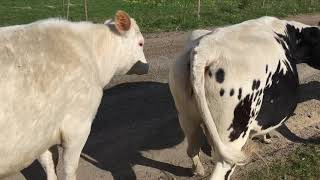
Richard Perkins narrates a farm workday: moving cows onto fresh pasture, preparing for delivery of layers (hens) and broilers/turkeys, and tidying infrastructure (eggmobiles, nest boxes, water, silos). He describes pasture condition after drought, feed logistics (bulk silos, protein levels for different birds), seedlings/market garden work, and upcoming courses on the farm.
Questions this video answers
May 13, 2019.
Two eggmobiles.
Turkeys: ~28% protein; broilers: 21% feed; layers: roughly 14% protein.
About 4 tons of pellet feed each (roughly 8 cubic meters).
Bought the silos for €500 and reported they saved €5,000 in the first year.
Chapters
So in today's video, we're getting the cows out on the grass and we're getting ready for the delivery of the hens tomorrow morning, which is super exciting. So the pollen this year is totally crazy. I don't normally react to pollen, but I am reacting this year. And I don't know if you'll make that out, but this decoloration of this compost is just the sheer amount of pollen. Look at this. Pollen on everything. Totally crazy. Hens come tomorrow. We've got two eggmobiles running this year, so Gustavo is learning the ropes how to attach eggmobiles. It's a job that I've normally taken on, but this year we're putting Gustavo on it. Dogs are going crazy and hopefully we'll get the cows out on pasture today. We'll see how time goes. But getting things ready for both coming tomorrow and in less than a week, all the boilers will be here too. So we've got the brood already last week, and we're just taking these in just to check anything. I see, like a bit of wood is broken there. So just fixing that up, checking all the roof sheet is in place and then having a look inside, just making sure the nest's all good, putting clean nest mats in. And then we put a sheet above here to stop manure going on to the nest boxes. Just check everything's good and grease the legs, the support legs, and then we're putting them up in the turning circle up at the top here where we can unload the birds from the trailer tomorrow. So we've been coming through in the mornings, just giving a little weed to the strawberries and taking some of the suckers away. And that just makes it easier to graze straight up to this line when we come through with the egg mobiles, etc. This was originally put in for the young seedling trees, and we've just filled the space with strawberries, but we've got about 7, 800 suckers out so far, which is pretty neat. There are some gaps where plants have been taken up by voles or taken out by over enthusiastic eggmobile movers, etc. But this makes moving boilers and layers a real joy in the mornings. So looking forward to that. Got a little bit of rough patches in the pasture this year after the drought, so it just didn't grow for 120 days last year. So we have a lot of rough spots where the birds were just making dustbasts and, you know, it just couldn't hold up without the aggressively growing grass that we typically have, but fun. Looking forward to seeing how the pasture recovers. And how all this lot returns back to grass this year. We'll go and have a look down over that way. So the neighbor's land's also taking a beating. One good thing that's come out of this is we've actually got a much better bridge here. Now. This is made. We had a tree trunk bridge that we made. But they've put some of the logging platforms over. And it's. It's actually quite a significant bridge that I think we could bring an egg mobile over here for the first time. It's quite a smooth transition compared to what it used to be. It's a bit trashy with all the brash in there. We've got a fence to sort of fix into here somehow. A lot of fencing to fix up. But this is quite a significant bridge. That you could bring heavy vehicles across now. And it's wide, so interesting. That's one benefit that's come out of this is we could start improving the neighbor's land if we wanted to. If we had more poultry in the future. Like scaled it up. But quite a lot of work to get this pasture back to happy days. It's quite a lot of clay here. And it's, you know, it's just flattened subsoil. It's. It's got topsoil mixed in with it. But this is where we typically start the turkeys. And so we'll be working out how to do this year. Probably starting. Might even just start in the big field. Just to have a nicer view. It's beautiful down here where the streams go. I think we might just avoid this field in general. Yeah. Okay. So we're leaving the eggmobiles up here for today. And we are gonna hopefully have him park up alongside close by. And then we're gonna be able to quickly load the hens in. We typically have one person in the eggmobile. One passing in full crates. Because he's typically delivering I don't know how many, but a lot of birds throughout the day. So we're gonna go quite fast. Handy to have this turning. Until the end of the row. And then picks up any mistakes after. Usually unless it's going really off palette from Japan. This is all the different seeders and dibbler boards. And more paper pot transplanters. Big day for the cows moving into Nutfield. So Gustavo and I, we just got a simple wire across the road there. And the simple wire here. Hoping that they will just go into Nutfield. They're going to go crazy on grass. So we're basically going to get them in the field, shut the spring gates, take these wires down so we're not blocking the road. And then we're going to usher them up to the top. They'll probably go for a big run around because they'll be excited to be out. We'll see how it goes. I'll try and film as we go. Okay, it's all yours. Take it away. Come girls. Come girls. This way. Let's go. Here. Love me. Not that way. Not that way. Not this way. Come on. Hey, come on. Everything's exciting when you first get out of there. But we're going down. We've got lusher pastures to get to. They're a bit confused because they just see green everywhere. Look on the sides of the roads. We've got much nicer pasture for you up here. Come. Go. Come, girl. Oh, big day. Once they get in there, they're gonna go running. Viola's looking really big after the winter. Clover May's calf has still been drinking milk on clovermay for quite late, but their calves are definitely quite fat. The fioco is a very small cow and we're hoping to get a Fialku bull very soon. There we go. So I'm gonna go take the wires away and then we'll go see where they've got to. At that point, they're super eager to eat. We're gonna try and just gently herd them up where we want. They got startled by the dog there. Hello. You just want to eat. Now we're going on a little trip to the top. We're getting them up to the top of that field there. Come on. Yeah. That's so exciting. Maybe not to scare them. They're not scared by us. They're just excited and jumpy. A bit like show ponies. These cows, they love to do flips and jumps like this. There we go. We're using just the speed fence to get a quick line across. This is a fence that's not great for making permanent paddocks and it's not great to be using it with one hand. But a very quick way to net like up to. I think it's 100 meter lines. So it's really great for temporary paddocks and really nice, efficient reel system that stops you getting caught up. Very nice. So it's made by Gallagher and they're not the highest quality in the world. So you can see the posts slot into the system like this. But it's just very nice. Quick way to put out multiple lines if you don't use nets. So we're up in the very top of nutfield now. This is where the highest water point is. And we're going to start the egg mobiles up here. So we want to see Mr. P in the distance. I don't know if you can make him out. Mr. P loves it when the poultry comes and any activity up here. When we've been planting the odd trees or mulching, he always comes up to see what's going on. Beautiful. We've got a nice week of weather ahead and the cows are very happy to be outside. They've been eating grass. They've been transitioning between haylage and fresh grass for the last couple of weeks. But it's not as lush as the grass are coming across here. We haven't made our grazing plan fully yet, but the aim is to start grazing this field and then make it through top field, which is still in areas of repair after the forestry. But basically as the grass is so young, we want to just nip the tops off this. So we're giving them quite a large area and we'll move them on tomorrow and have this ready for the eggmobiles. In a way, this grass up here is ideal for eggmobiles. As it is, it's not so long that it will short out the electrics and it's got enough ground cover to really protect the ground from the birds. But we've got to start the cycle somewhere. So we decided to get them up and they'll be very happy to spend the night out here. I'm sure. They're really into dandelions. This is ideal. Just having them take the tips off will be ideal for us to really just not stunt the grass too early in the year. So it's all about timing as always. But we'll have them in here overnight and have a look in the morning, see how far they go. They're definitely eating like crazy because it's the first flush of rich grass they've had. I've got to watch out for the back end of a cow at this time of year. But I think their long transition with the forest pasture will mean that their room in this quite well adjusted already. Well, we'll leave them to it. I think they're going to be busy for the next couple of hours. Transplanting, going on multi zone turnips. I showed you the look. This is the color of the compost. Look at the color difference. That's how much pollen there is in the air and it's all coming off these spruce right now. I've never had any allergy in my life, no pollen allergies or anything. And I've been suffering big time this year. Super runny nose. And they've been saying on the radio that people have never had allergies before having trouble. And it's pretty unbelievable when you really look at the color of these beds. They came out yesterday and I just thought gone moldy or something weird. Like it's just a bizarre color, but it's just pollen. Pretty unreal. So there's scarlet frills. First Mescalines from the 65 Cedar guys are doing multi road turnips. Very nice. All going good? Yeah. So got some lettuces in the tunnel. Seem to be doing fine. If you remember a few videos ago I was putting in the first ever paper pot crops. That was Mitsuna. She's doing lovely scarlet frills and some giant mustard leaves. We'll have a look on the hip. Very nice. So we'll have some salads for the courses coming up. Definitely some flea beetle pressure in here. So just surfacing these silos. These hold about 4 tons of pellet feed each of them which is maybe 8 cubic meters. And what we like to do at the end of the winter is just totally empty these channels out and put some grease on the base of the plate so it's not coming into contact with the feed because there's quite a lot of pressure on these so it gets quite hard to open. We keep a little lump hammer here and we'll open up the lid into the big wheelbarrows that we have kept under here. And this year is interesting. We've got number one for boiled food, number two for layer food. And they will. The transport costs, costs significant amount here. So we'll get them both filled at the same time. You might remember if you've been following the channel, we bought these for €500. They saved us €5,000 the first year in feed costs just by buying bulk feed. We invested quite a bit in a heavy duty concrete slab because obviously you've got an immense amount of pressure on each of the feet here and just put a little roof on it because these are indoor silos. But they will come anywhere between 11 and 4 in the morning tonight. Perfect time for layers arriving tomorrow. And it's typical to keep feed for no more than three months as recommended for layer food or boiler food. Boilers we supplement with organic grains that we keep in the low tech handmade silo in here. But we'll get the broiler food delivered at the same time. And we use that for turkeys as well. Once they hit five weeks, they're on 21% feed as well, which is very convenient. So you don't need to have bulk feed for other things. This year we're also getting turkey poults at one day old, the second batch that we're doing and that's quite new for us because turkeys, very young turkeys need about 28% protein. That's very high. For example, broilers will be on 21% protein and then that will decrease as we mix it with grains and the layers are on roughly 14% protein. Protein is the expensive bit of feeds and that's what costs the money. So that's just the way we've organized things because it makes sense for us. I'm back off up to the cows just to set their water up, check they're all good. If you've been following us for a while, you'll know these are the mobile field reels that we using for all the poultry. And they're pretty cool. It's good having water on a trolley. It's good having gas hose 100 meters looks like this. So it's very compact. It's quite heavy wearing so you can drag it around the field. It's, you know, it's held up for a few years for us. These trolleys, you know, they're probably cheap Chinese things but they, they work very well for just moving down the field between moves. It's very nice to be able to drag these around. And the only thing I've got to complain about this kind of thing is these kind of little rubber wheels are just so bad on, you know, even on modern wheelbarrows, anything, they're just pretty poor quality so they always need a bit of maintenance. And the other thing that's gone is the original hose that came with it was also perished. So what I've done is temporarily taken one off another cart because we don't have the turkeys here yet. And I'll just secure that one on there. And we have this reticulated network of quick release pipes that I've shown you many times. And this is the key that accesses it. So this network is marked by this post. And you find these posts all the way down the sides of the fields in all of our fields. So that wherever you go with a hundred meter gas hose, you can take water to any animals you like. That tree is waking up now let's get the animals back on the land. A lot of patchiness in the pasture this year to repair basically after the drought. And over here, obviously after all the forestry. It's a little bit heartbreaking after all the work we've been doing. I think we'll seed this back to grass this week. So grape cuttings just popping up into leaf here and then a lot of strawberry. Each of these root trainer cells is 32. So there's a whole bunch of strawberry in there, some stuff hiding off, ready to go out. The peas are ready to go with the paper pot. Getting busy in here. First seedlings coming up here. Very nice. Cucumbers up on top. Doing good. It's Monday. Some micros to do. Just having a look at the tomatoes under here. Doing good. They're getting quite rampant. Reaching out under their pots there. Different varieties, Got idli, my favourite, a few others, some black cherries, yellow cherries. Says idli up on top here. Very nice. Okay, that's all we've got time for today folks. And we'll be making a video about the hens arriving and little updates coming this week before we get busy in a week today with our farm scale pdc. Still a couple of spots if anyone wants to come last minute, join us for that. Then we roll into our internship program. We're making the. We have a three day holistic management training with Anders, who's a savory institute trainer, as well as pass through poultry weekends. And we have a four day master class, no dig market gardening with Charles Dowling, which we're really looking forward to. You can see all those on our website, which is in the links below and we look forward to seeing you in the next video. Don't forget to hit the thumbs up and subscribe if you haven't already. See you in the next video.
More from Richard


A review of short and intensive season on a mixed farm and restaurant/event space in Sweden






Alskade Kyckling Exploring complexities of poultry production in Sweden and what we stand for


