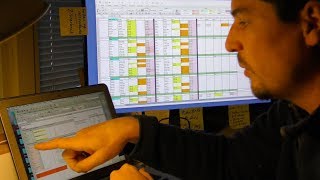
Richard Perkins (Ridgeside/Ridgesdale permaculture) walks through his farm’s seasonal planning: finishing crop planning and seed orders; using enterprise-level spreadsheets feeding a consolidated monthly cash-flow model to plan income, overheads and timing of invoices; redesigning the market garden for a paper-pot transplanter (seed lists, spacings, trays, and changed seeding/transplant dates); bed-block planting plan with rotation of 10-bed blocks across ~200 beds (yielding ~500 crop-placements per season); weekly task scheduling (Th/Fri seeding/transplanting, Mon harvest/microgreens); sales shift away from veg boxes toward RICO/market channels; experiments with mycorrhizal inoculants and woodchip/path resurfacing (king stropharia), and a note on reduced reliance on strict crop rotation in well-established no-dig systems. Also mentions trainings, guest instructors, and upcoming book rewrite.
Chapters
It's hard to imagine what's going on under the ground at this time of year and that life is still thriving in the forest. See deer and elk every day, and that life is going on in the ponds all around us under the thick ice. People are driving their cars around on the ice today I can hear down the road. But today I wanted to just share a bit about the planning for the season. I've just finished the crop planning, which I usually do in November the year before, but I've just put in my seed orders. So I want to tell a bit about what we're doing this year and how it's different from previous years and some of the overall planning that goes on in this deep winter time where we have this long break up here at 59 degrees north. So the starting point for our season for Johanna and I is to go through a cash flow analysis of the whole season. And this is the sheet that you find in our online training. And we have planning sheets for all your different enterprises. And then those are scaled for each season's production and then key figures are pulled out and put into this, which gives us the monthly in and out. There's a lot of work behind a sheet like this, but it's really important to have this because this is what allows us to make decisions effectively and make decisions to balance cash flow and where to make investments, etc. So every month is the ingoings and outgoings which are then accumulated at the top. We have our general farm overheads, any budgets for investing, and then costs of food and things to do with people and vehicles and salaries. And then it goes into each of the enterprises with broilers, layers, turkeys, pigs, cows and sheep, market gardens, microgreens, and then income from trainings and tours and then perennial crops, etc. So these things are all carefully thought through to put them into a monthly in and out. Because for example, if we're receiving broiler chicks at a certain date, we know we have an invoice to pay in 30 days time. And that means we know when we need to buy food, but we buy food in bulk so we know how long that food will last. So it's a lot of little calculations that go on behind this. Each of the enterprises has its own spreadsheet that feeds into this one so we can make changes throughout the season. And then our job is to use the accounting to monitor this sheet and see how progress is made and whether we're up or down on our planned accumulated balance so that we can Then make decisions to keep us heading the way we want it to. So that's all done for the season and that's great. We're a little bit behind this year because we've been having an extended break which has been really welcome and really important I think for getting the energy back to redesign how we're doing things to create more time for family and rest. And so we're feeling really good about that. So I talked a bit about wanting to put in flowers, edible flowers and flowers for flower bouquets, but we're realistically, we're in the middle of nowhere in a very rural community. So I just don't think we're going to be able to sell that many flowers. We're going to keep the north beds as they are, but these beds, which we call the east and west beds, the west beds fit the configuration of the rest of the garden with the solid 10 meter by 75 centimeter beds. But the east beds are a little bit funny because of the shape around the yurt here. So I'm thinking to put this down to perennial crops, both asparagus, which will be cropping, you know, once you've got good heads of asparagus, you can crop that for 20 years or so, but then putting the top row into flowers and just do a little bit of that on the side. So putting this into perennial crops and then the rest of it will be cropping continuously with intensive biointensive annual crops as we've always done. So because we're transferring the gardens to the paper pot system, I've had to really redesign the whole way we manage the garden and you won't be able to see these sheets in, in detail. They'll eventually come into the online training as we refine and you know, share how that experience with new tools and new setup is going to. But basically I've separated the seeds that I want to put into the through the paper pot and seeds that are direct seeded. Now interestingly, I was thinking at the end of last year that I would cut a lot of crops out because we still had maybe 40% low value crops, which I've talked about in other videos. But because of our rural location and it's not actually practical for us to only grow high value crops and I actually like having a lot of what you would determine as low value crops for our own consumption too. So we're actually growing pretty good range of crops and crops that will be direct seeding. These are all with the six row seeder that we sell at the Farmer's tools. There's rocket carrots, mescaline, radish, scarlet frills and mitsuna and mustard, those spicy leaves that can go in mixes. And then for the paper pot transplanter, we're going to put everything we can through there. That's going to be beans and some of the Asian greens, beets, spinach, spring onions, fennel, lettuce, chard, kale, turnip, peas, dill, coriander, parsley, leek, broccoli and romanesco calendula, basil. And then we'll be doing squash, cucumbers, tomatoes, tomatillos separately by hand. They'll go in tunnels and they're in bigger pots for transplanting. So we're actually only cutting out pretty much onions and cabbage. Cabbage is a real staple crop here that most people would expect to have, but it's never served us that well here. I think it's something that, you know, competing with field grown crops, it's not being worth the effort in our minds. So then what I've had to do with each of these crops is decide what spacing of the paper pot. So the paper chains come in 5, 10 and 15 centimeter spacings. And so I've calculated the spacings I want and how many rows and therefore how many plants there are in the bed and how many paper chains I need for each crop. And then as I make my year plan, I'm calculating how many beds of each I'm growing to allow me to understand how many paper chains I need, how many trays I need, etc. And I'll be sharing some of those spacings and testings throughout the season as we go here. So, so that then leads across to the planting plan. So this is blocks of 10 beds and we rotate each block round in a year. So that forms the basis of a rotation. But you see, for example, we have squash growing with brassicas and peas growing with mescaline and carrots. And so there's a lot of diversity in the garden and we're not following any tight rules that you might in a standard crop rotation. So here I mark whatever I'm growing and then the variety and then the start date in the paper pots. The yellow boxes are for things that are going to be transplanted with the paper pot. And then here's the date they go out. And then these orange boxes are things that are direct seeded. And this shows the first, second and third crop per bed. Most beds have two crops in the season and about half of them have three crops. So with the 200 beds we have, we can grow about 500 beds worth of crops. And so then the last job is to transfer all of this onto a calendar, which I haven't done yet, but that's an easy job. Now everything is done. And what that does is gives us a month by month breakdown, which I can show you last year's here. And so this becomes the operational sheet of what to do in every day. So it tells you bed numbers, what to seed, how many to seed in what type of tray, etc. And then they're marked off as they're done. And this helps every month throughout the season. So effectively you have a calendar that you can just follow and it tells you when to seed, when to harden off, when to direct seed, when to transplant and when to harvest. And that's how we run the season here. It's a bit of a complex process because we've got to, you know, determine totally new spacings for things and reorganize the dates. Because with the paper pot system, the actual cells that the paper chains make up are a little bit smaller. And so they can't. Plants can stay two to three weeks in those cells. And so it means all of our seeding dates need to change. And it pushes it back, actually, which means we, we have less, you know, we have a shorter season in a way. And because the paper trays are being planted out whole by the transplanter, you're not disturbing the soil roots in any way, so you can put out younger plants in the ground with less disturbance. And so they don't go through the transplant shock that they do when you pull them out of trays. And because the paper chains are in the special trays with air drainage and water drainage at the bottom, they don't become root bound. So I'm very excited to see the quality of plants that that produces, because I know from my experience growing trees in root trainers that this is a profound effect, particularly in perennials that obviously live a lot longer. And so a contorted root system is going to compound over a much longer life. But of course it affects all plants. Now, annuals are robust enough to deal with a little bit of pot bound, root bound conditions, but it's of course not optimal. So it's been a long process just going back and forth and double checking dates. And then what I've been doing is making sure all the dates are concentrated on Thursdays and Fridays. So Thursdays and Fridays are going to be our busy seeding and transplanting days. Mondays are going to be for harvesting and seeding microgreens. And later in the year that's when we typically slaughter poultry. And then Tuesday, Wednesday, Thursdays are the combinations of delivery days. So we want to keep market garden jobs, save watering and odd jobs, sort of routine things off the delivery day. So we can just focus on harvesting and quality prep for boxes and bundles going out. We're not actually doing veg boxes this week and that's been another layer of complexity with the garden plan is we're not doing prep boxes anymore. We're going selling everything on Ricoh. And if you're not sure what RICO is, I've made videos about that. It's my favorite selling method. And so things are changing in that way and it's interesting to consider. So it's a lot of new varieties this year. In fact, I'm growing a lot of new varieties of crops that I haven't actually grown before. And some of the classic favorites are things that we really like. But it's all looking pretty organized now, which is great. And I've had to balance that with the seeds that we have left from last season to make sure we're not, you know, doubling up on things we don't need. It's good to use fresh seed, but seed lasts for longer than we're told. Now it does affect germination rates when you keep seed for multiple years. But you know, if you're always sowing a bit of surplus, then that's usually not a problem at all. And bear in mind we dig up Roman graves that are a couple of thousand years old and wheat, you know, germinates and like these things want to stay alive. Everything's trying hard to survive in nature. So it's not a bad thing to reuse seed. And certainly if you're planting surpluses, and that's always the case, like with this, what I've always done is added 10% extra and seeded complete flats, basically rounding it up to whole flats to marry up with the number of plants I want in the bed so that we can select the best transplants. Now with the paper pot system, obviously they're joined together in the chain, but if you have some surplus, you can go back in and deal with one or two plants in a row that are suboptimal with some of the healthy transplants that are left over. So anyone particularly sharp eyed will notice that we left the caterpillar tunnels up in the same positions as we took them down last year. Now I want to speak a little about crop Rotations because I feel like I can say things that I didn't feel comfortable to say before. Now I actually am not working around a crop rotation and I haven't done the last year. And I think that I've been very cautious to talk about it. But meeting up with Charles Dowding in Oxford, we had a nice conversation about this. And it's really come to my attention that with no dig, where you're really focused on soil health and soil care, crop rotation becomes so much less important. Now we are mixing crops around just by simply rotating the bed sets each year, following a similar garden plan to each year. But we don't keep things totally separated just because numerically that doesn't work out for us with the amount of different varieties of crops we want to grow. But I haven't perceived it as a problem at all. In fact, I've seen so many no dig gardens that are well established, that have so little or no pest and disease issues that I've come to realize it's not important. I've been extremely hesitant to say that publicly or with any students in our trainings because I don't want to. You know, I'm aware of my responsibilities in informing people, you know, information that will shape their actions. And so I've been very reluctant to say that. But speaking with Charles about it, he said he's been telling people that for years and it's been his experience too. So I just found that really interesting that the thoughts and observations are aligned between other no dig growers. And yeah, I don't think I'll be promoting it heavily, but it's something that's definitely caught my attention and I think is something to really consider and the visual impact of working with such healthy soils. And it's been amazing to see. You remember I made that video with Jake at Oxton's Organics back in the summer and that was a beautiful no dig. And in his first year going no dig, you'll remember in that video it was the first year they didn't have white rot in their alliums and that area is plagued with white rot. And, you know, and basically we assume it's down to healthy fungal competition. And we can't be sure. There's no scientific data to back that up, but it doesn't surprise me. And I find that, you know, really interesting. So things are a bit of a mess. I like to keep my office in good order, but I've been super busy working on rewriting my book. I've actually sold out of books And I don't know if I'll get it printed again because I'm hoping to have finished the new book in April. So this is only available currently as an ebook and we've sold this in over 90 countries around the world now. And I get amazing feedback from people showing me what they're up to and yeah, who found a lot of benefit in this. But it's a mighty work to reschedule the book and update it with everything that's happened in the years since I wrote it and also combine it with the other book that I've been writing, which I've talked about in other videos. I've also been working a lot with the tool company, sending out a lot of tools for startups around Europe, which is amazing to see a whole load of new people starting up market gardens and getting all the tools they need in one place, which is fantastic. So we're introducing the paper pot system this year and that's going to be a major change which we'll obviously be documenting on YouTube and it should save us quite a lot of time throughout the season. That's my aim. And over longer term I'd like to see more perennial vegetables and flowers in the system. But I think it's a nice idea to see studied in a small scale way. Something I'll be doing a lot of this year is working with mycorrhizal inoculants and working with fungi in the market garden as far as we can. And I think fungi is a missing link in a lot of growing systems, especially where tillage is concerned, because tillage selects for bacteria and chops up mycorrhizal networks. But we know all plants have evolved to work with mycorrhizal fungi. So this is a product from Fungi Perfecti and it's different, there's different species you can see in here of mycorrhizal fungi and you can put this, you can do a root dip with it, you can water plants with it, or you can mix it into the potting mix. And I think that's what I will do. Now, something you see in no dig beds that you don't see in tilled market gardens is the proliferation of fungi. And that just is self evident that, you know, by not tilling and not turning the soil over, fungi can thrive on the organic matter that's available there as well as, you know, in association with plants through the polysaccharides, the short chain carbons released by the annual crops. But I'm going to try putting this into all of the soil mixes we make for potting up into the seeds, paper potato seed trays and see if I notice any difference. I might do a trial so that we see if there's any difference on side by side on the beds. And then I'm looking to resurface the market gardens this season. We've always used spruce wood chip and people have often written to me concerned about spruce wood chip, but it's no problem at all. It's mainly just because it's the only thing that you can get your hands on easily here because 99% of trees in Sweden are spruce. But I'm looking to see if I can find a supply of birch wood chip that's quite fresh. And then what I will do is buy king stropharia mushroom mycelium and put that on top of the existing paths and then resurface all the paths. So we have a busy spring. We're going to resurface all the beds and the pathways to bring them up level because over time the wood chip is decomposing and you keep adding compost to the beds and that ends up with a big raised bed, which I don't find ideal. I think it works best if things are quite level. And so that's a big job for the spring. And hopefully we can bring edible mushrooms into the gardens too, which I'm really excited about. That would be a dream come true for me. The other thing to update folks about is we have all of our trainings online now. The internships are already filling up, but we're really excited to host a holistic management training 20 this summer with Anders Kobstad, who's collaborated with us for the last few years. He's a Savour Institute trained trainer and is going to be running holistic management trainings for three days each that are open to the public. And then we're bringing back our weekend pastured poultry masterclass which is one day on layers and one day on broilers and turkeys. Last year we had an amazing time and we're involved in all processes. We bought the slaughtery outside the slaughtery and had everyone have a go at that process as well as how to run those systems in the field. And then we also have Charles Dowding coming, which we're really excited about, to do a full on week of no dig market gardening for growers. And then he's hosting a one day workshop at the weekend after for more aimed at home gardeners that want to grow their own food with a no dig set. Up. And then in the middle of the season in early August, we've got Jean Martin Fortier coming for another week long masterclass. And we also have our farm scale Permaculture course which has been attended by thousands of people from all over the world. Now there's two of those at the start of our internship program, so you can find all details on ridgesdalepermaculture.com Looking forward to another season and feel my energy coming back and getting ready to put planting. So looking forward to it. Thanks so much for watching folks and I hope to be sharing a lot of stuff this year on YouTube as normal and really nice to hear your thoughts and feedback on that as we go. So great to keep sharing in this way. Thanks so much. We'll see you in the next video.
More from Richard


A review of short and intensive season on a mixed farm and restaurant/event space in Sweden






Alskade Kyckling Exploring complexities of poultry production in Sweden and what we stand for


