DESIGNING WOODLAND FENCING FOR PIGS S4 ● E8
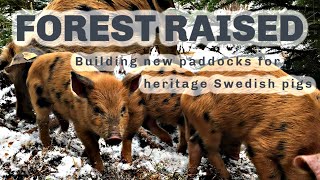
Richard Perkins explains planning and design for permanent woodland fencing to run pigs (and other livestock) through forest paddocks to drive ecosystem disturbance and agroforestry regeneration. He demonstrates use of simple tools (GPS, Google Earth Pro) to measure lengths/areas and produce a bill of quantities, and discusses practical constraints, fence specifications, and the economic rationale for the investment.
Questions this video answers
About 3.5 hectares.
About 1.6 hectares (separately he also refers to a 1.4 ha forestry patch later).
About 1.5 kilometres of fencing (perimeter).
Five-wire system; about 7.5 kilometres of wire line (total across wires).
About 400 fence posts (plus a few extra for difficult topography).
Chapters
It's quite challenging terrain we have here and we've worked with portable wire reels in this area, but it's quite a challenge because of the vegetation. And so we want to install a permanent fence. Permanent fencing is quite expensive and it's often overlooked in the costing and layout of the design of farms. So I wanted to show you through the process of how we're planning this using simple tools like Google Earth to come up with a bill of quantities and cost out the total of the fencing. We've already installed a lot of perimeter fencing around our main fields that you see here. It's got electric wires at the top here and at the bottom. That's mainly for wolf protection for the livestock. But it's also important to us to protect the silver pasture systems that we've installed that you see in the field behind me, because we have a lot of elk and deer here which would come and eat the fruit trees. But now we're looking to fence up into the forest paddocks for combined grazing of pigs and also the sheep and cows during the summer months. There's a few considerations. It's going to be a bit of a project putting this fence up. We have some access ways that the neighbour has a right to too, to get up into the forestry. And you see there's ditches here that act as temporary runoff in the forested areas. And these are areas that we need to include in our riparian, because bringing pigs into a vulnerable space like this will just create a mess. So the fencing really follows the lie of the land in a practical sense, but also these constraints of infrastructure and access, that's beyond our control. This is an area of cut forest that we've already run the pigs through last summer. Timing is pretty critical with pigs, and the impact they will have on trees is largely down to their management in terms of time. And so we have about three and a half hectares that we're going to run the pigs through. And what we found once we run the pigs through areas like this is that there's a big flurry in succession of pasture like species that weren't here before. A lot of great forbs and grasses come back that we can then bring the sheep and cows and add additional grazing. We're going to turn all of this land into agroforestry, essentially, as we thin out some of the big trees at the top of the property, we're going to let that turn back into diverse woodland too. And behind us is some of our old spruce monoculture. We have about 1.6 hectares of this. Now, most of Sweden is put down to monocultural spruce. And it's what I would like to call a vertical desert, has very low biodiversity and it's a very poor use of land on a small farm because we don't have enough trees to make it financially viable. And you're only harvesting this crop every 70, 80 years. It's not a good return per square meter. And what I would like to do is using the pigs to create ecosystem disturbance, is turn this back into native woodland, because all the species I see coming back are things like oak and rowan and ash, and these are all beautiful timber trees. And so what we will do here is harvest all the mature trees as and when we need timber. We have a local sawmill that we can turn that into dimensional timber for building up infrastructure here at the farm and just allow natural succession to take place. We won't do any planting and we'll just keep harvesting the oldest of trees. It's amazing the impact that pigs have once you bring them into an area like this. They're like a climatic trigger. And we've seen in other people's farms where pigs have been raised in the forest, you get a higher abundance of species of trees coming back than were there before. All those seeds are in the ground. It's amazing how many acorns and other seeds of different trees are in this ground. But they won't germinate until a certain disturbance has happened in the ecosystem. So pigs are what can drive that for us here. But then we also get the benefit of grazing cows and sheep through here too, because all the forbs and grasses that come back once we graze the pigs through and allow the land to recover. We have streams flowing through the property and it's our duty as land managers to protect the riparian zone, the area around the edges of watercourses that are naturally in perennial vegetation. So we will be leaving a buffer zone and fencing the stream out with a crossing so that we can access the other side. So my current plan is to put in a five wire system up to about a meter high, because we are going to be grazing sheep and cows as well as the pigs. And because the land that we're dealing with is so undulating and quite lumpy in structure, we want to have multiple wires just to keep ourselves covered, because it's not really practical to have a single wire that you could use for pigs in flatter ground. You can see these telegraph wires above us here, and we have this strip cut out about a hectare And a half of the farm later, they're going to dig all these electric lines under the ground. We turn around here, you can see them passing through the rest of the farm here. They're going to not create too much of a mess for us, hopefully, because the silver pasture lanes in our fields are put in in a way where they're only going to have to dig up one tree, it looks like, which is nice, but that will open up a whole load of space around the farm for us. But we can't stick a permanent fence under there because of the work that's going to happen. This is an area that the government keeps cut, so we'll probably use it as a natural division for our paddocks and come along the sides of the trees and we'll use temporary fencing to close up the gaps. This year, until they've done that work, and it's fine to use a bit of temporary fencing. What we'll do is have each paddock separated or isolated from each other so that they can be electrified and just by joining the wires together. But then we can also break those paddocks up into smaller strips to improve the animal impact as part of our grazing management, using temporary lines and posts to cut across the paddocks. It could all be done like that, perhaps, but it's a lot of work through the thick vegetation. It looks quite sparse right now, but it's quite hard to walk through here in the summer and we don't want to spend huge amounts of time clearing each individual fence line. We'd rather do one big job, put in a permanent fence from the beginning, and it's a big cost that people often don't factor in, but it's improving the property value and it just makes life easier in the long term. So it's really worth considering adequate fencing from the beginning. So as part of my design process for making this fence, I'm just coming out with a GPS and marking points that are critical to me, like gateways through the fencing and corner markings, etc. Which will then load up on Google Earth, which I can just then use to join some dots together and have that calculate lengths and areas for me that I can come up with a bill of quantities and cost the whole project before we start.
So here we are on Google Earth and you see the property boundary here in the purple with our forestry here. This is the land we use for market gardening. It's actually a neighbor's land. Nice a spot. This forest patch that's also the neighbours was once part of A field. If you look at the underlying topography on a topo map, it's quite interesting. Hopefully one day we'll buy this patch. This year we're starting to graze a neighbour's land and these are worn out kind of pastures. They've just had the grass cut every year for subsidies and lack of animals. There's a lot of sedges indicating poor nutrient and water cycle. But they're beautiful little paddocks with avenues of trees protecting them from the winds and you'll see more of them in the summer. But here's what I've been working on. So we've got this just to explain a few things. This blue line is the existing perimeter fence of the field and we've already fenced a larch patch in. We've already run pigs through here under the telegraph wire here and in this patch here. This photo is a bit old. This forestry has been cut here already. These two patches are the remaining sort of monocultural stands, about 70 years old that you see in the video. And here we have the riparian area. So we've broken this into paddocks that are roughly the same size, which makes management more timely and also that fit the sort of landscape and current infrastructure sort of patterns. It just is logical and makes sense to us protecting the riparian the whole time. And so what I've done by putting this on Google Earth, I'm using Google Earth Pro, which is basically just lets you calculate areas as well as measurements. I've put the essential lines on to create the amount of materials needed to put up this fence. And so this comes to about. Well, first I'll explain what we're going to do. They're going to dig this line under the ground and so that will happen later this year we believe, and it might be, that that line pops up through the property here to the road and then they'll be going along the road, it might come out and through this way. Either way it shouldn't disturb us too much and we will not be putting in permanent fence under that line yet. So this would be a temporary stretch of the fence. This summer we'll start grazing in here and each of these paddocks is isolated from the others, so it can be electrified all the way around. But then we will just put temporary wires across here to increase animal impact and have more control of the the animals whilst they're in each patch and they can just be hooked onto the perimeter fence to electrify them with some simple posts. So we'll start in here, and there's not much forage up in here. I mean, this is just monocultural spruce. So these patches will take more time to develop back to native woodland. But we'll probably put in the permanent lines on the edge of the forest there and use temporary lines just to complete these paddocks. So it's about one and a half kilometers of fencing. It's fairly substantial. If we use five wires, it's about seven and a half kilometers of line. And we'll use a galvanized high tensile wire that's joined together for each paddock to electrify the whole unit. We're not worried about deer and elk getting in because we're not planting anything into here. It's just going to be native regeneration. But we do want to keep sheep and cows and pigs in as well as their babies. And we're going to go for 11 gates. You can't see them on here, but I've been marking them on. I just haven't added them onto this yet. And we also can calculate from the corners and changes of direction how many additional support structures we'll need within the fence. So it's about 400 fence posts and you'll need to account for a few extra to get us over particularly drastic changes in the topography. And 11 gates and about 55 corner and change of direction assemblies that need to be taken care of. A couple of thousand insulators. And we're going to use spring gates like we have on the fence around the rest of the farm. And so that's going to come to, in Swedish prices, about 35,000 crowns, €3,500. So it's quite a big investment. And I share in this video just to show some of the planning considerations, but also talk about the economy, because this is something that's not often planned in when people are designing their properties in the beginning. But to put that into context, this forestry up here, about 1.4 hectares, that nets about 1500 crowns. That's €150 per hectare per year. And whilst it's low work, it's also based on monoculture. There's no habitat created through having these monocultures. And once it's clear cut, there's major problems with soil erosion and the hydrological cycle. In contrast to that, just the broilers and the layers that we run on our pastures here net over 130 times more than that annually. Whilst increasing diversity in building soil, we would hope to, you know, pretty quickly get that same value that we would have got every 70 odd years from this forestry every year just from running the pigs through here. Now we haven't. We're scaling the pig enterprise up slowly and we are using very low input costs because we get the spent grain from the local breweries and they get a lot of garden waste and are able to graze in here too. So there's going to be a balance point somewhere where it's more profitable to do less animals and not pay to feed them than to scale it up. So we'll see how that goes. But just to point on the economics because whilst it's a big investment, we are going to get a much higher return per square meter from using this land more intensively. Plus we're going to be able to graze the sheep and cows through here and increase diversity, increase resilience of this area. So yeah, I just wanted to show you and mention that because a lot of people are put off by making investments, but they can yield much greater returns if they're done intelligently.
So I hope you find that useful to see some of the considerations in our planning. It's possible we could do this in a cheaper way and our ideas might change between now and the spring, but I'm quite excited about the permanent, well constructed fence that will allow us to secure the animals properly and also work for multiple species of animals. It's a long term investment. So viewed in that context, I think it's a very good investment for us. I hope you found the video useful. Click subscribe to our channel below if you want to keep up to date with the farm. Leave any comments there. I'm interested to hear about your experiences fencing pigs particularly. And yeah, see you next time.
More from Richard


A review of short and intensive season on a mixed farm and restaurant/event space in Sweden






Alskade Kyckling Exploring complexities of poultry production in Sweden and what we stand for


