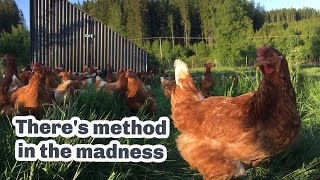
Richard Perkins shows his completed Eggmobile 2.0 prototype, walking through installation details like actuator mounting, nest-mat sizing, and automated doors. He's planning to house 700 hens, 70 turkeys, and 1,000 broilers, with indoor contingencies if bird flu spreads.
Chapters
Okay, welcome back to another episode, folks. I want to give you an update on what I've been doing, looking at little details with the nest box as well as thinking about design changes that need to happen if this is to roll out as a commercial product in the. So if you're new to the channel, these are Richdale Eggmobiles and we've been taking out our homemade low cost wooden nest boxes to install this design from Greentech Tools in Croatia. So this is a project I funded the prototypes of these from Bruno to test them out, see where they need design tweaks, etc. To hopefully be able to get a commercial product available within the EU for people between 12 and €1500. That would be amazing and a game changer because units like this typically cost €5,6000 for people further afield. As I said in the other video, Bruno's going to be doing a pay what you think it's worth CAD file on his website at some point, so you'll be able to get local tool makers to make one for you. You'll also remember I'm working with Caddles design from Heatherhill Farm over in Ireland. This is the simple control box he's put together for automating our style eggmobiles. And so I've just adapted its use to this one. Now before we go any further, I want to say this is a prototype, okay. And so my job with this is to find out all the little tweaks and nuances that need ironing out in design as well as fitting to different eggmobiles so that we can develop this model and get this available to people at a reasonable cost. That will change the way people can do small scale passive poultry. Now I've had to install this a little bit ropey because I've got hens coming in a week and so I don't really have options. I need to just get it in and working. And I've got a whole nother egmobile to address as well. So there are some things in here that I know will need tweaking over time. Anyway, I'm just telling you now because I don't have all the componentry to do things in the way that I might ideally. And so don't worry about commenting on those things. I'll explain them and why I've had to do them as we go. And I'm in a bit of a pinch time wise, so just added simple piece of wood here that will stop eggs at either end. Just have a little view underneath so you can see how that structure looks. I've added nest mats and there I found my first problem because my nest mats are actually made for our old style boxes, so they're a little bit too short. So I've just come up with a simple solution. I've cut an end piece so that there's no hole for the eggs to fall down and get stuck in. This end is flush. So that's fine. That works fine. I've been testing it out and that works okay. That's not going to be a problem for anyone that's getting new nest mats. I just have a lot of the old sized nest mats. I don't want to buy new ones because it's just a waste of money. Here you can see an actuator. There's one round here on the other side. And this is the solution I've come up with for our situation. If I want to close the nest boxes, you can see they work simultaneously and flip up the nests. Now, we wanted the nest to flip out like this, so so that if there's any egg residue on the mats, the hens will peck at that and clean them up. Now I've got to say it's definitely not ideal installing the actuator on a thin metal sheet roof. What I want as a solution for this needs to be done at the engineering level. And so you imagine this leg continues in here. The typical industry solution is to have an arc cut out of the metal and to have an actuator at the end that can do both nest boxes simultaneously. That's an obvious solution, but because of my time constraints, I've had to go with this. I've been watching it carefully. It doesn't put too much stress on that. I'm concerned about it. I just don't think it's the most ideal solution. But it works for us for now, so we're going to go with that. And another thing is that we have not got clips made yet for keeping the nest mats on the mesh grid underneath. That's an easy solution. It's basically a big sort of hairpin that holds the mats in. But I've just used cable ties for now though. That's a pain in the butt because I'll have to cut them off to change mats and do any maintenance or cleaning. But that's a quick fix for now. Another element I don't like with the actuators here is the wiring is a bit bodged in like that. But as I said, that can easily be solved by a cut here and we'll have to work out an actual mounting point for actuators. I think that would be ideal. The other place that I've put an actuator is here. Again, it's not ideal. And this is for leveling the nest box. So this works in tandem with this spirit bubble and this little switch here. And so I can easily level the nest box like so. Now, many people said, well, why do you need to do that? Because it's self leveling just by its own weight. Well, the trouble is with that is that when birds jump in, the whole box will wobble. So I want to be able to come in quickly and just flip a switch and level it up. Now, when you're moving the Eggmobile and you take it off the ATV or whatever you pull it with, then you need to make sure it's level this way. It's not totally critical. You could do it by eye, I would guess. Although you can easily just put a bubble on the front chassis of the trailer. The only thing is, if it's piling up one way or the other, the eggs will all roll down in a big heap. But that's not a. You know, it's not a major problem because they're going to get trapped up here anyway. But you want to get it level and then come in and level it off this way. Now, I've got only one actuator long enough because I need the other one for the other eggmobile. But what you really need is one on each end of the nest box. I can order those and get them in later. You can see I've bolted it into the actual steel frame of this, but unideally I bolted it into the perch. Now that's not a big deal. I can fix that later by putting another beam of wood. Obviously it depends entirely on how the egg mobile is built, and that's, you know, you can fit it however you want, but if you have two actuators, then you've got a solid platform where the nest boxes can't wobble in any way. So this does work for leveling it, but there's a bit of play. If there's a heavy weight put on the other end, it would wobble a bit. This is just a temporary fix for now. It does the job. I can get the boxes level. I'm happy with that. This is not the strongest point to bolt it to, but it's strong enough. These are screwed in deeply into this beam and this isn't going anywhere. So that will do for now and I'll Fix that up later. As I said, I've got to just get this ready for hens arriving. What else to say? Well, we can test it out and see what we think with the rolling. One thing I'm concerned about is eggs getting stuck between the nest mat and the actual rolling belt and getting stuck in no man's land and we're not able to roll them in. So we'll test that out now. Now, it does make some noise and that will spook the hens right in the beginning, but they will soon get used to that. They're creatures of habit and they will soon get used to that noise and know now's the time I can start laying eggs. This will open up on an automation early in the morning. The main door is automated. That will open up at a set time and if we want to move it, we have to clip it closed and then we have a manual adjust for the leveling. Pretty simple stuff. And the. That's the aim of the game. Let's get some eggs and we'll test how it actually functions. Now I've had to actually buy some eggs for the first time ever. I'm just going to plonk them down. We're on a bit of a slope. You can see that one rolling down and I want to see if they get stuck in that lip and whether they will actually come out. So seems like the angle is good. I want to know if it gets stuck in the corners. I think this solution I've come up with works totally fine for that. Let's see how it looks on the other side. So I'm particularly interested in those side eggs. Ah, look at that. That just picks them up perfectly. That's great. I was really concerned that they would get stuck in there, but as you can see, that is perfect. Perfect. Nice. So that's pretty neat. The only things that need adapting are the mounting points for actuators that I reckon should go through the end more here and this leveling system to have two and two actuators, that would be good. Now, obviously, that will need to be adapted to people's eggmobiles. Some people suggested I'd put them through through the floor and work off the floor. I don't want to do that because this whole thing has a little bit of play and it's got a bump around a bumpy field, so I want them attached to this structure on the top. It's just, I think, going to be less stress on the whole system. But that could look different in different people's egg Mobils. But I think great success so far. Not so much needs changing as far as I can see. But we need some additional parts. The nest mats clips. And I think the size of the nest mats is very, very important to make sure that it's not creating spaces where eggs can get trapped. But that's easy to fix too. All right, so I've got to get this done today. Next step is I want some mesh screening and a simple door. And there are different options for that. But I think I want a door that opens to this corner to allow humans in. So there's going to be a post here, post here, mesh. Probably a poo sheet on this little portion of roof so it's kept clean. And just a simple access door that I can open and close here that keeps this lot accessible. So we'll get on with that. Okay, let me show you what happens. So this is what I've done. It's a little bit homespun, just using scrap that I found around the farm. So. So what I've managed to do is put a little pool sheet above this front section. And I just found like some old compost mesh or some kind of mesh. And I've just articulated that to get around to the beam up here. And that still allows me if I. The birds can't get through, but it allows us to level the nests quite significantly. Very nice, Very nice. That'll do. I've just cable tied these on to the floor at the moment. That's good enough because I'm not sure if we'll have unintended consequences. And so I want to be able to rip things out quickly if we need to exchange back to our old nest boxes. A simple handle. That means I can get birds in here and I can access this. It's nice and easy. No problem to get in. Very cool, simple things. But that's how we like to do. I just like using whatever's lying around on the farm. And it's fun. Part of the creative process really, just to see what you can do with a bit of scrap. So last little touches for now include taking a bit of this batten wood and I'm gonna drill that and secure this net on so that that's totally foolproof. And what else? I'll do the same on the poo sheet, maybe up here so that that is secure. Then we got to work out our timers, but basically this lot doesn't need further protection because it's got nothing going to fall on it. Very nice. Just got to remember to set the timers, right. This is back to front because the mechanism is the opposite way around than our other nest boxes. But I'd say that's a wrap. Simple, simple, that's all it needs to be. It's going to give us much less need to go to the hens. It's going to give us really clean hygienic eggs. Much less cleaning the nest boxes because they're going to self clean with the gaps underneath. Automated opening, automated closing of doors and nests. Leveling on a simple system. That'll do it, folks. Got to put the solar panel on. So still haven't decided how I'm going to do that. It's going to be somewhere up on the roof that we can get that installed easily enough. And if I get another actuator sent, I'll install that in the same fashion on the other end. That should do for now. I feel like I've been playing mad professor all day. I've come back in here and just put little thin strips of wood on to hold that mesh in nice. Played around some more, doing some testing. It's working great. And now I've just got up on the roof and I've put in the solar panel and the beauty. I'm laughing because I just feel ridiculous with some of the things I get up to. I decided how to mount this finally. I've got old bookshelf hangers. Put a wooden frame on, put some bolts on, bit of string, you can tip it over. We love that. Because the biggest issue is that we are obviously running the Eggmobiles between three lanes and they are generally east to west. Some are north to south only in front field here behind me. But that means with the shape of the eggmobile, it's hard and you can either swivel something around, but this is obviously the easiest solution. I just screwed those hangers into one of the roof beams and I'll just have a bit of string with a weight on it and you just pull it and flip it over. It's really this kind of Willy Wonka stuff that is so fun. When we're building up the farm in the early years, we just dream up visions, just bust them out, make them happen. But I put a little guide string down so you can just pop the wood protects the panel. And then when you're turning round in the tree lane, you can just flip it over the other way. Doink. That's a wrap. It's been so nice recently building all these decks and working on the eggmobiles. I've got the other one to start tomorrow. I'm trying desperately to get it done before the weekend. I've also got to get down to Cleta and sort that place out before the team get here, so I can really focus on their arrival and getting everyone settled in and shown around. But it's really nice because it, you know, over the last few years it's just been more about maintenance and running stuff and I'm miss that creative process of just, you know, getting up early, working hard. I've been waking up 4 o' clock every morning recently to get this Richdale builds book progressing and then just out at 6:30 and working all day and it's. Yeah, it's really nice for me to do that, so. So got to get on with the next Egmo Bill tomorrow. We're just taking 700 hens this year, but because of bird flu we've had to come up with alternative solutions. So it seems like there's no exemptions going to be possible. So what are we going to do? We're going to dock the eggmobiles to either end of the tunnel here, which is just currently in bed. Still, because we didn't keep hens over the winter, we're thinking to put a mesh halfway down the tunnel to keep the flocks separated. Now, every winter we've kept hens in here, we've kept them as one big flock, but I've always thought next time I keep them in the winter, I'm going to experiment with keeping them in the eggmobiles, letting them out into the tunnel and dock them against it, because I think they're not only is the big change of environment stressful, but suddenly becoming a bigger flock is stressful. So I thought it's quite a nice idea to test that out. I'm curious if any of the listeners have actually done that, where we dock the eggmobiles, keep them laying in the same place and sleeping in the same place and just having their scratching space in the tunnel. Anyway, we don't plant our tomatoes till end of May here, so we will go with that for our layers. It's big enough for more than the amount of layers that we have by regulations. And if the pandemic with bird flu carries on past end of May, which we very much hope it won't, then we'll have a problem because of the heat. Options then are going to be basically re skinning the tunnel with shade net or something like that. We've got turkeys coming. We're doing 70 bronze turkeys this year as Opposed to the white turkeys. We've always done out on their gobbledygo, but obviously if they don't come go outside, we're going to raise them in the lean to barn. It's a €800 scrap barn that the sheep are going to be lambing in soon and that will have to suffice for the turkeys. Then the last piece of the puzzle will be broilers, and we've got a thousand broilers coming just about four or five days after the hens arrive. Now they spend three days, three weeks in the brooder, but we have to make a decision from there on. We do have this tunnel which by standards is big enough to raise those thousand birds, but it will get pretty stinky and nasty by the time that they go, which would be end of May too. So if the ban hasn't lifted, we will just not do subsequent further batches until later in the season when that clears up, or not at all if the ban isn't there. We don't really want to raise burrs inside, but a very significant part of the economy. Those boilers will be worth €30,000. There's no way we can just shut it all off. We have to find solutions. It's going to be a tough year for a lot of folks. It's definitely unprecedented. The cases. I mean, there's been cases every day in the last week and it's going to be at least three or four weeks until cases clear up that they lift the ban. That's what the authorities have told us. It's not possible to do net systems or boiler pens, anything like that. They must be indoors with the severity of the cases. So that's what you're dealing with. Barns, temporary structures, tunnels, and that's the way it goes. That's what we're doing, folks, and we'll keep you posted on how that goes. But exciting and concerning that birds are arriving in a week now and in about 10 days for the broilers. Super excited to have the team come in. It feels like we've been through the winter downtime. Things are livening up again. I'm ready to have a bit more people around the place, but the life and energy as the spring really kicks in. I'm excited to take you with us on our journey through the season on YouTube, as always. And I'm very excited to announce that in the next week or two, we hope to be announcing the Kickstarter for the Ridgedale Builds book. I'm going to get a test printing of that very soon, and I'm very excited to share that with you. Find out everything in the links below. Don't forget to click, subscribe, etc. See you in a video soon, folks. Sam.
More from Richard


A review of short and intensive season on a mixed farm and restaurant/event space in Sweden






Alskade Kyckling Exploring complexities of poultry production in Sweden and what we stand for


