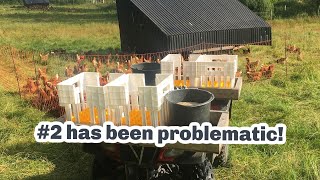
Richard Perkins details the build headaches with his second eggmobile: wheel configuration issues, punctures, and fabrication compromises to fit wheels through the subfloor. He also covers nest height trade-offs, electrical and solar setup, and the operational pressures of bird arrival and crew management. His Ridgedale Builds 3D CAD Kickstarter is fully funded.
Chapters
Welcome back to another video, folks. I'm going to show you around eggmobile number two, which I've also been installing a nest in, but it's been a pig's ear. And I'll explain all the little things I've been finding out. So chicken food arrives tomorrow. We've got to get access to the silos there. I've got to move a huge amount of wood, but to do that, I have to move an eggmobile. But I've got a puncture in one of the wheels and just my luck, it's on the inner wheel inside here. I've just been down at Cleta for a couple of days to sort out some things in the house there for rental. And it's. Yeah, I'm coming back to the madness. We've got Chef Elin here and Selma is back for running the gardens. We've got two more of the crew arriving tomorrow and then the apprentices arrive in early April. But we've got birds arriving on Tuesday. We've got cars to take to MOT's. It's all happening. And so I need to get this eggmobile fixed up as soon as possible, hopefully tomorrow. Now, talking about wheels, people ask how we make double wheels. We do it in quite a bodged way. It's going to be grainy video because it's dark under here, but we turn the outside wheel inside out, as it were, and then we drill through the actual main chassis of the wheel and then use spacers and bolt them together. You can also see we've put in these extensions for, like, lorry tyres so that you can pump them up easily. Now, that's a lot of fiddle and it's not the best engineering in the world. And, you know, we've been running them like that for years now and they've held up fine. There's probably better solutions out there. Big ag flotation wheels would be the obvious answer, but they are super expensive. We did this with old wheels lying around the farm and as everything we've built up, we've done everything with scrap and as cheap as we could to get started with a very low budget. Now, it's very different having two wheels side by side than it is having two wheels in line where you're still going to dig holes in pasture that's really wet. And because we got wet clay on the top of our land, we wanted to have wheels that are side by side. It does mean if you get a flat tyre like this, it's a major pain. You have to jack the whole thing up, take the wheels off and then try and fiddle them back in in an accurate way. It's tricky and it's not for the faint hearted. If you're confident with basic tools and engineering, you can make it work. But that's a solution we came up with because wheels in line is no good for us. It would still sink in the pasture. And wheels on each corner like a hay wagon is problematic in itself too. That works on really flat ground, but we have very undulating ground where you'll have torsion in the chassis which is less desirable. So that's the solution we come up with. Unfortunately, we're not going to be able to get that fixed. And until the birds are in. Birds coming Tuesday. I've got to move this out of the yard to move some wood for tomorrow for the feed to arrive. Then move it back into the yard and continue trying to finish this one up. We are going to be docking the hens to the polytunnel. So I figure at that point, as long as it makes it up to the turning circle, that we can load the hens and back down again. Then we can park it up next to the polytunnel, jack it up and we'll have to just crawl in there and risk getting covered in chicken poo to get the wheel off. But we're going to have several weeks of stationary eggmobiles in order to do that. Now there's not been cases here in Sweden for six days, which means in theory in three or four weeks the ban could lift. That's withstanding any more further big outbreaks. Let's see. We know we're going to have to have them in the tunnel. We're going to be making decisions regarding the market garden, how to rearrange things to make sure we get our early crops. And I'll tell you about them in subsequent videos. One thing I do know is they spread the weight on pasture way better than anything in line could possibly do. And it's prevented us sinking into the ground, which was happening in the first year when we only had single wheels. And this is an extremely light eggmobile. You couldn't actually make it any lighter. Now this eggmobile is very different from the last eggmobile, which has created its own problems. In this eggmobile, the wheels actually stick up through the subfloor. So you can see we've just made simple structures over the top of them. That means the nest box had to go higher up in order for the nests when they're closed down to miss them. And I've got a bit of the sub frame left in place from the old nest boxes. And I can't take it out because I don't have any spare mesh. And that's the way that the floor was built in this one. So it's resulted in the nests being a lot higher up, which means the roosts are quite high up, that it might create access problems for the birds here. Other than that, I got the nest in and I've started installing some of the electrical system. And you can see there's not much access room in here. It's much less desirable than the last egg mobile. I think in this case I'm just going to use a small wire division and just have a simple door. We don't need much access. And when the nests are closed, you can access it fine anyway, but it's a bit more of a fiddle. I've had big troubles with this frame lining up, and I think just minor inaccuracies in the fabrication meant there's no way I could square this up. So if you look closely, we'll zoom in. Had to hack this frame up with an angle grinder to get the belt sitting in. Now, the better solution would have been to take the angle grinder, take the frames apart and re weld them. But I just felt like I didn't have time and it was just about 3 or 4 millimeters needed to change. And so without really affecting the structural integrity, I decided that was the quickest, easiest option in the time limit I had. Now, I've shaved the edges smooth so it doesn't rip, but that allows me now to have the mats working fine. You see, the mats have to be perfectly square and level. And what happens if they're hitting up on the edge like that is the nest. Sorry. The conveyor belt will balloon up like this, and obviously that's not going to work because eggs will go under. So it took me several attempts putting the thing together, taking them apart, and, yeah, it's been a bit of an issue. I've also put these little side braces in that hold this metal sheeting together, because I noticed with the other eggmobile, the mats can catch on this and pull it inwards. So this is just holding it out at the right width. Apart from that seems okay. It's just been a big pain on this one because I've been stressed with time limits of having to get this done before people arrived and the complications that arose. It should have taken less time because I'd already built the other one. But it ended up taking three times as long gone for the same solar panel setup. I'm just wiring that up now, but working with a flippable solar panel, and that works totally fine. So I think we'll get there in the end. And as I said before, this is mostly a big experiment, testing out these nest boxes to refine them for the benefit of others getting them who might have any type of eggmobile. Whether we like this setup, certainly in this eggmobile, I don't know. It might be too cramped with the roosts here. There's certainly a lot more room for the birds to move around underneath. But it's going to be very interesting to observe this over the coming days. Oh, the things I do. Hey. But hey, this is innovation and progress in the making, and it doesn't always go to plan. The other eggmobile was just a dream. I just put it together. Boom. Everything worked perfectly. This one's been a real struggle and it's really exhausted me. I've had a lot of little minor finger injuries and just every little step feeling more and more stressful. And then to finish it off with a puncture has just made my heart sink a bit. But, hey, I'm in a good mood. It's all good. This is what we're doing, you know, ironing out kinks to make this into something that other people will benefit greatly from. And that really warms my heart back up again. Things are going good in here. We've got all different Brassicas and the spring onions germinating nicely in here. I still mean to give you an update. I'm waiting for the new drop seeders for these 64 and 144-cell, so I can show you them. But I've just looked in on the Kickstarter and we are 100% funded already. That's incredible, folks. Thanks so much for your support. The new Ridgedale Builds book is something I am super proud of and excited about. There's still a bunch of work to do over the next few weeks while the campaign is running, but for those of you who are new to the idea, this is a 3D CAD instruction manual. Think IKEA manual for farmers. Of all the great structures you've seen on YouTube and in regenerative agriculture, there's 22 different projects here. You can see them listed on Kickstarter in the link below. And there are combos of the PDF for those of you that want a copy. Hopefully late April, and if not early, maybe the campaign finishes. Yeah, I should be able to get the PDF copy out in April and then the hard copy will probably be July time. It depends on the printers. And then I'm offering a package with Regenerative Agriculture either as PDF or buying both of them as a hard copy. Thank you so much for your support folks. It's incredible to be able to bring you all of these different projects in beautiful 3D CAD plans. You've got all the angles, measurements, cut lists, materials, tools needed, etc. To build all of these awesome structures. Get involved on the links below folks. Obviously this book will become available on our site eventually, but we'll be dealing with all orders from the Kickstarter before we put it out for public sale. So get involved if you want to get yourselves a copy as soon as possible. And if you want to get a copy of Regenerative Agriculture at the same time, that will be 4 kilos of information for you. See you in a video soon.
More from Richard


A review of short and intensive season on a mixed farm and restaurant/event space in Sweden






Alskade Kyckling Exploring complexities of poultry production in Sweden and what we stand for


