Egg Mobile Tweaks, Paddy Ponds, Farm Scale Compost and Ridgedale Eats!
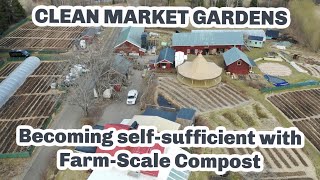
Richard Perkins walks through farm fixes: rubber seals on eggmobile nest boxes to stop eggs rolling, cardboard mulch on paddy ponds for dryland rice, and 50-60 cubic meters of compost in windrows. He's planning a Ridgedale Eats cookbook covering meat, veg, butchery, foraging, and fermentation.
Questions this video answers
April 7, 2021.
70 centimetres.
75 centimetres.
About 8–10 (not breeding pigs).
Approximately 50–60 cubic metres.
Chapters
Okay, it's a chicken poo day, So we're in eggmobile number one. And we have raised up the nests. As you can see, we've tightened the nest belt so they're not sitting up on there. And one of the problems with this nest design is that sheets at the back of the nest are quite flexible. So what I've done is put in little strips to keep them equidistant, because otherwise the nest mats can catch on them and bend them out of shape. The big flaw in the design of these nest mats, sorry, the nest boxes, is that there's nothing on the edge of this conveyor belt. So when the nests close, there's nothing stopping the eggs actually rolling off. And we don't want that. Now that's something that needs to be ironed out. But what we're doing temporarily, we've just got these rubber door seals and we're putting some strong glue on the back and we're going to stick them down. Trouble is, it's quite fragile system because it's got to be lower than the nest mat, so the eggs roll over it, but still high enough that an egg can actually come out. We've been in here all morning just messing around with things. It's a cramped little space to be under here, but no one's been pooed on, on the head yet, so it's all good. I'm expecting the first egg. My prediction is next Friday, not this Friday, coming the next Friday. And then it goes kind of exponentially. And a few weeks later we'll be in full production. So we need to get these systems working reliably enough by the time that we get to that point. Now we'll have to see with these nest boxes, if we get too many issues, we're gonna have to just switch back to our old nests because they just worked and we're fine. There's definitely days when I feel like regretting this whole big mission at the start of the year when we got plenty of other things to do. But it's interesting and we'll learn something for sure. And definitely a good bit of progress today. So we're just trying to get these stuck in by lunchtime. And then we let that dry and we'll test it with a load of eggs, run through different scenarios. If it works, we'll replicate it in the other egg mobile. So did a good job raising these nests up. Birds have a lot more room under there. And we re tightened this nest belt similar to the old one. We're waiting for all these side strips to dry nicely so we can test with some eggs whether we like this as a strategy. But it seems like that's not affecting the rolling of the nest mats. That's perfect. Hopefully that will do the trick. We'll let you know when we find out. Beef salads. Who has beef salad? We have beef salad. Elin's come with fika. What. What do you call that in Swedish? Brownie. I would say just a brownie. It's like a clad cocker. Doughy in the middle. Deliberately mulching paddy ponds. I think they're the only paddy ponds at 59 degrees and probably several hundred kilometers northernmost. Rice that went to seed outdoors, didn't we? Got the seed to germinate. Sorry to set seed a few years ago but didn't harden off in time. We're trying a few varieties this year. We just decided to. Because we haven't used these ponds for a long time. We're just putting down cardboard. Mulching it with old chicken bedding. This is two three year old chicken bedding. Looks beautiful, doesn't it? Mulch it up and it's a dry land rice. We'll be able to flood this out. We set the levels with the outflows and inflows. I reckon that's going to be beautiful. So as you can see, the cardboard I'm using is 70 centimeter rolls. This is what you would want to use under a market garden bed if you wanted to put down cardboard before you put down compost. Try and find packaging material in the right width. I like 70cm because we make our bed 75cm and that means it's not sticking out the edges, doesn't look unsightly, etc. And it's cheap way to buy cardboard. You can get it from. You know, any country has supplies of packaging materials like this. It's not very thick. You might consider two or three layers depending on your weed pressure. As I've said in hundreds of videos, we have made beds that never had tilled. This is all just on virgin lawn and some beds were tilled and then went to no dig. But yeah, we, you know, at this point with the cleanliness. If you look having just lifted up the row covers after the winter, you can see it's exceptionally clean and there's just no weed pressure to deal with. Last year was exceptional with those young spruce seedlings. But now you see it's just beautiful. Lots of worms. The soil is actually heaving with worms. Nice. And this just needs a good rake over and it's good to go. Very nice. We're off grid now with compost with all of our old chicken bedding. We've got three year old, two year old, and last year's bedding, which is what we'll mainly use in the gardens this year. But it's a really nice feeling to be able to produce all the compost we need from our winter bedding. And this stuff that we're putting down in the paddy pond is just beautiful. I mean, that is black gold. And we're producing 50, 60 cubic meters in the windrows behind the tunnel there and about 10 cubic meters a year in our market garden. Lean to bays. However, this year we're getting pigs. Not many, maybe like 8 or 10 or something like that, just to raise up for the season. No breeding pigs. And we're gonna obviously put a lot of veg scraps Peaks. It's for homestead supply and, you know, our own needs. And we eat a lot of meals here, as you've seen from some of the cooking we show. We eat epic eats here. And that brings me on to another topic I'd like to introduce, which is a big part of this year. Part of the reason we've put so much into a new kitchen wagon and developing the camping that I've talked about in the new forest that we purchased is we've decided this year to start compiling the material to write the Ridgedale Eats cookbook. And we've talked about it for years. Now Chef Elin is back on the farm. She's. And, oh, gee, really? She's been here from year one. And in the first year that we set up the farm and did epic amounts of work and just put the skeletons of the farm together, she basically cooked every meal everyone ate all season. It was epic. And we've always hired her back for trainings each year, every year, except one, I believe. So there's no one better to work on that book together. So I'll show you a few of the ideas, and I'd love to hear your thoughts and feedback too. Chef Ian's banging around the beats in the kitchen. But just to tell you a bit about what we're thinking with Bridgetale Eats or whatever it'll be called, we've just been brainstorming today with what we want to put into a book like this. And we're thinking around themes of, say, beef, sheep, chicken, pork, dairy, veg, wild foods, etc. And then a big thing we wanted to look at is Cooking for Family, how to cook for 10, how to cook for groups of 20 and 40, how to cater big events, how to cook on fire, how to do butchering and barbecuing, ferments, baking, foraging, how to store food, all of the economics and budgeting and ordering, hygiene protocols, tests and regulations, all this sort of stuff, as well as a bit about the psychology of food, the theory of cooking and all the things that Elon's been studying. And so we're looking at probably a pretty big old book and not sure exactly how we are finalizing the structure of it, but we're trying to come up with a plan and a structure that we can then start inputting a lot of data over the season. And I imagine it's going to be a pretty big book to complete the trio with the other two books that are on the bill. But I'd love to hear your thoughts and comments. What would you like to see in the Ridgedale Cookbook? Tell us in the comments below. We'd love to hear some creative input at this point while we're still formulating and crystallizing ideas. So the remaining apples are put into our pot root trainers that we made. This is building material that you typically put between the foundations of a house and the soil. We just drilled out the holes in the batch process. These will be outside, just potted up. They can be planted up at a later date. You can see old videos how we made these. These size air pot trainers typically cost 15, €20 each. Built these for like 80 cents each. Pretty nice. What better way to grow veg? I seriously, you know, I've said it so many times, but having come into farming at the age of 18 at ag school, learning things I knew I'd never use, essentially, and leaving with more questions than answers, I've never found a better way of growing veg than covering the ground with ample compost in the beginning, big thick layers in the beginning. And then, you know, on a 10 meter bed like this, we typically put down if needed, you know, four wheelbarrows, you would say, on a 10 meter bed, you know, up to 400 liters or so. And this is all farm made compost. This is all the winter bedding from our animals that we're breaking down in windrows. We're still buying in potting mix. Just because when you're using paper pot seeders and things like that, you need this uniform. Well, sieved material out in the field doesn't matter if it's lumpy, the cedar is working that fine. But it's, it's pretty Fine. Anyway, because of the material we're using on the bedding and. Oh, it's a dream. Look at that. People spend a lot of horsepower, a lot of maintenance hours to create tilth like this, but we're creating it with our weed suppression, with our plant food and soil biology food. And just having these wood chips soaks up so much of the excess water. This field was under standing water every year when we weren't growing vegetables on it. This was the neighbor's land that we just used for parking stuff and they used for parking forest machines. But standing water here because it's heavy clay, but it's just beautiful. You can walk around here in shoes all year round without getting muddy. Crops stay clean, eliminates a lot of washing. No dig is the future. And it's amazing to see how many thousands of farmers are taking this model that we've popularized and really making it work in their different contexts. It's amazing to see. So pile of trees is diminishing. Just one row left of blueberry. A few pollinator apples and quite a few rows are going to have Aronia. Then we're pretty much done. Well, some of you might think I'm crazy thinking about another book before we even got this one to print, but three days left on the Kickstarter, folks, going to go over a million crowns. That's incredible. See the support. My secret hope was a thousand copies pre sold. Might not make it up to that number, but it's a fantastic result. Thank you so much for all your support, folks. Last chance to get an early copy. Looking forward to get that to you. It's another big milestone and great to be thinking about the third book in the trilogy of the Ridgedale Library. It's amazing. Thanks so much for watching, folks. See you in a video soon. It.
More from Richard


A review of short and intensive season on a mixed farm and restaurant/event space in Sweden






Alskade Kyckling Exploring complexities of poultry production in Sweden and what we stand for


