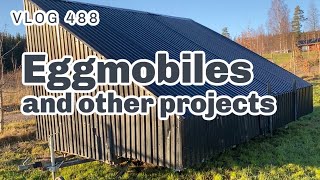
Vlog by Richard Perkins (with Hannah) documenting a week of farm projects: moving a butchered cow into hired deep-freeze storage, a road trip to inspect 5m and 10m mobile kitchen units for placing a commercial-grade kitchen on the farm, and camping en route. The video shows food-processing steps (rendering stock/fat and freezing portions), large timber deliveries for decking, and a barn renovation to create a level plywood floor (using a self-levelling laser level). Richard decides not to fully rebuild the Eggmobile fleet but to refurbish existing units and redesign rollaway nest boxes with automation to reduce daily visits. Ends with animal updates and an announcement about the Regenerative Agriculture Masterclass.
Questions this video answers
5 metre and 10 metre versions.
€250
Chapters
Welcome back to another video, folks. In today's video, just some random clips of the last week. We've been out and about looking at kitchens for the farm. We're buying a mobile kitchen we've been building. We've been doing all kinds of stuff. And so I'll just share a few thoughts with you. Okay. Cow is packed off to freezer. So freezer space in Carstadt. This is where we're putting the cow because way too big. We put one box in our chiller at home. So we've got a whole great crate for the winter and we've got a whole load for next year. We're actually leaving the truck here in Carlstead and we're going in our new camping truck for the first time to head south to look at kitchens, mobile kitchen units for the farm. So we'll show you what their fabrication units unit looks like. They've changed the gates since we were here last time. Can't get in.
I mean, it's a good idea because usually anyone can enter from the outside of this.
They've secured it. So this is the freezer space we hire. You've seen before, probably, if you follow the channel. And we're putting this in a deep freeze. The benefit of that is we have the space anyway for some other products. But it's guaranteed freezer, much colder and it's insured, so this will only take up half a pallet space. So economical for us. And there's no way we're going to eat all that in this winter, even if I try hard. Hoods up. We're going in here.
It's super cold. This is the freezer.
This is what it's like up north right now. Super cold. Don't want to get stuck in here. You might remember a couple of years ago when Matt was at the farm, we had a bit of a terrifying story where we dropped Matt off to do some organizing in the freezer. And then we all went across town to eat lunch. And we got a phone call half an hour later, and Matt locked himself. He frozen into the freezer. And he was like, I've only got a few percent left on my battery. Come and get me out the freezer. It was a bit scary, but he was fine. But things like that happen. Gotta be careful. Got a little bit of chicken left. We basically sold out all our stock. We're just going to stack this up, then hit the road south. First night camping. Bacon's on. We've got wraps and a beautiful view. We've made it this is a manufacturer of mobile kitchens we've come to have a look at. They only have 5 and 10 meter versions here and that will give us a good sense of what they look like, what the specs like. So the aim of the kitchen is to have all our food preparation totally outside our family home and to put the kitchen right in the middle of the farm so the chef is more seen and celebrated. And it's also a convenient way to serve food into the new tea piece that are right in the middle of the garden. So I think it's going to be an all round win and a commercial spec space. That means we can do further value adding on products. Well, temperatures dropped since the last video, but we are rewarded with these beautiful skies, a beautiful reflector telescope. Thought you said they were moon mice.
They live there, but I didn't see them there.
Oh, you didn't see them.
They're in. In the moon.
Inside the moon.
Yeah.
What are they doing up there?
They live there and eat the moon cheese.
They eat moon cheese. Maybe we can show people on the camera. Look. Whoa. Let's change the light exposure. Look at that. Crazy cool. What's going on with these?
Having boiled all the bones and some meat for two days, I think I strained them up. Strained them up. But first I carefully.
This one's pure fat, right?
All the top layer with fat. So I'm trying to take away any liquid in this fat. So it ends up to be pure fat. And then I would put it in a jar. And this I'm reducing now. And I'm skimming.
Then you have like Scotty skimmings.
I'm skimming, but I'm gonna also filter this through a cloth later to get it really clear. And then I'm gonna freeze it in smaller portions.
What are you two? Finished stock poured into little containers for freezing. This is all the timber for decking. Seven mighty decks. That's a lot of timber. Ragnar and I have got a fairly quick project. We're taking up this barn space, which is basically just trash. It's been used with pigs, sheep, cows. But the aim is to put a level floor where we can use the pallet truck all the way across to here, even up to the back of the brooder here. And then we'll be able to fit a lot more stuff in here for storage because it will be a level floor. But first, lots of cleaning and moving of rubbish around. It's ready work on a cold day. I've been getting on with this this morning. So anyone that's been to Ridgedale will know. This is the milling station for the boiler feed. We have our silo down here. This space has just always been multifunctional. It's never had a proper purpose. So what I've decided to do, I've got lots of deliveries of big things coming. Want to have a level floor all the way to the back of the brooder which is here. So what I've done is ripped up the old floor that was here and started this has had pigs in it, it's had cows in it. So I had all different iterations and now I've got my trusty laser level. One of the best tools you can have on a small farm. We've used this. I've had this 15 years now, since I started doing keyline layouts when I was younger. And we use it all the time for building for layouts. It's such a great tool. It cost me €250 at a time. You can spend a lot more but self leveling laser level, that's all you need. So the plan is now to get a floor level. I want to just take some measurements against the existing floor and mark some points across to see how I'm going to hang the floor and yeah, go out and get the board. So I'm just going to put thick plywood down and the aim is to end up with a level floor level with this that we can use the pallet truck to store and move everything better. Simple move, but big life change when you have little things like this under control. Peacocks are curious as ever. They love to come and explore what's going on. So I had to take out one structural beam that was running across the barn. But I'm not so worried about that. We've got lots of structural stuff up above us. Leaving these all in, but that's necessary to get the floor level. So I've decided to take one out and leave one in place. So job to do. That should do it. 18 mil ply for the floor and then the joists. It's a heavy trailer. So little by little, today's progress. I've put in the first bit of floor you can see. It's pretty strong. Should be able to hold the ATV and whatever we need to park on here. Still got a bunch to do here. And working in a space like this, nothing is level. So I've basically gone with an approximation that meets up nicely with this floor. But There's a good 18cm difference from one corner to another. About 12cm. This side to this side. So I've taken an average that will give us a flat enough floor. Gonna board that hole up where the pigs used to come in and out. And I'm gonna build stairs up this end to get access to the loft there, where we often keep row covers, but could keep a whole load of stuff. And then stairs here to give us access. Better access to this loft up here. But it should improve the functionality of this barn no end. We've got a big raise in the floor here that's been here since we moved, but that hopefully it's something I can address. Level that out and that'll be easier to access the barn from this side. Yeah, simple job, but happy with the progress so far. It's good to be out and doing stuff after this summer. So I talked about rebuilding EggMobile 2.0. This is our original Eggmobile. I've actually changed my mind. I'm not going to totally rebuild these. Why? Because they work and they're awesome. After speaking to so many farmers on the farm like a hero, experience the issues and nuances people have with these designs, with EU regulations and the need for scratch space underneath, which people have had to deal with in different ways. But actually we don't have to do that. And I thought, you know, being a demonstration site, we would build something new and open source the plans for the benefit of everyone. But I started to realize I've got loads of projects. I've got a massive pile of wood coming. I've got all these deckings to build for the teepees and the yurts and the new teepees. And I'm rebuilding in the barn. I've got so many projects on that, I figured why bother changing something that works? What I am going to do, however, is bring all these up to the yard one by one and fix them up in any way that they need. And I'm going to radically redesign the rollaway nest boxes because I like these rollaway nest boxes that you see with commercial systems like the Chicken Caravan. But I want to make my own and that's something really worth doing. I've done some preliminary planning and mathematically it will fit along the bottom here. And we will actually adapt the end wall of the Eggmobile. So you will actually collect eggs here. So there will be a tray system for your plastic trays, a system here to take hold of the white collection crates we use. And you'll wind in the eggs from the outside. And we'll automate the closing as well as the opening of the doors. And that will halve the amount of visits we need to do to the hens in a day. I'm also going to fix up little bits of sheathing, just pretty them up again, and that's what I'm going to do. I know that might be disappointing to some people who have been hoping to follow the process and get hold of our plans, but I really just figured that these egg mobiles have become somewhat iconic. Maybe it's a bit ambitious to say that, but they've been successfully replicated in many places and they work, they're simple, functional and there's nothing wrong with them. So I figure rather than remake the whole thing, I'll just adapt them to lower the amount of time we use them. So, currently, we come up in the morning, we move the egg mobiles, we feed the hens, then we will come up again for egg collection one and take half the eggs. And what we found with these nest boxes is hens will always lay where the other hens lay. So they're all at the bottom, very few at the top, some in the middle, but mostly in the bottom. So it's a bit of a scramble for nest space at that time. So we come up for one egg collection, then we come back to close nests, collect eggs again and feed them again. And then we come back at night to put lights in and to close up the egg mobile. But with automation, simple automation, we'll be able to open and close the nest boxes, we'll be able to turn the lights on and close the egg mobile automatically. So we'll only need to come up for one egg collection and the morning move and feed. And two times a day is good enough to keep a good eye on the flock. So that's what we're going to do. We're going to build new nest boxes and I'll take you on that journey as and when we do that. But it massively reduces my winter workload, which I'm happy about. The nest boxes will not be quite long enough to meet regulations. However, I'm deciding to go with that, because if I did have an inspection where they measured that, I could extend them slightly out the front and just have a separate roof cover. However, based on our experience of seeing that the hens are only using bottom rungs primarily. Sorry, the bottom nest primarily, I think that despite the fact that it would be about a meter shorter of nest space, they will actually have much better nest access because they'll be accessing from both sides. I'm going to build it with the same angle as the roosts on the roof so they don't sit on it. And it'll be harder to get access in here because the unit will be about a meter wide. But we don't need to go in there really. So I think it's going to be perfect. Hannah's just collecting the sheep fencing. We finally got the sheep over with the cows. They're in their forest paddock. She can just make out maybe they might be down the bottom eating. It's very wet here. It's been raining so much. Quite squelchy underfoot. But the sheep and the cows are in the spruce plantation where they have a shelter and so they're all in together. No more animal moves this year. That's it for today, folks. Thanks for everyone that's joined the Regenerative Agriculture Masterclass. For all of those who have got lifelong access passes previously, we'll be sending you an email in January when we start the course. There's going to be hundreds of farmers from all over the world on there. Super excited to have some of our previous students acting as mentors throughout the course. It's going to be awesome. I'm really looking forward to that. Don't forget, you can find out a lot more in the links below. Our book we have free short trainings as well as two different online trainings and the Farm Like a Hero experience. So lots of resources there for you. See you in a video soon, folks.
More from Richard


A review of short and intensive season on a mixed farm and restaurant/event space in Sweden






Alskade Kyckling Exploring complexities of poultry production in Sweden and what we stand for


