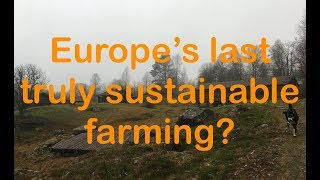
On-location YouTube piece by Richard Perkins exploring Finnskogen (Sweden–Norway border) and a historical Finnish shifting-mosaic slash-and-burn (svedjebruk) system. The video describes the method (ring-barking, felling, burning, rye cropping, turnips/cabbage, pasture, long fallow to forest), notes it required only simple tools (axe, sickle) and extensive land and labour, and frames it as one of the last examples of a self-contained sustainable farm system in Europe. The piece links that history to modern regenerative agriculture themes — especially the role of trees and agroforestry in carbon sequestration — and references research/slides (land-equivalent ratios ~1.3–1.4; Eric Toensmeier slides on sequestration).
Chapters
So we've come to the Norwegian border.
And we're in an area where some of the last sustainable farming in Europe happened in my mind.
So we've come to an area, it's in Sweden, but on the Norwegian border called Finnskogen. Yep, Finnskorgan. And this is an area the Finnish settled in the medieval times, in the 1500s, with a shifting mosaic slash and burn agriculture called. How do you pronounce it? Svirdebruk. Svjrdubruck is like to burn and they were burning the forest. Now some of you are gonna be surprised to hear that a slash and burn type agriculture could be sustainable, but really we've got to define what sustainable. We talk a lot about regenerative agriculture and restoring soil and restoring local community, economy, whatever, but all of the agricultures that we see on YouTube and in news and Facebook, whatever, all of our modern agricultures require massive inputs and that's the way it is. It's very hard to actually have an agriculture that's totally self sustained. And this was, I think, one of the last examples in Europe of truly sustainable agriculture. Now, not surprisingly, this type of agriculture centered around trees and trees are one part of the regenerative agriculture picture that's really influencing mainstream agriculture right now because it's not too weird to have trees. When we think of agroforestry, we typically think of silver arable or silver pasture systems. So integrating trees into arable fields or into pasture situations like we have at our farm. I'm getting a little out of breath because we're going uphill with heavy ragnar on the back, but we can talk about land equivalent ratios. Now Grouft in France, the research institute there have shown that you get land equivalent ratios of 1.3, 1.4 with those standardized kind of agroforestry systems where you can have, you know, if you have timber production and a cereal crop integrated together, you get up to 1.4 times the production of having those as separate monocultural enterprises. And I've seen some of the best examples currently in Europe, like Dennis Floris place and Professor Martin Wolf's place that you see in these pictures here in south of France and Verdanobles and in Suffolk in the uk. And so we all know that putting trees into farmland is a really good idea and really important part of the future. Often when we talk about sustainable agriculture, we get caught up with certain pictures of what it looks like. And what inspired me to make a video about this model was that it was a truly self contained model. It was run with an axe and a sickle and no further inputs needed. And it took up a large amount of land to sustain humans in that way, which is quite telling of how far outside our resource base we live today. But before we get into that and have a look at one of the old homesteads here in this forest clearing, I wanted to just read this quote from Plato. This is written nearly two and a half thousand years ago and it's quite pertinent to today too. He said what remains of our once rich earth is like the body of a sick man with the fat and soft earth having wasted away and only the bare skeleton remaining. Years ago, many of the mountains were arable and the valleys that were full of rich soil and their marshes, hills that were once covered with forests and produced abundant pasture now only produced food for the bees. Once the land was enriched by annual rains which were not lost as they are now by flowing from the bare land into the sea. Once the soil was deep and it absorbed and it kept the water, and this water soaked into the hills and it fed the springs and running streams everywhere. Now abandoned shrines to these dried up springs attest that our description of the land is true. And that was written two and a half thousand years ago. And you can read Plato and Cato's work. Some of these how to Print books are available online. If you look back at the history of farms around Europe, they always had perennial crops, tree crops and arable crops and animal systems integrated together. That was how to keep nutrient cycling as far as possible on the farm. And yet when you read those accounts from people like Plato, you see that all the farms were run by slaves. And you read these testimonies of how to feed your slaves before the olive harvest and all this kind of thing. And so what's inspiring about the Finnish slash and burn model was that they were working very simply in extended families in very small communities. What you see in this type of agriculture is as the Finnish settlers came in, they were clearing areas of the forest as clear cuts and then farming those areas and leaving them for 25 to 30 years in a kind of shifting mosaic. And all the resources for farming came from the piece of land that they were working on. And so often the fields would end up quite far from the houses and homesteads. We're walking up this trail to go to one of the best preserved old.
Homesteads that's out here. So we're here at this homestead and it's nice to just walk around a bit and look at some of these old Buildings, there's an old smokehouse, an old granary, the living quarters. And the way that this farming practice would have worked is quite interesting. They would come along and ringbug. This would have all been very dense forest a few hundred years ago, and it was poor land in the eyes of the Swedes. So they kind of, the king sent the Finnish people out here to live in the hinterland. But they would come along with an axe and ring bark trees to kill them. So when you take a strip of bark off the outside of a tree, it kills it back. And then they would chop them down, let them dry out before burning them. And with the ash, the nutrient in the ash of the burnt timber, they would then grow a rye crop. And in these beautiful old videos, you see the farmers and their wives, like, burning down all of the dense forestry and thickets and creating swiddens or fields, open fields made out of the forest. And then here growing a rye crop and really abundant rye growing in the ash and the nutrient of the burnt forestry. And then that would have been used for eating and also for feeding animals and making straw. And then this land would have been put down to, in subsequent years to turnips and cabbages. And then after about three or four years of crop growing, it would go to pasture and they would run it as pasture for some years, leaving it for 30 or 40 years to turn back to forest. So they had this shifting mosaic, using a piece of land intensively for a few years and then for grazing for many years as it turned back to forestry and then moving on and starting a new patch. Now, I think this was truly the last model of sustainable ag in that all of the inputs came from the land used. Now, the patches of land used for cultivation would have moved progressively around the farmstead and maybe further away. So the buildings might ended up quite far away from the actual working fields. And you could see from this model that actually to sustain a small community took quite a lot of land. But that's the nature of reality. Like our farm, people love to follow what we're up to, but we are importing a lot of chicken food, some winter feed for the animals. It's a lot of other land that's incorporated into our production and that's the same for every farm. You know, a small market garden of a thousand square meters can be highly productive, but it's running on someone else's dairy industry for the manure or chicken industry for the manure or big monocultural grain crops for the carbon, for the compost that's being inputted. So it's really hard to visualize all of these inputs and outputs. And I think this is truly one of the last examples of an actual sustainable farming pattern here in Europe. I might be wrong, there might be examples in other parts, but this was truly, truly self sustaining, all materials coming from the forest and then turning it back into forest in this shifting pattern. So I find that really, really interesting. You can see from looking at the terrain around us why the only tools needed were an axe and a sickle. Essentially because this landscape was too rocky and bare to be facilitating the use.
Of something like a scythe. And so because of all the rocky outcrops, people could come in and harvest.
Their grain crop by sickle, by hand, like you've seen in the video there.
Now, basically this model required felling and.
Burning trees every single year to enable.
The farmers to have some basic new.
Field to crop in for their grain crop.
And so it required a lot of.
Physical labor to run this kind of operation. And what you see is these little.
Farmsteads that popped up were small, intensive.
Communities with big extended families. And that's kind of how the communities.
Ran themselves in the middle of the.
Dense forest in this part of the world.
So what's left today is this kind.
Of like savannah of birch over really rocky, poor ground. That's all in pasture now, but it's.
Quite fascinating to walk around.
I bet this is a very beautiful homestead in the summertime. And I can imagine, like cows with.
Their bells kind of tingling out the hills. I can imagine that people had very hard working but very peaceful and wholesome.
Lives in this kind of farming. Trees have always been a very important part of agricultures all over the world, but also in soil sequestration, they're so important to the future of agriculture. Overlaid now you're going to see a couple of slides that Eric Tomsmeyer sent me, who wrote Carbon Farming Solution and is an expert on perennial crops around the world. And these slides show a couple of things. The first one you'll see is looking at the sequestration rates of carbon in tonnes per hectare per year, comparing different types of agriculture that you may well be familiar with. And you see it's particularly with the woody crops that that the most common sequestration is happening. Now, I would say that this is probably slightly skewed in terms of its data value in that when you go to the tropical regions of the world, then all of the biomass is held up in the plant systems, not in the soil like it is in the humid climates, in the temperate and cold temperate climates that we're in, where you have these thick, brown, rich topsoils. In the tropics, you don't have that. All of the, the carbon is up in the vegetation. And so I think that skews the figures a lot. But it's very clear that trees are so important to the future of carbon sequestration. I think those results skew the impact of holistic plant grazing, because grasses, just by their very nature, are so much more effective at sequestering carbon, which we've talked about in other videos. But as a basic recap, I mean, the shape of the grass plant is 20 lanes of superhighway heading straight towards the soil. This is the world's most effective photosynthesizer. And liquid travels in a grass plant up to 25cm a second, compared to about a meter a minute in the trunk of a large oak tree. And so by its very nature, grass is so much faster at putting sugar into the ground, that is carbon, and also the impact that animals have when they come along and harvest, that it can be harvested so many more times a year and it's moving liquid so much faster. So I think those results are skewed a bit by the way the data is collected. And then the second slide, you're looking at the lifetime soil organic capture through these different agricultural means. But needless to say, trees are such a vital part of capturing carbon. And I find it really interesting that the last example of sustainable ag in Europe that I can think of was fundamentally based around trees, although in quite a different way than we're used to when we're thinking about putting trees into agricultural systems, they were actually using the forest as the basis of their agricultural system. Now, I would expect to get a lot of comments from folks because I think a lot of people find it hard to get their head around the idea that this practice of farming could be considered sustainable in terms of burning all this timber. But you got to really factor in whole economy of how we farm in modern terms. We use a lot of fuel, diesel, petrol, which is, you know, very different to burning an area of woodland that's then regenerating, capturing carbon again. And so I think it's pretty interesting to think about because we are very far from true, you know, closed loop system farming. I've never been to a farm that's anywhere near close to closed loop and I think there's a lot of illusions in that.
And yeah, it's just very inspiring and.
Interesting to come here and think about how they, you know, must have labored so hard in the past and you know, farming must have been a lot tougher than it is now. But it's interesting that, you know, this is not a model that can be replicated. It's not scalable and it doesn't work in any industrial way. It's very human labor intensive and it's a, you know, a cultural thing. It was for small family run shifting enterprises like this as a subsistence farming. And that's not how we farm today. Like typically as we define farming today, it's not about subsistence, it's about creating a livelihood. And so, yeah, I don't think it's so appropriate, but I think it's very fascinating to really think, think about the past. And when we look back in history, we see that most of the farms were run by slave labor. And so they weren't exactly models of what's possible in any modern context. And then when we look at modern farms that are heralded as sustainable, they're often relying heavily, like our farm, on inputs from outside in terms of feeds and extra land or whatever it is. And so, yeah, I think the quest is still on to find truly sustainable farms today. If you know of any, then please let us know in the comments below. I'm very curious. I mean, I've studied this half my life and I've never seen anything close to it. But I am looking forward to a time when, you know, perennial grains are coming and about 10 years away from having perennial staple grains all over the planet. I mean, that's going to be massive for carbon sequestration and keeping soil intact, really. But yeah, really nice to come to the forest and check out this place and just feel into what, you know, it must have been like to live out here in this isolated, rocky, harsh ground in the middle of a dense forest. But it's fun to think about the process of what must gone on for people to move into this dense forest region that wouldn't have had much roads or any kind of infrastructure like that. And to set up like this, they must have bought a bunch of supplies on horse, no doubt. And basically the first year they would have had to clear all this land by burning and set about building and growing a crop in their first year. The supply network of food and resources at that time in Sweden was horrendous, especially out here in the hinterland. So it's quite fun to just get into the mindset and really think about the actual process that would have gone on. It would have Been extremely tough. And this is quite a cold region. We're a bit higher up in altitude. It's very damp, you see, on the moss, on all the structures and the trees. And it's a different type of cold when you come to damp places like this. Many parts of Sweden are really dry air, but this is a very humid part of the landscape that is very cold. But, yeah, it must have been a very interesting establishment phase to get open land and start cropping it immediately to have a food supply whilst building all these structures with the timber right from where you're standing. And amazing to see all these old buildings that are built with proper old carpentry. No nails and, you know, everything's actually made of the wood other than the glass and the metal in the hearth of the fireplace. Now, I made videos in the past about how sometimes the oldest trees in the forest are really tiny just because they've been browsed continually year after year by deer or something like this. And here's a great example of one. This is an old juniper, and this could be over 100 years old. It's very likely that it is, because this was planted in homesteads, you know, a very long time ago. You can see it's very stunted and it's been eaten repeatedly, but you can tell by the trunk it's a very old tree. And we were near Stockholm doing a forestry course, where we took a core sampler, which basically drills a hole into a tree and extracts a core sample. So you can count the rings, which you do in forestry, to assess the age of trees, etc. And we found oak trees 140 years old that had trunks no thicker than my wrist. So it's interesting because you wouldn't know unless you knew. And I just think this is probably a very old specimen of juniper planted in the homestead. Could have been a very, very long time ago, many generations ago.
Here's an ancient apple tree behind the homestead here. And something I wanted to just show you up on the roof here. It's very common around here.
But for those of you in other.
Countries who might not be familiar with.
This, this is how they roof their houses. And it's overlapping birch bark that you cut with a knife around the birch tree and peel the whole circumference of.
The birch bark off and lay it like tiles, overlapping. And then it's held down with just.
Wood from the forest.
And this is how houses were covered for hundreds and hundreds of years here. And then they went to using pine species for shingles, which is what our barn and house is covered with. They've just put a new roof straight.
On top of it.
But just local materials and local vernaculars that are interesting to share.
Now you often hear about slash and burn as being really unsustainable and it's usually talking about the tropical regions of the world where hundreds of millions of people practice slash and burn agriculture. Now, there was a professor at Sussex Uni when I was living there that I think it was called James Reid, who had documented the first truly regenerative slash and burn agriculture going on somewhere in Africa. The details escape me now. It was many years ago, but he was showing that more biodiversity was coming back in the places that humans had touched. Now, I think it's a whole different cup of tea in that climatic zone where you have this dense aerial perennial cropping that's quite different from, from our lands where all the nutrients held in the soil primarily. But I think it's interesting that, you know, we have these preconceptions and connotations with these practices. But yeah, I'm really curious to see if anyone has seen a better model for truly encapsulated self contained ag in Europe, because I think, you know, it's. I can't think of many and certainly not any as recent in history, so it'll be interesting to hear your comments.
I don't know if you can see the girth of this apple tree, but it's about 80 centimeters in diameter.
The trunk, ancient tree planted on the homestead. This was the traditional way of fencing, just using tops of trees that weren't useful for much else for protecting against elk and wild boar and deer. Whilst this isn't actually high enough for elk and deer to, you know, they can easily jump over this, I think because of the amount of vertical struts, they just choose not to.
It's a visual barrier as well as.
A physical barrier for smaller animals. It's quite interesting to think about the past in history because this would have been a time when people didn't have the luxury of importing resources and nutrients around the place, so they had to farm within their meats or trade essentially. And so people living out in isolated communities like this are often where we can find insights into how people manage those cycles. Now, many of the things that make for a self contained sustainable life just involve massive amounts of hard graft and labour. And so that's why people tend to, you know, it's much easier to buy a bag of MPK fertilizer than to run an animal enterprise just to supply your production of vegetables or whatever. So you know that that plays into it a lot I think. And I love looking into old historical accounts of farming, particularly really old ones. And there's some great old books you can find on soilandhealth.org it's an out of date agricultural and health resource that I've been pointing people towards for many years. There's a lot of amazing books about keyline design, about grazing and all of Cato Plato's work about how to select a farm two and a half thousand years ago. An amazing resource that's there for people to download. But yeah, really interesting to go into history and just see how people used to do and how can we then apply modern science, modern techniques, modern technologies to those practices because biological processes still work in exactly the same way. That's it for today folks. Thanks for watching. Nice to step back in history. And don't forget you can find out a whole bunch more about agroforestry or any of the things we're up to, parts of poultry, running a farm, market gardening, etc in our online course. It's available on a month to month subscription in the links below, along with links to our book and all the other things we offer. Thanks so much for watching. See you in the next video. It.
More from Richard


A review of short and intensive season on a mixed farm and restaurant/event space in Sweden






Alskade Kyckling Exploring complexities of poultry production in Sweden and what we stand for


