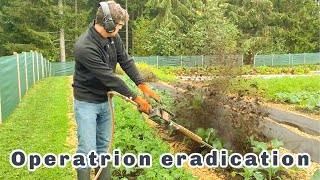
A vlog-style farm update by Richard Perkins showing daily farm life and practical pest and tool demonstrations. He discusses a very hot sauna (110 degrees), the market garden and irrigation effects, and details an active vole infestation and the use of a Rodinator to collapse burrows and kill voles. He notes vole biology (sexual maturity ~40 days; litters up to 15 young) and that poisoning/predators are ineffective for this pest. He shows a praying mantis (named species in transcript: 'Hiradula membranasia'), showcases an electric motorbike (noting it reaches ~80 kilometers/suggested speed), and mentions product/pricing/shipping specifics (Rodinator typical cost ~€3,000; he bought one second‑hand for ~€500; book shipping 10–12 weeks to some countries). He also promotes his Regenerative Agriculture book and online training.
Questions this video answers
About 40 days.
Up to 15 babies.
Typical cost about €3,000; he bought a second‑hand unit for about €500.
110 degrees (stated as the hottest he has run it).
"It goes 80 kilometers now" (stated in transcript).
Chapters
Welcome back to another episode, folks. I just got out of the most ridiculous sauna I've ever had here in my life. Just show you around the farm before it gets dark. 110 degrees. This is the hottest we've ever run this order. And I can tell you it's too hot to sit down without putting water on the seat first. It's intense. Don't necessarily recommend it, but this is a proper steam up. Bit of an open day tomorrow. It's Taste Van Land, our county here, so we expect some people to come even with the predicted bad weather. So we'll be doing little tours and selling veg, etc. And we just ripped out the pumpkin patch. So this was tree beds, then pig paddock. And last year we did some trials that didn't really show much conclusivity. This year we just put it all down to pumpkin. That's what we got out of it. Pretty nice. A bit late for some of these guys, but beautiful big tomatoes. Check out the difference with these espalers that we've got here that aren't irrigated. Put in as little 80 centimeter whips some years ago, but behind the wash station here, look at the size difference. With these they get all the water from the wash down and that really has made a tremendous difference. So that shows you what irrigation can do. So a lot of vole activity this year due to the mild winters we've had the last few years. And so we got the rodinator out to work through the tree lanes in front field. But there's been a few voles encroaching out of the forest edge here, so we decided to blow them up. I'll show you what that looks like right now. So, hello. This is called a rodinator. This is the tool for exterminating burrowing rodents like gophers or voles. In our case, they've been devastating to the trees and they've started to come in the market garden. It's basically taking oxygen and propane, mixing them through these mixer taps, pumping it down into the hole. And we have a safety shut off and we can ignite that. Now that's important with voles because they sexually mature in about 40 days. They reproduce several times a year and can have 15 babies, up to 15 babies. So once you have an episodic problem, you need to get rid of them. And poisoning doesn't really work for voles. And predators don't really work either because they spend the majority of their time underground. Obviously. We've had four winters in a row without snow and ice, that they've just infested the tree lanes. As well as starting to come into the market garden out of the forest edge, it seems like. And so what this tool does is it allows us to kill them on percussive impact and then it also collapses their tunnel, which is very important because if you take a vole out through a predator or through poison, another one will come and just live in its burrow straight away. So this is an effective tool. They cost about €3,000, but I actually found this second hand on ebay in America for €500, which felt like a really good deal. So we've used it in our tree lanes, thinking we'd got rid of the infestation we had when we moved in here because the pasture had not had livestock on it for years. Things that help with voles are keeping the edges of the grass here really short or having animals disturb the landscape. But when we moved in, it was thick thatch all over the pastures, so we had huge voles. And when we first pulled the keyline plow through in the first weeks of being on the farm, they were running like lemmings towards the riparian. So we, after planting trees in the first year, we saw them come back into the tree lanes. We blew them up with this. But the recent years of episodic growth with the mild winters has meant we need to go around again. So today we're just working in market garden and in front field and we'll find a hole, pump gas for about 5, 6 seconds and then ignite it. And you do see redneck versions online on YouTube with people using their oxy tanks for welding. Just be careful, it's gas, it's a mobile bomb, it's dangerous. You want to be really careful that you're wearing ear protection, eye protection, and never igniting gas outside of the hole because the ground takes a lot of the shock and a lot of the sound as well. But it's a very dangerous thing. And you'll see in videos you find on YouTube, people with rocks flying past their faces, etc. That's not the correct use of this tool, so just be steady. But it is a very useful tool for what it is. So I'll fill a first hole here and we can see how it looks and sounds. There she blows. And you can see here, you can see it's collapsed, this tunnel in the bed. Now this is in compost in a no dig bed, so it's not such a significant tunnel. And you can see it probably extends much further down this bed. But if we were in the pasture situation or in our tree lanes, it would be a much more solid tunnel that the gas would travel all the way down it. So we might blast in here again or find where the end of the blast was over here somewhere and make sure we go all the way down this bed. So that's what we're going for. Pretty big voles and they can cause devastation. Obviously. This one is still warm. This wasn't actually got by the radiator Rodinator. Seems like it was maybe taken by a cat or something. This is the telltale sign of fresh vole activity. And what we've been doing with the rodenator is just going through tree lanes, etcetera, Looking for the latest hole. There you go. And this is running both directions. So that's what we're looking for in the tree lines. This beautiful soil that we've built over the years. Beautiful crumb like structure. It's not so good at holding gas because it's quite porous. It's different in different parts of the farm. Here it's quite sandy, but over up at the top it's just silt. Down the bottom here is heavy clay in top field. So yeah, but we'll see. We just need to make sure we really keep the land patchy. Intermittent disturbances and also keeping them out of the tree lanes with the occasional explosive disturbance is quite helpful. You can see quite a few beds getting covered up now. Every day it's more and more. Now some of you might found the Rodinator a little bit har, but anyone that works with this stuff knows that when you have an episodic problem like that, you've got to deal with it. Poison is not good enough. Traps are not good enough. Predators are not good enough. Planting beneficial plants around the place, not good enough. You've got to deal with it and that tool is fantastic for that. So just wanted to let you know that whilst I have respect for all beings in the habitat, when a pest is unmitigated, when a pest is out of control like that, you have to take action or you're not going to have veg or, or trees left when the spring comes, certainly if it's another mild winter. So that's the effective way that we've decided to deal with the problem here. Wow. Look what just came in the post. Ragnar's own praying mantis. This is Hiradula membranasia. It's the great green praying mantis, but it's a male and It's a brown color, so they can be green, but the females are often green. But this one is brown and it's in its adult format, so they have several moltings till they get to full size. Look, we just gave him some drops of water and fed him a fly. So this is a male. The females are better for free ranging they call it just on the plant, but we thought we'll try in the bathroom. He's a male so he can fly. He has big wings, but he eats a few of these flies a week. So as long as he has water and some flies should be okay. What a crazy creature. Do you know where the slum is? Thanks everyone who's been sending in pictures of eggmobiles. I've seen dozens that have been inspired by us and it's great to see the response to that. I'll be making a video probably in the next week, so I hope any others that see the previous video or this one. If you've built a Ridgedale style eggmobile inspired by our farm, please send us a picture and the name of your farm, the country it's in. I want to make a video compiling all of that just to celebrate the beautiful pastured eggmobile movement that's happened and has really spread out from this farm with the simple low cost design that we've put out there for you folks. All the trees are turning colors now. It's beautiful, the reds and oranges. It's been a good year for color this year and it's a longer autumn than normal. Sometimes it just goes from summer to winter and from winter to summer again without much of a transition. But nice to see the birds happy and healthy. Been a great year for tree grass. Some of my chestnuts from seed put on some really good growth and stems as thick as my arm now. Super happy about the growth. Let's see which ones will actually stay alive and bear fruit in our strange climate up here. Gorgeous color on the walnuts here and then zooming past the hens down here. Just look at the gorgeous colors like phosphorescent. Beautiful time of year. Probably my favorite time of year. Just reaching down the bottom and then the birds will be going into front field again. Now we aim to get them through front field again which we've been careful with touching this year because of the damage it got last winter before getting the cows back into hopefully into nutfield stuff. Take the grass before the birds come through. It would be a shame to waste the beautiful forage there. But we're still working down K3 we'll go and check out the cows and sheep. Now. I've been using this little electric motorbike for quick farm checks and loving it. Super quick and nifty. It's really good for rapid observation around the farm. It's quite a crazy little machine. Don't know if I've ever shown you like this, but I love it, so I'll show you now. They're a little bit expensive. I don't necessarily recommend these as farm vehicles, but because our ATVs are so busy on day to day basis, I bought this as a quick get around that gets me to the lake and up into the forest to forage or just take time out then. Super handy. It's basically like a downhill mountain bike. A little bit heavy, it's probably 50, 60 kilos, but it goes 80 kilometers now, which is fast enough that you feel pretty scared. But it certainly means I can get out and about and quickly go check on what's going on around the farm. They're very curious about this funny noise, but you can see we've grazed the basically all the way up and around the house. And so this is the line across. You can see where they've grazed this side. So we're grazing back down here. You can see the sort of paddock size here with the new fence laid out. So once we've been through here, hopefully we'll get up to Nutfield before coming back to the two other fields on the neighbour's land. I used to ride motorbikes a lot as a kid. That's how I got around when I left home. I used to ride motorbikes, little mopeds, like old style mopeds, through to bigger bikes as I got older. And I always had a lot of friends that rode bikes. I lost two of my best friends when I was young, one when I was 18 and one a little bit later to motorbike accidents. And so I quit riding motorbikes. But I've always loved it. So for me this is a little blast of the past to be able to scoot around and have that sense of freedom. You get on a bike without riding on the road. Certainly in Sweden with the winters we get here. It's a summer only kind of operation. But this gives me enough joy zipping around the forest off road and it's kind of like a glorified mountain bike without the effort. And it goes really fast. I'm really happy with it. I've been using it a lot this summer. So thanks so much for watching. As always folks, it's really it's you folks that make this channel and give me the inspiration to keep putting this out there. I know from hearing back from you, from comments and from emails etc. That that it's really beneficial to follow the farm and decision making and economy and all the bits that we've been putting out there. Don't forget you can find out a whole bunch more in our book Regenerative Agriculture. We ship that out from the farm to you wherever you live in the world and you can buy that as a PDF e book. Now shipping of books has taken a long time this year. Some people are reporting back getting books really fast, but it's often been 10 to 12 weeks getting to USA, Australia, Canada where a lot of people are buying our book from. And so with the COVID mess, I'm sorry I can't do much about the postage and that's just the way it is. I'm a recipient of that with products I've been purchasing online, etc. It's just the way it is with this mess this year. But if you want instant downloadable version, the PDF version, you can buy that online for immediate download. You can find out a whole bunch more in the links below, including our short online training Start the Right Farm. Already had a lot of feedback that people have found that super beneficial. And then our full online training is going to launch again this winter. For those of you you want the widest, broadest, most in depth regenerative agriculture online training on the planet. That's it for today folks. We'll see you in a video soon. Bye for now.
More from Richard


A review of short and intensive season on a mixed farm and restaurant/event space in Sweden






Alskade Kyckling Exploring complexities of poultry production in Sweden and what we stand for


