Richard Perkins updates on his farm: a completed permaculture design course with international participants, hundreds of kilos of meat processing underway, and extensive mushroom foraging that includes a lesson on saprophytes versus mycorrhizal fungi.
Questions this video answers
About an hour and a half away.
About 5.5 kg and 5.8 kg.
Probably 300–400 kilos of sausage to make.
September 3, 2019.
Chapters
So time is going really fast. It's just a couple of months now till the end of our production season. So much to do, so little time. And we've just finished the farm scale permaculture design course and we have a new group of interns who are off camping in the nature reserve about an hour and a half away and we're just catching up with things on the farm. So a little update with things that are going on at the moment.
Back in fun field with the turkeys. Turkeys are hiding around the back. Beautiful.
So we had a really great design course and lots of engaged people from various places around the world, as is typical of our trainings here, really nice groups. And Chef Elan, who has been here on the first year that the farm set up, came back as the chef for the training and delivered amazing food as always, including a lovely feast of canapes and lots more delicious things to send off the team as they go out and do good stuff in the world.
Egg and bacon canopies.
Look at this.
What have you got, James?
Wasabi chips.
Sorry.
Kale chips with wasabi, mayo, kohlrabi and apple. Mmm.
Yummo Joe.
What are you making?
I've made Yorkshire pudding puddings.
Yorkshire pudding puddings from a Yorkshire man.
What's in them?
Yorkshire pudding. Then it's going to be caramel, then whipped cream, then homemade strawberry jam.
Then.
Chocolate, then a strawberry spy.
You want to try? Yes.
We're gonna. So many bumblebees.
So these two ladies were spared from slaughter. They are weighing about five and a half and 5.8 kilos and they've become barnyard chickens now. They're very big and also very robust. They've got strong feet, foraging on their own. We've done this mainly out of interest.
For people to see.
We kept some for a year before with the laying flock and they grew to over 8km kilos. But still they were sleeping on roosts. They were laying goose sized double double yokers every second day. They're not exactly good egg layers, but they learned to be chickens. Hello. And it goes to show, management is key. These are healthy, happy birds and by restricting the timing of their feeding, their movement is greater, their foraging is greater, their leg development is fine, they're adequate and robust, healthy birds.
Hello, girls and boy.
Come on.
The sheer mass of these, aronia, we've been growing these up for seed and aronia is not so good to eat raw, but it makes wonderful jams that can be sold and they're quite popular here and we've been selling them fresh on the Rico, but I'm thinking to replace all of the hazel that's died from droughts or voles up in the fields with aronia, because it's such an abundant crop here. It's very hardcore plant. It doesn't need any care or attention and just masses of fruit. So I'm thinking of stratifying and planting.
A lot of seed of this. Again.
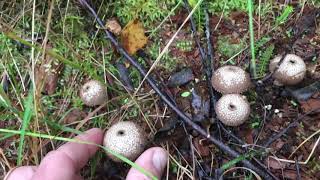
Cloth balls. Now, mushrooms are hydraulic, so they can pop through. This is an old tarmac road, but you see mushrooms can break through that in the first part of succession, the physical succession with weathering and things like fungi and bacterias, before we even get to plant succession. But these porcinis have busted through the road.
They're too old to eat now.
You can see they've been cracking up this road through the forest. But there's just an incredible amount of mushrooms. When you really start looking down at the ground. We're out looking for chanterelles and porcini that aren't too old. But there are so many mushrooms in Sweden at this time. It's just your eyes become accustomed to finding them. And there's a huge amount of Flying Garricks and so many species that I don't actually know what they are. So here is the brown chanterelle. You have to look real close because it's actually lots of. It's a mycorrhiza mushroom. So whenever you find some, you find a bunch more. There's just so many fungi everywhere, but most of them are not the edible ones that we're after. Look at all them. Spores. So there's four primary types of mushrooms. These are saprophytes, so they're eating dead organic material. So this is the type of mushroom that can turn anything that once lived back into life. But that's the edible mushrooms we typically grow, such as oysters and shiitake. What we are interested in with the edibles, like the. This is porcini. Karl Johan in Swedish. Or the brown chanterelle. We are looking for mycorrhizal fungi, so they are numerous all around the forest floor, but they are growing in association with a tree, so they are exchanging minerals for sugars from the photosynthesis of the tree. Now, we're a little late for hunting, so we're not finding so many as we'd like. But, yeah, the mycorrhizal fungi that we come and hunt, typically all the ones you hunt in the wild are mycorrhizal, like truffles or porcelainies, etc. Okay. The Great sausage pines. So we have a stack of turkeys, pork, laying hens and some lamb as well. We're going to make a lot of.
Sausages of all different kinds of recipes. Lots of boning and processing of meat.
To do in the next few days. So we'll be following this process along as we go.
So we have probably 3 or 400 kilos of sausage to make now. In the next days we have turkey and we've got some laying hens. We've got sheep, mutton, lamb, and we have pork and pork fat that we are going to put into different mixes, different recipes, and I hope to document some of that for you. There's a lot of work to prep all that. Lots of boning and lots of just grinding and getting everything down. It's a lot of work to make sausages, but it's really nice process to do with the interns when they come back from camping now to make our food supply for the next weeks. And we'll be trying out lots of different recipes and I'll try and document them as we go next week. So, looking forward to the training. Now we jump into holistic management training with Anders, who's coming to visit from Norway as a savory hub trainer. And then we jump into our program until the end of the season now. So I'll be putting out videos as much as I can. It'll be busy but inspiring times here at the farm and I look forward to giving you updates soon. You can find out a whole bunch more in the links below in our online training, which is a very condensed overview of how to do all these things and the numbers and the processes to make them work on the ground. You can find out all that in the links below. See you in the video soon.