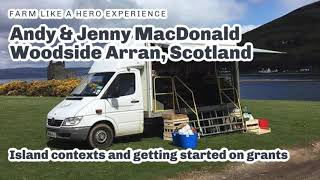
Jenny and Andy MacDonald moved to Scotland's Isle of Arran and transformed a derelict 32-hectare farm into Woodside Arran, a community interest company. They started with free-range hens, a market garden, and a mobile sawmill to serve an island with limited access to food and goods, working through challenges like no water and a five-year lease ending in 2024.
Questions this video answers
2017.
32 hectares.
Free-range laying hens; a market garden; a mobile sawmill (and a mobile shop/delivery service).
A five-year lease running through 2024.
Woodside Arran on the Isle of Arran, west coast of Scotland.
Chapters
Okay. Welcome to a new episode of Farm Like a Hero, folks. I'm Richard Perkins. Today I'm here with Jenny and Andy McDonald from Woodside Arran. Located on the Isle of Arran in the west coast of Scotland. Living remotely with the lack of access to good food and products, I was really inspired by the food truck delivery service they created to start selling their products alongside other producers Goods. Started in 2017 as a community interest company, the farm is 32 hectares run by Jenny and husband Andy and an additional manager. The farm has free range laying hens, a market garden and operates a mobile sawmill. So you guys, thanks so much for taking the time out to join us today. So please tell us a bit about the Isle of Arran because that's quite a remote place in terms of the uk. How did you end up there?
On a whim? It wasn't very sensible. We were meant to move to another island and turned up for a job interview with a house and all nice sensible things. But it just like within five minutes it just didn't feel right. We kind of looked at each other and went and then had a few days off work so thought, oh, right, rather than going home, oh, the children are asleep and the ferry for Aaron runs, let's just go there for two days. And within about 20 minutes of getting off the ferry we both just went, oh, I love this here. And so beautiful.
Even in the rain with the midges, it was beautiful.
So rather than moving to the place with a job and a house, we just sold everything and moved here. No job, no nothing and a three month old baby. So that was sensible. Sometimes, you know, you've just got to take those mad notions and it worked out in the end.
Where were you living before?
So we were in the Scottish Borders, about half an hour south of Edinburgh and we'd been there for maybe two years after we grew up there, but we'd been down in Devon and down in the southwest, came back up due to family health reasons, but just knew we weren't wanting to settle there at all and also didn't want to be 8 hours away if somebody got unwell again or there was a family emergency. So that's how we ended up here. We're suitably far away that we don't get enough visitors, but not so far away we can't get to where we need to go in a panic. So it was a middle ground.
Super interesting. There's lots of elements I'd like to talk to you about regarding island life because it's something that's appealed to me that I've not actually pursued yet. But I'm curious firstly just to hear a bit of your background because you've brought different work skills with you to set up this project. Could you give us a summary of what you were doing before?
So before started life as a gardener, landscape gardener. So done that until it was. It was too sore, too sore in the body. And then I ended up into mental health nursing. So they paid you to study. So I thought I'll do. So the plan was to nurse in the wintertime and landscape garden through the summertime. So that lasted a while. And then paperwork and just general bureaucracy was just disgusting. So I did it back in farming and gardening after about a three, four year stint in nursing. And then when we came back up the road from Devon, happened upon a sawmill, a beautiful sawmill in Carnwa. The wood place. Wonderful. They just specialize in hardwood and my friend was working there. So I ended up just. Just fancied. Fancied a change. I've always wanted to build their own house and that's what I thought started with the sawmill would be a good place to start working with wood. I really enjoyed it. And then what did we do?
Well, you grew up in a smallhold.
Oh, yeah, yeah, yeah, sorry.
Instinctual with animals. He's got that, you know, you can tell somebody that grew up with animals and that's very much so.
Yeah. I grew up in a small hold in Damhead, so that's about four miles outside of Edinburgh. And then when I was about 12, when my mum and dad bought a farm, it was only 22 acres outside of Peebles. So that's just about 24 miles away from Edinburgh. It's a nice little microclimate. Lovely place. So, yeah, so we had grown up with the sheep and hiling cows and so kind of the usual chickens and whatnot kicking about.
So it wasn't really a business.
No, it wasn't, but it was more a hobby. My dad is. My dad's dad's retired, so it was a hobby for my dad. So it was a kind of. There wasn't business sense. And my dad was always quite scared of turning farming into business because I always knew, well, he thought there was no money in it, but here we are.
And what about for you, Jenny? Because you were working more with like when you were herbalist.
Yes. So my degree was in herbal medicine and nutritional medicine. So I've always had a. Well, my grandmother has the most amazing garden. But of course you become a teenager and you're not interested in any of that or any of the skills that these people could have passed on to you. But Andy's mum was quite interested in herbal medicine and we've been together for a really long time and she convinced me to do this herbal medicine degree because I always fancied doing medicine but I was more interested in being a doctor than that. But long story short, ended up falling in love with that and the plants and learning quite a lot of practical skills and, you know, botany and all that kind of stuff through that and then we found my childhood love for gardens. I can't say I'm not much for flowers or perennials. If you can't eat it or turn it into medicine, I'm not really that interested. So did a bit of, you know, freelance gardening and then had my own clinic and stuff with that. But then my kids came along and we knew for a long time that we wanted a piece of land but land access is a major, major issue. It's so expensive. And we tried down in Devon, never really worked out. Came back to Andy's parents farm but you know, families are an interesting, an interesting issue with succession and things like that. And so yeah, just tried a few different things but then as I say, ended up on a whim with our boys moving here and worked on some community projects, community gardens, things like that. And we're actually in a fairly horrible wee tiny flat, kind of miserable because there's almost no houses to rent on the island. It's all second homes and very expensive. We're second only to London in the disparity between wealth and house prices. Wow, okay, yeah, it's like eight to one. So it's really, really tricky to find accommodation here. And so we were grateful we had something but we'd been driving. Am I talking too fast?
She TALKS too fast, Slow down.
Andy had been driving back and forth past this piece of land for about six months and kept going. Oh, I really, nobody's in that farm, Jenny. I really like it, I really like it.
The farm was just sitting in rack and ruin. You know, there was brambles up the walls and it's like been sat empty for about six years. And so I kept saying to Jenny, I said, come on, we try to find the man who owns that or the person who owns that, please. And Jenny, God bless her, she'd say a whiz on the computer. Took her two, three months, tracked the owner down and he was living in Dubai and he just split. Yeah, as you do, spare farm, he shut the door Six years ago when him and his partner split up and kind of will never came back to play golf. And that was. That was it. So yeah, you find him and he said luckily enough he's going to come over and play golf. I'll meet you in four weeks time and negotiate. Yeah. So negotiated for the. Well, it was just. I mean you've got a massive shed. It was like a gun room in the shed. It's like. It's just ridiculous really is. You have to kind of nip yourself. It's that. It's like a dream. The view's spectacular, the woodland round it. We've got a pond, big pond.
It's a big pond.
Big pond.
A good like 5th of an acre pond.
Oh maybe. Yeah, it's huge. So I kind of just cheekily said, you know, would you like to rent the place? And the guy said, oh yes, yeah, why not? And he asked me what we were paying in rent at the time and as you do tell, a little white fly and said that was paying less than I was and he went, fine, so I'll give you it for that price. That's fine. So we got this whole farm for the same price as the little two bedroom flat. This is a four bedroom house.
It has a four bedroom house as well. So it's quite a good situation we're in. That's not to say it's been without.
We had no water.
We didn't have any water. We only had a year at a time lease for the first well until last October. So everything we did, we were constantly.
Everything was mobile. Yeah. Hence the mobile shop. And everything was mobile so we could take it away if we had to go.
Okay, so then what's happened now? Have you negotiated a long term lease?
So We've negotiated a five year lease. So we're here and we're sorted till 2024.