FARM LIKE A HERO EXPERIENCE: Biotop Oberland, DE
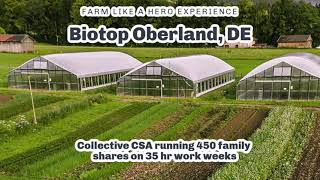
Sebastian Gehrman runs Biotop Oberland, a German CSA cooperative with 450 members farming 2 to 2.5 hectares. He describes how commercial grading standards make up to 30% of produce unsellable by appearance alone, and why he formed a cooperative instead. Land costs around €40-50k per hectare to buy, or €450 per hectare to rent.
Chapters
Okay. Welcome to a new episode of Farm Like a Hero, folks. I'm Richard Perkins. Today I'm here with Sebastian Gehrman, who's part of the team and sits on the board of the collective Biotop Oberland, a 450 member CSA farming on 2 hectares in Germany. Sebastian, thanks so much for taking the time out of your busy schedule to join us today.
Thank you for having us.
I understand it's. Is it a harvest and delivery day for yourselves there?
That's right, yeah. Thursday is our. And Wednesday and Thursday are our harvest and delivery days. Yeah, that's right.
Well, I'm sorry for taking you out of that, but thank you very much for joining us. Tell us a bit, please, Sebastian, the background of. For yourself, like how did you come into farming? What's your background with that?
Well, it was actually a little bit accidentally that I came into farming. I was on a big road trip worldwide for two and a half years and I came back not really knowing what I want to do. I just knew that I was always interested in basically how nature works, plants. All this from childhood on I found interesting. And that was the reason why I decided to study agriculture. I was not into agriculture then, not at all. I was just interested in nature principles, basically. And I thought studying agriculture is a good way to learn about that, which it was not really. But anyways, I decided to study agriculture, which I finished now almost nine years ago. And in that time I found out that I actually find agriculture very interesting. Not what I learned in my studies actually, because it was still conventional agriculture.
Yeah.
So I basically did my. I would say my private side studies while I was studying. I figured out more and more what I'm really interested in and which way I want to go. And that was small scale organic farming, including permaculture principles. And so after my studies, I was looking around for places where I could work like that, and I found a small farm nearby where I live. And I started working there and was responsible for basically the whole. The whole greenhouse growing and also in the. I don't know what is Freiland outside? Like on the field Pastureland or. Yeah, yeah, exactly. Not pastured, sorry. It was the vegetable growing outside.
Okay. Arable.
Arable, yeah, exactly. And I worked there for three years and it was a small organic farm. And during that time I found more and more things that I was not happy with, even though it was a small organic farm.
What things do you mean by that? Like processes and practices or materials or.
Yeah, the processes were not really what I think was Ideal. But that was not my main problem. The main problem that I found is that we were growing so many vegetables that were not even going to market because we had to throw them away before.
Basically bad planning or lack of sales or combination of.
I think it was a part of. It was planning. That's right. But the bigger part of it was the problem that I find is very huge in Germany, that we have this very high standard, what vegetables should look like. And to a degree that even the organic stores were calling us after a delivery and saying they will not take the vegetables because they don't look like what they expect.
Okay.
And it was. In some years it was always dependent on how the weather was, but in some years it was almost 30% of what we were growing. We were not able to sell because it didn't look like it was expected to look like.
Yeah. Okay, so is that going into. Because it was going into commercial sales routes, as it were. So you.
Exactly, yeah, yeah, that was the problem. And I think we have this really high standard here in Germany, because when I'm in Italy, for example, and I see the quality of the vegetable they sell in the stores, it looks completely different. And it would never be imaginable that you can buy something like this here in an organic store or in a supermarket.
So super frustrating to put all the work and time in and then be rejected on grading from some other body.
Yeah, exactly. Like from a sustainable view, of course, because all the resources you put in before, like the. All the preparation that goes in it, and also from all the work we put in there, it's just frustrating if you put three months work into a vegetable just to plug it in, throw it on the compost afterwards.
That's soul destroying.
Yeah, exactly. And yeah, there was one point when I was actually picking zucchini. And you know how it is. Like in summertime they grow like 2, 3 centimeters a day. And of course that's always in time when you have so much to do in the farm that you can't pick picked zucchini every day. So there was like a three day break in between. And I already knew, okay, I first have to go through all the zucchinis, take out all the ones that are 2cm too big and throw them on the compost. And it was like, I don't know, it was like 10 huge boxes that day that I had to throw away. Even though the quality itself is perfect, it's not just how they look like. And it was really that day that I decided that I do not Want to work like that in the future. Yeah.
So big. Yeah, I can relate to that kind of moment. And so then how did that progress from there? Because you're working with a bit of a team there. Did you. How did you meet the other members of the CSA that you run then?
Yeah, I was actually really lucky because I knew from the beginning on if I want to found a cooperative, I cannot do it alone. Of course. And it was actually coincident that three friends of mine had enough time at that moment to develop this idea with me together and also have the financial freedom to say we can put at least one year work in this without having to earn a salary from it. From the beginning on. Yeah.
Machines going by in the background.
Yeah, sorry. And I just see that they are starting to mow here. I hope I have to look for another place if it goes on. I think it's okay.
Yeah. And so that sort of structure of the cooperative is quite common with vegetable farms out in Germany, isn't it? It's quite a model that people are familiar with and there's a lot of sort of support for it there, it seems.
Not really. It's actually quite new. I mean, the whole idea is a CSA that stands behind it community supported agriculture. But to put it in a form of a cooperative is actually quite new. I think right now There are only 10 cooperatives in Germany that are working like that. Yeah. So I think the first one started around seven or eight years ago. And right now there's a big momentum in it and a huge development going on, but it was actually quite a new thing.
Right, okay. So how did you end up at that particular spot, like, and how have you sort of addressed decision making in the formation of the, like the cooperative?
We ended up in this spot because. Well, at the first place we started in this farm where I worked, we were able to rent land from this farm and also to use their machinery and just pay them on an hourly rate. And that was for us, of course, the perfect place to just experiment if this whole concept is working, especially in a very pretty rural area. We are not near to a big town. So we didn't know if it really works out. So we had the place there to test it. And after one year we knew it does work out. And there are many, many people in this rural area interested in this concept. So when we knew that, we started looking for our own land. And we were pretty lucky actually, because we were only looking for three months and we found a farmer just next to my, to my home place. Who was willing to rent us 2.5 hectares. Around 2.5 hectares of land in total for at least 15 years and probably longer after that. But that's what we have right now. We know we can stay here for 15 years.
That's great.
Yeah, that's awesome. And for us, a good base to do some further planning.
Yeah. Tell us a bit, just for context, for listeners around Europe. Obviously the price of land varies dramatically there, depending on proximity to cities, etc. But tell us about the rental price there.
The rental price is right now for us, €450 a hectare a year.
Wow. So that really makes it easy to step in.
That's really, really cheap, I find. Especially compared to if you want to sell. If you want to buy the land, what would.
In the rural location you are. What would be the price of a hectare approximately there, do you think?
I think if it's only for farming, like not building land, it's around 40 to €50,000 a hectare.
Oh, yeah, yeah.
Which is not really cheap.
More from Richard


A review of short and intensive season on a mixed farm and restaurant/event space in Sweden






Alskade Kyckling Exploring complexities of poultry production in Sweden and what we stand for


