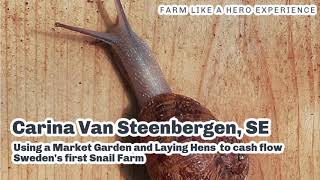
A Farm Like a Hero interview (Sept 14, 2020) with Carina (van) Steenbergen about starting a snail farm in Sweden (began 2019) under mentorship from a Belgian producer. The conversation covers why she chose snails (small land footprint, low water use, nutritious niche product), practical husbandry (tunnel housing with a mist sprinkler system, evening watering, dry periods during the day), species used (Helix aspersa maxima and Helix aspersa muller), a purchased batch (~50,000 snails previously; planned but disrupted larger purchases due to COVID), and winter/seasonal challenges in Sweden that required process changes.
Questions this video answers
2019
Ingrid van der Aura (Belgian biologist/snail farmer)
About 50,000 snails
Helix aspersa maxima and Helix aspersa muller
She states she believes she is the only one (aside from very small hobby growers)
Chapters
All right, welcome to a new episode of Farm Like a Hero, folks. I'm Richard Perkins. Today I'm here with Karina van Steenbergen, who started a snail farm in 2019 under the mentorship of a Belgian producer to explore how they fare under the Swedish climate conditions. Escargot is pretty uncommon here, yet it's a very nourishing ingredient that gives chefs a lot of possibilities with minimal impacts on the environment and taking up very little space as a meat producing enterprise. At the same time, Queen is running a small market garden and layer flock mostly to complement the snail farm as it comes into full production and later so that she'll have control over the whole process of preparing the snails for a saleable product with crops such as garlic and parsley, etc. It's a process that I know virtually nothing about and I'm guessing most of you listening also probably don't. So Karina, thanks so much for taking the time to join us today.
Well, thank you for making me a part of this whole hero experience. Although I don't feel so much as a hero, but thanks for having me.
You were saying a bit of the history before we were recording, but in France obviously that's part of the traditional cuisine and the bid in Belgium and the once French bit.
Yeah, France is still the big escargot country. Belgium especially the south side is Wallony. It's very much the French speaking part of Belgium. And also there you have several snail growers. Also in the Netherlands you have some. But in Belgium for us it's common to have a snail farm here and there. Here in Sweden I get a lot of attention of the media. I don't think anybody would have bothered if I started the snail farm there. Locally maybe, but how many snail farmers.
Are in Sweden then?
What did you say?
How many snail farmers are there in Sweden?
For what? I know I'm the only one, but the hat for what I heard is in the 80s French guys try started one and then on this big island, Gotland, there's a very small one, but they more grow for own use in their own cafe restaurant. So it's for me it's really the meaning that I start growing them for restaurants because they are still on the menu all over Sweden in several restaurants and hotels. But that's all import. It cannot be different. I like to eat them myself, mostly fried. You make a good dough when you wrap them in and you fry them in hot oil and then a bit of salt. And they are so good, I think, but also Because I wanted to. I think there are already enough producers of meat and lamb and sausages and let them have their skills. Start producing a niche product here in Sweden was appealing to me. But most of all it's very sustainable. You can grow a lot of very nutritious food on a very small surface. And I really don't need a lot of water. I have a isabe tank in a tunnel so that the water is not too cold and they get a shower every evening. So I have in my tunnel a mist sprinkler system. So when the sun is gone from the tunnel, it's standing perfect, I think, because it's the place that has the quickest shadow. In the afternoon I start spraying them quite early because it's so hot now. In the morning they also get some minutes, some water. But they need a dry period during the day. Although now it's a bit too warm for them. So it takes a bit long before them to wake up. So I spray and then after 20, 30 minutes they come forward, they come out of their sleep and then they. Because they are night animals, they start to get active. And then I make sure they have their feet and so what.
Tell us a bit about the. I want to hear about the whole process. But you had a mentor in Belgium, you said that you were working with?
Yes, I have. Her name is Ingrid van der Aura, very Flemish name. And she's a biologist. She is a biologist working in fertility clinic in Belgium. But as a hobby Moore. She has her own snail farm already for almost 10 years. And I was contacting her also because of the language. I speak French, my mother language is Dutch and she's Dutch speaking also. And then we went overhaul the process. We were looking together at the climate here in Sweden and actually I was. She's still there. When I have questions, I have to call her, mail her. And she's always there with the right answers or the help I sometimes need. Although lately not so much anymore. It's just now she gave me the big advice to do it step by step. So last year I bought in a batch of 50,000 snails. 30,000 because I have two swords. A lot of people think it's this snails you find easy in the garden after the rain with the shell, the Helix pomasia, the Burgundy snail. And that's still a snail that's often used in France to prepare. But that because people were also picking them from the wild, they are not allowed to pick them from the wild anymore. There are several reasons also why you grow snails in a Controlled environment. Snails easily take up like heavy metal or poison stuff and they store them in their organs. So when we eat them then they are not clean anymore. So we take in those, then they can have it. They store it in their organs but that doesn't mean they get sick or so from it. But when we have it. And she also gave me the advice. So I have two swords. The big gray one and the small gray one. Helixa sperza maxima and Helixa spersa Muller. That's a small one because the small one can have a little bit of frost minus temperatures. While the big sword not when you really have an unexpected night going minus four or so, they die. But they are the two swords that are mostly grown because they have the most light and tender meat. Also the small sword is easier to process because the big one has a liver that you actually have to take away. And that was going to over expression over all expectations. Good with both sorts. But then in the wintertime it was going wrong because here the winter in Sweden is quite long. So I have to rethink my process and make sure I can start earlier next season. And this year because of COVID I only have a small sort of because I could. I was buying in two month old snails coming from Poland and then my plan was to have hundred thousand of the big sword babies and let them grow. But it turned out by the. By the farmer in Poland, by Covid it turned out completely different.
Yeah.
And I have a little bit too much mortality in the beginning of the season. But I could pull that right again. And for the moment I have really some beauties crawling around there. I can really enjoy in the evening when my tunnel is transforming into kind of rainforest. Going there and see them crawling. And then I think in spite of this hard beginning this year I have some real beauties going around here.
I've got so many questions, Karina. So the in the. Would it be like what's the life cycle of a snail and the sort of time periods you're dealing with? And do you think that it's possible to keep them year round like you just need a heated space as it were?
Well, a snail form is very sustainable. One kilo of feed is giving one kilo of meat. You don't need a lot of water to keep a snail farm going. They need their amount of water every day, but it's very minimal.
Hang on one one to one conversion ratio. That's like more efficient than a fish which has got cold blood and doesn't fight gravity. So that's. And it's vegetable crop, right? So it's.
No, they eat. Mainly they eat some kind of flour with a lot of carbohydrates and aminos. Amino acids in. Because the life cycle of it of a snail, they get born and then the growth is going exponentially. They grow very fast when they get the right feed in the right circumstances, of course. Sa.