FARM LIKE A HERO EXPERIENCE: Charles Dowding, UK, Trailer
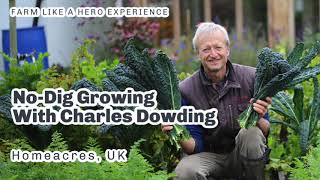
A recorded interview (Farm Like a Hero) in which Richard Perkins interviews Charles Dowding about his background and evolution as an organic market gardener. Charles recounts growing up on a dairy farm, studying geography at Cambridge, becoming vegetarian in 1979 after reading Peter Singer (Animal Rights), joining the Soil Association in 1981, starting his own market garden (began beds by Sept after volunteering in Wales), earning Soil Association organic status in 1984, running a market garden from 1983–1990, experimenting with mulches and later adopting cardboard+compost around 2008, and developing the no-dig approach he is known for.
Questions this video answers
Geography.
1979.
1981.
1984.
1983–1990.
Chapters
Okay, folks, welcome to another episode of Farm Like a Hero. I'm Richard Perkins. Today I've got a very special guest, Mr. Charles Dowding, who I'm sure you already know of through YouTube as an author and educator. And I'm super excited to hear a bit more of Charles's past and how he initially got into farming in the first place. He's been farming for several decades now, and then I'd like to geek out on everything about no Dig. So, Charles, thanks so much for taking the time and being with us today.
A pleasure, Richard. Yeah. I only wish we could be in the same room together, but there you are.
Well, I'd love to go back to the beginning, maybe even to your childhood, Charles, if you. If you're prepared to talk a bit about where you grew up and where your first influences in farming came from.
I grew up on a dairy farm just six miles from here. And my family were. My father was very hardworking dairy farmer, but he's quite a bit older than me. He was a late marriage, perhaps, thanks to Second World War and all that. And so he was 55 when I was born. And I didn't get to know him that well. I just knew that he was always busy on the farm. And I would go out and help in the summer months mainly, so I was protected from that almost. It was like he didn't want me to go into farming. In fact, I think of the three kids, I was seen as the one who might have a career earning some proper money. And, you know, I was more academic type and obviously it didn't work out like that, but I did enjoy farm work in the summer holidays and that was my first experience of it. And I also remember working in my mother's kitchen garden picking raspberries and that kind of thing. But it was very gentle. I wasn't full on outside very much, actually.
Interesting. And did you go like. Maybe you could talk about when you became like an independent adult. Did you go off into other works and career before you came back to farming?
Yeah. No. What happened was. I mean, I can, with benefit of hindsight, you can sort of see it more clearly how the thread was running. But while I was at university at Cambridge, I really enjoyed that. That was the only bit of education I actually enjoyed was at university. And I came across a book. Someone recommended me this book by Professor Peter Stringer, who's an Australian, and he. It was called Animal Rights and it's about animal treatment in farming and having grown up on a farm and dairy cows and all that kind of thing. And reading this book was like, wow, it was a bit of a eureka moment. And I became vegetarian just like that. And so this was 1979, when vegetarianism was pretty marginal and all the people in the, in the college, you know, whereas the college kitchens gave me funny looks and the chef was, oh, God, it's that vegetarian again. But, you know, it felt right. And that led me into just looking outside more and thinking about things differently because, you know, in the 70s, things like battery farming were totally taken for granted and nobody was too worried about it. Well, not nobody, but it wasn't a concern that is now in many places. So, yeah, this was all a bit radical and revolutionary. And then I discovered the Soil Association. So I joined the soil association in 1981 and my friends just took the mick no end, the soil associated. And that got me into thinking about organic and being on a farm. It didn't dawn on me immediately that I could do this myself. It just felt too big a step. My training was not in horticultural farming and for that I'm really grateful, actually, because it meant I came at it from a bit outside and not from inside the profession, so to speak. And I hadn't learned about things like, say, rotation or whatever it might be, all these.
Yeah, yeah.
So when I started, which happened because I went to year after university, I came down and I just didn't know what to do and I just knew that I didn't want to do all these office jobs and things that were being proposed. So I found some farm work in Wales, just as volunteer on a organic market garden. In the early 80s, organic was revolutionary, you know, it wasn't anything like as accepted as it is now. It was seen as very radical and left wing. And I was working on this place and a really nice guy called Charlie Wacher, special place, and he gave me the confidence, he said, you know, you could do this, why don't you become an organic market gardener? I wasn't sure myself. Anyway, yeah, he sparked the feeling that I could do it. And so that was in like May. And by September I was already starting my market garden at home. So I was lucky enough, you know, I had the land there. And the shock bit is, the horror is that I borrowed the farm rotivator to rotivate the pasture. This was my first step because I didn't know any other way. So I rotated the ground and shaped up my beds. But before I got into rotating, actually, I don't know if any of your listeners might know, there's something Called the Kemink system. K E M I N C K. It's a German guy in the 80s and it was a sort of ridging, aerating, lifting tool. And I had a friend in Somerset who was using that too. He said you could break up the grass with it. And I tried that and it wasn't working. Basically, my father came out one afternoon and he said, what are you doing? You just get the rotivator. It was almost the only time he actually gave me any advice about anything, really, because he was quite remote in many ways. And as it happens, it was good advice. So it's kind of ironic, I know, because I'm no dig, but at that point, the rotivator was very useful to give me clean ground. And I shaped up beds, an acre and a half with a spade. I made an acre and a half of raised beds, just shoveling soil out from path to bed and backed on from there.
I want to just go back step. What was it you actually studied at Cambridge?
Geography.
Geography. And did you at that point feel like you might go like. Did you have a idea in mind what you might be doing at that point?
None whatsoever, no. I think I was actually, of truth be told, I really hadn't thought. Well, nothing had. Nothing had come at me and I can now see this was my right path. But at the time, it. It seemed so weird or impossible that I didn't think.
I wonder then. So you studied an acre and a half. What's that, 6,000 square meters of bed. That's quite a lot to manage. Was that a steep learning curve for you?
Yeah, it was, yeah. The first year was I made a few mistakes. The. Probably the biggest mistake I made actually was I'd also read one of my people who inspired me is Ruth Stout, you must know, he did the hay mulching and I bought a load of old hay because I thought, this clearly works for her, I'll march with hay. Because what I'd seen before that I'd gone the way I taught myself was looking at what other people were doing. And I think that I'd recommend that to anybody. I think you could learn more by going and seeing a working market garden than probably from two weeks in a college, because, you know, if you're really open to understanding and ask questions. And I saw a lot of what I consider were not brilliant methods, mainly with weeds. I just saw so many weeds and I just thought, no, they were spending so much time weeding, so there's got to be a better way. And so I was really focused on that more than anything. And the haymarching scene logical clearly stops the weeds growing but then roost out. I've since realized doesn't have slugs. So dry climate in Connecticut. And we do. So with my haymarches I was getting a lot of slug damage to my new plantings the following spring. So that's where I started. You know, I still wanted to be no dig but compost mulch in our climate.
So you started out with cultivation, but then mulching and covering the soil and working like that. But when did you actually first transition over to just laying down compost as.
The mulch do you know? Not at all in the 1980s. It's, you know, although it was no dig from the initial reservation because it was just there. And I hadn't really thought about why it would be better not to or what way I could use to kill the grass. So I just carried on doing that. And I think the first time I did say cardboard and Compost wasn't until 2008, so fairly recently. But I've always been, I do, you know, as the second phase, if you like. Once, once I got the bare ground, I just hadn't taken it that step further back.
How long were you running that farm.
When you had seven years, 83 to 90.
And what was the state of the. Because you were talking about like, were you working to organic standards?
Yeah, I got the organic symbol, the solar association in 1984 and it wasn't quite as strict looking back on it as it is now. We were just given a once over quite casually really, once a year. That was the symbol in 1984. And that did help me to sell like I was selling quite a bit to London supermarkets even. There was a growers Cooperative in 1986 in Somerset. We were selling to big supermarkets and a lot of us got our fingers burnt with that and to shops in London as well. But in. In the 80s there was a real shortage of organic food. It was still very small and there weren't enough growers to meet the growing demand, even though. So selling actually wasn't a problem. And it was amazing how I didn't have a marketing plan, but nearly every time I had a crop really, the phone seemed to ring. Someone wanted something, you know, it just worked really well.
Was that wholesaling most of the products?
Yeah, it was a lot of wholesaling and you know, the wholesaling. I realized after a while that I just wasn't making enough money, you know. Well, you know, all this, some of Your listeners might not, but the price of vegetables is in real terms, Even in the 1980s, it was higher than that. Actually, you know, I could do on. By 1986, I was cropping seven and a half acres. So that's two and a half hectares, I think. No, two hectares. No, wait a minute, three hectares. All no dig, raised beds. So that was a lot of time. I reckon that one person could manage one and a half acres or 6,000 square meters, that was my calculation at that time. For field vegetables, I would call it, rather than what I'm doing now, more, which is much more intensive, small scale, high value. So I was growing in the 1980s, things like sweet corn, red and white cabbage, celeriac onions for sale, leeks, parsnips, what I would call more field crops that you can mechanize. And so. But the prices were just about high enough, but only just. And by the time you go wholesaler night with supermarkets, one load of lettuce, I sent off fanload of letters and the phone call came two days later. Sorry, we just had to reject all of that because we found a slug and the leaks went off and then the phone call came back. I'm terribly sorry, Mrs. Allen. Your leaks, they're too long, we can't use them. You don't need many such phone calls to really realize there has to be a better way than this. Those guys have got too much power, you know, they can just call all the shots. So it was actually in 1989, finally I started a market stall in the local town and developed a box scheme. I started doing boxes in 1983, actually. Did six a week, did 10 a week by 1984, you know, I was one of the first doing that. And it grew only slowly because people weren't used to the idea. But it did start to catch on. And by 1989 we were doing around 180, 100 boxes a week. So that became my mainstay by that stage. Don't, don't, don't, don't, don't.
More from Richard


A review of short and intensive season on a mixed farm and restaurant/event space in Sweden






Alskade Kyckling Exploring complexities of poultry production in Sweden and what we stand for


