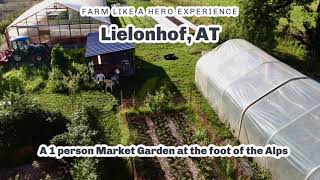
Transcript of an interview between Richard Perkins and Christian Rid discussing Rid’s Leylandhof farm in Austria. Covers Christian’s pathway into farming (travel, permaculture influences, family gardening), land purchase and renovation (3.2 ha split across five parcels; main parcel ≈1 ha; bought 2013, moved in late 2014), local land-price context, infrastructure development, and the establishment and scale of a no-dig market garden (≈800 m² beds, main tunnel plus a 60 m² small tunnel).
Questions this video answers
3.2 hectares (split into five parcels)
About 1 hectare (primary production area)
Bought in 2013; moved in by the end of 2014
Below 800 square metres of bed space
Approximately 60 square metres
Chapters
Okay, welcome to a new episode of Farm Like a Hero. Today I am here with Christian Rid who runs leylandhof in Austria. So three hectare farm started in 2015 and it's one of the farms featured in my book. And we actually met in Thailand over a decade ago now when Christian was cycling from I think the south of Australia all the way back home to Austria. And then more recently we met again when Christian attended a training here at the farm at Ridgedale and he's been raising poultry and building up an extensive no dig market garden which is now the primary focus today with products sold primarily by farmers markets in Salzburg. So Kristin, it's a big pleasure for me to meet you again on here.
Yeah, good to meet you.
Tell us a bit about your pathway, Christine. I can't remember when we met. I was at the Pannier project when you cycled through. But was that trip for you part of your pathway into farming? Were you visiting farms on your ride home?
Yeah, I think so. You know like I always wanted to see a lot and I've seen a lot, probably too much same basically repeating all the time if you are traveling long time but you know, seeing like big fires basically in every country where I've been and where I've been cycling through and seeing like basically erosion caused by industrial agriculture everywhere. And yeah, being kind of aware about all those things back then already brought me more in that direction. You know, like the big permaculture topic which is obviously a gateway for a lot of people to a more like you know, also money wise sound form of regenerative agriculture because that's just not. So I don't see that happening in like mandala gardens and you know, odds, bad shapes and you know, all those crazy plantings. So yeah, so it brought me that direction of course. Yeah.
What's been your pathway like since then? So that was a long time ago now obviously. But what's been big inspirations and key moments in leading up to starting your place.
Key moments? Well, The taste of good food probably. So with my upbringing my father was a quite good cook. So I basically was growing up always with like three star or meats basically. So I really how food is well presented and served and cooked and I know the necessity of goods quality from the start. I mean you can cook, cook like non quality food to a very good point also with spices. But if you really know how things taste then you will recognize the difference for sure. And this is probably one thing which happened really early on and another thing is there was always gardening involved in my family. So my mother and grandmother, they've been all running gardens, you know like small style hobby gardens but with quite some output. And yeah, you know I grew up in the countryside basically seeing farming from really early on and yeah, so basically that this, all those things pointed me already in this direction and yeah, later on, you know, just moving through all those permaculture stuff information and yeah, it just grew and kept on growing and yeah, I'm lucky enough to have the opportunity to start something like this, which is not true for everybody, especially here in Austria with crazy prices or even non availability of land because the market is really very limited as there are a lot of mountains and really not that much land which is suitable for agriculture.
What's the land price there just for reference for listeners?
Oh, it depends very much. You know, on the one side there are those Internet prices where people are asking crazy amounts for land and they can be up to say €20, €20 per square meter. Even for pasture, if it is next.
To a city, it's €200,000 a hectare. Wow.
But you know the book kind of where all the ownership and all the contracts are written so to say they are publicly. So all the contracts where the land is getting sold are public. So you can have a look into those contracts and you can see what the actual prices are. And you know I'm. I've been working a lot in that immobilian area so I've been renovating and managing building stuff in town and you can just look up the real prices which are really paid then and that's then less. So I would say average for arable land would be 750 or something. And if it is really next to a town then it's probably going up to 20. So it's kind of in that range. For Salzburg for example it would be this. But further north where there is more land and less population it would be kind of €5 or so. Depends on the land quality then super expensive.
So what was it you ended up buying? Was it a rundown sort of small holding?
Essentially run down small holding. It was not one big chunk of land. So the total land base is 3.2 hectares, but it is split into five parcels all over the place. And I'm really farming just one main parcel which is one hectare kind of ish in size and that's the best land quality. So I'm really happy with Sandy free draining loam. So really the best what you can really expect around here. So really, really good place to start. Yeah, and yes, and it was just a dead building. You know, it was shot by a huge hail event and never repaired. So there was water leaking through the roof for 20 years and it wasn't possible to even walk into the first floor. You know, it would just cut through and end up one level lower again.
So is that what you've been, is that what you built out to be your home?
Yes, but it was not renovated. It's really a new building, so it's not renovated. You know, it was just like the old mixed walls, you know, stones and just not possible to renovate. It was beautiful. But yeah, it wouldn't meet modern day life.
So you spent a good few years getting infrastructure up to a standard that you could be there and live there with the family rent.
Yes. So basically I bought it in 2013 and I started building the main building in 2014 and it was basically finished kind of the same year. You know, with our family we've been always involved with building and we know all the companies so it's really easy to get them when you really want to have them. So you know, if you are paying your invoices in time and stuff like this, that certainly helps and relationships with all the building companies and so that all helps. So yeah, it was done really fast. And yeah, basically I moved in by the end of 2014 and then starting out with a lot of projects like starting trees from, from seed a lot and like building up hedges, hedgerows, all from own cuttings and crafting apple trees. You know, I've been getting a lot of crafts from. You know there is basically in every country there is that one organization which is collecting like old trees and like figuring out which variety they are and I've just been working with them together and I'm, I've been getting a lot of crafts and I'm crafting them onto rootstock and I'm like giving some of them back for free to just to pay for their work, so to say. And I kept some and I sold some and all those things and I've been having some, some picks and free range layers in a mobile coupe. So that's really what I did the early years besides like working a full time job.
Okay.
Yeah.
So getting things in place and then you've really turned your attention to the market garden as your primary thing.
I mean one, one it was really a good idea to see your place, you know, because basically you took all the good ideas from, you know like all the people out of the permaculture world. And assembled it really well. And I think your place is really the place to go if you want to see all those systems in place and also like working systems which also work money wise and not just. Yeah. With a good ideology in the background. You know, that's certainly something you have to put aside a little bit at least to start out and. Yeah, yes. And. But my intention really never was to grow a market garden because I really never wanted to run a tiller through dirt all the time and eroding the soil and you know, like lowering a lot of that around the world and I just don't want to do that. But seeing your no big version back then made me think and yeah, it fits our context as a family really well and that's basically why I ended up starting a market garden.
And you've been doing that as a. Like you designed the market garden around you working full time without support essentially, didn't you? Can you tell us a bit then the size like the area of beds and I know you've got a super nice tunnel set up as well.
Well like the bed size. So really actual bed space is below 800 square meters and it's one third in sight, one big main tunnel and the rest is just outside beds and there is also a small tunnel which is just 60 square meter of space which is kind of left over from like hobby gardening in the very early days. So 2013 or so. And yes. So that's. That's basically the size 800 square meters.
And so you've. How's your. After running that for a while now you've. What's your reflection? Is that an optimal size for you as a one person show, as it were?
Yes. I mean with more experience I could do more but we also have more than one year old son and there needs to be time for this and I'm certainly taking time for this and I'm also a person so I'm not somebody who is just into one thing. So that's just not me. So I always need something else to feed my mind and to. Yeah. Just to do and I want to have time for that. So that's really important for me and it's also important for us so to be away for a weekend for example. So it is a really good size if you are considering that. But there is certainly more area possible for one person.