FARM LIKE A HERO EXPERIENCE: Claus Ilsoe, DK
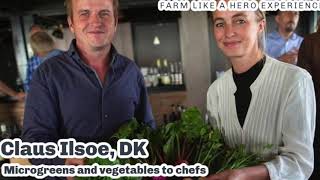
Claus Ilsøe left social work to start a micro-farm on half a hectare in Denmark in 2019, growing baby vegetables and microgreens for local restaurants. He uses no-dig methods, heavy compost, and greenhouse tunnels on just 250 square meters, with plans to expand to 400 square meters.
Chapters
Okay. Welcome to a new episode of Farm Like a Hero, folks. I'm Richard Perkins. Today I'm here with Claus Ilsu of Ilsegard in Denmark. It's a 0.5 hectare micro farm started commercially last year in 2019, producing baby veg and microgreens primarily for Copenhagen chefs. They've been producing also small fowl and are not able to do that this year for reasons we'll hear about. So Klaus, thanks so much for taking the time to be with us today.
Yeah, hi Richard, and thanks for having us.
Yeah, super welcome. Please tell us a bit about your journey into this. How did you end up doing what you're doing?
Well, I met my wife 17 years ago and we sort of had, you know, the same dreams and hopes for the future. And they, well, they included having a family, but they also included the dream of having a small country or a small farm in the country and being, well, at least somewhat self sufficient. And for a lot of years that was not what was actually going on. So I started to study and she started to study and in between that we had the children. But I got a bachelor in social work in 2010 and actually worked with that full time until the end of 2014 when I, well, I became a leader or chief or whatever it's called, Still in the topic of social work. So I, I would have around 15 or 20 social workers referring directly to me. And it was, well, you know, it was, it was an okay job and, and, and it was still. But I think in the end of 2018, I was just, well, getting more and more frustrated because all of the values and all of the dreams and hopes that we actually had so many years ago, I was sort of getting to realize that we weren't actually doing this. We weren't teaching our children how to be self sufficient in any way. And we were just sort of living that hamster wheel, you know, up early in the morning, getting the kids ready to go to school or kindergarten or whatever and well, going to work, rushing home to getting them into the car, getting home, making a dinner and getting them into shower and they were off to bed and we were tired every night. So at some point I just started to get more and more and more frustrate because that wasn't the dreams and hopes that I had in any way for, well, for myself or for my family. And that's pretty much how it started. And we, well, we still have a fairly small ground. So I was like, well, you know, if I could do something completely different, something that I thought, okay, this would make sense for myself, this would make a lot of sense for my family. Then what would it be? And I was sort of thinking about this for a long time and then I thought, well, you know, if I could, if I could, well, you know, be self sufficient, but also actually making a living of that, that would be fantastic.
And.
I just started watching a lot of YouTube up Curtis Stone, Charles Dowling, and also this guy Richard Perkins. And, and, and I was intrigued, I was curious because this was pretty cool. And they were actually doing what I thought, well, you know, if, if they can do it on, on the sort of land they have available, well, you know, then can I. And that's how it started. And in 2019, that's when it got to be okay. We were actually producing so much on a very small scale. I think last year we only had about 250 square meters. That was it. But we produced a lot of it both in that small ground. And that's pretty much how it started. And since that we're just sort of expanding and we're extended, expanding again now. So we don't have any sort of education in gardening or anything, but. Well, I use a lot of time just absorbing knowledge about what's going on and how can you do things.
Yeah. Is it essentially like. Is it where you live? Is it like the garden of your family house as opposed to an actual farm in sort of normal terms, as it were?
Yeah, well, it is our garden and well, there are two very small fields, but it is the place that we live. And we bought this small farm around probably around 15 years ago.
Sort of living in the place and was that part of it you were living there but working in your job and not using the space you had and now you.
Yeah, well, I think in all those years we were still growing vegetables, but I think the thing we were growing most was actually weeds because the. There were zero energy and zero time to actually take care, you know. So it was just.
Well, so you've got, have you. I can't remember the exact location. You've got proximity to Copenhagen and. No, no, no.
We live in southern of Denmark, not that far from the German border actually.
Okay.
And I'm originally from Aarhus, which is town in Denmark, and my wife is from the, in the north. And when we met, well, we were sort of. Well, where can we afford to buy a farm?
That would also pretty expensive, right? In certainly nearer the cities and.
Yeah, yeah, yeah, yeah, yeah. It is near the big cities. It's. It's very Expensive to, to buy houses. And if you would have, well, if, if you would have money to invest near big towns, it would probably still be a place that would need a lot of caring and, and a lot of money to actually get into a decent place.
Yeah.
So.
But you're selling product into Copenhagen, is that right?
No, no, no. We are so lucky that where we live we have some very fine restaurants. Probably because of that we live so close to Germany. So there's. Well, there's a big town called Flensburg in northern Germany. And between Denmark and Flensburg there's sort of. Well, there's a water and there's some restaurants placed near that water with the. Well, a beautiful view and some of the, some of the, some of the more expensive wristbands. Well, we, we have had the offer to sell to Copenhagen, but it's not a long way. Yeah. And we really, really would like to stay loyal to the things, you know, produce locally, sell locally. Because there's a very fine line between, well, between doing what we really think is the right way to go in terms of producing food and doing something different. Because if we would start selling to things that were 250 kilometers away or more, then it would just, it would end up being, well, not what we think is the, is the right way to produce these things. So.
Yeah, I think maybe I have my wires crossed with the. Because you're quite a long way away from there. I saw on your feed, you've. It seems like you've gone a really nice way in creating. It looks like you're doing no dig, but you've done, you did like a turf removal and then put down compost. Is that right?
Yeah, yeah, yeah.
And how's that worked out? It looks like a smart way to go about it.
Yeah, Well, I think it actually worked out pretty cool. I like to see what's in the earth beneath. So I thought, well, you know, we're gonna remove all of those turf and get all of the rocks away. And then we just. Well, we got probably around 15 tons of compost that we bought and all this out in the garden and, and it wasn't even enough. So. But. Well, there's a lot of compost needed to grow that away. But the soil is just incredible when you start to use compost and you can see the. On the vegetables, they also grow. They grow better, but also faster. Really?
Yeah. Has it been effective with like weed control, like by taking away that top sod lairs? How's it been with weed management?
Yeah, it has Been a lot easier because we had a lot of grass. I'm not quite sure what that specific species of grass is, but it has very long roots and out of those roots, if you don't get it away, it will just keep on coming back.
And back to has like sort of white. Yeah, exactly, it is.
And well, we got away with all of that and we also. And we docked everything up by hand and sort of pulled it up and just doing that and well, we actually have, well, almost zero of the Quick wood boundary. So it's been hard work, but it's worth it.
Yeah. And it seems like you've sort of taken the Charles Dowling approach with just a good old layer of compost and then compost pathways sort of walk down in.
Yeah, yeah, yeah, yeah. That's. Yeah, that's pretty much how we, how we do it.
Nice. And you also have. It looks like you've built your own tunnel space. I know you do microgreens. And is that for your starts as well? Was that right? Is that the home built?
Yeah, we have a home built tunnel. All of our microgreens we had. We actually have inside in a room with LED lights and. Well, we built our own first crown greenhouse. We actually just bought another greenhouse, a tunnel from a Dutch company I think. Is it called something like that? It's a 115 square meters greenhouse and we actually plan to have two of them. And then we plan to have two of the smaller greenhouse, 50 square meters each. So we will probably end up having 400 square meters of greenhouse.
Okay, nice.
Yeah, yeah.
Is that like growing for restaurants primarily? Are you. What's that look like in terms of your crop selection? Is it really focused in specifically on restaurants? So you're growing specifically for their needs? Like how do you run that side of things?
Well, I think, I think this year probably 95% of our of our crops are for restaurants. But we also, we actually started yesterday at the farmers market, which was great. I mean, and we are lucky that we have a Facebook today because it's just an incredible platform. So we just did a mobi, put it in Facebook that we plan to come there tomorrow. And there was a lot of customers. We were. Well, we were actually surprised because it's from 8 o' clock until 1 o' clock and at 10 o' clock we had, we had no more vegetables. And it's not necessarily good because people also expect that you have something there. But we actually brought a lot of carrots, a lot of beets and tomatoes and so. But when you know, organic is. It's a popular thing.
More from Richard


A review of short and intensive season on a mixed farm and restaurant/event space in Sweden






Alskade Kyckling Exploring complexities of poultry production in Sweden and what we stand for


